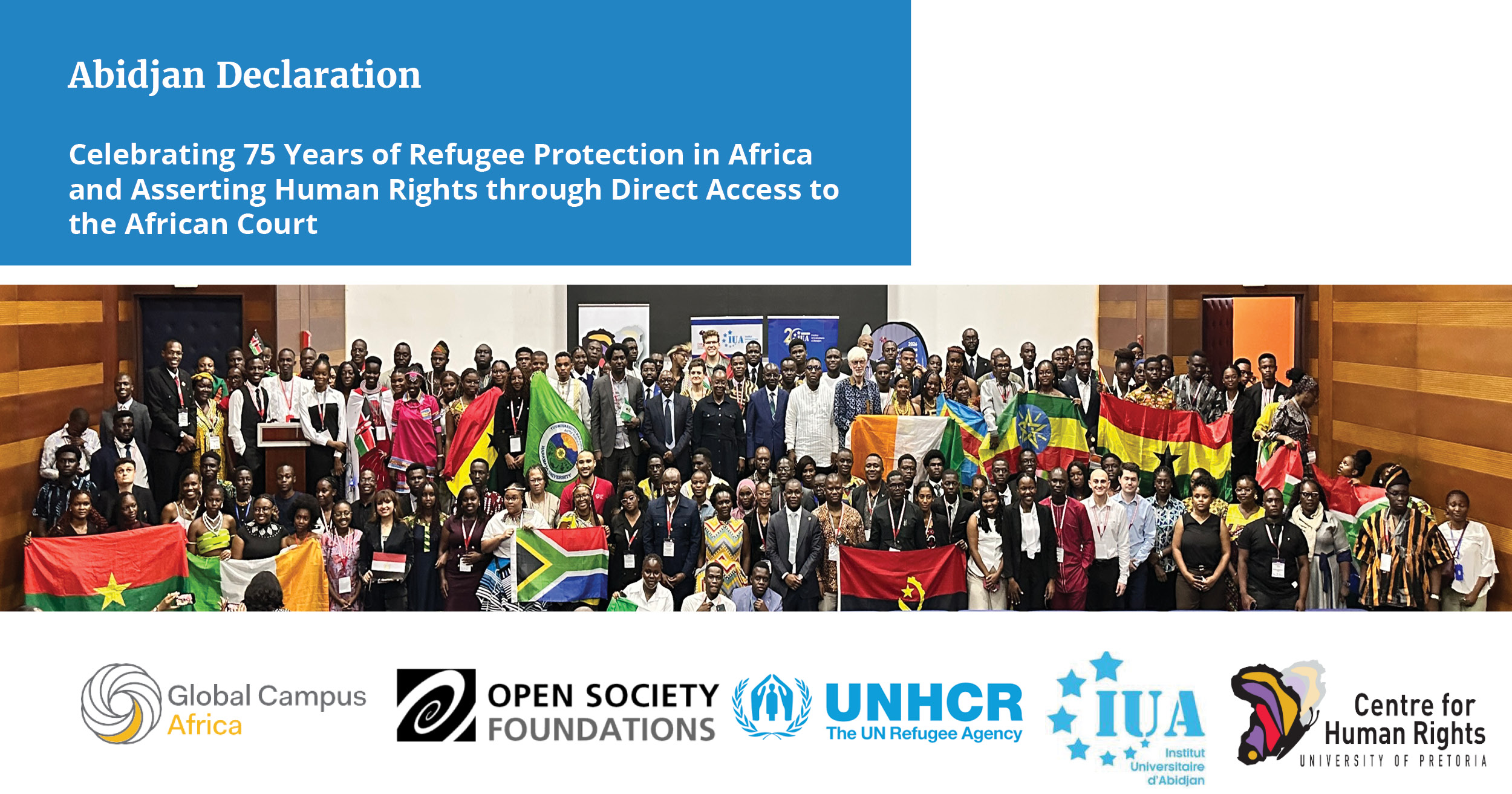
We, lecturers and students representing 61 universities, and members of international and civil society organisations, from across the African continent, participating in the Christof Heyns African Human Rights Moot Court Competition, held in Abidjan, Côte d’Ivoire, from 27 July to 2 August 2026:
Recognising the indispensable role of students, universities and emerging generations of African lawyers in advancing human rights, justice and the rule of law on the continent;
Celebrating 75 years of international refugee protection under the 1951 Convention relating to the Status of Refugees, while acknowledging the distinctive and progressive contribution of the 1969 OAU Convention Governing the Specific Aspects of Refugee Problems in Africa;
Welcoming the continued generosity of African States and communities in hosting refugees, and noting that low- and middle-income countries continue to host a significant proportion of refugees;
Recalling the Global Compact on Refugees, adopted by the United Nations General Assembly in 2018, as a framework for solidarity and responsibility-sharing;
Celebrating twenty years since the start of the operations of the African Court on Human and Peoples’ Rights;
Reaffirming the importance of effective access to the African Court as an essential component of the African human rights system;
Noting with concern the repeated attacks against human rights and human rights advocates on the continent as well as the threats to the many hard-won gains made in the protection of individual rights in Africa;
Equally concerned about the spread of Afrophobia, hostile rhetoric and practices against foreign nationals, migrants, asylum seekers and refugees;
Mindful that legal commitments acquire meaning only when they are effectively implemented and translated into tangible protection for individuals and communities;
Adopt this Abidjan Declaration and resolve as follows:
I. Celebrating 75 Years of Refugee Protection in Africa: Challenges and opportunities for the next generation
-
We call for universal adherence by African states to refugee law treaties. We encourage the remaining African States that are not yet parties to ratify or accede to the 1951 Refugee Convention and its 1967 Protocol, as well as the 1969 OAU Refugee Convention. We further encourage States to withdraw reservations that unnecessarily restrict refugees’ enjoyment of the rights guaranteed by these instruments.
-
We call for a transition from legal commitment to effective implementation. The central challenge is no longer merely the absence of legal norms, but the persistent gap between those norms and the lived experiences of refugees. States must ensure that the rights guaranteed under international, regional and national law are given practical effect.
-
We call for the removal of barriers to the enjoyment of rights. States should ensure that refugees enjoy freedom of movement; access to identity and travel documents, education, healthcare, livelihoods, justice and essential public services; and meaningful inclusion in the communities in which they live. Refugees should be enabled to live in dignity, develop their capabilities and contribute to their host communities.
-
We call for stronger accountability for refugee protection. National and regional courts, national human rights institutions, refugee protection authorities, civil society organisations and universities have a critical role in ensuring that protection commitments are translated into practice. Refugees must have access to effective complaints procedures, legal assistance and remedies when their rights are violated.
-
We call for the rejection of anti-refugee and anti-migrant rhetoric and practices. African solidarity requires that refugees and migrants be treated with humanity and dignity. Political and public discourse should neither portray refugees and migrants as threats nor use them as scapegoats for broader social and economic challenges. States, civil society, the media, universities and other actors should act urgently to counter misinformation, xenophobia and discriminatory practices.
-
We call for the preservation of access to asylum. Legitimate national security concerns must be addressed consistently with international human rights and refugee law. States must preserve access to fair and effective asylum procedures that protect all refugees without any discrimination, respect the principle of non-refoulement and uphold the principle that refugees should not be penalised solely because of their irregular entry or presence where the applicable legal requirements are met.
-
We call for enhanced responsibility-sharing and African solidarity. Refugee protection is a shared responsibility. States and regional institutions should strengthen cooperation and provide sustained support to countries and communities hosting large refugee populations, while ensuring that responsibility-sharing arrangements respect the rights, choices and dignity of refugees. . We note the importance of the Global Compact on Refugees adopted by the UNGA in 2018 as a compass for enhancing responsibility-sharing, and we encourage more transformative pledges and commitments by States, private sector, international financial institutions, regional and international organisation, civil society and others to advance protection, solutions, inclusion and self-reliance of refugees as well as support for host communities ahead of the Global Refugee Forum 2027.
-
We call for greater support for host communities. Effective refugee protection should be accompanied by investment in the communities that receive and support refugees. Development initiatives should expand infrastructure, education, healthcare, livelihoods and public services for refugees and host populations alike, thereby fostering social cohesion and reducing competition over limited resources.
-
We call for renewed efforts to achieve durable solutions. States, the African Union, international organisations and civil society should intensify efforts to facilitate voluntary and sustainable return in safety and dignity, meaningful local integration, resettlement and complementary pathways. No solution should be imposed without taking account of the wishes, safety and individual circumstances of the persons concerned.
-
We call for the adaptation of the protection framework to contemporary challenges. As Africa confronts mixed movements of refugees and migrants, climate change, environmental degradation, conflict, food insecurity and other emerging drivers of displacement, legal and policy responses must continue to evolve. These responses should remain grounded in human dignity, protection standards, international cooperation and equitable responsibility-sharing, leveraging the Global Compact on Refugees’ mechanisms.
-
We call for greater protection for people displaced in the context of climate change and disasters. States and regional institutions should develop principled responses for persons whose protection needs may not fall squarely within existing refugee definitions, while making full use of the broader protection possibilities offered by African regional law.
-
We call for renewed efforts to eradicate statelessness. African States should ratify and implement the international conventions on statelessness and the African Union Protocol to the African Charter on Human and Peoples’ Rights relating to the Specific Aspects of the Right to a Nationality and the Eradication of Statelessness in Africa. States should address gender discrimination in nationality laws, ensure universal birth registration and establish accessible procedures for confirming, acquiring and restoring nationality.
-
We call for the meaningful participation of refugees. Refugees, including women, children, young people, persons with disabilities and members of other groups facing heightened barriers, should participate meaningfully in the formulation, implementation and evaluation of laws and policies affecting them. Refugees should be regarded not merely as beneficiaries of protection, but as rights-holders and partners in developing solutions.
-
We recognise the responsibility of the next generation. African students, universities and emerging legal professionals should contribute to refugee protection through research, legal assistance, public education, strategic litigation and advocacy. The next generation must preserve Africa’s tradition of hospitality and solidarity while helping to develop responses suited to new patterns of displacement.
II. Asserting Human Rights through Direct Access to the African Court: Making the case for expanding the scope of declarations under Article 34(6) of the African Court Protocol
-
We affirm the importance of direct access to the African Court. Direct access by individuals and non-governmental organisations under declarations made by States in accordance with article 34(6) of the Protocol to the African Charter on Human and Peoples’ Rights on the Establishment of an African Court on Human and Peoples’ Rights (Court Protocol) is central to the further institutionalisation, effectiveness and legitimacy of the African Court. The great majority of applications submitted to the Court have originated through this avenue.
-
We express grave concern about the withdrawal of declarations. The withdrawal by five States Parties of their article 34(6) declarations -- including Côte d’Ivoire’s withdrawal on 29 April 2020 -- has significantly restricted access to regional justice and reduced the number of declarations in force to seven. These withdrawals are particularly troubling because they followed a sharp increase in applications to the Court, demonstrating both the demand for and the importance of direct access.
-
We call for the restoration of direct access through constructive engagement. We invite States that have withdrawn their article 34(6) declarations to consider reinstating them. We encourage these States to engage with the African Court through sustained dialogue and diplomacy, with a view to addressing concerns, strengthening mutual confidence and preserving effective access to regional justice for individuals and non-governmental organisations.
-
We call for the expansion of direct access. We are equally concerned that 22 States Parties to the Court Protocol have never made an article 34(6) declaration. We urge all States Parties that have not yet done so to deposit such declarations and call upon States that have withdrawn their declarations to reconsider their decisions and restore direct access.
-
We call for constructive engagement between States and the Court. While noting certain concerns about particular decisions or aspects of the Court’s practice, we consider that such concerns should be addressed through sustained dialogue, principled criticism and appropriate institutional reform, rather than through measures that deprive individuals and non-governmental organisations of access to regional justice.
-
We call for appropriate technical and procedural reforms. The Court should continue refining its procedures in ways that strengthen fairness, consistency and confidence in its work. This may include, where appropriate, considering questions of prima facie admissibility before issuing provisional measures, while retaining the capacity to intervene urgently where there is a risk of irreparable harm.
-
We call for clearer criteria governing the referral of cases. The African Commission on Human and Peoples’ Rights should elaborate, publish and consistently apply clear criteria for referring cases to the African Court. Given the limited number of cases referred by the Commission to date, a more predictable and effective referral practice would help mitigate the consequences of restricted direct access.
-
We recognise the limitations of pursuing treaty amendment at this stage. Although amendment of the Court Protocol to establish compulsory individual access remains legally possible and may constitute a desirable long-term objective, we consider that pursuing such an amendment is unlikely to provide the most feasible or productive immediate response.
-
We call for a contextual and politically informed approach. The challenges surrounding article 34(6) declarations cannot be addressed solely through technical legal reform. Responses must take careful account of national political contexts, the concerns of States and the need to build broader public understanding of the Court’s role.
-
We call for broad national coalitions in support of regional justice. Civil society organisations, universities, bar associations, national human rights institutions, professional bodies, affected communities and other national actors should work together to promote understanding of the Court and advocate for the making or restoration of article 34(6) declarations. These national coalitions should, where appropriate, be supported by regional and international partners.
-
We equally call for a renewal of a human rights culture at the domestic levels. The performance of international human rights protection systems and the work of monitoring bodies depends intimately on the strength of a domestic human rights culture. International bodies such as the African Court can only intervene as a last resort. Respect for and protection of human rights is first and foremost a national imperative. We therefore call upon political, social, religious, and civil society forces to demonstrate a renewed commitment, in the spirit of the great struggles of the past for respect for human rights, to defend and preserve human rights in African states.
-
We call for renewed engagement in Côte d’Ivoire. We encourage all relevant actors in Côte d’Ivoire to initiate an inclusive national dialogue on restoring direct access to the African Court. Such a process should provide space for government institutions, civil society, universities, legal professionals, national human rights institutions and affected communities to consider the benefits of renewed engagement with the Court.
-
We call for greater transparency and participation within the African human rights system. Initiatives aimed at improving transparency, inclusion and public participation in African Union human rights institutions—such as the Arusha Initiative concerning the nomination and election of judges and members of African Union human rights bodies—offer useful models for broader mobilisation in support of the Court and direct access to it.
-
We call upon Africa’s emerging legal community to act. African law students, lecturers and universities should teach, study and promote the jurisprudence of the African Court; undertake research on its impact; increase public awareness of its work; and contribute actively to national and continental campaigns for effective access to regional justice.
Our collective commitment
-
We commit ourselves to using our knowledge, skills and professional positions to promote effective access to the African Court, protect the rights and dignity of refugees and stateless persons, and strengthen Africa’s regional human rights system.
-
We call upon African States, the African Union and its human rights institutions, other international organisations, universities, civil society organisations, legal professionals and all other relevant actors to give practical effect to the commitments contained in this Declaration.
Adopted in Abidjan, Côte d’Ivoire, on 2 August 2026, by the participants in the Christof Heyns African Human Rights Moot Court Competition.
French Declaration Portuguese Declaration
For more information, please contact: