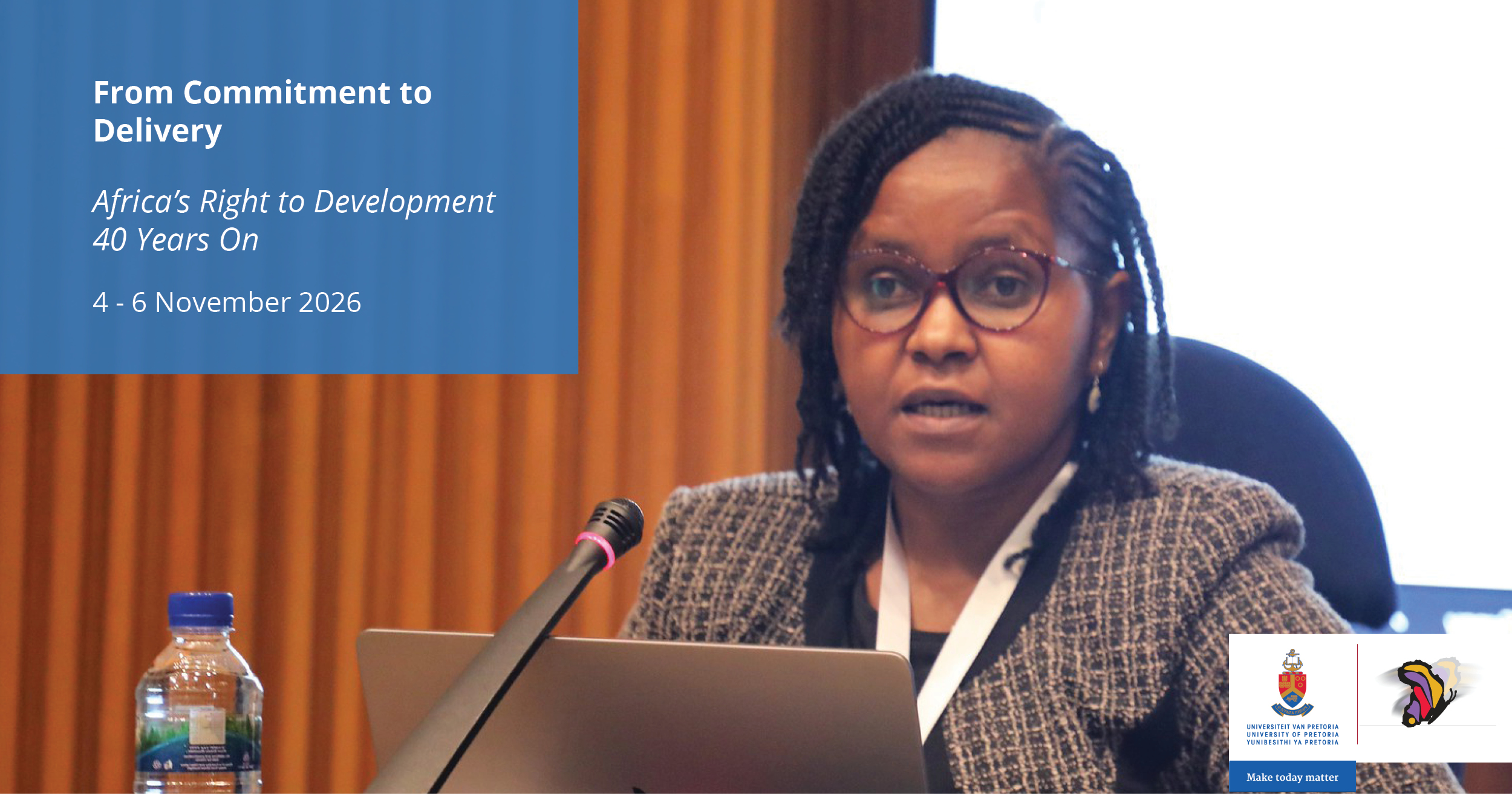
Forty years post the adoption of the Declaration of the Rights to development, the Centre for Human Rights, University of Pretoria, and its partners on the Annual Conference on the Right to Development have called for closer attention to whether that promise is making a difference in people's lives.
The call came at this year’s 9th International Conference on the Right to Development, held from 4 to 6 November 2026 at the African Union Headquarters in Addis Ababa, Ethiopia. This year’s conference was hosted by the African Union in partnership with the Centre for Human Rights, University of Pretoria, the University of the Free State, University of Addis Ababa, the University of Dayton and other partners. The conference brought together African and international stakeholders to commemorate the 40th anniversary of the United Nations Declaration on the Right to Development as well as the 40 years of the African Charter on Human and Peoples' Rights.
The Centre was represented by its Director, Prof. Nkatha Murungi, who in her opening speech challenged participants to look beyond four decades of legal recognition and to consider what has changed for the communities the right is intended to serve. The right to development, she stressed, must be "not only declared, but delivered".
Prof. Murungi also reflected with pride on the Centre's role as the pioneer of the conference series since its inception. What began as a Centre initiative, she noted, has grown into a global community of universities, regional bodies and international institutions, and has now found a continental home at the African Union.
On the second day, Africa's young population and its place in the digital economy featured prominently in the contributions by Dr Dorcas Basimanyane, Project Manager for Business and Human Rights at the Centre and Regional Coordinator of the African Coalition for Corporate Accountability (ACCA) hosted by Centre. Speaking on the plenary on educating Africa's youth, she argued that the continent's young population is "not a statistic, but a decision waiting to be made".
Reflecting on the Continent being a young one, evidenced by around 60% of Africans under the age of 25, she called for education systems that prepare young Africans to become creators and innovators, rather than simply consumers of technology. She also emphasised the importance of human rights literacy, ethical responsibility, and stronger cooperation across African education systems.
In a separate presentation on infrastructure, Dr Basimanyane questioned whether Africa's expanding infrastructure necessarily gives the continent greater control over its own development. "Localisation is not ownership. Access is not autonomy," she observed, calling for greater attention to African ownership, institutional capacity, and technological independence. Her chapter on the subject, Africa's 'Infrastructural Turn', appears in the commemorative volume launched at the conference.
On the last day, Dr Basimanyane returned to deliver closing remarks on behalf of the Centre for Human Rights, where she firmly reflected on the challenge facing Africa after four decades of commitments and the need to change the narrative from resilience to prosperity:
"The first forty years gave us the promise. The next forty years must deliver the prosperity."
As the Centre marks its own 40th anniversary, its participation reinforced a message that ran throughout the conference: progress on the right to development must ultimately be measured by improvements in people's lives, opportunities, and dignity.
Beyond the Centre’s contributions, discussions throughout the three-day conference explored critical minerals and climate justice, infrastructure and regional trade, governance and accountability, children’s rights, education and artificial intelligence. Across these themes, a central challenge emerged: moving beyond the recognition of the right to development towards its practical implementation, while ensuring that Africans shape, own and benefit from their development.
The Centre for Human Rights extends its sincere appreciation to the African Union Commission and the Government of Ethiopia for hosting the conference, and to the Office of the United Nations High Commissioner for Human Rights (OHCHR) for its collaboration. The Centre also acknowledges the African Commission on Human and Peoples’ Rights, UNDP Regional Service Centre for Africa, UN Expert Mechanism on the Right to Development, UNESCO and the African Committee of Experts on the Rights and Welfare of the Child, alongside its academic partners: Addis Ababa University, the University of the Free State, the University of Siena, the University of Dayton, Universidade Autónoma de Lisboa and the Global Alliance Against Hunger and Poverty. Appreciation is also extended to all speakers, moderators, organizers, book editors and participants.
For more information, please contact:

Tel: +27 (0) 12 420 6398
basimanyane.k@up.ac.za