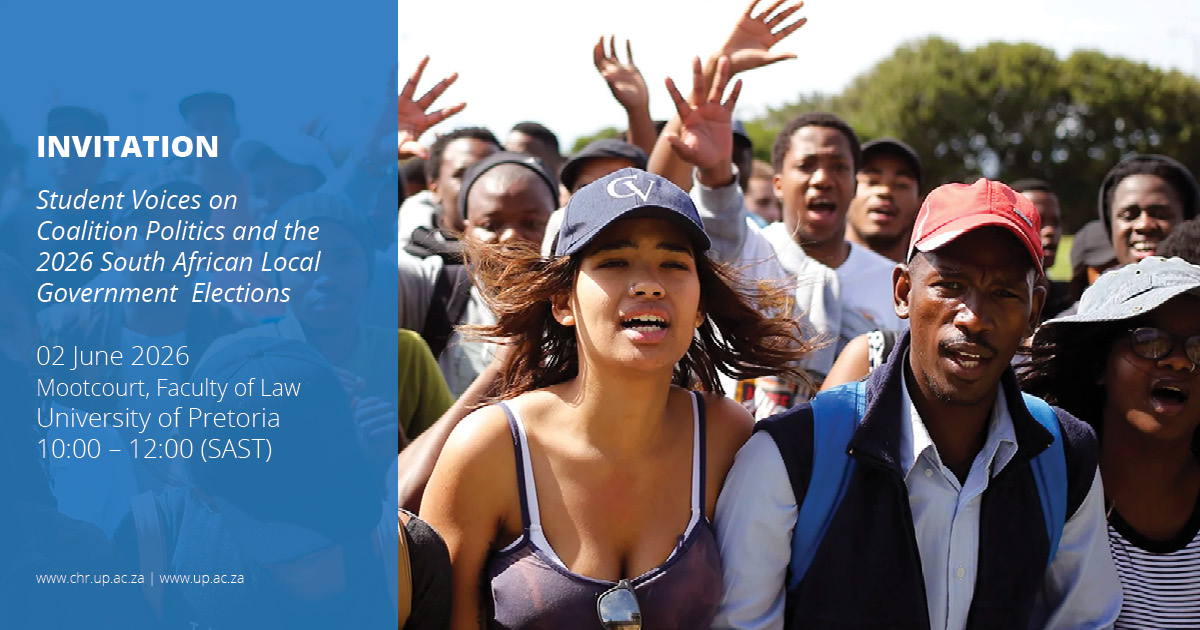
The Centre for Human Rights, Faculty of Law, University of Pretoria cordially invites you to a dialogue on coalition politics and youth's engagement on electoral process in South Africa. The dialogue is set to take place on 2 June 2026 in the Mootcourt, Faculty of Law, University of Pretoria from 10:00 – 12:00.
Event Details
Date: 02 June 2026
Venue: Mootcourt, Faculty of Law, University of Pretoria
Time : 10:00 – 12:00 SAST
Click here to RSVP Download Invitation
Background and Rationale
Since the 2024 General Elections, South Africa has entered by a complex period which is of course not a first occurrence in governance where a formation of a Government of National Unity (GNU) had to be established. The first GNU was formed in 1994, during the transition period until 1997, and since then one political organisation had won elections with outright majority. This shift marks a departure from thirty years of single-party dominance, thrusting coalition politics into the centre of the national discourse. As the country prepares for the 2026 Local Government Elections, This is as a result of the volatility of the unity due a myriad of issues such as idealogy, policy impasse and internal power dynamics. The Ten (10) party Government of National Unity (GNU) as led by the African National Congress (ANC) has faced numerous existential challenges that has threatened these parties and their constituencies across board.[1]
these will be the first elections to be held following the formation of the Government of National Unity in 2024. With elections held every five years, the fifth term of local government in South Africa will end on 1 November 2026. There has been an increasing low voter out over the years, particularly among young people. In the 2016 Local Government Elections, voter turnout stood at approximately 58% of registered voters, reflecting relatively stable participation levels at the time. This, however, declined significantly in the 2021 Local Government Elections, where turnout dropped to 46%, marking the lowest level of participation in local elections since 2000 (Elections South Africa). In the 2024 National and Provincial Elections, about 11 million registered voters did not cast their vote, the voter turnout stood at 58% (HSRC, 2024).
Historically, the youth demographic (ages 18–35) has shown fluctuating levels of democratic participation, especially elections. While students are often at the forefront of social activism, there is a growing concern regarding low voter out The complexity of coalition governance often marked by malleable negotiations and shifting alliances threatens to further alienate young voters who may perceive these arrangements as prioritising elite bargaining over service delivery and ideological integrity. Understanding how young people and students navigate this new political landscape is critical to predicting the future of South African democratic participation and complexities that come with it.
Problem Statement
Despite the prominence of coalition politics in mainstream media, the South Africa media houses, Civil Society organisations focusing on elections and civic education have note fully explored the d the influence of the coalition governance on youth political behaviour, and ultimate turn at the polls. Specifically, it remains unclear whether the GNU model encourages a sense of pluralistic representation or if it exacerbates confusion and cynicism among students. Without capturing these voices, electoral bodies and policymakers risk overlooking the specific motivations or deterrents that will drive student and youth voter turnout in the 2026 local elections
Objectives of the Project
- To solicit student perceptions of the GNU’s performance and its impact on the upcoming elections.
- To explore the mobilisation strategies used by student political organizations (SPOs) within a coalition-centric environment.
- To assess whether the move toward coalitions increases or decreases student/ young’s people willingness to vote.
- To identify the specific priorities for young people’s expectation of local government issues (e.g., housing, safety, infrastructure) that students prioritize under a coalition framework.
Methodology
This project adopts a participatory dialogue-based approach. The dialogue will be built upon structured, facilitated discussion rather than clinical one-on-one interviews. Representatives from key student political formations including the Student Representative Council (SRCs), South African Student Congress Organisation (SASCO), (Democratic Alliance Student Organisation) (DASO) and the Economic Freedom Fighters Student Comand (EFFSC) and faculty houses will be invited to participate in the dialogue to provide young people and student perspetives on the impact of coalition governance on elections and electioneering. The dialogue will be captured using professional audiovisual equipment, ensuring high-fidelity sound and visuals for broadcast quality.
Expected Outcomes / Significance
- Acts as a platform for youth to articulate their political agency, potentially reducing feelings of invisibility electoral processes.
- Provides a snapshot of political sentiment that can serve as a primary source for future political science and sociology students.
- Offers electoral bodies (such as the IEC) and civil society organisations insights into the barriers preventing youth from engaging in electoral processes.
Target Audience
- University students and academic researchers in Politics, Lawociology.
- Student political party strategists.
Ethical Considerations
This dialogue is a creative media engagement rather than formal human-subject research. However, the following ethical pillars will be strictly maintained:
- All participants will sign a release form consenting to be filmed and acknowledging how the footage will be used.
- Students may withdraw from the dialogue at any point without prejudice.
- Should a student wish to contribute to a dialogue but remain off-camera for safety or personal reasons, their identity will be protected via digital blurring or voice alteration.
Conclusion
As South Africa navigates the complexities of the GNU, the voices of the youth remain the most accurate barometer for the country’s democratic longevity. ‘Student Voices on Coalition Politics and local government elections in South Africa’ seeks to bridge the gap between high-level political manoeuvring and the lived realities of the student body. This dialogue will not only capture a historical moment in South African politics but also serve as a vital tool for encouraging informed electoral participation as we head toward 2026.
[1] https://www.citizen.co.za/news/south-africa/politics/how-many-times-has-the-da-threatened-to-leave-the-gnu/
For more information, please contact:
Yolokazi Mfuto
Yolokazi.mfuto@up.ac.za
Neville Mupita
u18060120@tuks.co.za