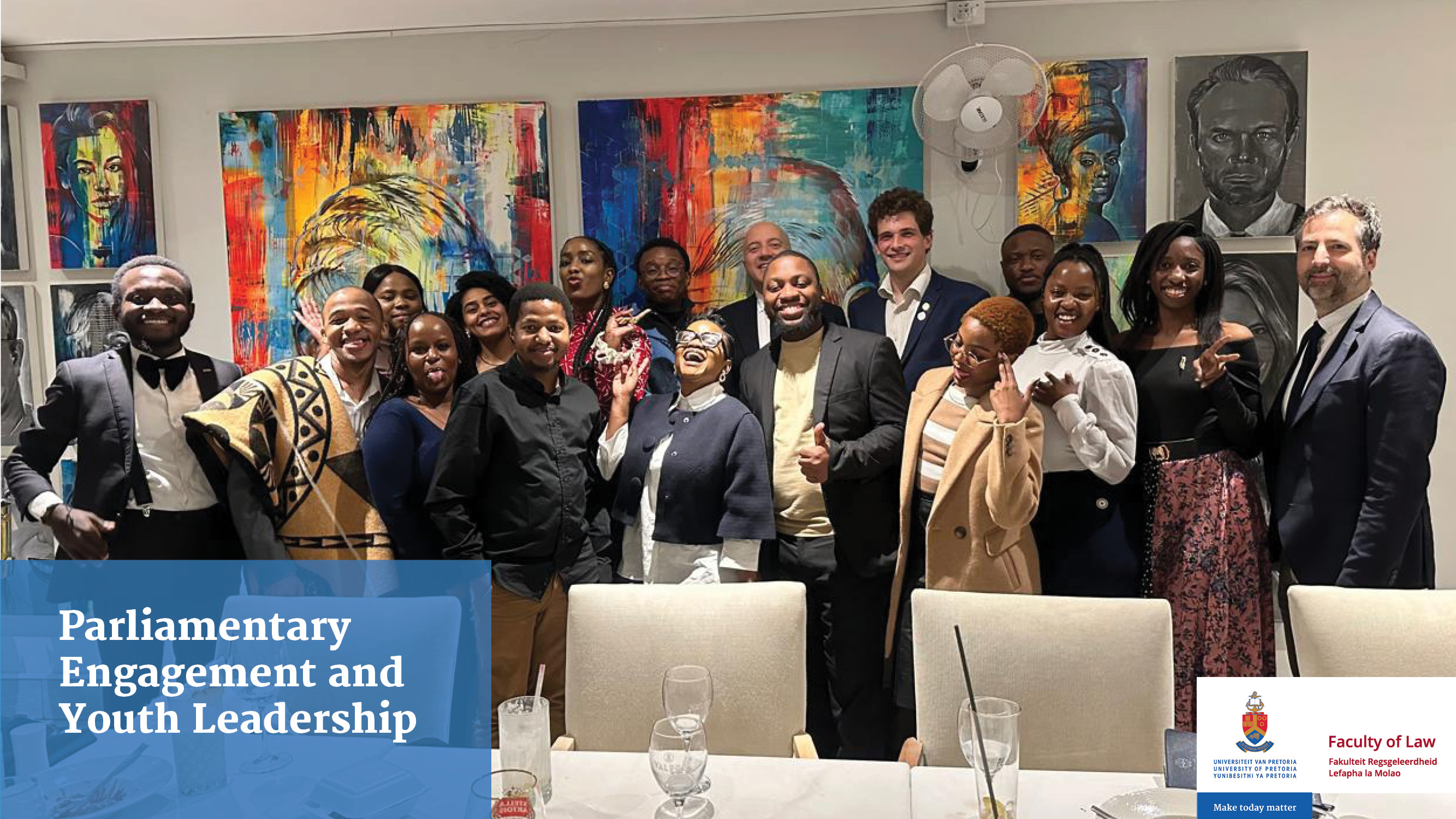
On 22 July 2026, the Centre for Human Rights,Faculty of Law University of Pretoria, convened a roundtable discussion with emerging scholars from the University of Pretoria and the University of South Africa, together with European Parliament officials based in Addis Ababa.
Relations between Africa and the European Union (EU) have undergone a significant transformation since the adoption of the Joint Africa-EU Strategy at the 2007 Lisbon Summit. This strategy formally sought to reorient the relationship away from the donor-recipient paradigm that had long characterised development assistance. This reorientation has been reinforced through subsequent AU-EU summits, which have increasingly framed the relationship as a “partnership of equals”, emphasising mutual interests, strategic cooperation and shared responsibility in addressing global challenges. Yet the substantive realisation of this partnership of equals cannot be secured through executive-level summitry alone; it requires institutional mechanisms capable of embedding democratic legitimacy and direct representation within the relationship itself.
Against this backdrop, parliamentary diplomacy has emerged as an increasingly important mechanism for strengthening intercontinental cooperation. The relationship between the European Parliament and the Pan-African Parliament (PAP) provides a unique institutional platform through which democratic governance, human rights, regional integration, and citizen participation can be advanced. Beyond facilitating legislative dialogue, parliamentary engagement creates opportunities for political exchange on emerging geopolitical developments, while reinforcing democratic accountability on both continents.
Building on the momentum generated by the 2025 AU-EU Civil Society and Youth Forum in Luanda, Angola, ahead of the AU-EU Summit, the round table brought together emerging scholars around four strategic pillars: peace, security and governance; prosperity; people; and multilateralism. Central to the discussion was the distinction between participation and influence. Although African and European institutions have created more platforms that include young people, simply being present does not constitute meaningful democratic participation. Genuine participation requires youth perspectives to substantively shape policy formulation, implementation and accountability rather than merely being consulted after decisions have been made. Without institutionalised pathways through which young people can influence outcomes, their inclusion risks becoming performative rather than transformative. Participants emphasised that this is precisely why it mattered to engage with young, emerging scholars, not as beneficiaries of a development agenda, but as political actors and co-creators of policy in their own right.
The same emphasis on substance over symbolism was evident in the discussion of Europe's role in Africa. Participants were careful not to oversimplify the complex relationship by reducing it to a single verdict. There was genuine appreciation for the EU's long-standing role as one of Africa's largest development and trading partners, as well as for its normative commitment to democracy and human rights. While this commitment is not always reflected in practice, it still distinguishes the relationship from purely transactional alternatives. At the same time, however, participants were candid about the shifting dynamics in Francophone West Africa, where recent political upheavals have exposed deep dissatisfaction with the political, military, and economic arrangements inherited from the colonial period.
The discussion also turned specifically to South Africa, the only African country with which the EU maintains a formal bilateral Strategic Partnership and one of the Union’s largest trading and development partners on the continent. Participants questioned what underlies this exceptional status, considering whether it reflects South Africa's economic weight and its role as a gateway to the wider region, a genuine convergence of shared democratic values, or a more strategic European interest in establishing influence in a country that also sits somewhat uneasily within the BRICS bloc and maintains close ties with China and Russia. Most participants concluded that it was a combination of all three factors.
The underlying question that united these threads, ranging from the distinction between participation and influence to Europe's own record in Francophone West Africa and South Africa, was not whether the AU-EU relationship has value but whether its commitments to partnership, inclusion, and accountability are consistently upheld. At its core, this is a question of democratic accountability: whether domestic or international power remains genuinely answerable to those it claims to serve, and whether inclusion translates into influence rather than remaining merely symbolic. For the AU-EU relationship to mature into a genuine partnership of equals, both sides must continue to engage in structured and candid dialogue, ensure greater consistency between their principles and practices, and strengthen the role of parliaments as representative institutions capable of promoting accountability, transparency and sustained political dialogue across both continents.
For more information, contact:
Ms Bonolo Makgale
Programme Manager: Democracy and Civic Engagement Unit
bonolo.makgale@up.ac.za
Yolokazi Mfuto
Project Officer: Democracy and Civic Engagement Unit
yolokazi.mfuto@up.ac.za
Neville Mupita
Project Officer: Democracy and Civic Engagement Unit
u18060120@tuks.co.za