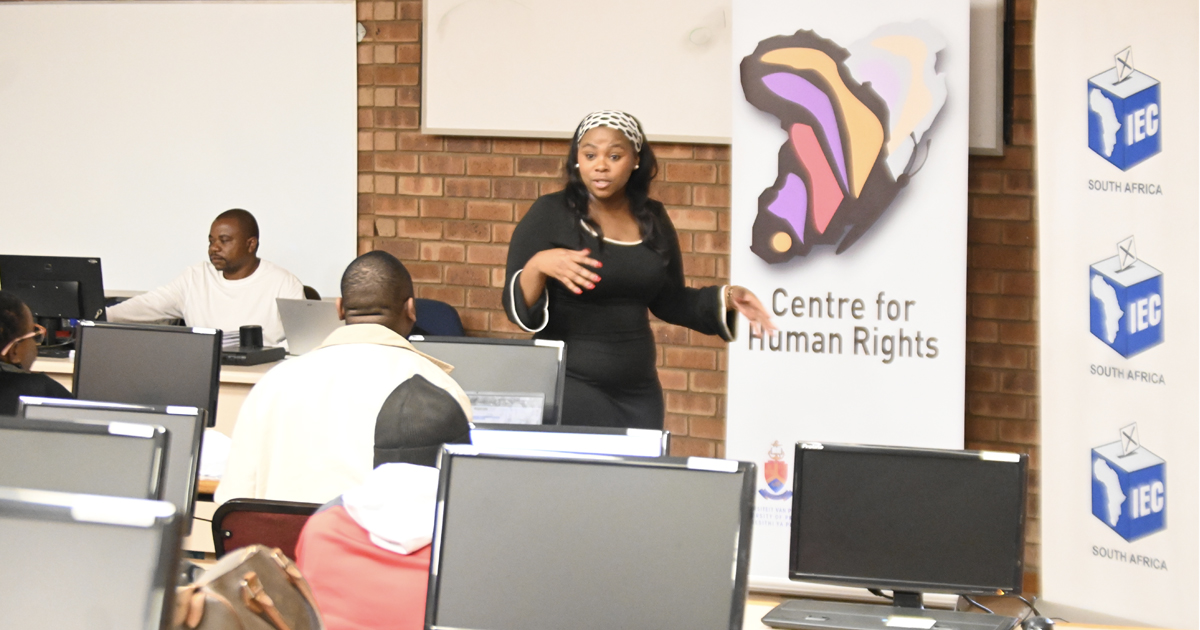
Between August and October 2026, the Centre for Human Rights (the Centre), University of Pretoria, in partnership with the Electoral Commission of South Africa (IEC), convened five voter education and civic engagement workshops ahead of the 4 November 2026 Local Government Elections. The workshops took place in Mamelodi, Eersterust and Hammanskraal in Tshwane, as well as in Rustenburg and in Johannesburg, and reached more than 500 participants. Participants included young people, first-time voters, student leaders, ward committee members, representatives of faith-based and civic organisations, and candidates contesting the elections. The workshops were designed to strengthen informed participation by equipping residents with practical knowledge of electoral processes, the responsibilities of local government and the mechanisms available to hold elected representatives accountable. Each workshop was hosted with a local partner: UP Community Engagement; the Eersterust Community Development Forum; Tshimologo Care Centre and Tandanani; the University of South Africa (UNISA); and the Friedrich-Ebert-Stiftung (FES) South Africa.
Electoral participation in South Africa has been declining steadily. Turnout in local government elections fell from about 58% in 2016 to 46% in 2021, and roughly 11 million registered voters did not vote in the 2024 national and provincial elections[1]. This disengagement is often associated with disillusionment, declining trust in public institutions and limited access to reliable information. However, it should not automatically be interpreted as apathy. When registration closed in August 2026, approximately 29 million people were on the voters’ roll, and the IEC observed strong participation by young people during registration weekends.[2] The challenge therefore extends beyond registration: voters need accessible information about how to vote and what they are entitled to expect from elected representatives. The workshops were designed to close that gap by pairing electoral information with civic education.
Led by the Centre in collaboration with the Electoral Commission (IEC), the workshops covered the following topics:
- Democracy, constitutionalism and active citizenship beyond the ballot;
- The functioning of local government, including the representative roles of ward and proportional representation councillors, coalition arrangements, Integrated Development Plans (IDPs), municipal budgets and ward committees;
- The right of access to information;
- The IEC’s mandate and independence, voter registration and eligibility, voting procedures; special votes; and the Universal Ballot Template;
- Identifying and responding to election-related disinformation, as well as understanding the Electoral Code of Conduct and electoral offences as safeguards for electoral integrity.
The workshops demonstrated that participants are more likely to engage when civil education is practical, locally relevant and delivered in trusted community spaces. This suggests that disengagement is not inevitable; the reach and effectiveness of civic education depend, in part, on how and where it is delivered. A finding across all workshop sites was limited understanding of local government. Participants’ knowledge of municipal structures and responsibilities was generally weak, and some candidates were unable to distinguish clearly between the roles of councillors, mayors, speakers and municipal managers. This knowledge gap has direct implications for accountability: citizens need to know which office-bearers are responsible for particular decisions and services if they are to hold them to account, while candidates need a sound understanding of the offices they seek to occupy.
Participants often describes non-voting as a considered response to distrust, rather than indifference, reflecting a belief that elections do not result in tangible change. Unemployment and declining municipal services were identified as factors that reinforce this perception, while misinformation can deepen it. In Rustenburg, many participants had indicated that they had chosen not to vote. The discussion also highlighted that young people are not a homogenous group: many are active in their communities but remain disconnected from formal electoral politics. Outreach strategies should therefore recognise the diversity of young people’s experiences and avoid treating them as a uniformly disengaged constituency.
Improving voter turnout requires more than encouraging people to cast their ballots. It requires rebuilding the connection between voting, responsive local government and ongoing public accountability. The workshops point to three priorities:
- Sustained civic education beyond election periods, with a focus on municipal responsibilities, public participation and accountability;
- Targeted, practical outreach to first-time voters, equipping them with information about voting and directing them to reliable, official sources;
- Stronger partnerships with trusted local organisations, creating meaningful opportunities for residents to engage elected representatives and participate in ward committees and IDP and municipal budget processes.
The Centre and its partners will continue this work beyond the election period, with a focus on strengthening youth participation, promoting municipal accountability and improving access to information. The broader objective is to support citizens to hold elected representatives accountable between elections, and not only at the ballot box.
For more information, please contact:
Bonolo Makgel
Programme Manager: Democracy and Civic Engagemen Unit
Yolokazi Mfuto
Project Officer: Litigation and Implementation Unit
Yolokazi.Mfuto@up.ac.za
Neville Mupita
Project Officer: Democracy and Civic Engagemen Unit
Neville.Mupita@up.ac.za
[1]https://hsrc.ac.za/news/governance/elections-2024-the-big-no-vote-over-11-million-registered-voters-did-not-cast-ballots-in-2024-polls/
[2]https://www.sanews.gov.za/south-africa/over-1-million-citizens-interacted-electoral-commission-weekend