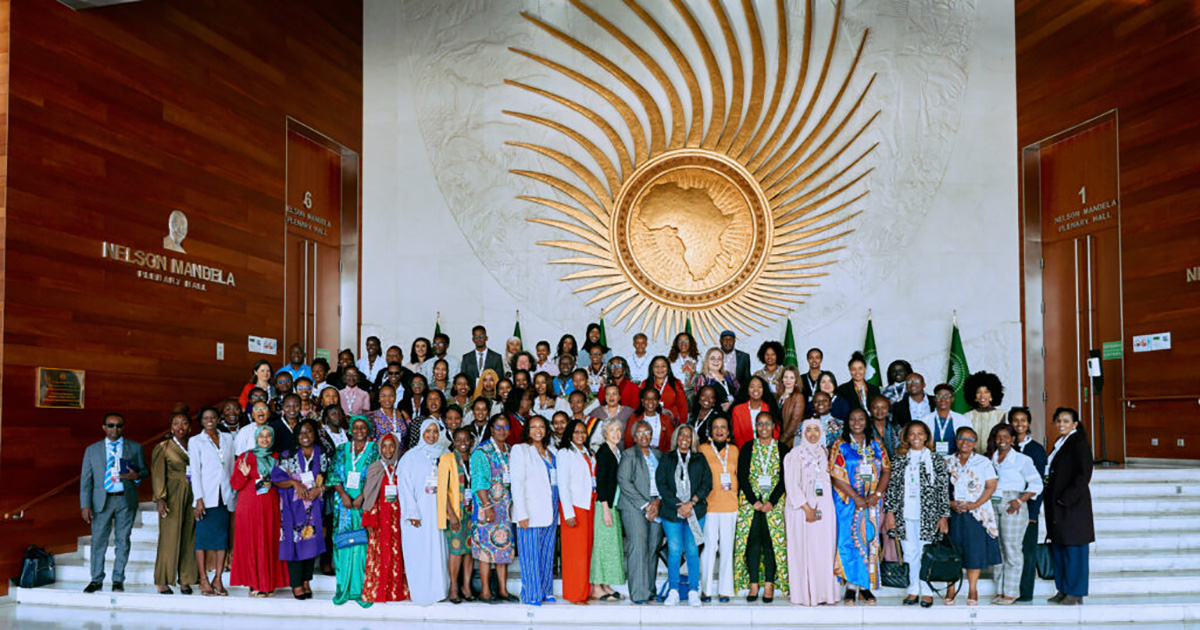
The Centre for Human Rights, Faculty of Law, University of Pretoria, through its Expression, Information and Digital Rights (EIDR) Unit, participated in the 2025 conference of the African Women in Media (AWiM), hosted at the African Union headquarters in Addis Ababa, Ethiopia from 4 to 5 December 2025. The conference was convened under the theme “Beyond Commitments: Advancing Policies for Gender-Safe Media”.
The gathering brought together journalists, digital rights advocates, policymakers, regulators, researchers, and technology actors from across the continent to interrogate the gap between policy commitments and lived realities in African digital spaces. Discussions focused on platform accountability, information integrity, digital governance, and responses to technology-facilitated gender-based violence (TFGBV).
The Centre was represented at the conference by Ivy Gikonyo, who participated in two panel discussions addressing structural challenges in digital governance and gender justice.
The first panel, Opportunities and Challenges in Implementing Digital Policies and Digital Rights Frameworks in the African Social Media Landscape, examined whether Africa’s current digital policy trajectory is capable of reducing, rather than reproducing inequality. The discussion emphasised that digital transformation is not neutral. Where policies are designed on gender-blind assumptions, they risk embedding exclusion into the architecture of emerging digital systems.
In her contribution, Ivy highlighted documented concerns around digital identity systems, including Kenya’s Huduma Namba, where documentation and verification requirements raised risks of exclusion for marginalised communities. In many African contexts, women are disproportionately less likely to possess formal identity documentation due to historical inequalities in birth registration and land ownership. As such, digital ID systems and related e-governance reforms may inadvertently entrench gendered exclusion if not designed with structural realities in mind. The session further reflected on the limitations of continental frameworks such as the African Union Digital Transformation Strategy (2020–2030), which advances important objectives on digital trade and data governance, but does not consistently integrate a gender-responsive lens across implementation mechanisms. The discussion underscored the need for inclusive policy design grounded in recognition and agency, ensuring that women and marginalised communities are not only users of technology, but participants in shaping and governing it.
The second panel, Utilizing Information Integrity and Platform Accountability to Combat Tech-Facilitated GBV, convened by Moxii Africa, focused on operationalising commitments under Resolution 631 and strengthening policy responses to online violence against women and girls. The discussion addressed how misinformation ecosystems, algorithmic amplification, and weak content moderation systems intensify gendered harms online. Drawing from recent engagements with major technology platforms, Ivy reflected on the persistent tension between corporate self-regulation and rights-based accountability. While platforms often express willingness to engage, they frequently seek to define the scope and remedies of that engagement. This dynamic underscores the importance of regulatory and human rights frameworks in redistributing agenda-setting power. The conversation reinforced that advancing gender-safe media requires more than corporate commitments or aspirational strategies. It requires enforceable obligations and accessible pathways for accountability and remedy. Regulatory frameworks create duties that platforms must follow, human rights mechanisms establish normative benchmarks, and regional instruments provide avenues for escalation and oversight.
The recent release of the AWiM conference report consolidates many of these insights, documenting policy gaps and recommending stronger coordination across governments, civil society, regulators, and technology companies.
Participation in the AWiM 2025 conference reflects the Centre’s continued commitment to advancing freedom of expression, information integrity, digital safety, and equality in online environments. Engagement in these continental spaces remains central to the Centre’s work to ensure that Africa’s digital transformation is not only innovative and efficient, but also, just.
For more information: