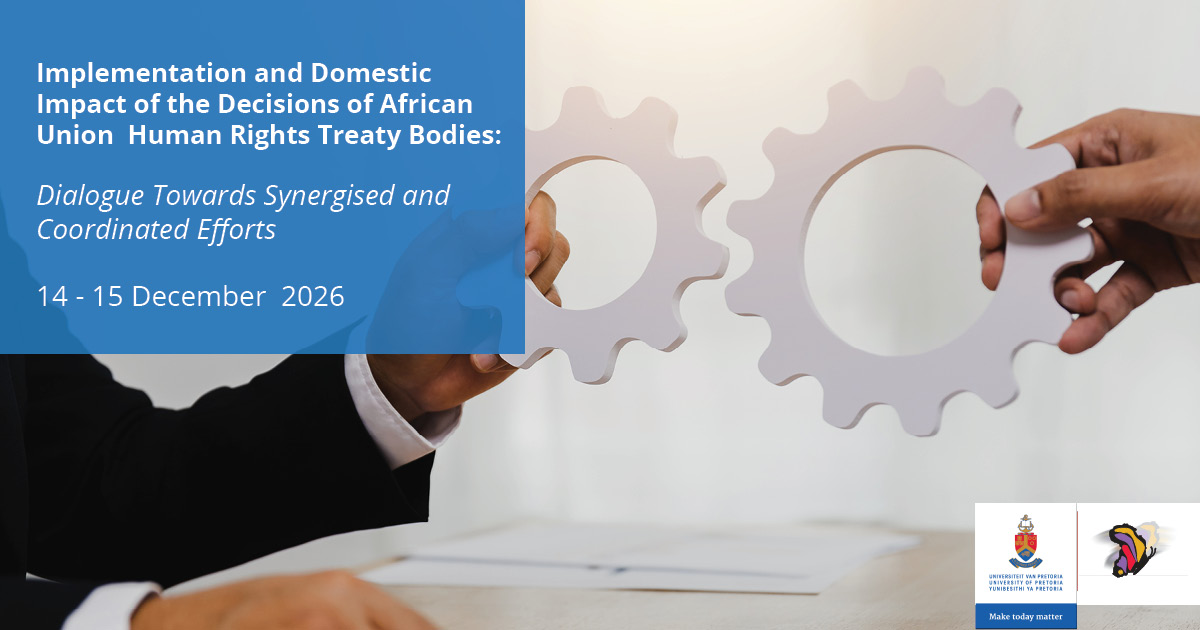
The Centre for Human Rights has, with the support of the Open Society Foundations, held three conferences focusing on the domestic implementation and impact of the decisions of the three African human rights treaty bodies: the African Commission on Human and Peoples’ Rights (African Commission); the African Court on Human and Peoples’ Rights (African Court), and the African Committee of Experts on the Rights and Welfare of the Child (African Children’s Committee). The aim of these conferences was to foster academic and multi-stakeholder dialogue concerning the progress, challenges and opportunities in realising the rights protected through regional human rights frameworks, as expounded on by the work of these treaty bodies.
The first conference focused on the implementation of the decisions of the African Commission, which has a mandate to enforce and monitor the realisation of the African Charter on Human and Peoples’ Rights (African Charter). This conference, held in Pretoria on 13 to 15 September 2023, brought together a diverse group of stakeholders to engage in an academic dialogue on the topic, with 23 research papers presented. Some of the main recommendations from the conference were that an online database would be established, detailing the status of implementation of the decisions reached by the Commission in communications submitted to it; regularising implementation hearings; and initiating a detailed study on implementation to establish a baseline for assessing implementation. From the papers presented at the conference, a publication was released in 2024, in a special issue of the African Human Rights Law Journal.
On 21 and 22 June 2024, the Centre for Human Rights co-hosted a second implementation conference focusing on the decisions of the African Court, which is the judicial body that hears cases of violations of the African Charter. The other co-hosts for the conference were the African Court and the Coalition for an Effective African Court on Human and Peoples’ Rights, and the event was held in Arusha, Tanzania. One of the main outcomes of this conference was a communique that included recommendations tailored to a wide array of stakeholders identified as having the ability to support the implementation of the decisions of the African Court. The recommendations included that States should ratify the African Court Protocol and further deposit the required declaration under article 34(6) to allow individual access to the Court; that the African Commission, the African Court and the African Children’s Committee should enhance complementarity in their respective mandates, including by making better use of their existing tools and mechanisms to monitor implementation of their decisions and that they should jointly engage with the AU Policy Organs for increased leveraging of political will; and that other African Union bodies including the PAP, ECOSOC and AUDA-NEPAD should incorporate questions of compliance with the decisions of the Court (and the other human rights treaty bodies) when engaging with States. From the papers presented at the conference focusing on the African court, a publication was also released in 2025 in a special issue of the African Human Rights Law Journal.
A third implementation conference, which took place on 30 September and 1 October 2025 in Pretoria, was merged with a civil society capacity-building workshop, focusing on the implementation of the decisions of the African Children’s Committee. This conference also gathered academic, government actors, civil society and the representatives of the African Union organs, to focus on the progress with implementing the African Charter on the Rights and Welfare of the Child (African Children’s Charter). The conference included high-level presentations and 17 academic papers focused on the implementation study published in 2025 by the African Children’s Committee; the quality of the Committee’s decisions; limitations to realising children’s rights in de facto States; the role of traditional authorities in implementation; and evidentiary considerations when litigating before the Committee. The papers presented at the conference focusing on the Committee are currently under review and set for publication in 2026, also in a special issue of the African Human Rights Law Journal.
Some of the main recommendations coming from the African Children’s Committee conference and capacity-building workshop were that there is a need for a fourth edition conference focusing on all the AU human rights bodies collectively, to facilitate a multi-stakeholder dialogue on how these bodies can synergise their implementation and follow-up efforts; and that a core group of civil societies who have litigated before the African Children’s Committee and received a decision on merits should be created to facilitate experience sharing and peer support as these organisations work to advocate for the implementation of their decisions at the domestic level.
It is on the basis of the recommendations from these three conferences, particularly from the African Children’s Committee conference, that the Litigation and Implementation Unit at the Centre for Human Rights, in collaboration with the South African Research Chair in International Constitutional Law, plans to host the fourth edition conference, with a focus on Implementation and domestic impact of the decisions of African Union human rights treaty bodies: dialogue towards synergised and coordinated efforts in the region and sub-region.
Scope and themes:
Building on the dialogues that have arisen from the previous conferences, the fourth edition of the conference will provide an opportunity for stakeholders to reflect on the progress with operationalising the recommendations of the prior gatherings and having a discussion on implementation challenges facing the broader continent, beyond the three AU human rights treaty bodies.
The implementation of some of the recommendations from the prior dialogues are already underway. For example, during the 2025 conference, a representative from the African Commission shared that the Commission’s implementation unit has produced a baseline report on implementation from 1994 to 2024, and has also been developing a consolidated database of recommendations issued by the Commission, which also incorporates data on the status of implementation on merit decisions. Additionally, the African Children’s Committee held a Symposium on Litigating Children’s Rights Before the Committee during October 2025, which can be seen as a step towards addressing evidentiary issues and thus the quality of decisions adopted concerning children’s rights violations.
Furthermore, the 2025 Activity Report of the African Court submitted to the 48th Ordinary Session of the AU Executive Council, shows that there have been concerted efforts to enhance complementarity between the African Commission, the African Court and the African Children’s Committee. For example, there is a Complementarity Roadmap of 2023–2028 adopted by the African Court and Commission; all three organs have been collaborating on a study on compliance with decisions of African Union Human rights organs; and these organs have also collaborated on the creation of the African Jurisprudence Database, which is a “comprehensive and accessible repository of the jurisprudence of the Commission and the Court, as well as other international judicial mechanisms in Africa”.
In light of these ongoing developments and growing collaboration among the treaty bodies, therefore, the conference provides a timely opportunity for an academically grounded discussion on the implementation progress and procedures of regional and sub-regional bodies. This will enable discussion on potential outcomes of ongoing developments, identify gaps that can be addressed as the AU organs solidify their enforcement and follow-up efforts, appraise or critique the processes that are currently employed by the organs, consider the role of other AU stakeholders in supporting implementation of the treaty bodies’ decisions, consider the role of sub-regional courts and mechanisms in supporting the implementation of the decisions of the AU bodies, and initiating an additional dialogue focusing on implementation challenges concerning sub-regional mechanisms.
Therefore, the fourth implementation conference aims to foster discussion on the following themes:
- Similarities and differences in the monitoring and follow-up procedures of the African Commission, African Court, and the African Children’s Committee, and how these bodies can learn from each other’s successes and challenges;
- Similarities and differences in the factors affecting the implementation of each body’s decisions;
- The desirability and scope of a potential harmonised implementation and enforcement strategy among the organs, including the benefits and limitations of adopting a synergised approach, and potential modalities for such an approach;
- The role of other AU bodies (including the Executive, Peace and Security Architecture, ECOSOC, PAP, AUDA-NEPAD, and all other structures and organs) in supporting and mainstreaming the implementation of the decisions of the AU human rights treaty bodies;
- The role of sub-regional courts and other mechanisms in supporting the implementation of the decisions of the AU human rights treaty bodies; and
- The implementation challenges and successes of the sub-regional treaty bodies, and how these are similar to the experiences of the AU human rights treaty bodies.
Submission of Abstracts
Interested participants are invited to submit an abstract of no more than 500 words by 15 May 2026. The abstract should highlight the key findings, innovations, unique insights, and the prospective recommendations of the proposed paper. The outcome of the abstract submission process will be communicated by 15 June 2026, and accepted authors will be expected to submit their full first drafts (no more than 10 000 words) by 15 August 2026.
Authors whose papers are accepted will be facilitated to attend the conference in accordance with University of Pretoria travel policies.
Publication:
Papers presented at the conference will be considered for further development and publication in a peer reviewed publication under the Pretoria University Law Press, in 2027.
For more information, please contact:
Ntokozo Sibanyoni
Junior Project Administrator
ntokozo.sibanyoni@up.ac.za
Ruth Versfeld
Project Officer
ruth.versfeld@up.ac.za