
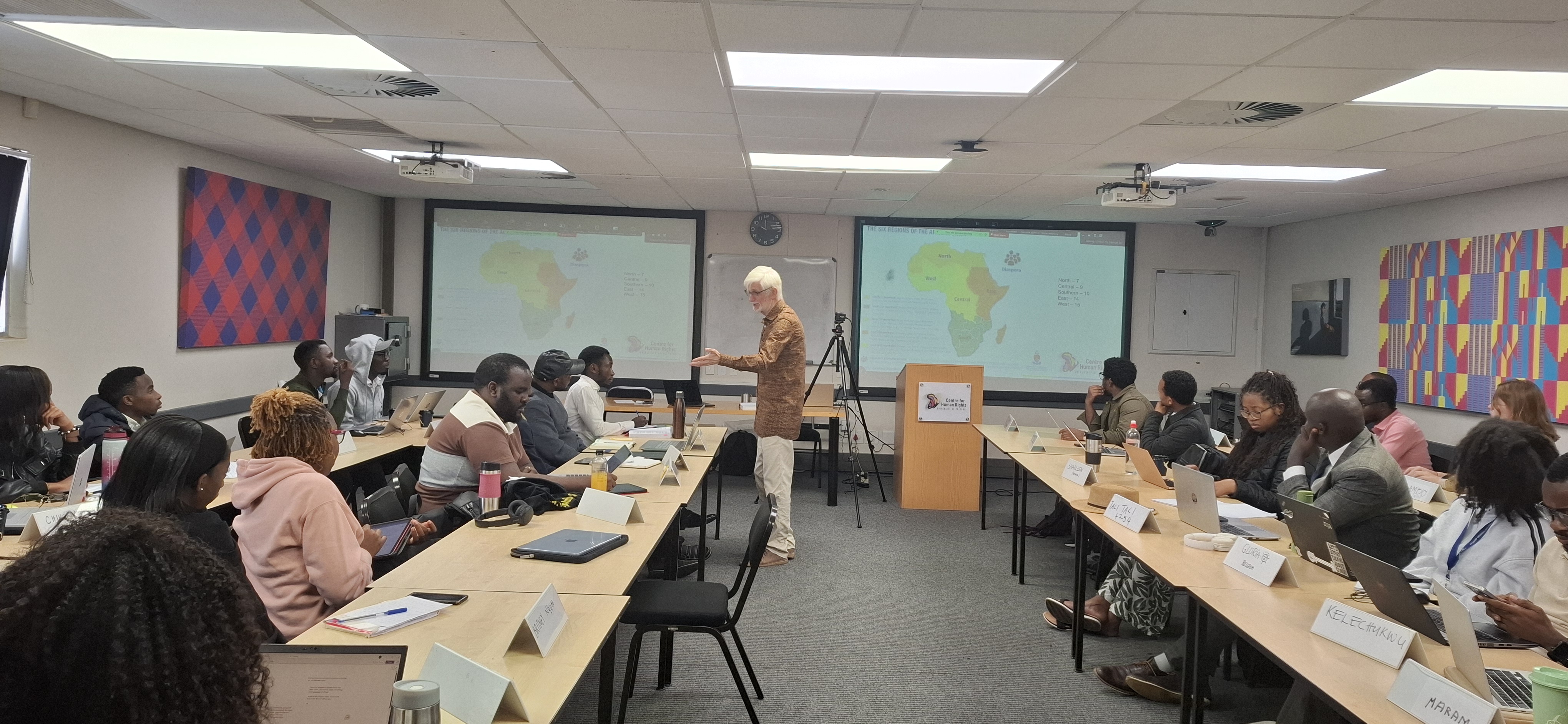
The Centre for Human Rights, Faculty of Law, University of Pretoria, presented the 2026 edition of the Advanced Human Rights Course on the African Human Rights System in Comparative Perspectives from 20 to 24 April 2026.
Offered in a hybrid format, the one-week course brought together participants both in the Centre’s classroom and online via Zoom. Forming part of the Centre’s Advanced Human Rights Courses, the programme explored the institutions, instruments and processes that shape the African human rights system, while placing them in conversation with other regional human rights systems.
The course opened with a welcome and introduction by Prof Magnus Killander, followed by sessions by Prof Frans Viljoen on the African Union and human rights, the African Charter on Human and Peoples’ Rights and the African Commission on Human and Peoples’ Rights, and Prof Nkatha Murungi on the African Committee of Experts on the Rights and Welfare of the Child.
Sessions of the course further explored sub-regional human rights protection and litigation before the African Commission. Clement Mavungu, the legal counsel of the Pan-African Parliament (PAP), provided insights on PAP’s work in relation to human rights and Adv Batlokoa Makong, advisor to the APRM CEO, presented on the African Peer Review Mechanism. The registrar of the African Court on Human and Peoples’ Rights, Dr Robert Eno, presented on the Court's work. The programme also engaged with practical and thematic issues, including human rights documentation and databases and women’s rights in Africa. A highlight of the week was the launch of a database on the domestic impact of UN human rights treaties, which added a practical and research-focused dimension to the course.
A key feature of the programme was its comparative approach. The fourth day introduced participants to the European and Inter-American human rights systems, presented by Profs Yves Haeck and Clara Burbano-Herrera, from the University of Ghent in Belgium, while the final day considered comparative supranationalism by Prof Babátúndé Fágbàyíbọ́ and a panel discussion on lessons from regional human rights protection. Participants also took part in a practical exercise on making an NGO statement before the African Commission and completed a course quiz to reflect on the knowledge gained during the week.
Overall, the 2026 course offered a focused and engaging opportunity to study Africa’s principal human rights institutions, explore their comparative dimensions, and reflect on their continuing relevance for scholarship, advocacy and practice.


For more infomation, please contact:

Tel: +27 (0) 12 420 4197
dennis.antwi@up.ac.za