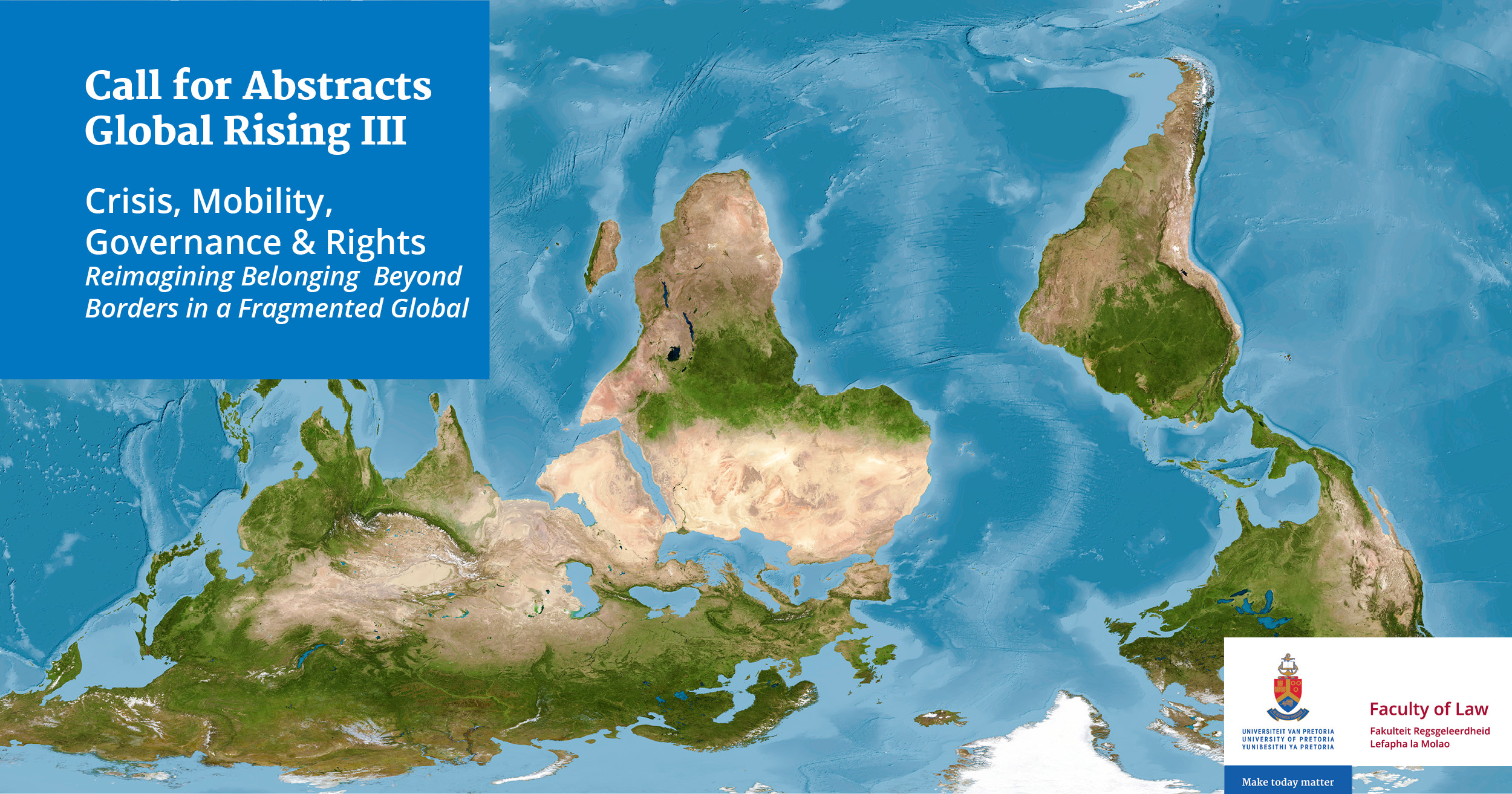
The Global South Rising research network invites submissions for its third annual symposium. The Global South Rising Research Network is an interdisciplinary platform that seeks to re-centre historically marginalised scholars, perspectives, and epistemologies in critically interrogating and reimagining international law and global governance.
In collaboration with the SARChI Chair in International Constitutional Law, Department of Public Law, and the Centre for Human Rights, at the University of Pretoria, this year’s event seeks to critically examine how contemporary crises of mobility, governance, and belonging are reshaping legal and political orders across the Global South and beyond. Against the backdrop of intensifying migration regimes, climate displacement, xenophobic violence, securitised borders, economic inequality, and shifting geopolitical configurations, the symposium explores how mobility and belonging are increasingly contested within a fragmented global order. While Global South states and peoples have historically challenged exclusionary international systems rooted in colonialism, empire, and racial hierarchy, new forms of exclusion, bordering, and internal fragmentation are also emerging within postcolonial societies.
The symposium will also examine how crises of mobility, governance and belonging are reshaping constitutional, regional and international legal orders across the Global South. Its central concern is the role of international constitutional law in mediating the relationship between international norms, regional and subregional legal orders, and domestic constitutions, legislation, institutions and practices. Migration and displacement are not governed at only one legal level. International frameworks, including international human rights and refugee law and the Global Compact for Safe, Orderly and Regular Migration, interact with African Union norms, subregional arrangements such as those developed through SADC, ECOWAS, the EAC and IGAD, and national constitutional systems. These overlapping legal orders may reinforce one another, but they may also generate fragmentation, normative conflict and significant implementation gaps. The symposium will consider whether international constitutional law can provide a framework for understanding and strengthening the relationships among these different levels of governance.
The symposium moves beyond North-South binaries in order to critically interrogate the tensions between solidarity and exclusion, liberation and governance, mobility and securitization, both internationally and more particularly the global majority of states commonly referred to as the Global South. The symposium aims to provoke questions including: how does the law, governance structures, and political institutions shape contemporary experiences of movement, displacement, citizenship, identity, and belonging? It also seeks to trigger the exploration of alternative and more equitable imaginaries of political community beyond colonial borders and exclusionary nationalisms.
Sub-Themes
To ensure greater thematic coherence and focused discussions, submissions are invited under the following sub-themes:
- Borders, Migration, and the Coloniality of Mobility
Colonial borders; unequal mobility regimes; passports, visas and citizenship; racialised and class-based access to movement; irregular migration; border communities; and the continuing influence of colonial legal structures. - Xenophobia, Nationalism, and Internal Exclusions in the Global South
Xenophobic violence and discourse; exclusionary nationalism; constitutional equality; access to healthcare, education, housing and employment; political participation; statelessness; and the responsibilities of states, political actors and regional institutions. - Governance, Regionalism, and the Crisis of Solidarity
Migration and mobility within the AU, the AU Migration Policy Framework; the AU Free Movement Protocol; at sub-regional level: SADC, ECOWAS, the EAC, ECCAS, IGAD and other regional communities; the relationship between regional integration and state sovereignty; economic and political contestations to a borderless Africa, labour mobility; refugee protection; regional citizenship; and implementation at the national level) - Climate Crisis, Displacement, and Resource Governance
Climate-induced mobility; internal and cross-border displacement; disaster / emergency management, loss of territory and livelihoods; extractive industries; environmental degradation; urbanisation; food and water insecurity; and the adequacy of existing international, regional and constitutional protections, with a focus on the 1969 OAU Refugee Convention) - Conflict, Displacement and Colonial Legacies
Conflict and continued reliance on former colonial powers as destinations for economic migration; shifting and unequal responses to refugees and asylum seekers from conflict zones; unconstitutional changes of government and the rejection of Françafrique in some ECOWAS states; and the coloniality of resource extraction and displacement - Reimagining Citizenship and Belonging beyond Borders
Pan-Africanism; regional citizenship; solidarity and hospitality; conceptions of community; diaspora belonging; and alternative constitutional imaginaries that transcend exclusionary national borders)
- International Constitutional Law and Multilevel Migration Governance
The relationship between international commitments, AU law, subregional norms and domestic constitutions; incorporation and implementation; normative conflict; constitutional pluralism; judicial dialogue; and institutional accountability; legal and political significance of the Global Compact; its implementation in Africa; and the case for, and possible content of, an African migration compact or coordinated continental framework).
The symposium particularly welcomes contributions that re-centre historically marginalised perspectives, epistemologies, and lived experiences, as well as those drawing on critical and interdisciplinary approaches. We especially encourage submissions that challenge dominant legal and political imaginaries and advance more equitable, plural, and transformative understandings of governance, mobility, and belonging within the contemporary global order.
Submission Guidelines
- Abstracts of no more than 300 words should:
- state the author’s name and institutional affiliation indicate the relevant sub-theme
- identify the paper’s principal question, argument and potential scholarly contribution
- briefly indicate the methodological or conceptual approach
- In addition, a short biography (maximum 150 words) should be submitted together with the abstract, in a single document, to: thenette.mulder@up.ac.za
As limited funding is available to support participation of presenters, applicants are also encouraged to briefly indicate whether they would require financial assistance to attend the symposium. The symposium welcomes submissions from scholars at all career stages, particularly early-career researchers and scholars from historically marginalised contexts.
Symposium Format
The symposium will take place in a hybrid format at the University of Pretoria. Selected participants will have the opportunity to contribute to a special issue for a peer-reviewed journal and or future collaborative publications and research initiatives associated with the Global South Rising network.
Important Dates
- Abstract Submission Deadline: 30 September 2026
- Notification of Acceptance by: 15 October 2026
- Symposium Dates: 8 and 9 December 2026
Submissions and inquiries should be sent to the organisers
Prof Frans Viljoen, Prof Babatunde Fagbayibo, Dr Dorothy Makaza-Goede and Dr Michelle Maziwisa through the following email: thenette.mulder@up.ac.za