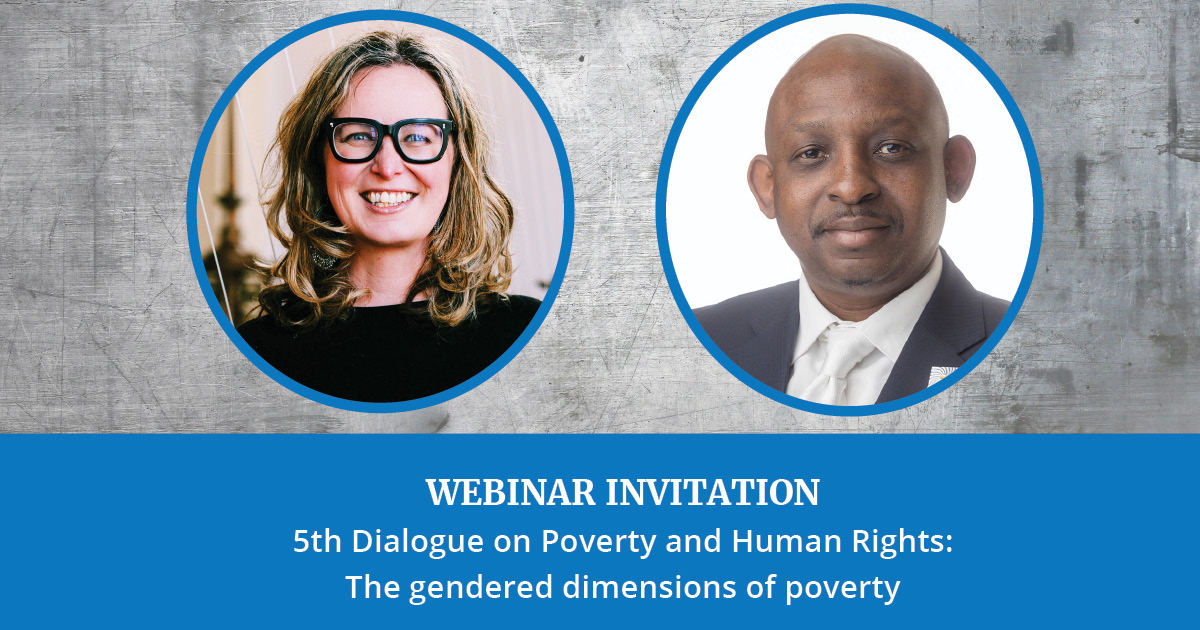
The Centre for Human Rights, Faculty of Law, University of Pretoria, cordially invites you to the 5th Dialogue on Poverty and Human Rights. The 5th Dialogue will focus on the gendered dimensions of poverty, exploring the relationship between gender, equality and socio-economic rights, and examining the structural factors that contribute to the disproportionate impact of poverty on women.
Webinar Details
Date: Wednesday 21st October 2026
Time: 15:00 – 17:00 (SAST)
Download Invitation Register on Zoom
A human rights-based approach to poverty is crucial as it transitions the discourse from charity to justice, and from needs to rights and accountability. It acknowledges that individuals in poverty are right holders, whereas states and other entities are duty bearers with responsibilities to respect, preserve, and fulfil these rights. Against this backdrop, the Centre for Human Rights is commencing a series of webinars titled ‘Dialogue on Poverty and Human Rights’.
Aim
This dialogue seeks to establish a space for critical examination of the connection between poverty and human rights, as well as how legal and policy frameworks might facilitate inclusive and accountable responses.
Objectives
- To analyze poverty from a human rights perspective and to foster discourse on rights-based approaches to poverty, especially within the African setting.
- To stimulate debate on how inequality and social injustice can exacerbate poverty
- To highlight states’ obligations in addressing poverty as a human rights challenge
- To explore the multidimensional perspective of poverty
- To share good practices among African states regarding policy formulations and programme to address poverty.
Goals
The dialogue seeks to examine the correlation between poverty and the realization of human rights; to emphasize poverty as both a catalyst and result of human rights infringements; to underscore relevant international and African regional human rights frameworks ; and to promote contemplation on pragmatic, legal, and policy measures addressing poverty rooted in dignity, equality, and social justice.
Normative Framework
While none of the international or regional human rights instruments contains explicit provisions on poverty, the various provisions of these instruments can be applied directly or indirectly to address poverty. Poverty can undermine the enjoyment of human rights such as dignity and life. Conversely, human rights violations can exacerbate poverty conditions. For instance, a denial of access to adequate housing can expose an individual to poor living conditions.
The Universal Declaration of Human Rights, at the international level, asserts the intrinsic dignity and equal rights of all individuals and acknowledges rights essential to combating poverty, such as the right to social security, employment, education, and an appropriate quality of living. The International Covenant on Economic, Social and Cultural Rights is notably important, as it guarantees the rights to employment, social security, sufficient nourishment, clothes, housing, health care, and education, and mandates that states undertake measures for the progressive realization of these rights. The Convention on the Rights of the Child and the Convention on the Elimination of All Forms of Discrimination against Women are pertinent, particularly in illustrating the disproportionate impact of poverty on children and women. The Convention on the Rights of Persons with Disabilities emphasizes the necessity for inclusive strategies to tackle the specific susceptibility of individuals with disabilities to poverty and marginalization. The UN Guiding Principles on Extreme Poverty and Human Rights emphasize that poverty is both a cause and a result of human rights breaches, asserting that anti-poverty initiatives must be formulated within a human rights framework.
The African Charter on Human and Peoples’ Rights serves as a significant normative framework at the regional level for combating poverty through rights including dignity, equality, health, education, property, and development. The African Charter on the Rights and Welfare of the Child is pertinent in acknowledging children’s rights to survival, development, health, and education, all of which are jeopardized by poverty. The Protocol to the African Charter on the Rights of Women in Africa (Maputo Protocol) is significant in tackling the gendered aspects of poverty and in advancing women’s rights to dignity, health, food security, and sustainable development.
African Union Agenda 2063 envisions an Africa characterized by inclusive growth, sustainable development, social justice, and enhanced quality of life, thereby serving as a valuable additional framework for this discourse. The Guidelines and Principles for the Implementation of socio-economic rights in the African Charter outline states’ obligations to realise the
socio-economic rights in the Charter, including addressing poverty.
The dialogue corresponds with the 2030 Agenda for Sustainable Development, specifically SDG 1 aimed at eradicating poverty in all its manifestations globally, while also closely relating to SDG 2 concerning zero hunger, SDG 3 focused on health and well-being, SDG 4 regarding quality education, SDG 5 promoting gender equality, SDG 6 addressing clean water and sanitation, SDG 10 aimed at reducing inequalities, and SDG 16 pertaining to justice and inclusive institutions.
Anticipated Results
The debate aims to enhance comprehension of poverty as a human rights concern, bolster awareness of pertinent legal and policy frameworks, and provoke discourse on rights-based approaches to poverty in Africa. The objective is to promote more participation among
academics, students, practitioners, politicians, and civil society regarding the necessity for
accountable and inclusive anti-poverty initiatives.
Intended Auidence
Academics, researchers, students, legal professionals, politicians, civil society organizations, development practitioners, and members of the public concerned with poverty, social justice, and human rights.
Structure
This will be an hour’s program, including a welcome address, Expert speaker’s introduction, a keynote address, a moderated discussion, audience engagement, and closing remarks.
Program
15:00 - 15:05 - Moderator’s Introduction Dr Olayinka Adeniyi
15:05 - 15:15 - Welcome address Dr Sabelo Gumedze
15:15 - 15:40 - Keynote Address Prof Meghan Campbell
15:40 - 15:55 - Moderated Discussion / Audience Engagement
15:55 - 16:00 - Closing Remarks
Speakers bios’
Keynote Speaker - Professor Meghan Campbell
 Meghan Campbell is a a Professor of International Human Rights Law and Head of the Department of Law, University of Birmingham,
United Kingdom. Her research focuses on women’s economic inequality and overlooked aspects of women’s equality including on rurality, the procedural rules on international access to justice and temporality. Her first monograph, Women, Poverty, Equality (Hart 2018) examined women’s poverty in the CEDAW and her second, supported with a British Academy Mid-Career Fellowship, Hanging in the Balance: The Function of Justification in Achieving Women’s Equality (Hart 2025), looks at the relationship between women’s equality and limits on rights. She is the editor of two collection, Human Rights and Equality in Education (Policy Press 2018) and Feminist Frontiers in Climate Justice (Edward-Elgar 2023). She has collaborated on a range of human rights projects with the International Labour Organization, the World Health Organization, the UN Office of the High Commissioner of Human Rights, the South African Human Rights Commission and civil society groups including the Equal Rights Trust and Centre for Child Rights. She has acted as an independent expert advisor to the Council of Europe on comprehensive sexuality education and the UK Cabinet Office on equal pay.
 Welcome Address: Dr Sabelo Gumedze is the Assistant Director (Operations) at the Centre for Human Rights, Faculty of Law, University of Pretoria. He holds a Doctor of Social Sciences and a Licentiate in Social Sciences in International Law from Åbo Akademi University, Finland, as well as an LLM in Human Rights and Democratisation in Africa from the University of Pretoria. He is an internationally recognised scholar and practitioner in international law, human rights, peace and security, private security regulation, and the African human rights system. Before joining the Centre, he served as Executive Head of the Africa Institute of South Africa at the Human Sciences Research Council and as Head of Research and Development at the Private Security Industry Regulatory Authority. He has also worked as a Senior Researcher at the Institute for Security Studies and held academic appointments at several South African universities. Dr Gumedze has also served as Chair and Vice- Chair of the United Nations Working Group of Experts on People of African Descent, contributing to international work on racial justice and the rights of people of African descent.
For more information, please contact:
Dr Olayinka
Programme Manager: Socio Economic Rights
olayinka.adeniyi@up.ac.za
www.chr.up.ac.za