Global South Rising: Towards Equity, Justice, and Decolonising International Law Symposium
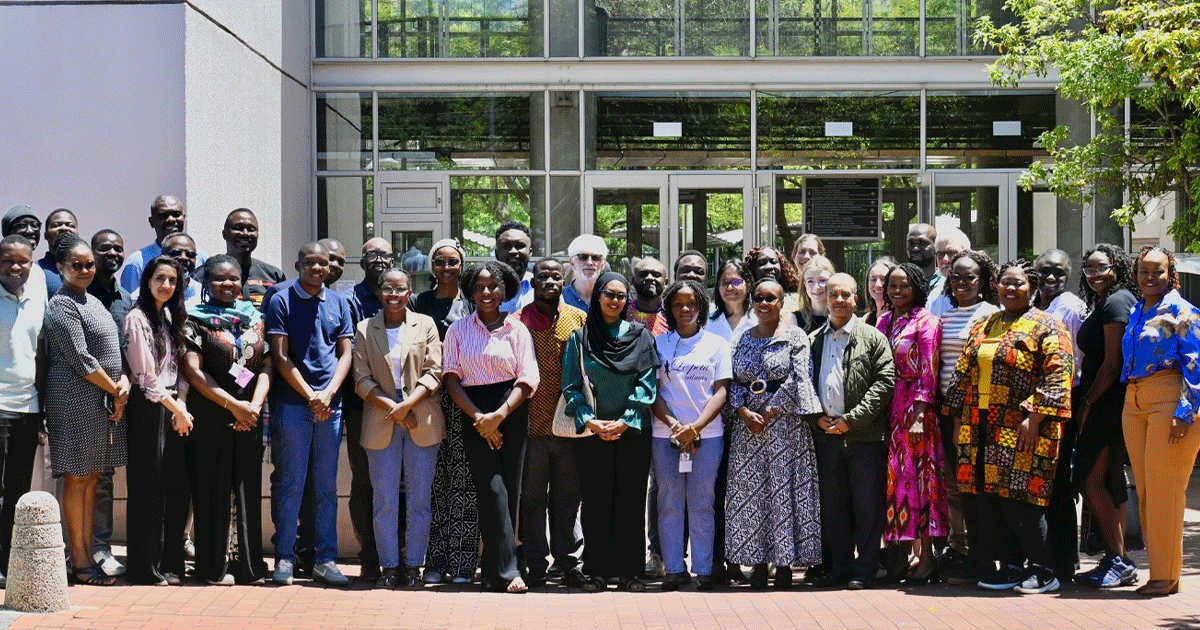
The Centre for Human Rights (Centre) and the NRF Chair in International Constitutional Law, at the Law Faculty at University of Pretoria, in partnership with the Law Faculty of the University of Hamburg, co-hosted the Global South Rising: Towards Equity, Justice, and Decolonising International Law Symposium from 8 to 9 December 2025 at the University of Pretoria Moot Court Room. The two-day event brought together 50 participants, including senior scholars, researchers, practitioners and students from the Global South and the Global North to critically interrogate the historical and contemporary foundations, structures, and logics of international law from Global South perspectives, and to propose pathways for reconstructing the field in more equitable and inclusive ways. This year marked the second event in the Global South Rising Symposium series initiated by Dr. Dorothy Makaza-Goede and first hosted at the University of Hamburg in November 2024, with funding from the Excellence Strategy of the Federal and State Governments (Germany).
The symposium kickstarted with a panel on Reclaiming Histories, Epistemologies and Legal Foundations which was moderated by Clement Agyemang, where Dr Sara Wissmann interrogated the ‘prayer of intertemporality’ as a tool that sustains Eurocentric legal narratives. Complementing this, Franziska Bachmann and Dr Dorothy Makaza-Goede explored alternative epistemic conceptions of equity at the International Court of Justice, while Prof Babatunde Fagbayibo highlighted the power of cultural artefacts as pedagogical tools in African international law classrooms. The second panel examined Governance, Rule Making and the Political Economy of International Law, with Dr Michèle Olivier and Prof Konstantinos Magliveras assessing inclusive rule-making in the African Union, Prof Kwadwo Appiagyei-Atua discussing the role of the African Union Commission on International Law in decolonial norm-shaping, and Dr Michelle Maziwisa offering a critique of Africa’s international investment agreements. This panel was moderated by Franziska Bachmann.
The second day of the symposium started with a panel on International Criminal Justice and Transitional Justice Frameworks, moderated by Barbara Lamara, in which Dr Daniel Ruhweza offered Global South perspectives of the Ongwen case, decided by the International Criminal Court; Fatma Ismail proposed a gender-just reparations framework in South Africa; and Tendai Mbanje interrogated Global North impunity. This was followed by a panel on Environment, Climate Justice and Extractive Legacies, moderated by Ntando Moyo. In this panel, Nciko wa Nciko and Samrawit Getaneh called on the African Court to speak on matters of climate justice where the ICJ has stayed silent; and Dr Dorothy Makaza-Goede and Verena Kahl evaluated the gains and gaps in advisory opinions on state obligations in the climate crisis. This was followed by Fortunate Chilenge’s critique of extractive economies and colonial resource regimes in Africa. The final panel explored Knowledge, Representation and Justice in a global changing order, moderated by Verena Kahl. Akram Abdel-Monem reviewed the Common But Differentiated Responsibilities (CBDR) principle, which establishes the common governmental responsibility for anthropogenic climate change, within the Global South development project, Prof John-Mark Iyi explored decolonising legal education for reparatory justice, and Dr Janet Gbam argued for pluralising international law to centre African approaches as epistemic resistance.
The symposium concluded with a forward-looking roundtable on Decolonial Futures for International Law, during which participants reaffirmed their commitment to continued collaboration, joint publications, and the consolidation of the symposium as an annual platform for advancing Global South decolonial scholarship through the established research network. Across the discussions, a shared understanding emerged: decolonising international law requires a sustained, balanced, and multidirectional approach. This includes looking both inward, to support the development of homegrown, context-specific processes that amplify the voices and experiences of those historically excluded from the making and shaping of international law; and outward, to ensure accountability of all stakeholders and to challenge global structures that perpetuate inequity. The symposium’s key insights thus underscored that decolonisation is not a moment but a continuous collective endeavour.
The Centre acknowledges the partnership and financial support of the University of Hamburg through its law faculty and the Excellence Strategy of the Federal and State Governments of Germany, as well as the South African National Research Foundation and the European Union through the Global Campus of Human Rights. The Global Campus is a network of human rights institutions working on research and training of human rights across eight regions. The Centre, which coordinates the Masters in Human Rights and Democratisation in Africa (HRDA), is the regional headquarters of the Global Campus Africa region. HRDA partners and students also participated in the symposium.
For more information, please contact:
Tel: +27 (0) 12 420 6703
michelle.maziwisa@up.ac.za