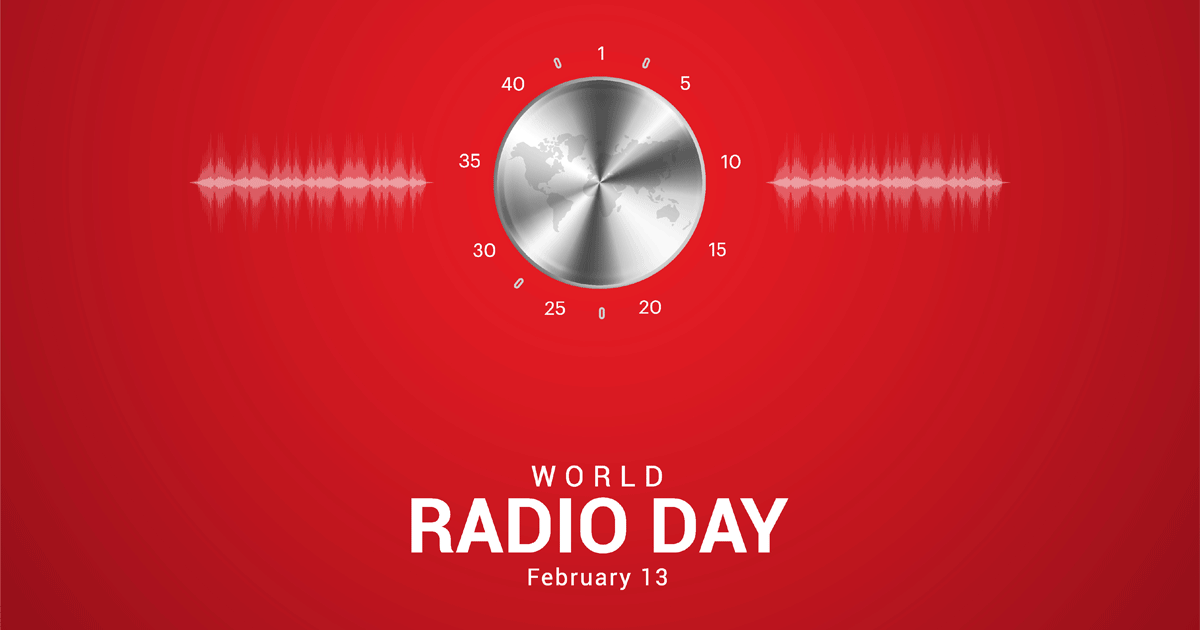
Today, 13th February 2026, is World Radio Day, a moment to pause and honour one of the most familiar companions of our lives.
Radio represents and advances the fundamental rights to freedom of expression and access to information. Most of us grew up with the radio. It was always there in the background of ordinary days, perhaps resting on a kitchen shelf, placed on the bedside table, balanced on a windowsill, or tucked into the corner of a small shop. It played in buses and minibuses, in taxis, tro-tros, jeepneys, dala-dalas, colectivos and matatus. It kept farmers company in the fields, vendors alert at their stalls, drivers awake on long roads, and families connected long before smartphones entered our pockets.
Through radio, many of us learned about the world beyond our immediate surroundings. We heard election results announced deep into the night, new leaders sworn in, borders closed, schools reopened and fuel prices rose. We received early warnings during floods, earthquakes, pandemics and conflict. Long before push notifications and social media timelines, the radio voice carried breaking news that was trusted.
Radio has always met people where they are. Even today, in an increasingly digital world, radio remains essential. An estimated 2.6 billion people globally remain offline, excluded from digital media by cost, geography, infrastructure gaps, disability, literacy barriers or political restrictions. For many of them, radio is the primary source of information. It continues to reach more than 80% of the world’s population, making it the most accessible mass medium in existence. In rural areas, conflict-affected regions, informal settlements, and low-income communities, radio often reaches further than television and the internet combined. Community radio stations broadcasting in local and indigenous languages remain lifelines for women, older persons, displaced communities, and young people seeking platforms to be heard.
Radio is also one of the most participatory forms of media. Call-in programmes, listener messages, local debates, and public announcements allow audiences not only to receive information, but to shape it. In moments of crisis, such as when electricity fails or networks collapse, radio continues to function, offering timely, reliable information when it is most needed.
Yet radio’s power also makes it vulnerable. Over the past years, we have seen a worrying rise in attacks on radio freedom across regions. Independent and community radio stations have been suspended or shut down for hosting dissenting voices or covering protests and elections. Journalists and presenters have faced arbitrary arrests, threats, and intimidation for reporting on corruption, governance, armed conflict, and human rights violations.
In several countries, radio signals have been jammed during elections or periods of political unrest, deliberately cutting communities off from information at critical moments. Emergency and national security laws have been invoked to justify content bans, punitive fines, and licence withdrawals, often without transparency or due process. In conflict zones, radio stations have been damaged or destroyed, silencing local voices just when communities most needed trusted information.
Experience has also shown that radio’s influence can be misused. In certain contexts, including in Africa, broadcasting has been exploited to spread incitement, and dangerous propaganda. The well-documented role of Radio Télévision Libre des Mille Collines during the Rwandan genocide remains a stark reminder of the harm that irresponsible broadcasting can cause. Acknowledging this history is not a call for censorship, but a recognition that the right to freedom of expression carries responsibilities.
At the same time, many community radio stations continue to struggle with financial precarity, unequal access to frequencies, and regulatory frameworks that favour commercial broadcasters. Broadcasters are increasingly expected to counter disinformation and hate speech without sufficient resources, training, or legal protection, turning legitimate regulatory concerns into tools for censorship. Addressing misinformation and harmful content must therefore be grounded in support for ethical journalism and human rights values, rather than restrictive state control. Radio stations and journalists should be supported and encouraged to comply with journalistic ethics and principles of non-discrimination, while safeguarding editorial independence.
On this World Radio Day, these realities call for renewed commitment and concrete action. We therefore urge states, regulators, media institutions, civil society, and international partners to:
- Protect radio journalists and presenters (particularly those working in rural and high-risk contexts) from violence and harassment.
- Guarantee fair and transparent regulation that promotes pluralism and editorial freedom.
- Support community radio through equitable licensing processes, access to frequencies, and sustainable funding models.
- Refrain from using emergency powers and national security laws to suppress public interest broadcasting.
- Affirm radio as a public good, deserving of protection and investment alongside digital and emerging technologies.
- Promote and uphold professional journalistic ethics and human rights standards within broadcasting, ensuring that efforts to address harmful content strengthen, rather than undermine freedom of expression.
Radio has endured not because it is old, but because it is adaptable and deeply human. As we mark World Radio Day, we recommit ourselves to defending radio as a cornerstone of freedom of expression and access to information for everyone, everywhere.