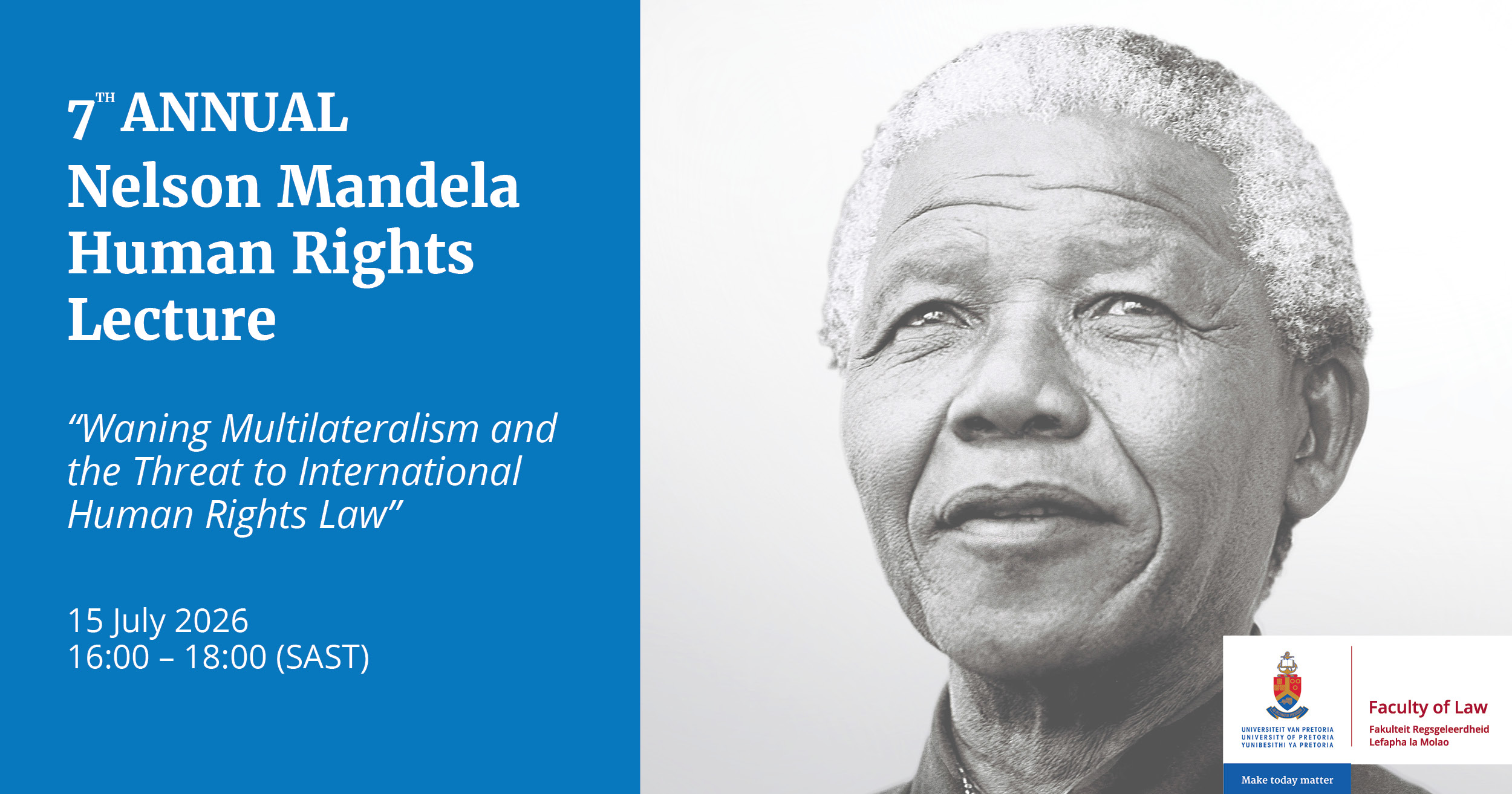
The Nelson Mandela World Human Rights Moot Court Competition presents The Seventh Annual Nelson Mandela Human Rights Lecture “Waning Multilateralism and the Threat to International Human Rights Law” presented by the Centre for Human Rights, Faculty of Law, University of Pretoria, in partnership with the South African Permanent Mission to the United Nations and other International Organisations at Geneva, the Human Rights Council Secretariat, Office of the United Nations High Commissioner for Human Rights, and the Geneva Academy of International Humanitarian Law and Human Rights.
Lecture Details
Date: 15 July 2026
Time: 16:00 – 18:00
Venue: UNHCR Global Headquarters, Rue de Montbrillant 94, 1201 Genève, Switzerland (Room MBT 04)
Registration:
Given the limited seating capacity at the venue, participants are strongly encouraged to register early to secure their place. Registration details will be communicated in due course, and early confirmation will help ensure a smooth and well-organised event for all attendees.
Main lecture delivered by: Dr George Ulrich, Academic Director, Global Campus of Human Rights
Respondents:
- Dr Bertrand Ramcharan, Coordinator, The Human Rights Observatory
- Mona Rishmawi, Member of the UN Independent International Fact-Finding Mission on Sudan.
Moderator:
- Prof. Manfred Nowak (Secretary-General, Global Campus of Human Rights)
Purpose and Focus of the Lecture:
The purpose of the Lecture is to provide a structured and critical examination of the impact of waning multilateralism on the protection and enforcement of international human rights law. It seeks to move beyond abstract institutional analysis and to explore how geopolitical fragmentation, selective enforcement, and security-driven exceptionalism affect the universality, credibility, and effectiveness of human rights norms in practice.[1] In particular, the Lecture aims to deepen understanding of the challenges facing UN human rights mechanisms, the role of civil society in sustaining accountability, and the continued relevance of regional human rights systems. It also seeks to equip students participating in the Nelson Mandela World Human Rights Moot Court Competition with a realistic and principled understanding of the system they are trained to defend.
The Lecture will invite reflection on the following interrelated questions:
- How has waning multilateralism affected the authority, independence, and effectiveness of international human rights institutions?
- What are the implications of selective compliance and enforcement for the universality of human rights norms?
- How do civil society actors and regional human rights systems respond to the limitations of global multilateral mechanisms?
- What responsibilities do legal scholars, practitioners, and future advocates bear in defending human rights norms under conditions of political constraint?
Background and Context to 2026 Lecture:
The international human rights system is facing one of its most serious challenges since the establishment of the post-Second World War multilateral order. Multilateral institutions, particularly within the United Nations system, have long served as the primary framework for the articulation, monitoring, and protection of universal human rights norms[2]. In recent years, however, these institutions have increasingly come under strain due to geopolitical polarization, selective compliance by states, and the growing instrumentalization of international law for strategic purposes.[3]
From the perspective of the United Nations itself, multilateralism remains indispensable. The UN continues to affirm that there is no viable alternative global framework capable of ensuring universal participation, legitimacy, and normative coherence in the protection of human rights.[4] At the same time, UN human rights mechanisms openly acknowledge the constraints under which they now operate, including political pressure, budgetary limitations, non-cooperation by states, and reprisals against mandate holders and civil society actors engaging with the system.[5]
These challenges are not merely institutional. They have direct consequences for the realisation of human rights on the ground. Accountability mechanisms are frequently delayed or obstructed, enforcement remains uneven, and grave violations are often reframed as unavoidable consequences of security concerns or geopolitical necessity.[6] The result is a growing perception that the application of international human rights law is contingent rather than universal.
Civil society organisations have consistently documented how these dynamics affect victims’ access to justice and remedy. For accountability actors, waning multilateralism is experienced as a shrinking space for protection, advocacy, and legal redress, particularly in politically sensitive contexts.[7] Reprisals against those cooperating with UN mechanisms further undermine the effectiveness and credibility of the system.[8]
At the same time, the erosion of multilateralism is neither uniform nor absolute. Regional human rights systems, particularly in Africa, demonstrate that human rights law can remain operational through jurisprudence, interpretation, and sustained engagement, even in the absence of strong enforcement powers.[9] This resilience, however, does not negate a deeper concern identified by critical legal scholarship: that the most serious threat to international human rights law lies in the normalisation of selectivity. When powerful states evade accountability without consequence, particularly in relation to armed conflict, torture, migration control, and extraterritorial conduct, the universality of human rights norms is undermined from within.[10]
Situating the 2026 Lecture within the Mandela Lecture Tradition:
Since its inception in 2018, the Nelson Mandela Human Rights Lecture series has developed as a space for critical reflection on the evolution of international human rights law, with each edition responding to the most pressing challenges of its time.
The First Nelson Mandela Human Rights Lecture (2018) focused on the human rights implementation agenda. It was presented by Ambassador Nazhat Shameem Khan, addressing implementation challenges from a state perspective; Frans Viljoen, reflecting on implementation from an academic and civil society standpoint. The Lecture was moderated by Marc Limon, the Executive Director of the Universal Rights Group.
The Second Lecture (2019), held in Geneva on the occasion of Nelson Mandela International Day, was delivered by Albie Sachs and Michelle Bachelet. Their reflections on personal struggle, political transition, and institutional consolidation captured a moment of confidence in the human rights project. The Lecture was moderated by Christof Heyns.
Following the COVID-19 period, the Third Lecture (2022) was presented by Ian Fry, and focused on climate justice. The panel included Ashfaq Khalfan, Vanessa Nakate, and Therese Arnesen, reflecting a multi-actor response to climate-related human rights challenges.
The Fourth Lecture (2023) examined refugee protection and the adequacy of the 1951 Refugee Convention in a changing global context. It featured senior-level participation from the United Nations High Commissioner for Refugees, including Gillian Triggs, highlighting institutional responses to displacement driven by conflict, climate change, and global instability.
The Fifth Lecture (2024) addressed the intersectionality of race and gender in affirmative action processes. The main lecture was delivered by Patricia Galvão Teles, with panel contributions from civil society and legal practitioners examining the persistent non-implementation of equality norms at national and international levels.
The Sixth Lecture (2025) focused on sexual orientation and gender identity in the context of migration and forced displacement. It was presented by Graeme Reid and examined how international refugee and human rights law responds to persecution based on sexual orientation and gender identity, particularly in relation to African LGBTQ+ refugees.
In 2026, the Seventh Nelson Mandela Human Rights Lecture is situated in a markedly different global moment. Rather than reflecting on the consolidation of human rights after political transition, the 2026 Lecture confronts a period in which the institutions built to protect those rights are themselves under strain. The shift is not away from human rights as a normative ideal, but toward a recognition that legal and institutional gains cannot be taken for granted. Where earlier lectures reflected the optimism of institutional arrival, the present Lecture addresses the responsibility of institutional defense.
This contrast does not signal a departure from the Nelson Mandela’s legacy. On the contrary, it affirms one of its central lessons: that human rights are not self-sustaining, and that their survival depends on continued vigilance, principled engagement, and the willingness to confront power when institutions are tested.
[1] Bhupinder Singh Chimni, International Law and World Order (Cambridge University Press 2017); Moyn (n 5).
[2] ‘Document Viewer’ <https://docs.un.org/en/A/79/292> accessed 16 January 2026.
[3] Martti Koskenniemi, From Apology to Utopia: The Structure of International Legal Argument (Cambridge University Press 2006); Philip Alston, ‘Does the Past Matter-On the Origins of Human Rights’.
[4] ‘Document Viewer’ (n 1).
[5] ‘Annual Reports on Reprisals for Cooperation with the UN’ (OHCHR) <https://www.ohchr.org/en/reprisals/annual-reports-reprisals-cooperation-un> accessed 16 January 2026.
[6] ‘The International Commission of Jurists - ICJ’ (International Commission of Jurists, 13 January 2026) <https://www.icj.org/> accessed 16 January 2026; Samuel Moyn, Not Enough: Human Rights in an Unequal World (Harvard University Press 2018).
[7] ‘The State of the World’s Human Rights: April 2024’ (Amnesty International, 23 April 2024) <https://www.amnesty.org/en/documents/pol10/7200/2024/en/> accessed 16 January 2026.
[8] ‘Annual Reports on Reprisals for Cooperation with the UN’ (n 4).
[9] Frans Viljoen, International Human Rights Law in Africa (Oxford University Press 2012).
[10] Manfred Nowak, Moritz Birk and Giuliana Monina, The United Nations Convention against Torture and Its Optional Protocol: A Commentary (Oxford University Press 2019); Makau Mutua, ‘Savages, Victims, and Saviors: The Metaphor of Human Rights’ (2001) 42 Harv. Int’l LJ 201.