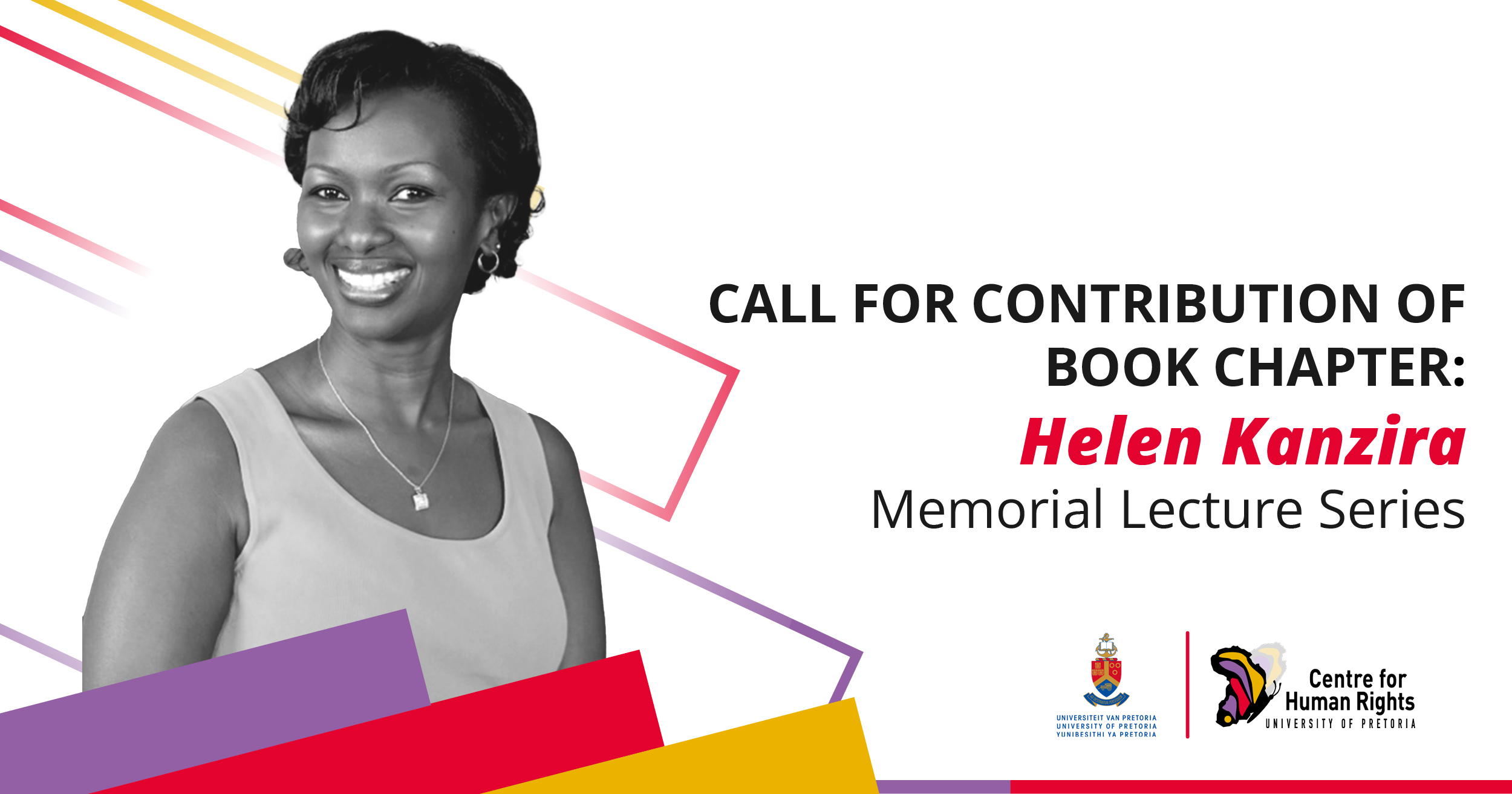
The Centre for Human Rights, Law Faculty, University of Pretoria invites academics from, and practitioners attached to, the 13 regional partner universities that offer the Master’s programme in Human Rights and Democratisation in Africa (HRDA) to submit academic papers aligned with the themes of the Helen Kanzira Memorial Lecture Series on Sexual and Reproductive Rights in Africa.
Important Dates
|
Task |
Due Date |
|
Abstracts |
15 August 2026 |
|
Full papers |
15 October 2026 |
|
Peer Review |
October to November 2026 |
|
Final chapters |
15 January 2027 |
Peer Review and Publication
All contributions will be anonymously peer reviewed and the book will be published by PULP Publishers at the University of Pretoria.
Editors
- Dr Michelle Maziwisa,
- Prof Ebenezer Durojaye,
- Prof Solomon Abay,
- Prof Usang Assim
Overview
The Helen Kanzira Memorial Lecture is hosted on a rotational basis by the 13 regional partner universities that offer the Master’s Programme in Human Rights and Democratisation in Africa (HRDA),[1] every alternate year. The lecture is held in commemoration of Helen Kanzira, an alumna of the HRDA programme’s inaugural class (2000). After completing the programme, she used her knowledge and skills to advance human rights in Uganda.[2] Helen Kanzira passed away in 2007 due to childbirth complications.[3] The annual lecture honours her memory and her dedication to human rights. The aim of the lecture is to evaluate the state of sexual and reproductive health and rights in Africa (SRHR).
The proposed volume seeks to document the past 24 years of Helen Kanzira Memorial Lectures hosted by the Centre for Human Rights in partnership with the programmes’ regional partners noted below. The objective of compiling Helen Kanzira's lectures is to promote awareness of the experts' discussions in different areas of sexual and reproductive health and rights in Africa. In light of this, the volume captures the memorial lectures according to four thematic areas, and each thematic area starts with the keynote speech ‘the lecture’ presented in the relevant years, followed by a selection of scientific/academic papers.
Significance
Sexual and Reproductive Health and Rights (SRHR) have been and continue to be a contentious issue in Africa, putting African women and girls’ lives at risk. The realisation of SRHR continues to lag due to regulatory and infrastructure gaps, and societal and systemic barriers. Harmful traditional practices that persist continue to widen the gap between women’s expectations and women’s lived realities. In this regard, UNICEF notes that:
‘[Africa] is home to 130 million child brides and nearly 140 million girls and women who have undergone female genital mutilation. Over 40 million girls and women in Africa have experienced both harmful practices.[4]
The World Health Organisation’s 2025 report shows areas of progress and regression. For example, maternal mortality has reduced in six countries, and vertical transmission of HIV has declined, as has adolescent birth rates. However, Africa remains the most unsafe place to give birth compared to other regions; this is compounded by high rates of death due to unsafe abortion, among others. High rates of teenage pregnancy coupled with low use of contraception have aggravated maternal mortality in the region. Additionally, intimate partner violence remains pervasive, and gender-related budgets are not taking SRHR into account sufficiently.[5] Not even one country has met its 15% of budget commitment made in the Abuja Declaration, although some have reached 10%.[6]
Themes
Using a human rights-based approach, and intersectional lens, the volume brings together the 12 Helen Kanzira memorial lectures from 2011 to 2026 supplemented by academic papers to trace the gains and opportunities for the realisation of women’s sexual and reproductive health.
The memorial lectures and scientific/academic papers contributing to each lecture will be grouped into the following themes:
- Sexual Health – adolescent and children’s sexuality, sexual minorities, sex workers etc.
- Reproductive Health – maternal mortality, access to contraception, unsafe abortion, self-managed abortion, reproductive justice, reproductive health and rights of marginalised groups, and legal and policy reforms, etc.
- Emerging Issues – digital technologies and SRHR, surrogacy, obstetric violence, climate change and SRHR, SRHR of older persons, SRHR in humanitarian settings or during emergencies, etc.
- Intersectionality - applying intersectionality to SRHR, rural women, migrant women, women with disabilities, indigenous women, etc.
[1] Centre for Human Rights, University of Pretoria ‘Helen Kanzira lecture https://www.chr.up.ac.za/public-lectures/helen-kanzira-lecture (accessed 10 October 2024).
[2] As above.
[3] As above.
[4] UNICEF ‘Towards Ending Harmful Practices in Africa’ (UNICEF 17 June 2022) available on https://data.unicef.org/resources/harmful-practices-in-africa/ (accessed 23 April 2026).
[5] World Health Organisation (WHO) ‘Newly released 2025 scorecard unveils progress and setbacks on health and gender equality across Southern Africa’ (WHO, 24 February 2026) available on https://www.afro.who.int/news/newly-released-2025-scorecard-unveils-progress-and-setbacks-health-and-gender-equality-across (accessed 23 April 2026).
[6] WHO ‘Newly released 2025 scorecard unveils progress and setbacks on health and gender equality across Southern Africa’ (WHO, 24 February 2026) available on https://www.afro.who.int/news/newly-released-2025-scorecard-unveils-progress-and-setbacks-health-and-gender-equality-across (accessed 23 April 2026).