
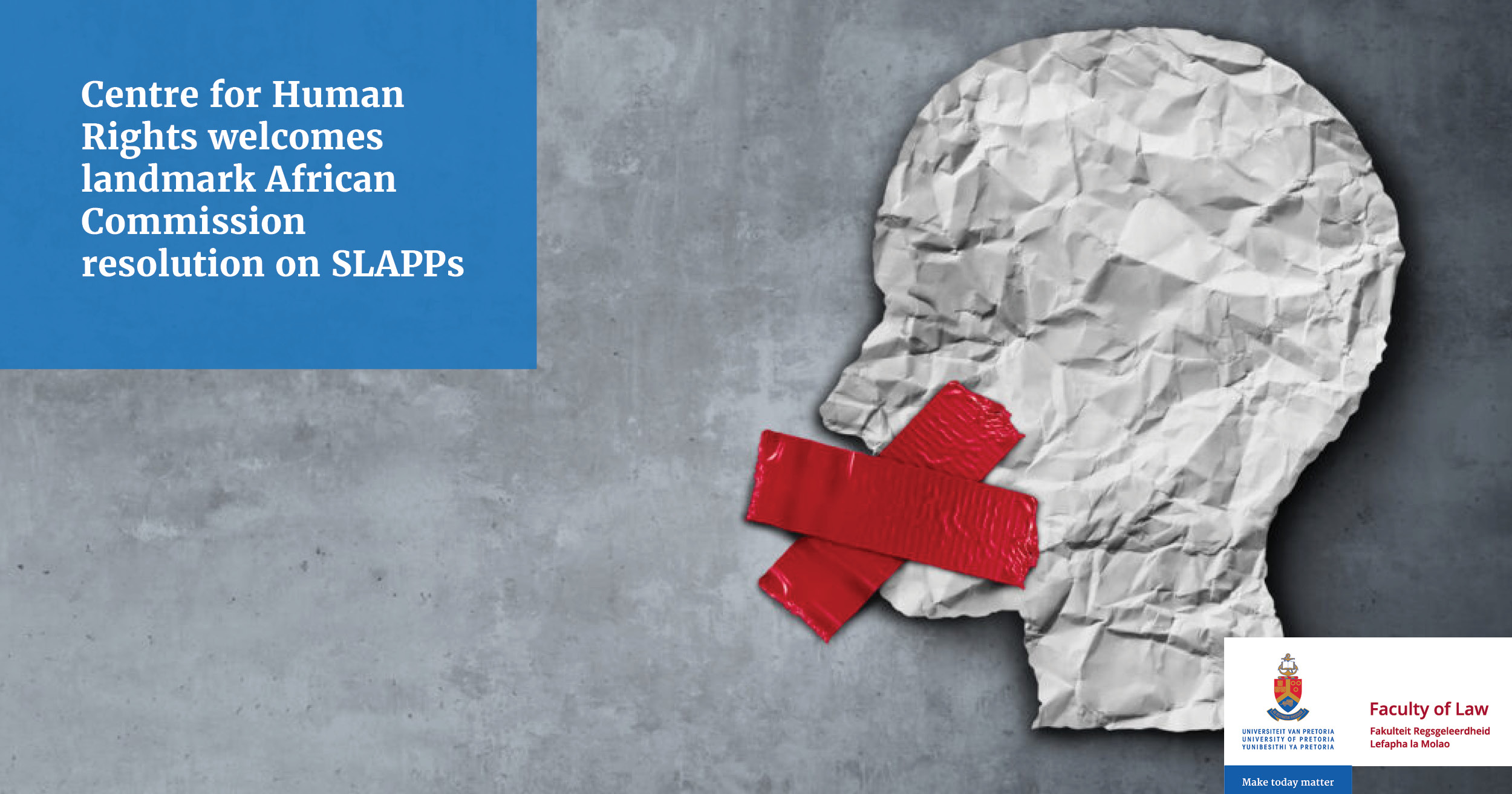
The Centre for Human Rights, Faculty of Law, University of Pretoria, welcomes the adoption by the African Commission on Human and Peoples' Rights of Resolution on the need to conduct a study on Strategic Litigation Against Public Participation (SLAPPs) in Africa. Resolution 667(LXXXVIII) was adopted during the 88th Ordinary Session of the African Commission, held virtually, from 17 to 31 July 2026.
The resolution is a landmark step in Africa’s response to the use of the judicial process to silence and exhaust those who speak out or act on matters of public interest. It builds on the Commission’s earlier work on participation rights, freedom of expression, access to information, criminal defamation, and judicial harassment, most importantly, Resolution 657 on Access to Information and the Right to a Healthy Environment, which addressed SLAPPs in the specific context of public participation in environmental matters. With Resolution 667, the Commission now treats SLAPPs as a broader threat to public participation.
It gives concrete expression to the problem by identifying those most vulnerable to such proceedings, namely human rights defenders, journalists, whistleblowers, community activists, lawyers and opposition figures, particularly ‘those pursuing advocacy for human rights, climate and environment, corruption, corporate accountability, labour rights, and sexual and gender-based violence’. It also highlights how human-rights-unfriendly laws relating to defamation, false news, insult, sedition, and harassment may facilitate such improper proceedings and deepen their insidious impact, particularly where those laws are broadly or vaguely worded or impose severe and disproportionate sanctions. Proceedings of this kind threaten the rights protected under the African Charter on Human and Peoples' Rights, which the resolution reaffirms, including access to justice and a fair trial, freedom of expression and access to information, association, assembly, and participation. They also undermine principles such as transparency and accountability, which other African Union treaties, as recalled by the resolution, are meant to uphold, including the African Charter on Democracy, Elections and Governance and the African Union Convention on Preventing and Combating Corruption.
The Centre welcomes the resolution’s pairing of the mandated study with measures it urges states to take immediately. It tasks the Special Rapporteur on Freedom of Expression and Access to Information in Africa and the Special Rapporteur on Human Rights Defenders in Africa with conducting a study on the nature and scope of SLAPPs in Africa, as well as the steps needed to address them. It does not, however, leave those at risk waiting for the study’s outcome. It urges states to investigate abusive litigation and hold those responsible to account; to tighten regulatory frameworks for legal practitioners and law firms; and to facilitate legal aid and assistance for vulnerable and financially disadvantaged SLAPP.
The Centre views the mandated study as a timely response to a growing yet under-documented problem in the region. While reports of the use and threat of SLAPPs are increasing across African countries, including South Africa, Eswatini, Cameroon, Lesotho, Morocco, DRC, Botswana, Zambia, Nigeria, Kenya, Zimbabwe, Sierra Leone, and Malawi, the evidence remains patchy, with a serious lack of systematic data. This partly explains the limited attention to SLAPPs and the protection gap across the region, where the only specific response is South Africa’s judicial recognition of a SLAPP defence under the common law rule against abuse of process. The study therefore offers an opportunity to build the evidence base for developing an anti-SLAPP response at national and regional levels.
Henok Ashagrey Kremte, a Project Officer with the Centre’s Expression, Information and Digital Rights Unit (EIDR) and a doctoral researcher on SLAPPs, said the study could move the discussion ‘beyond scattered evidence and place it on a stronger evidentiary and analytical footing’. ‘It could help map the scale of the problem, identify recurring patterns in how these cases are brought and pursued, and uncover the legal and procedural factors that may enable or constrain their use,’ he said. ‘It could also shed light on how, and to what extent, particular features of legal systems and judicial practice, alongside wider social, economic and political realities, may shape the use and impact of SLAPPs.
Such evidence, according to Henok, would be important for responses that reflect both regional trends and country-specific realities.
The Centre stresses that the effectiveness of any regional protection will ultimately depend on a careful synthesis of what the study reveals about shared regional realities and differences between national contexts, together with relevant comparative experience, including regional initiatives such as the European Union’s 2024 anti-SLAPP Directive and the Council of Europe’s 2024 Recommendation.
Wesley Mwafulirwa, a doctoral researcher on SLAPPs at the University of Cape Town, welcomed the proposed study and called it ‘a necessary first step’ towards such protection. ‘I hope it culminates in soft-law guidance at the continental level, of the kind the Commission has developed in cognate areas such as the Declaration of Principles on Freedom of Expression and Access to Information in Africa,’ he said.
The Centre emphasises, however, that the study should not be understood as a reason for states to delay action. States should not wait for the study to be completed. Resolution 667 already calls for investigations into the abusive use of court processes, stronger safeguards governing legal practitioners and better access to legal assistance for those targeted. States should therefore act immediately.
The Centre finally notes, with appreciation, the Commission’s call for stakeholders to cooperate with the two Special Rapporteurs. Drawing on its long engagement with the Commission and its special mechanisms, it stands ready to contribute to the study alongside other civil society organisations working on the issue. It will support the Commission in building the evidence base necessary to inform a stronger, rights-based continental response to SLAPPs.
For more information, please contact: