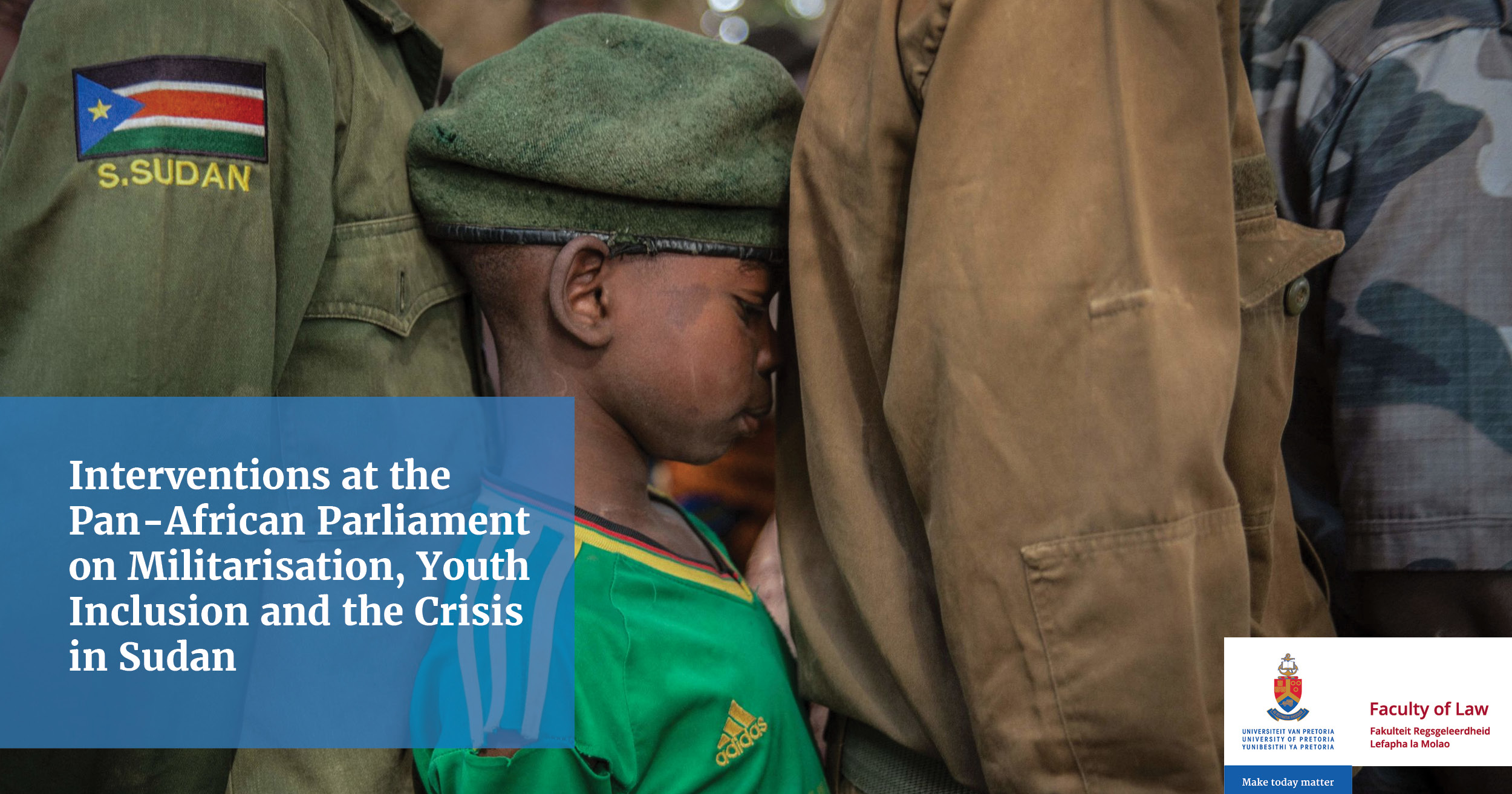
On 21 - 23 July 2026, the Centre for Human Rights, Faculty of Law, University of Pretoria, in partnership with the Open Society Foundation, delivered three interventions before sittings of the Pan-African Parliament’s permanent committees in Midrand, South Africa. The interventions returned to a common premise that the continent’s normative architecture on democracy, youth rights and conflict prevention already exists in considerable depth. What varies is what stands in its way on militarisation and youth, enforcement on Sudan, political will and the willingness to name the external actors sustaining the war.
The Impact of militarisation of politics on democracy and constitutionalism.
A popular phrasing in African political commentary is ‘coup contagion’, where a successful military takeover increases the likelihood of similar uprisings in regionally linked nations. State office is routinely treated as a prize to be captured, giving security institutions both grievance and pretext to intervene. Transitional charters in Mali, Burkina Faso and Niger have repeatedly extended military rule under a security rationale that has not been borne out, while Gabon reached the same destination by a different route: a 2023 change of government, then a new constitution and elections in April 2025. Three recurring origins of security-sector entrenchment were identified: party-security fusion, colonial-era security lineages, and liberation-movement command structures folded into civilian governance, each demanding distinct oversight. This sits within the continent’s third surge of coups since 2019, from Sudan’s removal of al-Bashir through Mali, Guinea, Chad, Burkina Faso, Niger, Gabon, and, in October 2025, Madagascar, framed not as evidence that Africa lacks rules against militarisation, but as evidence that existing rules go unapplied. An extensive legal framework already exists, spanning the Constitutive Act of the African Union (AU)’s Article 4(p) and Article 23 sanctioning power, the African Charter on Democracy, Elections and Governance, the Peace and Security architecture, the African Charter on Human and Peoples' Rights (the African Charter) and the Protocol on Amendments to the Protocol on the Statute of the African Court of Justice and Human Rights (Malabo Protocol). The Centre argued that the problem is implementation: sanctions, where they exist, are applied unevenly, eroding deterrence. The African Commission’s 2022 //africanlii.org/en/akn/aa-au/statement/resolution/2022-12-12/resolution-on-coup-detats-military-transitions-and-attendant-violations-of-human-and-peoples-rights-in-burkina-faso-guinea-mali-and-the-sudan/eng@2022-12-12">resolution on Burkina Faso, Guinea, Mali and Sudan catalogued the concrete costs: suspended constitutions replaced by unaccountable transitional charters, judges appointed and removed by military authorities, parliaments dissolved in favour of unelected councils, and civic space narrowed through banned parties and restricted movement.
The presentation noted that militarisation does not always arrive by tank. It can arrive through term-limit resets, poorly run elections and the technical disqualification of challengers, each of which can be defended individually as lawful when looked at on its own. It is only when these tactics recur, one after another, that a coercive logic becomes visible beneath the democratic surface. Two routes to this outcome were traced. The first works through constitutional amendments and referenda that remove or reset term limits, typically once security institutions have already signalled their alignment behind the incumbent staying in office, so that no direct intervention is ever required. The second works by shaping the competitive field before a vote is even cast: through the intimidation of opposition organisers, restricted rallies and movement, and a security presence heavy enough to narrow how freely people vote or organise, even where the resulting election survives formal legal challenge. Weak institutions can produce the same erosion of public trust without any coercive intent at all, through late results, under-resourced electoral commissions, opaque campaign financing, and parliaments or courts unable to hold power to account; incompetence, the Centre argued, can open the same door as manipulation. The Centre urged the Parliament to strengthen its early-warning role to flag governance risks before they escalate, establishing a continuous governance monitoring platform rather than relying on ad hoc reporting after a crisis hits, drafting a report on how well the African Union’s own anti-coup norms are being implemented, and reviewing its enforcement tools to give accountability standards a defined institutional home. On this basis, the Centre called on the Parliament to review the African Charter on Democracy, Elections and Governance and identify the provisions that need strengthening, a process to be taken up further with member states. It also proposed that states be required to disclose election information proactively and voluntarily, closing off exactly the kind of opacity around results, financing and process that this section identified as corrosive to public confidence in its own right.
Youth and democracy
The session opened by highlighting Africa’s demographic reality. Africa is home to approximately 532 million young people between the ages of 15 and 35, accounting for over one-fifth of the world’s youth population. More than 60 per cent of the continent’s population is under the age of 25, and the African Development Bank projects that Africa’s youth population will more than double by 2050. Despite this demographic advantage, one-third of young Africans are unemployed, another third is engaged in informal and insecure employment, and only one in six holds formal wage employment. The Centre observed that young people therefore represent both Africa’s greatest developmental asset and its most economically excluded constituency.
Against this backdrop, the Centre argued that unemployment, poverty and limited access to productive resources continue to undermine the potential of young people across the continent. While political liberalisation has expanded democratic institutions and electoral competition, these gains have not translated into corresponding improvements in the material conditions of young Africans. Instead, the benefits of democratisation have too often been captured through patronage networks rather than generating broad-based employment, entrepreneurship and economic mobility.
The discussion introduced the concept of “waithood” to describe the prolonged transition from adolescence to adulthood experienced by many young Africans. Persistent unemployment, poverty and structural inequalities prevent young people from attaining economic independence, establishing stable livelihoods and participating fully in the economy. As a result, many remain trapped between dependence and adulthood, unable to achieve the social and economic markers traditionally associated with adult life. The Centre argued that waithood is not merely a social phenomenon but a developmental challenge that delays wealth creation, constrains entrepreneurship and weakens young people’s confidence in democratic governance. The Centre therefore noted that Africa’s liberation cannot be measured solely by political independence, constitutional democracy or regular elections. Rather, liberation must also be reflected in the ability of democratic governance to improve livelihoods, reduce poverty and create meaningful economic opportunities for young people.
The Centre further argued that the African Continental Free Trade Area (AfCFTA) demonstrates what can be achieved where sufficient political will exists. Signed by 54 of the 55 African Union Member States, the Agreement is projected to generate approximately US$450 billion in additional income and create nearly 18 million jobs by 2035. However, the discussions emphasised that these economic opportunities cannot be fully realised while the movement of people remains legally constrained. The Centre, therefore, highlighted the importance of complementing the AfCFTA with the Protocol on Free Movement of Persons, Right of Residence and Right of Establishment, which would enable young Africans to move across participating states in search of employment, establish businesses, reside lawfully and access regional markets. They further noted that the AfCFTA Protocol on Women and Youth in Trade reinforces these objectives by requiring the progressive elimination of non-tariff barriers affecting women and youth in trade (Article 6), promoting access to affordable financial instruments and services for youth-owned enterprises (Article 10), strengthening productive and export capacity through education, training and integration into regional value chains (Article 11), and facilitating access to market intelligence and trade information to enable young traders to benefit from AfCFTA opportunities (Article 12). Together, these instruments provide the legal framework necessary to expand youth entrepreneurship, labour mobility and participation in continental trade. Despite this potential, the Protocol on Free Movement of Persons has been ratified by only four of the fifteen Member States required for its entry into force. The Centre, therefore, called on Member States to demonstrate the same political commitment shown towards the AfCFTA by accelerating ratification of the Free Movement Protocol.
The Centre further observed that Africa's challenge lies not in the adoption of continental commitments, but in addressing the implementation deficit that continues to undermine their effectiveness. Although the African Youth Charter marks its twentieth anniversary this year, it lacks a dedicated reporting mechanism through which Member States can be held accountable for implementing its commitments. This accountability gap was contrasted with the African Charter on Democracy, Elections and Governance, which requires periodic implementation reports from State Parties. However, despite 39 Member States having ratified the Charter, only Togo and Rwanda have complied with this reporting obligation.
Against this backdrop, the establishment of a Youth Caucus Network to work alongside the Pan-African Parliament Youth Caucus was welcomed as an important platform for coordinating youth engagement and advancing common priorities across the continent. The Centre further recommended that the Youth Caucus advocate for the ratification of the Protocol on Free Movement of Persons to unlock employment, education and entrepreneurial opportunities for young Africans. They also proposed the introduction of youth quotas within the Pan-African Parliament, modelled on the existing gender representation requirement that each Member State include at least one woman among its five parliamentary representatives, as a means of strengthening the representation and participation of young people in continental decision-making.
The war in Sudan and the limits of continental silence.
The framing of the war as a tribal conflict was firmly rejected: it is fundamentally a war of succession between the Sudanese Armed Forces (SAF) and the Rapid Support Forces (RSF), the two security pillars of the al-Bashir regime that jointly staged the 2021 coup before splitting over the sharing of power. The African Union was credited with two consistent achievements: refusing to lift Sudan’s suspension and refusing to recognise the RSF’s parallel administration, though this sat alongside an unsparing account of the SAF’s own record, which has fought almost exclusively against its own population. The central appeal was that Sudanese civilians have no champion on the continent, and that the African Union, not Gulf or Western mediators, is the only actor able to demand a ceasefire. The United Arab Emirates (UAE)’s financial and logistical support to the RSF was named directly, with a warning that continental reluctance to confront this was allowing African sovereignty and lives to go to the highest external bidder. Open-source evidence identified fourteen African states as logistical or financial conduits for the war, and traced mercenaries trained at a UAE facility through Somalia into Darfur, where they were present in El Fasher during atrocities the International Criminal Court (ICC) prosecutor has since linked to war crimes charges. Roughly two-thirds of SAF-linked gold is reportedly smuggled out through that same state, evidence that commercial interest now drives the war as much as ideology. Drone strikes by poorly trained foreign operators have separately been linked to more than 1,700 tracked civilian deaths. A call was made for a resolution condemning the UAE’s role, alongside a warning that the African Union-United Nations (AU-UN) joint fact-finding risks subordinating an autonomous African mechanism to external processes. The presentation closed by asking the Parliament to commit to an extraordinary sitting on Sudan later in 2026, and to use members’ influence to secure access to the African Union-African Commission on Human and Peoples' Rights (AU-ACHPR) fact-finding mission, which has so far been denied.
Taken together, these interventions demonstrate that Africa’s challenge is not the absence of legal and policy frameworks, but the implementation of the commitments that already exist. Whether addressing unconstitutional changes of government, youth exclusion or the conflict in Sudan, the Centre consistently argued that the relevant legal instruments, reporting obligations and enforcement mechanisms are already in place. What is required is sustained political will and institutional follow-through to translate these commitments into tangible outcomes.
It is within this context that the work of the Pan-African Parliament Civil Society Organisations (CSO) Forum assumes particular significance. The Forum provides an institutional platform through which civil society organisations, researchers and policy experts engage directly with the Pan-African Parliament, ensuring that evidence-based recommendations inform parliamentary deliberations and oversight. By facilitating structured dialogue with the Parliament’s permanent committees, strengthening civil society engagement and supporting advocacy for the implementation of African Union legal instruments, the Forum helps bridge the gap between continental norms and parliamentary action. These interventions therefore demonstrate the value of sustained collaboration between civil society and the Pan-African Parliament in advancing accountable governance, democratic constitutionalism and human rights across the continent.
For more information, contact:
Ms Bonolo Makgale
Programme Manager: Democracy and Civic Engagement Unit
+27 (0) 12 420 4199
bonolo.makgale@up.ac.za
Mr Neville Mupita
Researcher: Democracy and Civic Engagement Unit
neville.mupita@up.ac.za
Ms Yolokazi Mfuto
Project Officer: Democracy and Civic Engagement Unit
yolokazi.mfuto@up.ac.za