By Tendai Mbanje
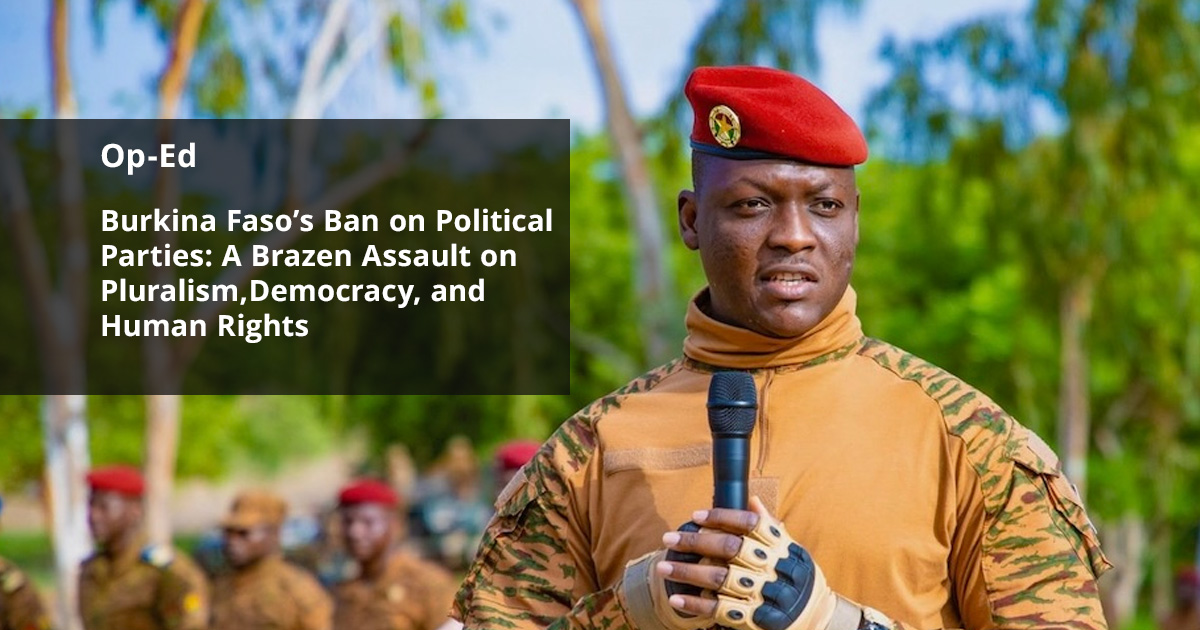
Citizens of Burkina Faso now endure life stripped of dignity, denied the rights to political participation, association, expression, and assembly. Under the self‑proclaimed pan‑Africanist Captain Ibrahim Traoré, the promise of liberation has curdled into repression. Once hailed as a defender of sovereignty, Traoré has become an oppressor to his own people, extinguishing freedoms and ruling through fear.
Burkina Faso’s military government, led by Captain Ibrahim Traoré has crossed a red line. The dissolution of all political parties, the scrapping of the laws that established them, and the seizure of their assets mark not only an authoritarian consolidation of power but also a grave violation of international human rights law. What the junta frames as “rebuilding the state” is, in reality, a wholesale assault on the basic rights of Burkinabè citizens to participate in public life.
This act represents the collapse of political pluralism, the erosion of democratic governance, and the denial of fundamental freedoms that modern civilisation regards as non‑negotiable. Far from being a saviour of Burkina Faso, Traoré has entrenched an authoritarian model of governance once rejected by societies committed to human dignity and common sense.
International human rights law is unambiguous. Article 25 of the International Covenant on Civil and Political Rights (ICCPR) guarantees every citizen the right to take part in public affairs, directly or through freely chosen representatives, and to vote and be elected at genuine periodic elections. The dissolution of political parties makes the exercise of this right impossible. Citizens cannot freely choose representatives if no parties exist to organise political competition. Similarly, Article 22 of the ICCPR enshrines the right to freedom of association, which explicitly includes the right to form and join political parties. By criminalising the very existence of parties, the Burkinabè junta has stripped citizens of this fundamental freedom. These violations are compounded by restrictions on freedom of expression under Article 19 of the ICCPR, as media outlets such as the BBC, Voice of America, and Human Rights Watch have been blocked, and critics have been forcibly conscripted into military service.
The African Charter on Human and Peoples’ Rights (ACHPR), to which Burkina Faso is bound, reinforces these protections. Article 10 guarantees the right to free association, while Article 13 affirms the right of every citizen to participate freely in the government of their country. The junta’s actions therefore represent not only a breach of universal human rights norms but also a betrayal of regional obligations under the African Charter. Furthermore, The African Charter on Democracy, Elections and Governance (ACDEG) further obliges member states to promote political pluralism and protect fundamental freedoms. Burkina Faso’s act of dismantling political parties has placed itself in direct violation of these commitments, undermining pluralism, democracy and human rights.
The rights violated extend far beyond political participation and association. The December 2023 constitutional change that placed the judiciary under Traoré’s supervision undermines judicial independence, violating Article 26 of the ACHPR, which requires states to guarantee the independence of the courts. Reports of forced conscription of journalists and judges, arbitrary detentions, and disappearances of opposition figures highlight violations of personal liberty under Article 9 of the ICCPR and Art 6 of the ACHR. The cascade of these human rights infringements illustrates how the ban on political parties is not an isolated act but part of a systematic dismantling of the civic and political space, and democratic institutions.
The implications of this decision extend far beyond Burkina Faso’s borders. The African Union (AU) and the Economic Community of West African States (ECOWAS) have long championed democracy and constitutional order as foundational principles. The AU’s Constitutive Act condemns unconstitutional changes of government, while the ECOWAS Protocol on Democracy and Good Governance prohibits substantial modifications of electoral laws that undermine democratic principles. Burkina Faso’s dissolution of political parties is a flagrant breach of these commitments. Yet the country’s withdrawal from ECOWAS, alongside Mali and Niger, and its formation of the Alliance of Sahel States (AES) signals a rejection of regional democratic oversight. This withdrawal undermines ECOWAS’s ability to enforce its standards and weakens the AU’s credibility as a guardian of democratic norms.
The international community faces a test of resolve. The United Nations Human Rights Committee, tasked with monitoring compliance with the ICCPR, must address Burkina Faso’s violations with urgency. Targeted sanctions, diplomatic pressure, and international advocacy are necessary to signal that the suppression of political rights will not be tolerated. Yet history shows that impunity often prevails. For instance, in Guinea, General Mamady Doumbouya seized power in 2021, restricted political activity, and later stood for election, winning by a landslide despite widespread concerns about fairness. In Mali, the military government has similarly curtailed political freedoms while extending its rule. These examples illustrate a troubling pattern: coups followed by restrictions on political parties and electoral institutions, with little accountability from regional or international bodies.
The human cost of these violations is deep. Citizens of Burkina Faso are stripped of their dignity, agency, denied the ability to shape their future through democratic means, and forced into silence or complicity. The promise of elections by 2024 has been postponed to 2029, effectively extending military rule for another five years. In the meantime, insecurity has worsened. It is reported that armed groups linked to al‑Qaeda and ISIL now control about 40-60 percent of Burkina Faso’s territory. Fatalities are reported to have tripled since Traoré took power, with both jihadist groups and the Burkinabè military accused of atrocities against civilians. Human Rights Watch has documented massacres by jihadist groups in northern towns, as well as killings by the Burkinabè military and allied militias, including the deaths of 223 civilians in early 2024. The junta’s narrative that political parties foster division and corruption cannot justify the wholesale denial of rights. Corruption and fragmentation are challenges to be addressed through reform, transparency, and accountability, not through authoritarian decrees.
The use of propaganda further illustrates the dangers of authoritarian entrenchment. Media reports that Traoré has cultivated a cult‑like following through AI‑generated videos that portray him as a pan‑Africanist visionary, likened by supporters to the late revolutionary leader Thomas Sankara. This digital manipulation, combined with anti‑colonial rhetoric and the expulsion of French troops in favor of Russian security support, has bolstered his popularity among some constituencies. Yet popularity cannot substitute for legitimacy. Genuine legitimacy arises from free and fair elections, respect for rights, and adherence to the rule of law.
Burkina Faso’s trajectory is a cautionary tale for the future of human rights. It demonstrates how authoritarian regimes exploit insecurity to justify repression, how regional institutions struggle to enforce democratic norms, and how the international community often fails to hold violators accountable. If left unchecked, the Burkinabè precedent could embolden other regimes to dismantle political pluralism under the guise of stability. The AU’s silence or inaction would erode its legitimacy and betray its commitment to democracy. The international community’s failure to respond decisively would reinforce a culture of impunity, where human rights violations are tolerated in the name of geopolitical expediency.
The crossroads at which Burkina Faso stands is emblematic of a broader crossroads for human rights in Africa. Will the continent uphold the principles enshrined in the ICCPR, the ACHPR, and the ACDEG, or will it allow authoritarianism to erode decades of progress? The answer will shape not only the future of Burkina Faso but also the trajectory of democracy and human rights across the region.
In conclusion, the dissolution of political parties in Burkina Faso is a violation of international human rights law, regional commitments, and the fundamental principles of democracy. It infringes upon the rights to political participation, association, expression, assembly, and creating a civic vacuum where authoritarianism flourishes. The African Union and ECOWAS must respond with wisdom, lest their silence normalise and deepen the erosion of democratic governance in West Africa. The international community should not only remain concerned but act. Burkina Faso’s future remains deeply uncertain. The rights enshrined in international treaties are not abstract ideals, they are lifelines for citizens whose voices must be heard, whose freedoms must be protected, and whose future must not be sacrificed at the altar of authoritarian expediency. The world must not stand by as democracy is extinguished in Ouagadougou. To do so would be to accept impunity, to abandon human rights and to betray the very principles upon which the international order is built.
About the author:
Tendai Mbanje is a distinguished governance and elections scholar, widely recognised for his expertise in African electoral processes. His research and professional contributions focus on the role of the African Union and African Regional Economic Communities in fostering credible, transparent, and legitimate elections across the continent. Through his work, he critically examines the institutional frameworks and normative standards that underpin democratic governance in Africa. Mbanje writes in his personal capacity, offering independent insights informed by both academic rigor and practical experience.