
By Rotondwa Mashige, LLD candidate and Acting Manager of the Children’s Unit, Centre for Human Rights, University of Pretoria
Every 12 June, the international community observes World Day Against Child Labour to raise awareness and activism to prevent this scourge. South Africa isn’t exempt from the problem of child labour, which is unequivocally a violation of fundamental rights, and serves as a clear indication of a society fractured by poverty-driven vulnerability and economic inequalities.
Despite the constitutional guarantees and legal frameworks designed to protect children from exploitative and hazardous work, millions continue to be at risk of child labour. When poverty and inequality collide, they pose an immediate threat to a child’s fundamental rights, trading the right to a safe childhood for mere survival.
In South Africa, poverty acts as a relentless, exclusionary force, with over 51% of children living below the lower-bound poverty line, and more than 37% existing below the food poverty line as of October 2025. This stark reality means that millions of children go to bed hungry, rendering them inherently vulnerable to economic exploitation. According to recent data from Statistics South Africa, the national unemployment rate stands at an alarming 32.7%, and child labour spikes drastically in households where adults are jobless. With adults unable to find work, children are forced into the informal economy as substitute providers, taking on the financial burden caused by structural poverty and inequality.
South Africa ranks as one of the most unequal countries in the world, and this inequality directly correlates with the prevalence of child labour, which is deeply entrenched along economic lines. Children facing multiple vulnerabilities are overwhelmingly located in rural areas and historically under-resourced provinces like the Eastern Cape, KwaZulu-Natal and Limpopo. In these and other regions, children are often drawn into child labour and exploitation in the artisanal mining, agricultural and hazardous informal trade context to support their families.
Furthermore, the spatial segregation that has persisted since the end of apartheid has resulted in severely underfunded schools in impoverished provinces, rural areas and townships. When educational institutions are difficult to access or fail to provide a path out of poverty, families are left with no choice but to withdraw their children from classrooms and place them in the workforce. The distribution of labour is also gendered, with boys primarily visible in agriculture, informal construction or commercial transportation, while girls are disproportionately pulled into domestic work, informal child-minding or commercial sexual exploitation, often keeping their vulnerabilities hidden from view.
The intersection of child labour and inequality creates an unending cycle that stifles social mobility and perpetuates historical disadvantages. Child labour directly undermines education, leading to high rates of absenteeism and dropout, particularly in rural areas and townships. This results in a generation of adults barred from participating in the formal, skills-driven economy of South Africa. Additionally, the loss of foundational literacy and technical skills perpetuates a youth labour market where the majority of individuals aged 15 and older are unemployed. The intergenerational trap created by child labour exacerbates the cycle of poverty, as individuals enter adulthood accepting low-wage, unprotected informal jobs to meet immediate food needs, only to raise their own families in similar circumstances.
To effectively eradicate child labour, South Africa must move beyond mere legal prohibitions and actively confront the economic engines that drive this exploitation. The government must significantly scale up the Child Support Grant to align with real food inflation rates, eliminating the desperate reliance families have on their children's earnings. Funding must be intentionally redirected to revamp schools in the poorest provinces, ensuring safe transport for scholars, proper infrastructure and effective feeding schemes to reduce dropout rates. Furthermore, a concentrated effort is imperative to intensify the Department of Employment and Labour's multi-departmental inspections, especially in areas where there is a high incidence of child labour, to enforce the framework aimed at preventing and eliminating it.
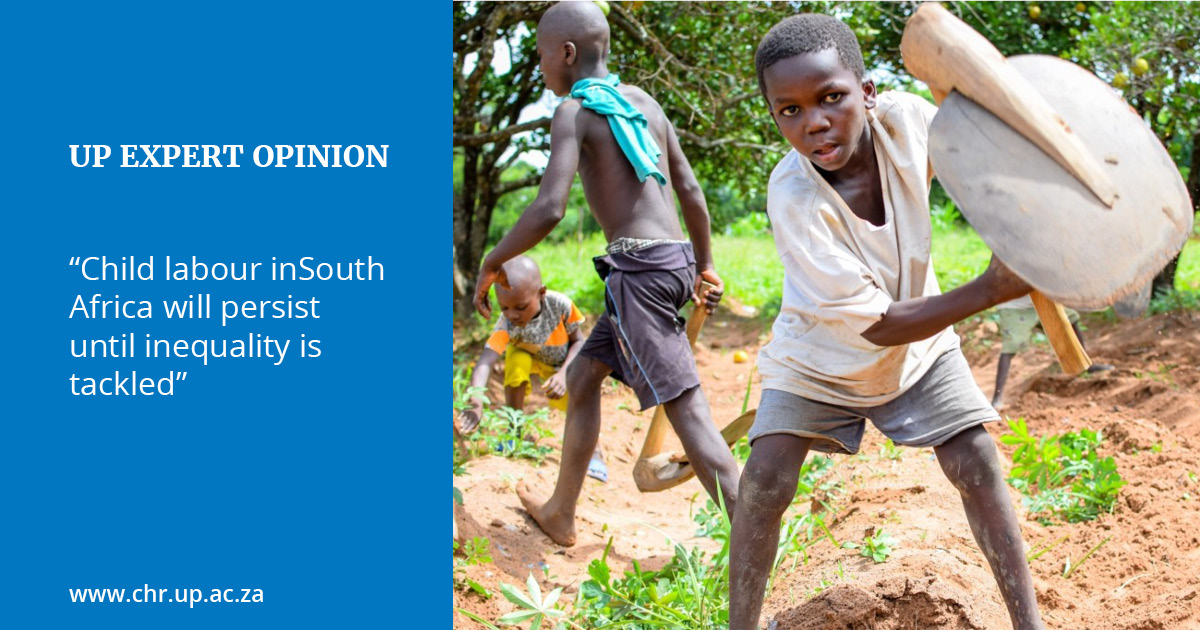
Child labour in South Africa will persist until the country decisively tackles the inequality that makes such exploitation a grim necessity for survival. Until our economic structures effectively protect the vulnerable, the promises of the Constitution remain empty for our most at-risk citizens.
Disclaimer: The opinions expressed in this article are solely those of the author and do not necessarily reflect the views of the University of Pretoria.