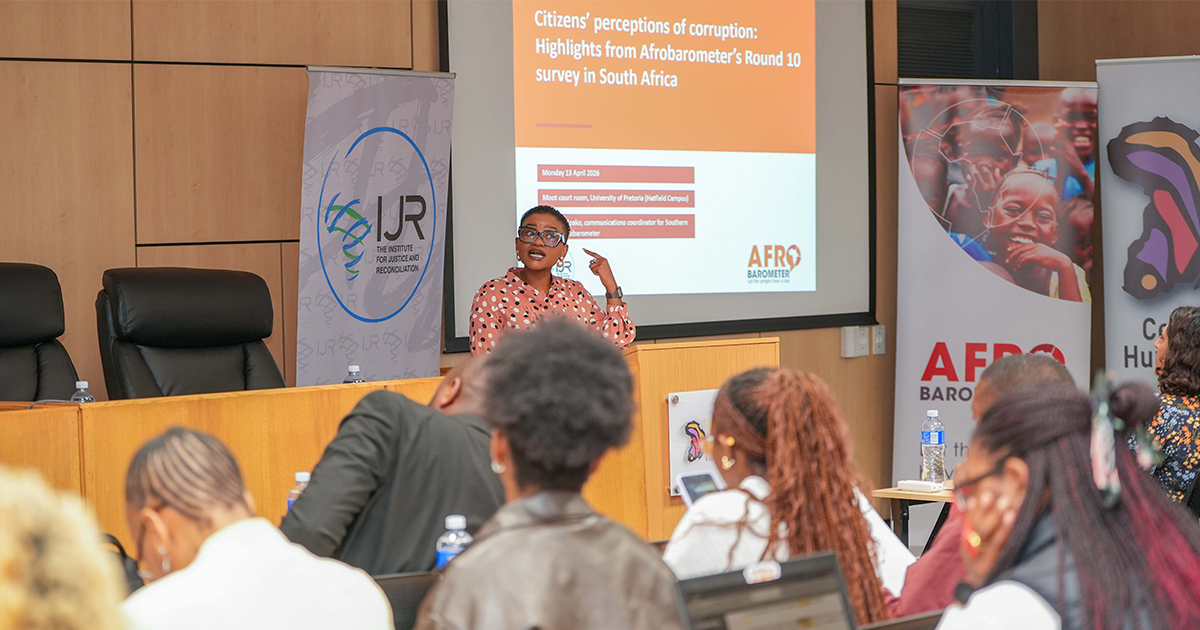
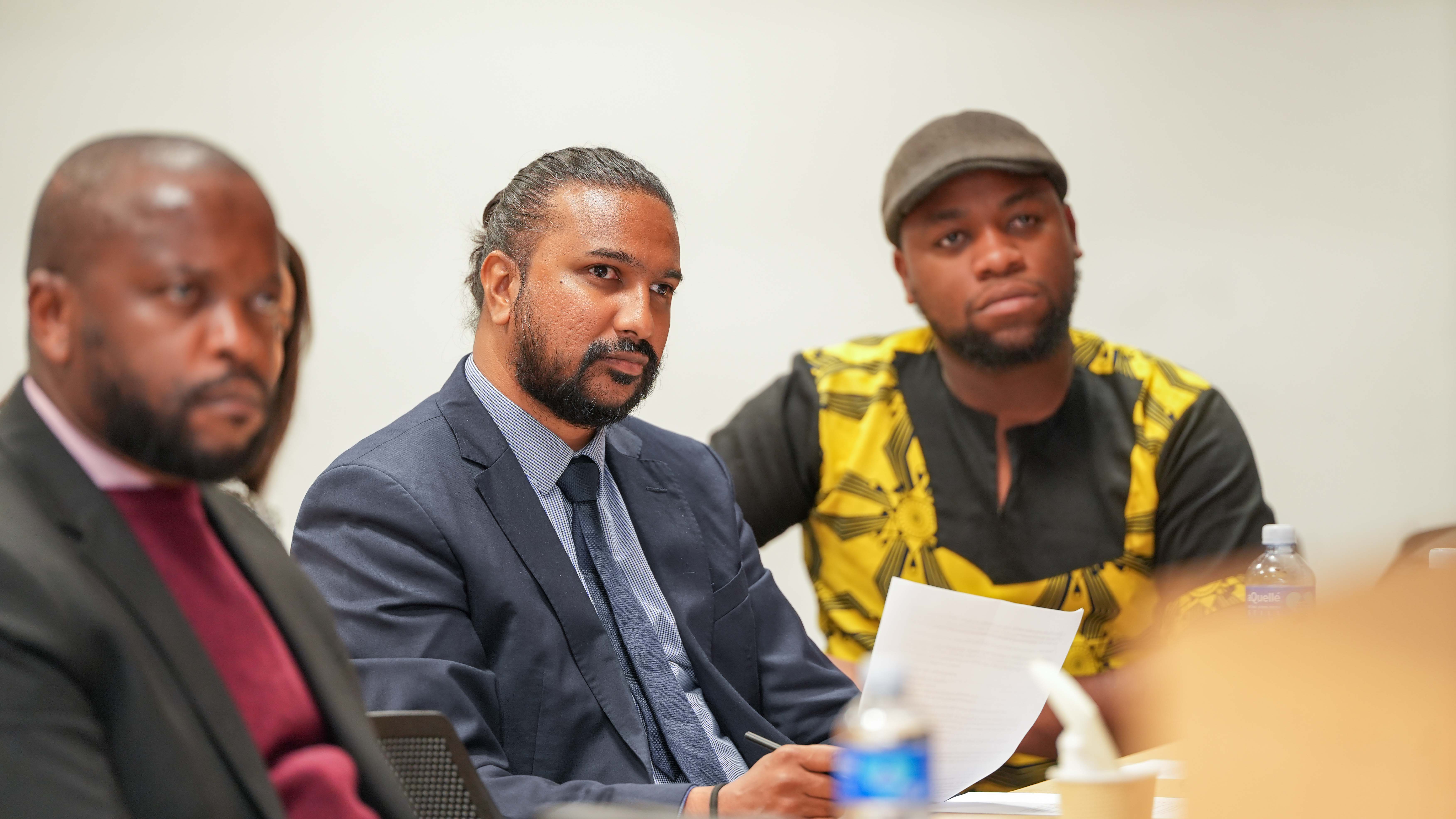
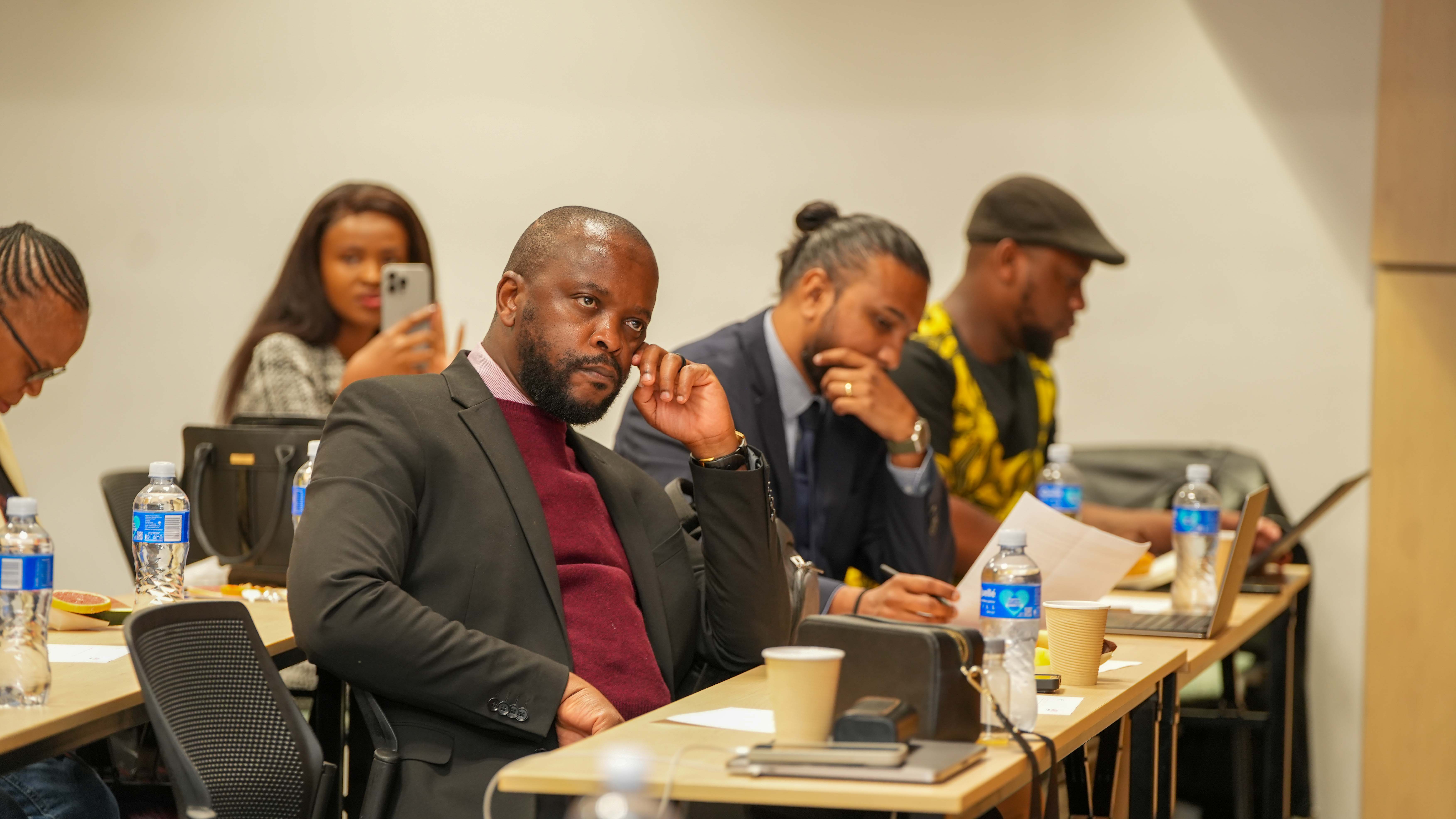
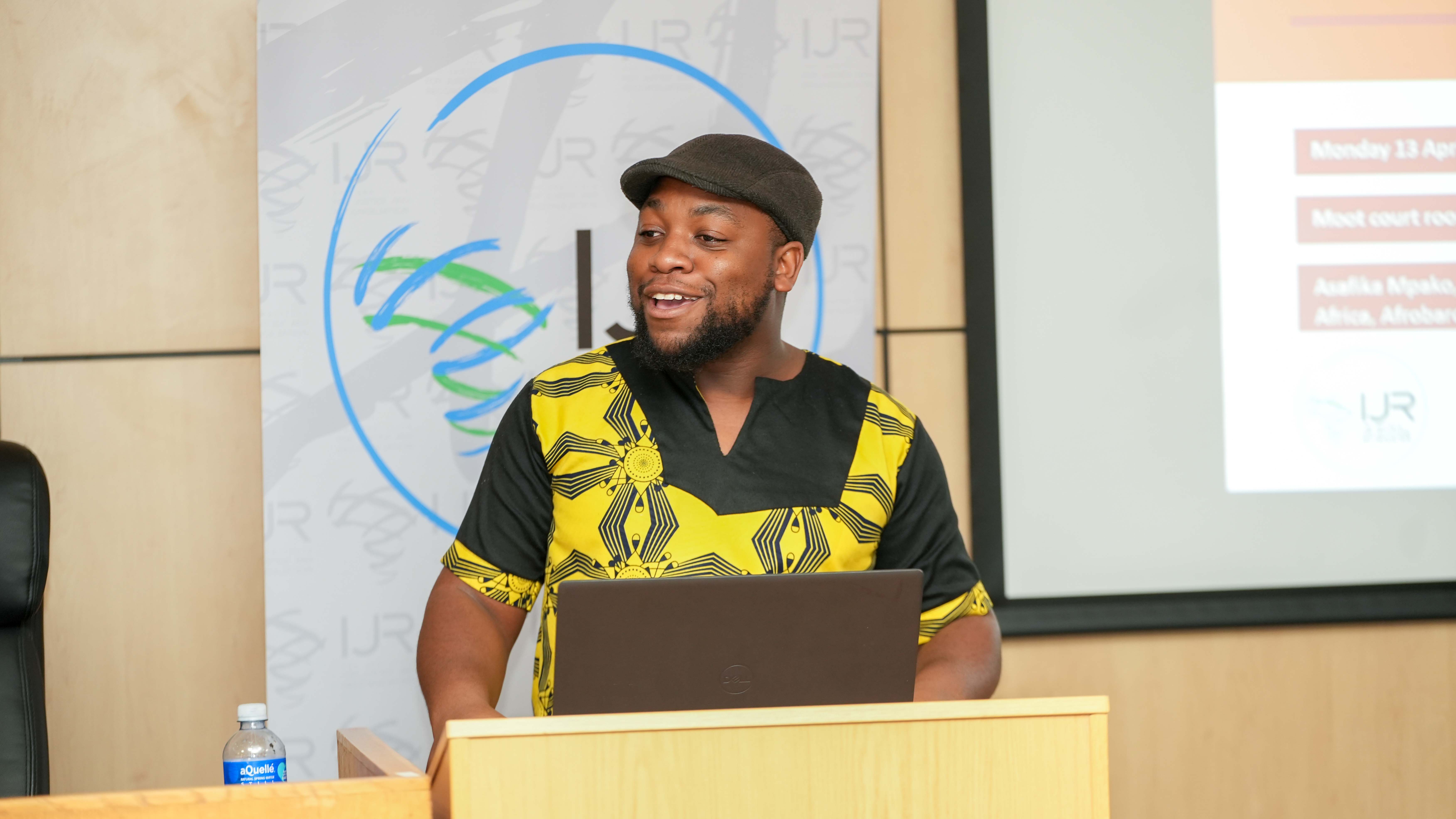
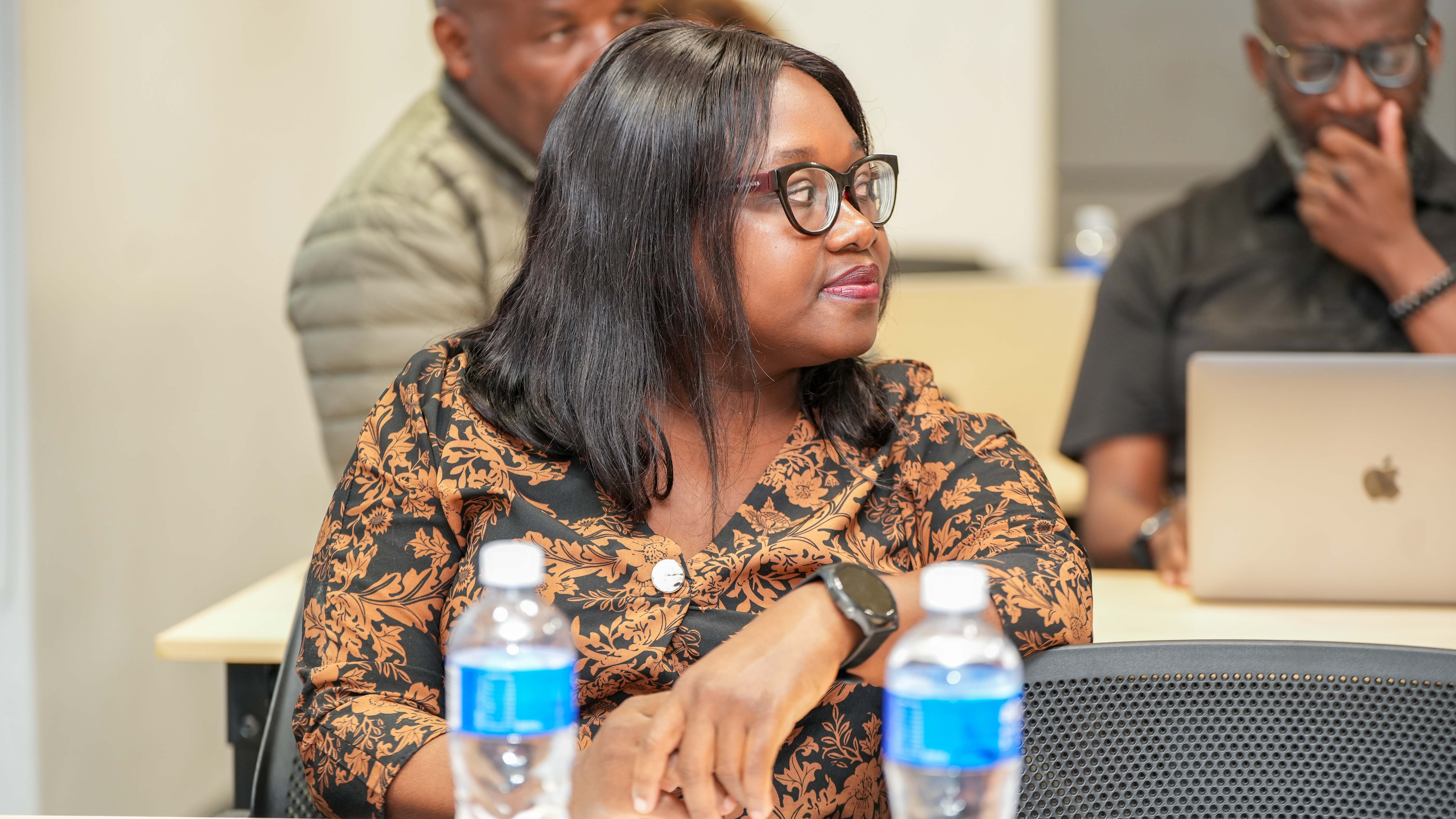
On 13 April 2026, the Centre for Human Rights at the University of Pretoria, in collaboration with Afrobarometer and the Institute for Justice and Reconciliation, convened a public briefing to present the results of the 2025 Afrobarometer survey in South Africa. Held at the University's Hatfield campus, the event brought together civil society actors, legal practitioners, and researchers to examine the systemic challenges of corruption and their implications for the country's democratic trajectory.
Opening the session, Neville Mupita, Researcher in the Democracy and Civic Engagement (DCE) Unit at the Centre, grounded the discussion in lived realities. He emphasised that corruption should not be understood as an abstract concept, but as a concrete phenomenon that directly shapes the quality of public services, including schools, healthcare, and infrastructure. Mupita emphasised that the event's significance lay in its use of empirical evidence reflecting the lived experiences and perceptions of citizens across the country.
Building on this foundation, Bonolo Makgale, Programme Manager in the DCE Unit, extended this analysis by addressing the deeper question of what the data reveal about the state of South African democracy. She argued that liberal democracy is founded on core commitments: transparency in the exercise of power, the use of public resources for the public good, and accountability for those who abuse public trust. While South Africa formally embraced these principles in 1994, she noted that corruption has since become deeply entrenched. In her view, corrupt actors have appropriated the language of accountability while systematically undermining its substance, often exploiting transformation processes for personal gain.
Makgale characterised this trend as indicative of a profound democratic crisis. Each act of corruption, she argued, constitutes a violation of the social contract underpinning South Africa’s constitutional democracy. Resources diverted from essential services represent broken promises to citizens, while compromised institutions erode public confidence in democratic governance.
This erosion of legitimacy was further contextualised through reference to the Madlanga Commission, established to investigate corruption and maladministration within the South African Police Service (SAPS). Makgale highlighted the gravity of this development, noting that corruption within law enforcement institutions signals a deeper institutional crisis. When agencies tasked with upholding the law themselves require investigation, the credibility of the state is fundamentally undermined.
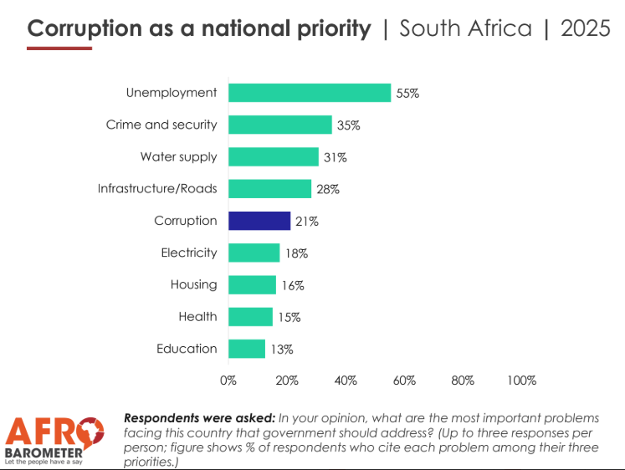
The empirical core of the briefing was presented by Preston Govindasamy, Project Manager at Afrobarometer, and Asafika Mpako, Communications Coordinator for Southern Africa. Their analysis revealed that 92% of South Africans believe the government is performing poorly in its fight against corruption – the lowest rating among 38 surveyed African countries. Corruption ranks as the fifth most pressing national concern, following unemployment, crime, water supply, and infrastructure.
 The survey further revealed widespread perceptions of corruption across key institutions, including the Presidency, Parliament, and the police. Of particular concern is the climate of fear reflected in the data: 83% of respondents believe that ordinary citizens risk retaliation if they report corruption, representing a 20-percentage-point increase since 2018. These findings, Govindasamy noted, signal a critical weakening of democratic accountability, as citizens increasingly perceive that they cannot safely challenge wrongdoing.
A panel discussion, moderated by Yolokazi Mfuto, Project Officer in the DCE Unit, brought together representatives from Democracy Works Foundation (DWF), Corruption Watch, and the Platform to Protect Whistleblowers in Africa (PPLAAF). The panel emphasised that the risks faced by whistleblowers extend beyond professional consequences, noting a documented rise in targeted killings of individuals exposing corruption.
The panellists further highlighted the interconnected nature of South Africa's key national challenges. While corruption ranks fifth among public concerns, it was described as a structural driver underpinning unemployment, crime, infrastructure failures, and service delivery deficits. The panel argued that greater public awareness of these linkages could significantly elevate the prioritisation of anti-corruption efforts.
Attention was also drawn to disparities between urban and rural experiences of corruption, with limited access to information in rural areas shaping both perception and reporting. Local government was identified as a critical yet under-scrutinised site of corruption, where weak oversight mechanisms and limited civic engagement contribute to accountability gaps.
Compounding this, the documented rise in whistleblower assassinations since 2018 was identified as having a measurable chilling effect on the willingness of ordinary citizens to come forward with information. Together, these dynamics point to a deepening accountability vacuum at the community level.
Concerns were also raised regarding declining public trust in the justice system. With public confidence in judges and magistrates appearing increasingly divided, panellists stressed the importance of enhancing transparency in judicial appointments as a means of restoring institutional legitimacy.
In closing, Yolokazi Mfuto made a decisive call for action, reaffirming that data must serve as a tool for accountability and reform. She underscored the importance of the nexus between law, politics, and public administration, noting that these conversations are essential to prevent the normalisation of state failure.
The briefing concluded with a consensus that South Africa requires visible consequences, institutional reform, and robust protection for whistleblowers. If the democratic state cannot persuade its citizens that it is capable of self-correction, the danger is no longer merely the theft of resources, but the eventual demise of democratic legitimacy itself.
For more information please contact:
Ms Bonolo Makgale
Programme Manager: Democracy and Civic Engagement Unit
+27 (0) 12 420 4199
bonolo.makgale@up.ac.za
Ms Yolokazi Mfuto
Project Officer: Democracy and Civic Engagement Unit
yolokazi.mfuto@up.ac.za
Mr Neville Mupita
Researcher: Democracy and Civic Engagement Unit
u18060120@tuks.co.za