Group leaders:
Norman Taku
Eric Lwanga
The task of this Clinic is to:
- Produce a short documentary film on a human rights theme, to be used as an advocacy tool.
- Conceptualise the documentary project; research the topic; write a storyboard; make contacts with subjects and plan recording and interviews.
- Record film sequences; edit and compile into a logical sequence; write a narrative and do a voice-over recording; do final editing.
- Organise a formal launch for the documentary, including an expert guest speaker; introduce the documentary and facilitate a discussion afterwards; develop a plan for using the documentary as an advocacy tool.

'Changing Lenses: A Short Film about Youth Empowerment' is aproject of the Centre for Human Rights at the University of Pretoria, in collaboration with Umuzi Photo Club; as part of the LLM programme in Human Rights and Democratisation in Africa 2012, funded by the European Union, DAAD, the Dutch Government an OSISA. Filmed and edited by Adam Heyns. Directed and produced by Benedicta Armah, Josua Loots and Marina Lourenço da Cunha.
Group leader:
Magnus Killander
This group will gather information about human rights developments in Africa (both positive and negative) and post analysis of these developments on the Centre web site and the Africlaw blog. The group may also contribute to press releases, opinion pieces in newspapers and letters to alleged perpetrators of human rights violations. The group will also follow developments in the UN and regional human rights systems.
Group leader
Melhik Bekele
The tasks of the clinic in 2013 are:
- Prepare at least one shadow report on a state report submitted for the next session of the African Commission.
- Prepare a civil society Universal Periodic Review report on one African country.
- Prepare a briefing report for the African Commission’s Working Group on Socio-Economic Rights.
Group leader:
Ally Possi
The tasks of the clinic in 2013 are:
- Prepare and submit a communication to the African Court or sub-regional Court on any appropriate matter.
- Follow-up on case already submitted to the ECOWAS Court and the amicus submission submitted to the African Court.
ECOWAS Documents
 Initial submission by RADDHO [EN]Initial submission by RADDHO [FR]Application for expedited procedures [FR]Response of the state of Senegal [FR]Anticipated response and further arguments by RADDHO [FR]
African Court Documents
Statemennts
First statement
ECOWAS Court adjourns Senegal case for hearing on 4 May 2012
Third statement: ECOWAS Court to rule on preliminary objection in Senegal election case
Group leader:
Adem Abebe
The tasks of the clinic in 2013 are:
- Prepare and submit a communication to the African Commission based on the provisions of the Protocol to the African Charter on the Rights of Women in Africa.
- Prepare and submit a communication to the African Commission on any relevant matter.
- Follow-up on the communication submitted to the African Commission.
Documents
Provisional Measures under Rule 98 of the Rules of Procedure of the African Commission on Human adn Peoples' Rights
Request for Provisional Measures under Rule 98 of the Rules of Procedure of the African Commission on Human adn Peoples' Rights
Communication to the African Commission on Human and Peoples' Rights in the matter between the Centre for Human Rights (on behalf of David Mendes) (The Victim) and The Republic of Angola (The Respondent)
Statements
Centre for Human Rights submits complaint against Angola to the African Commission, requesting for Provisional Measures to protect David Mendes
Coordinator
The tasks of the clinic in 2014 include:
- Provide research support to the UN Special Rapporteur on the situation of human rights in Eritrea for her report that she will deliver to the UN Human Rights Council (UN HRC) in June 2014. This will include drafting a legal opinion on national service and detention conditions in Eritrea.
- Develop a research document on the situation of children in Eritrea, this will provide support to the SR Eritrea’s submission to the UN Committee on the rights of the Child.
- The Centre will host an event at the 55th Ordinary Session of the African Commission on Human and Peoples' Rights, were it will launch a report on Freedom of Expression in Eritrea. The group will provide support for this event by developing a flyer to launch the event and invitation letter to be sent to various stakeholders.
- Develop a strategy on how best to create more awareness on Eritrea’s Universal Periodic Review (UPR)
Coordinator
The tasks of the clinic in 2014 include:
- Comments on regulations in relation to community rehabilitation, see http://www.khulumani.net/reparations/government/item/913-submission-made-by-centre-for-human-rights-in-respect-of-draft-regulations-for-community-rehabilitation.html
- Provide research for a compendium of legislation and case law related to extractive industries
Coordinators:
- Contribute to a paper on possible litigation under article 21 of the African Charter on Human and Peoples' Rights prepared for Open Society Justice Initiative
- Ad hoc research for the African Court on Human and Peoples' Rights
- Follow up on cases submitted by the Centre for Human Rights and its partners to the African Commission, African Court, African Children's Committee and ECOWAS Court
- Prepare new cases for submission to these bodies
Cases
Decided
Michelo Hunsungule & Others (on behalf of children in Northern Uganda) against Uganda
Documents
Complainants submission on the meritsDecision on the admissibilityComplainants communication
Documents
Provisional Measures under Rule 98 of the Rules of Procedure of the African Commission on Human adn Peoples' RightsRequest for Provisional Measures under Rule 98 of the Rules of Procedure of the African Commission on Human adn Peoples' RightsCommunication to the African Commission on Human and Peoples' Rights in the matter between the Centre for Human Rights (on behalf of David Mendes) (The Victim) and The Republic of Angola (The Respondent)
Pending
ECOWAS Documents
Initial submission by RADDHO [EN]Initial submission by RADDHO [FR]Application for expedited procedures [FR]Response of the state of Senegal [FR]Anticipated response and further arguments by RADDHO [FR]
Statements
First statement
ECOWAS Court adjourns Senegal case for hearing on 4 May 2012Third statement: ECOWAS Court to rule on preliminary objection in Senegal election case
Request for advisory opinion by Socio-Economic Rights and Accountability Project (African Court on Human and Peoples' Rights
African Court Documents
Senegalese talibes v Senegal (African Committee on the Rights and Welfare of the Child)
Documents (2014)
Submissions of the government of Senegal to the African Committee [FR]Summary of the proceedings concerning the talibés caseResponse from the State of Senegal
Coordinators
The tasks of the clinic in 2014 include:
- Prepare a shadow report on the state report of Uganda to the African Commission on issues related to HIV
- Prepare an academic article on negligent transmission of HIV
- Research on confidentiality and age of consent
Position Paper on the negligent transmissionof HIV
Guilty in the Eyes of the Public: ‘The Case of Ms. Rosemary Namubiru in Uganda’
Download the Position Paper on the negligent transmission of HIV
The intentional and negligent exposure of HIV transmission has increased willingness to extend liability on tort. This is due to the skyrocketing infection rates for Sexually Transmitted Diseases (STDs) which have reached epidemic proportions. To this end, more than half of African states have criminalised transmission and exposure of STDs including HIV by having specific laws on HIV or through provisions in general laws. The case of Ms. Rosemary Namubiru in this paper brings to focus once again not only the injustices that may derive from legislation criminalizing HIV transmission but also how public sentiment may be manipulated to perpetuate stigmatisation and exclusion and thus derail the path of justice.
The focus of this paper is on Uganda and section 171 of the Penal Code of the country, which makes it an offence to expose others to a disease dangerous to life. This paper is presented in four sections. Section 1, the current section, is the introduction. Section 2 covers negligent transmission of HIV where section 171 of the Ugandan Penal Code Act 120 Laws of Uganda is juxtaposed to the international standards on HIV as well as a discussion on the rights of the accused. Section 3 is a synopsis of the implication of Namubiru’s case for other people living with HIV and AIDS (PLWHAs) and section 4 is the conclusion.
LLM/MPhil students launch HIV information tool in Hammanskraal
The Centre for the Study of AIDS (CSA) in collaboration with the University of Pretoria runs a para-legal advice bureau for people living with HIV/AIDS in Hammanskraal. The bureau is called The Place and it offers HIV related information along with structural assistance to Thulani Mvula, a community-based HIV activist and support group coordinator.
Thulani’s vision is to empower people living with HIV to live full and healthy lives and not to internalise the discrimination that they face on a daily basis. He says that the people he works with are not aware of their rights and thus cannot defend themselves against unfair treatment. The Place also expressed the view that the HIV positive community is not aware of the legal and other services available to them.
Following a needs assessment with Thulani and officers of The Place, three students from the LLM/MPhil in Human Rights and Democratisation in Africa programme decided to compile an HIV information pamphlet for the Hammanskraal community. The pamphlet was printed in both English and in Setswana, the local language. It sets out the basic legal rights which people living with HIV/AIDS enjoy in the healthcare and employment settings as well as information on the process for applying for a social grant. The pamphlet also contains the contact details of service providers of concern to people living with HIV/AIDS in the Hammanskraal area.
The pamphlet was launched on 22 May 2013 at one of the support group meetings that Thulani hosts at the Jubilee clinic. It will be useful to the members of the support group in understanding their rights and in reaching out to other members of the community suffering from HIV/AIDS.
Download the HIV/AIDS pamphlet [EN]Download the HIV/AIDS pamphlet [Setswana]
Group leaders:
Christof Heyns & Romi Brammer
The tasks of the clinic in 2014 include:
- Participate in right to life seminars
- Assist in undertaking research on the use of force and the right to life
- Prepare shadow reports on state reports to the African Commission related to the right to life
Group leader:
Romola Adeola
The tasks of the clinic in 2014 include:
- Draft a country report on Botswana for the African Yearbook on Disability Rights
- Prepare a shadow report on the Uganda state report to the African Commission related to disability rights
- Draft a moot court question for the disability rights moot court
- Develop a database on disability rights
Group leader:
Lola Shyllon
The tasks of the clinic in 2014 include:
- Prepare shadow reports on the state reports of Liberia and Mozambique to the African Commission on issues related to freedom of expression and informartion
- Draft a paper on the Ghanaian freedom of information bill
- Update the annual report on the status of access to information in Africa
Group leader:
Remember Miamingi
The Children’s Rights Clinical Group is a platform for individuals who are passionate about and committed to the promotion and protection of the rights and welfare of the child.
The tasks of the clinic in 2014 include:
- Follow up on draft communication related to children accused of witchcraft in West Africa
- Prepare a new case for submission to the African Court on children's rights in collaboration with the litigation group
- Prepare an academic article related to child domestic work
Documents
Summary of the proceedings concerning the talibés caseResponse from the State of Senegal
Group leader:
Remember Miamingi
The Children’s Rights Clinical Group is a platform for individuals who are passionate about and committed to the promotion and protection of the rights and welfare of the child.
The tasks of the clinic in 2013 include:
- Follow up on draft communication related to children accused of witchcraft in West Africa
- Prepare a new case for submission to the African Court on children's rights in collaboration with the litigation group
- Prepare an academic article related to child domestic work
Documents
Group leader:
Ademola Oluborode Jegede
The Children’s Rights Clinical Group is a platform for individuals who are passionate about and committed to the promotion and protection of the rights and welfare of the child.
The tasks of the clinic in 2012 include:
- Follow up on draft communication related to children accused of witchcraft in West Africa
- Prepare a new case for submission to the African Court on children's rights in collaboration with the litigation group
- Prepare an academic article related to child domestic work
Documents
Communication to The African Committee on the Rights and Welfare of the Child (English)Communication to The African Committee on the Rights and Welfare of the Child (French)Letter to the Committee (English)Letter to the Committee (French)
Coordinators:
Ms Karen Stefiszyn
Ms Ashwanee Budoo
The task of the clinic in 2014 include:
- Assistance to the African Commission’s Special Rapporteur on Women.
- Prepare a draft general comment on article 6(B) of the African Women's Rights Protocol
- Prepare a shadow report on Malawi's state report to the African Commission on Human and Peoples' Rights in relation to women's rights
- Develop the gender unit's web site so that it becomes a main resource for anyone looking for information on women's rights in Africa
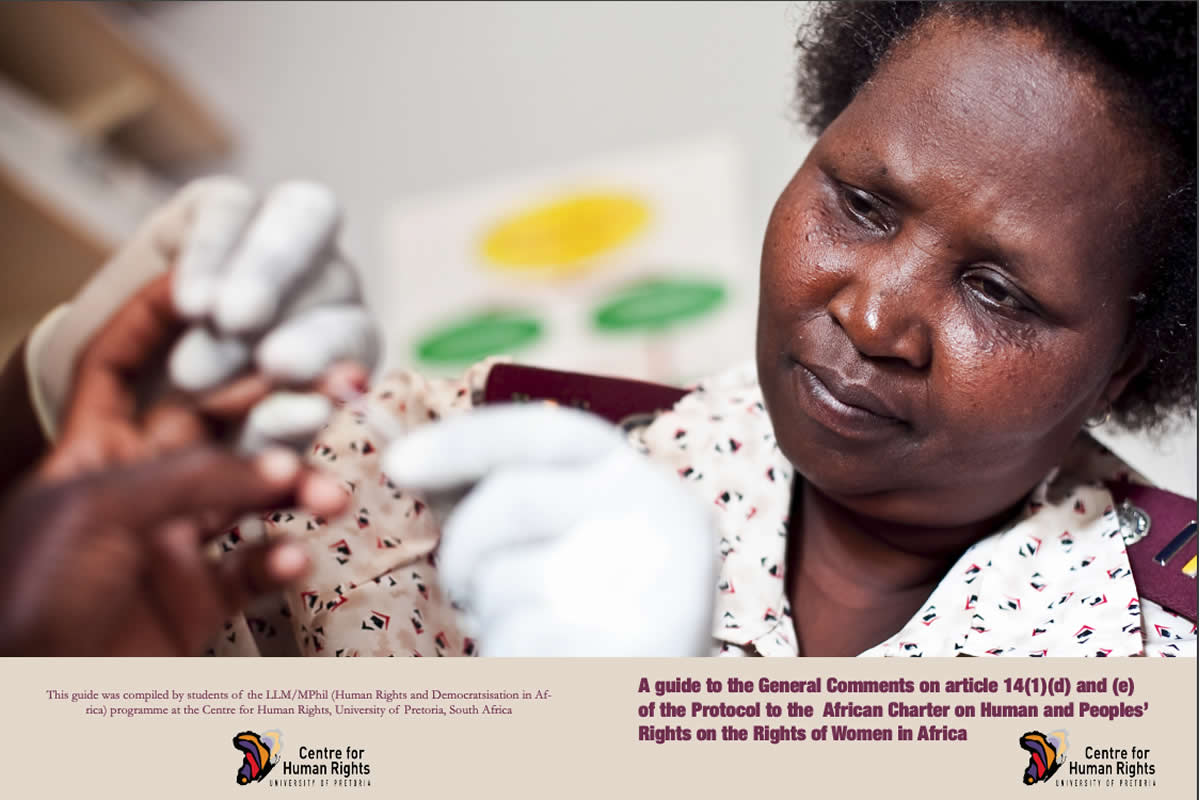
A guide to the General Comments on article 14(1)(d) and (e) of the Protocol to the African Charter on Human and Peoples’ Rights on the Rights of Women in Africa
The Women’s Protocol is a complementary legal document to the African Charter on Human and Peoples’ Rights which was adopted by the African Commission in 2003 and entered into force in 2005. Its main aim is to expand the substantive protection of women’s rights in Africa by enumerating the rights of women and the corresponding obligations of state parties.
The General Comment was adopted in order to clarify the specific measures that states should take in order to fulfill their obligations under Article 14(1)(d) which provides for the right to self-protection and to be protected against sexually transmitted infections including HIV/AIDS and Article 14(1)(e) which provides for the right to be informed on one’s health status and on the health status of one’s partner
This guide simplifies the content of the general comment for advocacy purposes and was compiled by students of the LLM/MPhil (Human Rights and Democratisation in Africa) 2013.
The students on the LLM/MPhil programme in human rights and democratisation in Africa are assigned to human rights clinics which contributes to the work of the Centre’s research units and give the students practical experience and advance the Centre’s mission towards the realisation of human rights in Africa.
Mandate:
- Prepare shadow report on Zambia state report to the African Committee on the Rights and Welfare of the Child
- Prepare advocacy material around Agenda 2040 of the African Committee on the Rights and Welfare of the Child for states and CSOs
Members (2018)