- Details
The Centre for Human Rights is located on the 2nd and 3rd floors of the Law Building, Faculty of Law
at the University of Pretoria, South Africa.
Centre for Human Rights
Faculty of Law
University of Pretoria
South Africa
0002
Tel : +27 (0) 12 420 3810 / +27 (0) 12 420 3034
Fax: +27 (0) 86 580 5743
Email: chr@up.ac.za
Website: www.chr.up.ac.za
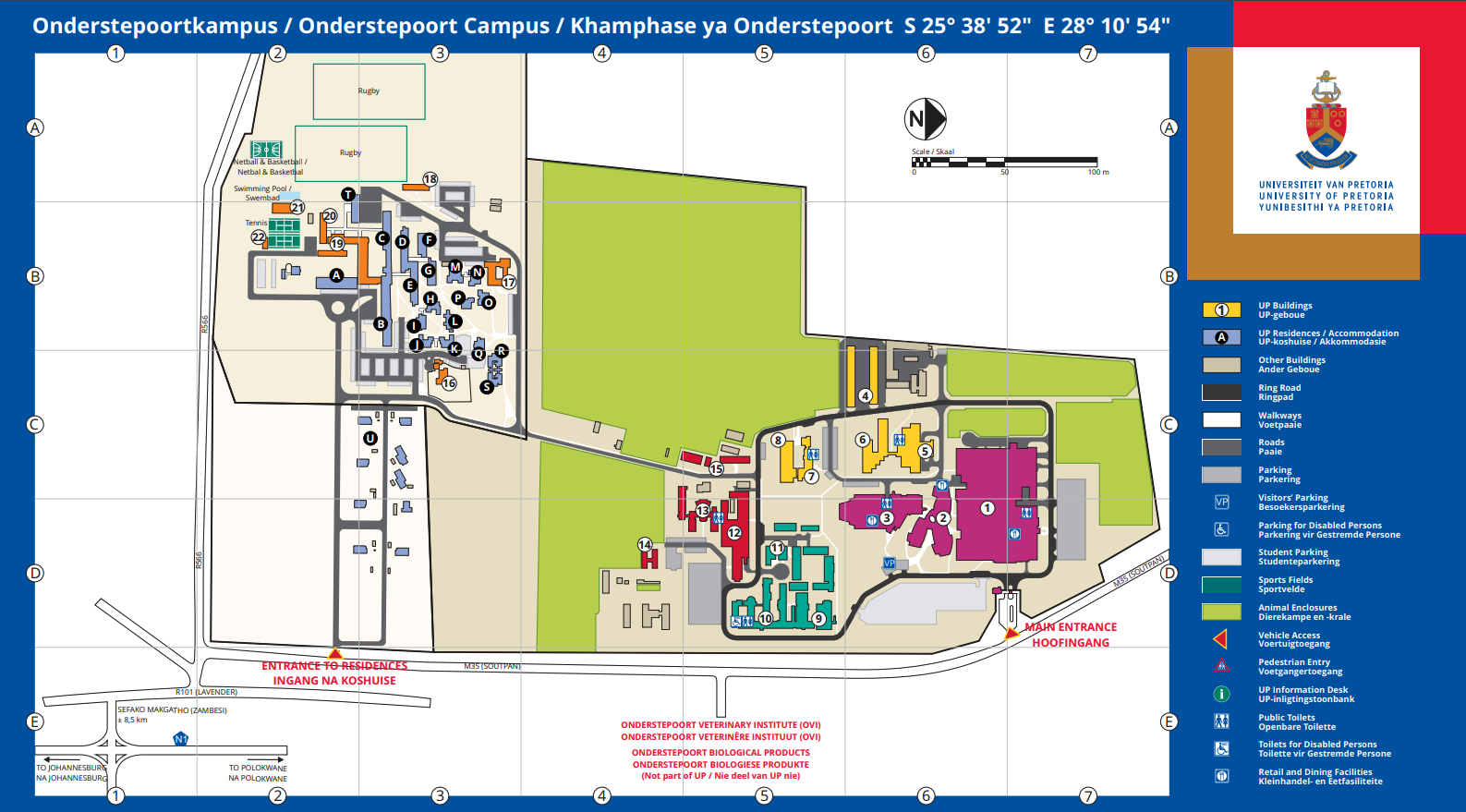
Map of the University of Pretoria campus
Map to the Centre for Human Rights
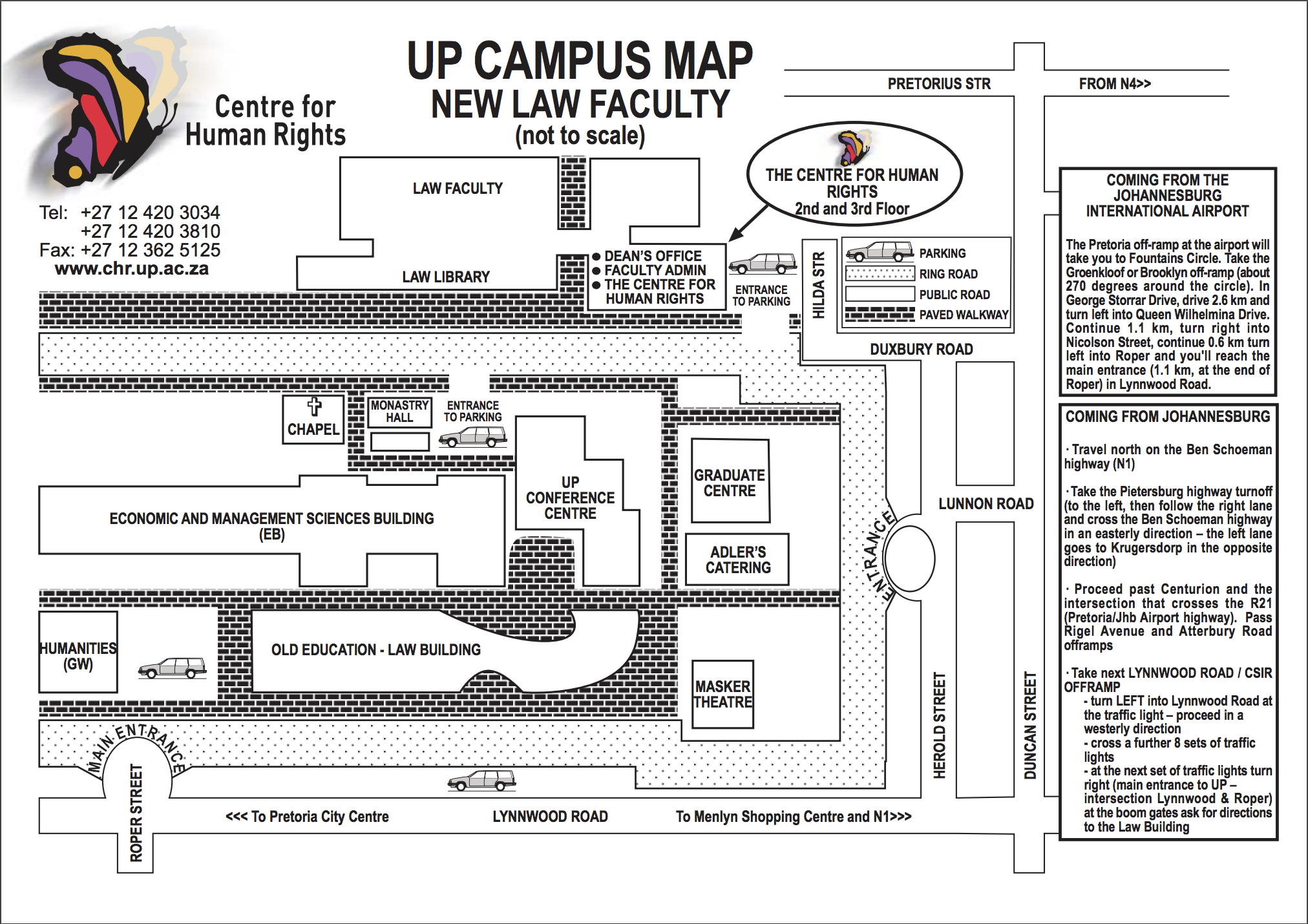
Directions to the Centre for Human Rights
Coming from the Hatfield Gautrain Station:
Head south on Grosvenor Street toward Park Street and turn right at the 3rd cross street onto Prospect Street. Continue towards the University's entrance on the corner of Festival Street. After you have passed through the gate, turn left and follow the Ring Road past the Student Centre, and continue utill you pass the Chapel on your right and the Centenary Building on your left. The Faculty of Law is now on your left.
Coming from Johannesburg:
N1, take the R101 Pretoria East off-ramp (you'll see UNISA at this stage on the hill to your right). Follow the Brooklyn M7 (right and then left) to reach Fountains Circle. Stay in the lane second from right to take the Groenkloof off-ramp at the circle. In George Storrar Drive, drive 2.6 km and turn left into Florence Ribeiro Drive. Continue 1.1 km, turn right into Nicolson Street, continue 0.6 km turn left into Roper and you'll reach the main entrance (1.1 km, at the end of Roper) in Lynnwood Road.
Coming from the O R Tambo International Airport:
The Pretoria off-ramp at the airport will take you to Fountains Circle. Take the Groenkloof or Brooklyn off-ramp (about 270 degrees around the circle). In George Storrar Drive, drive 2.6 km and turn left into Florence Ribeiro Drive. Continue 1.1 km, turn right into Nicolson Street, continue 0.6 km turn left into Roper and you'll reach the main entrance (1.1 km, at the end of Roper) in Lynnwood Road.
Coming from the north, the main entrance via Lynnwood Road:
N1, the Pietersburg highway, will take you to the N4, the Witbank Highway and then straight into Pretorius Street. Turn left into Gordon Road following the M7 Brooklyn turn-off (Gordon changes into Jan Shoba Street) for 1.8 km. (You'll cross several traffic lights.) You are now at the Lynnwood Road traffic light. Turn right and continue 0.8 km. You are now at the traffic light at the main entrance. Turn right.
Coming from the west:
From Schoeman Street, turn right into Gordon Road following the M7 Brooklyn turn-off (Gordon changes into Jan Shoba Street) for 1.8 km. (You'll cross several traffic lights.) You are now at the Lynnwood Road traffic light. Turn right and continue 0.8 km. You are now at the traffic light at the main entrance. Turn right.
GPS Coordinates of the University of Pretoria
Hatfield campus: S25° 45’ 21”E28º 13’ 51”
- Details
The Centre for Human Rights hosts two moot court competitions annually: the African Human Rights Moot Court Competition and the Nelson Mandela World Human Rights Moot Court Competition. The Centre also established the National Schools Moot Court Competition, which is currently organised by the Department of Basic Education, Government of South Africa.
Christof Heyns African Human Rights Moot Court Competition
The Christof Heyns African Human Rights Moot Court Competition is the largest gathering of students, academics and judges around the theme of human rights in Africa. This annual event brings together all law faculties in Africa, whose top students argue a hypothetical human rights case as if they were before the African Court on Human and Peoples’ Rights.
Nelson Mandela World Human Rights Moot Court Competition
The World Moot is open to undergraduate and masters students from all universities in the world. Teams of two students (gender diversity is encouraged) from every university in the world are invited to submit heads of argument for a hypothetical human rights case. The 50 teams with the highest memorial grades are invited to participate in the preliminary oral rounds and present their arguments to human rights experts and judges of international tribunals at the UN headquarters in Geneva
Read More
National Schools Moot Court Competition
The Competition aims to create greater awareness in schools and communities in South Africa about the Constitution and the values that it embodies through active participation. The aim is also to encourage talented young people to consider pursuing a law career.
Read More
- Details

Ms Lulama Shongwe
BA Law(UP) LLB Candidate(UP)
Student Ambassador
Tel: +27 (0) 12 420 4199
Fax: +27 (0) 86 764 5621
lulama.shongwe@gmail.com
- Details

LLM (UP)
Project Officer: African Coalition for Corporate Accountability (ACCA)
Tel: +27 (0) 12 420 4531
Fax: +27 (0) 86 580 5743
guillain.koko@up.ac.za
- Details

LLB(Newcastle University, UK) LPC(Northumbria University, UK) LLM(McGill University, Canada) ORCID
ORCID
Manager: Disability Rights Unit
+27 (0)12 420 6398
dianah.msipa@up.ac.za
Expertise
- Disability rights
- Access to justice
- Sexual and reproductive health and rights
- Legal capacity
- Disability rights in the African human rights system
Publications
Journal articles
- ‘Albinism as disability: The key to ensuring equal access to justice for the vindication of economic, social and cultural rights by persons with albinism in South Africa?’ (2022) Southern Africa Albinism Socio-Economic Rights Journal (forthcoming)
- ‘Access to heath care by mothers impacted by albinism in South Africa’ (2022) Southern Africa Albinism Socio-Economic Rights Journal (forthcoming) (with M Buyco et al)
- ‘Moshoeshoe v DPP: A missed opportunity for persons with intellectual and psychosocial disabilities in Lesotho?’ (2021) 13 Drexel Law Review 909
- Court accommodations for persons with severe communication disabilities: A legal scoping review’ (2021) 27 (3) Psychology, Public Policy and Law 399 (with R White, J Bornman and E Johnson)
- ‘Implementing article 13 of the Convention on the Rights of Persons with Disabilities in South Africa: Accommodations for people with communication disabilities’ (2018) 6 African Disability Rights Yearbook 99. (with R White)
- ‘The right to work and employment in Southern Africa: A Commentary on how selected employment laws fare against Article 27 of the CRPD’ (2016) 4 African Disability Rights Yearbook 283.
- ‘How assessments of testimonial competence perpetuate inequality and discrimination for persons with intellectual disabilities: An analysis of the approach taken in South Africa and Zimbabwe’ (2015) 3 African Disability Rights Yearbook 63-90.
- ‘Global reasonable accommodation: How the Convention on the Rights of Persons with Disabilities changes the way we think about equality.’ (2014) 30 South African Journal of Human Rights 252. (with Frédéric Mégret)
- ‘Getting disability rights into the mainstream of human rights advocacy: An appraisal of Zimbabwean disability rights policies and legislation’ Available on SSRN (with Thompson Chengeta)
Book chapters
- ‘The African Disability Protocol: Towards a social and human rights approach to disability in the African Human Rights system’ in Handbook of Disability: Critical Thought, Human Rights and Social Change in a Globalizing World (Springer: 2022) forthcoming (with P Juma)
- ‘Critical review of reforms in the African region’ in N Espejo & M Bach (eds) Legal Capacity, Disability and Human Rights: Towards a comprehensive approach (2021) (forthcoming)
Book reviews
- ‘Book review: Oche Onazi: An African path to disability justice: Community, relationships and obligations’ (2020) 8 African Disability Rights Yearbook 264.
Blogs
- Dianah Msipa, ‘Pursuing justice for rape victims with intellectual disabilities’
Podcasts
- Africa Rights Talk The right to access to justice for persons with disabilities
- Details

SOGIESC Unit / Communications and Advocacy Associate
LLB(UP) LLM(Candiate)
Tel: +27 (0)12 420 3151
Fax: +27 (0) 86 580 5743
thiruna.naidoo@gmail.com

- Details

Ms Msthoka Moyahabo
Fax: +27 (0) 86 580 5743
- Details
LLM HRDA(UP)
Programm Manager: Expression, Information and Digital Rights Unit
Tel: +27 (0) 12 420 4199
Hlengiwe.Dube@up.ac.za
Media articles
-
COVID-19 and the access to information conundrum in Africa
Originally published in AfricLaw
10 April 2020

- Details

Ms Lidya Stamper
BA(University of Redlands)
Fax +27 (0)86 580 5743
- Details
Ms Bonolo Makgale
Bth (CI-CPT) BA Hons (Wits) MMPP (Wits)
Programme Manager: Democracy and Civic Engagement Unit
+27 (0) 12 420 4199
bonolo.makgale@up.ac.za
Media Publications
- COVID 19 and the working class
Originally published in DDP
25 September 2020 - Political Open Sesame: Navigating the Inclusion of Independent Candidate Participation in South African Electoral Processes
Originally published in DDP
25 September 2020 - Populism v Politics: An Analysis of Corruption & Inequality in the ANC Governance Systems
Originally published in DDP
25 October 2020 - Strategies of Resistance By Women: Then and Now
Originally published in DDP
21 August 2020 - The impact of Covid-19 on South Africa Political Landscape
Originally published on DDP
16 June 2020 - The scourge of homelessness and evictions during COVID-19
Originally published in AfricLaw
6 May 2020 - Young and Free? The vulnerability of young people in a COVID-19 South Africa
Originally published in DDP
6 May 2020
- Details

BA(University of Washington), LLM(Irish Centre for Human Rights) PhD(University of Sussex)
Postdoctoral Researcher, UP Vice Chancellor Fellow
Project Officer: Women's Rights Unit
Tel: +27 (0) 12 420 4397
Fax: +27 (0) 86 580 5743
ciara.o'connell@up.ac.za
- Details
2005 - 2007 Editions
Subscription enquiries and orders for the 2005, 2006 and 2007 editions should be sent to:
PULP (Pretoria University Law Press)
Faculty of Law
University of Pretoria
Pretoria
0002
Tel: +27 12 420 4948
Fax: +27 (0) 86 580 5743
Email:pulp@up.ac.za
Website: www.pulp.up.ac.za
Brochure
Click here to download the brochure for the 2005 edition
Order forms
Click here to download the order form for the 2005 edition
Click here to download the brochure for the 2006 edition
Click here to download the order form for the 2007 edition
2000 - 2004 Editions
Subscription enquiries and orders for the 2000 - 2004 editions should be sent to:
Juta Law Customer Services
Business Reply Service CB 0920
Lansdowne 7779
South Africa
Telephone: (021) 763 3600
Fax: (021) 761 5861
Email: cserv@juta.co.za
- Details
Cases from national courts that would be of interest to include in future issues of the African Human Rights Law Reports can be brought to the attention of the Editors:

Prof Magnus Killander
jur kand(Lund) EMA(Padua) LLD(UP)
Academic Coordinator: LLM/MPhil Human Rights and Democratisation in Africa (HRDA)
Professor of Human Rights Law
Tel: +27 (0) 12 420 5407
Fax: +27 (0) 86 580 5743
magnus.killander@up.ac.za
- Details
The African Human Rights Law Reports is a joint publication of the African Commission on Human and Peoples' Rights and the Centre for Human Rights at the University of Pretoria and are published by Pretoria University Law Press.
The editors are:
[module-634]
- Details
African Disability Rights Yearbook (ADRY)
The African Disability Rights Yearbook aims to advance disability scholarship. Coming in the wake of the United Nations Convention on the Rights of Persons with Disabilities, it is the first peer-reviewed journal to focus exclusively on disability as human rights on the African continent.
African Human Rights Law Journal (AHRLJ)
The African Human Rights Law Journal (AHRLJ) a leading peer-reviewed journal focused on human rights related topics of relevance to Africa, Africans and scholars of Africa. The Journal aims to contribute towards strengthening indigenous African scholarship.
African Human Rights Yearbook (AHRY)
The African Human Rights Yearbook spearheads studies on the promotion and protection of human rights and provides a forum for constructive engagement about the African human rights system with academics and other human rights commentators on the continent.
African Human Rights Law Reports
African Human Rights Law Reports contains legal decisions of relevance to human rights law in Africa. These include selected domestic decisions from the whole continent, as well as the decisions of the African Commission on Human and Peoples’ Rights and the United Nations treaty bodies, dealing with African countries
African Human Rights Policy Paper
This African Human Rights Policy Papers series is one of the means by which the research and advocacy Units of the Centre for Human Rights, together with the self-standing Institute for International and Comparative Law in Africa (ICLA) and the International Development Law Unit (IDLU).
Guide to the African human rights system
This Guide provides an overview of developments related to the African Charter on Human and Peoples’ Rights, its supervisory body, the African Commission on Human and Peoples’ Rights, the African Court on Human and Peoples’ Rights, as well as the African Charter on the Rights and Welfare of the Child and its supervisory body, the African Committee of Experts on the Rights and Welfare of the Child.
Pretoria University Law Press (PULP)
Pretoria University Law Press is an open-access publisher based at the Centre for Human Rights, University of Pretoria.
AfricLaw Blog
AfricLaw, launched in April 2012, is a blog that provides a platform for discussion for those interested in the rule and role of law in Africa.
- Details
- Details
Ageing in the LGBT community: a positive outlook for older lesbian women in South Africa?
*Glossary of terms and abbreviations:
LGBT stands for Lesbian, Gay, Bisexual and Transgender; GFBT stands for Gay, Female Bisexual, and Transgender; ‘Closeted’ means secretive about one’s sexual orientation.
Author: Geoffrey Ogwaro1

The Constitution of the Republic of South Africa (thereafter the Constitution), protects older lesbian women through its provision that prohibits discrimination based on an intersectional number of grounds for lesbian women: age, gender, sex, marital status, pregnancy, sexual orientation, disability, and conscience.2 I have chosen these eight grounds for discrimination because they may apply, at any one given time or different times, to the average situation of older lesbian women: Older lesbian women will be older, have a sexual orientation that is same gender-loving, identify as biological women, might not be married or might never have married, have never had children, have age-related disabilities, might be discriminated against for the fact they are women, and believe in lesbian equality/gender equality and strongly and publicly express these views therefore becoming victims or prisoners of conscience.
The Constitution also protects the inherent dignity of everyone and stipulates that that dignity must be respected and protected.3 This provision will definitely also apply to older lesbian women too.
South Africa has legislation that governs the wellbeing of older persons. The Older Persons Act 13 of 2006 defines ‘older persons’ as ‘in the case of a female is 60 years of age or older’. The age is higher for males and stands at 65 years of age.4 However, there is nothing in the Act that deals with diverse older persons which highlights the unique challenges that older lesbian women (or the wider LGBT community) might face in terms of ageing.5
The question that this article addresses is what is the situation of older lesbian women in South Africa. The article does not restrict itself to the age of 60 but accommodates the other ages below 60 but above 50 because there is very limited research on older lesbian women to begin with, and older lesbian women who are from the age of 60 going up. This could be for the reason that not many older lesbian women are visible because they came from an era when LGBT rights were not much emphasized and LGBT identities were on the down low for the most part. Additionally, there is very little research on older lesbian women- specific wellbeing in South Africa. Therefore the article alludes to general LGBT aggregated research that would highlight statistics of older LGBT persons in general. However, the situations faced by older GFBT persons can be generalized to older lesbian women as well.
Human rights violations against older lesbian women in South Africa – is their need to fill some gaps?
Having read through many media reports of the murder, rape and assault of younger lesbian women in the country, one would expect that many older lesbian women would be closeted in fear of being stigmatized and violated. However, a research done in 2016 by the Love Not Hate (LNH) Campaign conducted by OUT LGBT Well-being, found that 55% of older LGBT persons sampled were open about their sexuality to those around them despite the danger of being stigmatized or violated; 51% of those LGBT persons from the age of 55 going up were reported to not have any fear of discrimination due to their sexual orientation or gender identity and; 88% of those LGBT from and above the age of 55 reported not having experienced any discrimination in the health care sector due to being gay, lesbian, bisexual or transgender.6 However, the same research showed that 20% of those older LGBT persons from and above the age of 55 said they had experienced verbal insults directed at them because they were lesbian, gay, bisexual or transgender; 9% had been threatened with physical violence; 7% had had personal property or possessions damaged or destroyed because of their sexual orientation or gender identity and; 4% had been sexually abused or raped because of their sexual orientation or gender identity in the previous 24 months.7 Although these statistics do not disaggregate the data according to sex or gender, the picture could be as grim for older lesbian women too.
Though a significantly higher percentage of those older LGBT individuals interviewed reported being free from any violations against them because of their sexual orientation or gender identity, a smaller but worth noting percentage reported violations as serious as sexual abuse and rape, which, though not exclusively, is a violation that affects disproportionately more women than men.
The problem is that no significantly larger and specific research exists on the human rights situation for older lesbian women in the country and until this gap is filled, not much can be said about older lesbian women. The recommendation would be to start disaggregating data and research to target older lesbian women in particular. The other alternative would be to centre research around lesbian women and girls and in that way aggregate them by age category.

1 Geoffrey Ogwaro heads the Sexual Orientation, Gender Identity and Expression Unit of the Centre for Human Rights, Faculty of Law, University of Pretoria. He is also a DPhil student writing his thesis on the participation of LGBT individuals and groups in the Equality Courts of South Africa.
2 The Constitution of the Republic of South Africa, 1996, section 9(3).
3 As above, section 10.
4 Older persons Act 13 of 2006, section 1.
5 Neil Henderson, and Kathryn Almack, Lesbian, gay, bisexual, transgender ageing and care: A literature study
6 Hate crimes against lesbian, gay, bisexual and transgender (LGBT) people in South Africa, 2016, OUT LGBT Well-being.
7 Same as above.
- Details
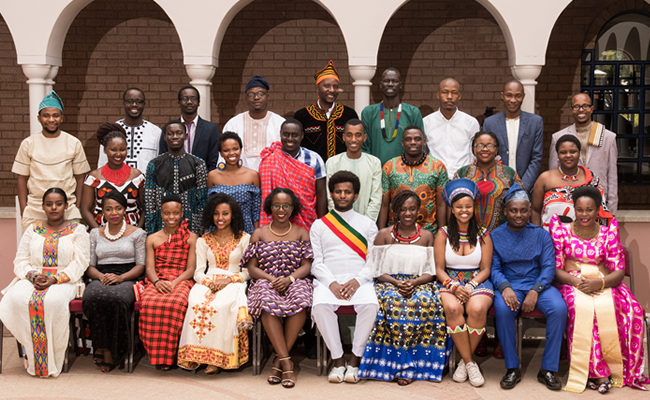
Since its formal recognition as an academic department in the Faculty of Law, the Centre for Human Rights has been able to invest its efforts in both formal academic programmes, on the one hand, and research, advocacy and less formal human rights teaching and training, on the other. In 2008, the Centre continued with the Master’s in Human Rights and Democratisation in Africa, again preparing 30 of Africa’s most talented young lawyers to make a difference within the sphere of international human rights law in Africa. An innovation introduced in 2008 was the LLM Partner’s Conference, held just before graduation on 10 December. Academics from participating faculties and LLM students presented work-in-progress and summaries of their dissertations, respectively, at an event aimed at stimulating further reflection among partners about the content and methodology of themes covered in the Master’s programme. The Centre further continued to cultivate continuous and constructive discussions among registered doctoral students on topics in human rights in Africa.
HRDA
LLM (Human Rights & Democratisation)
The LLM in Human Rights and Democratisation in Africa is a prestigious one-year intensive course where 25-30 exceptional individuals spend 6 months in Pretoria and 6 months at one of the 13 partner universities all over Africa.
Read more
DRIA
LLM (Disability Rights in Africa)
The Masters in Disability Rights in Africa is embedded in the international human rights framework, the programme explores disability rights in the light of United Nations Convention on the Rights of Persons with Disabilities and the Protocol to the African Charter on Human and Peoples’ Rights on the Rights of Persons with Disabilities in Africa
Read More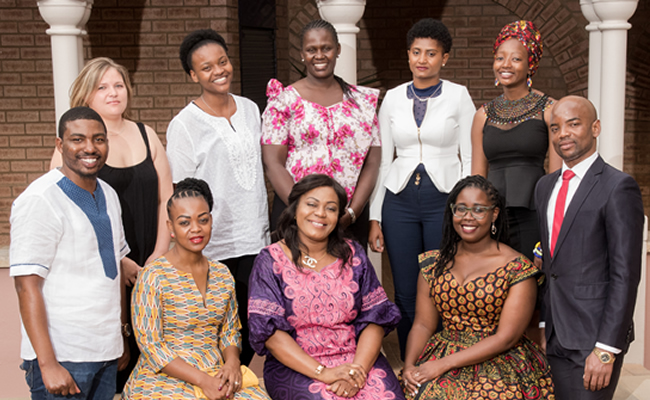
MDHR
LLM Multidisciplinary Human Rights
The LLM degree in Multidisciplinary Human Rights gives students from various disciplines the opportunity to engage with human rights issues from a number of perspectives. This programme is for lawyers and non-lawyers.
Read more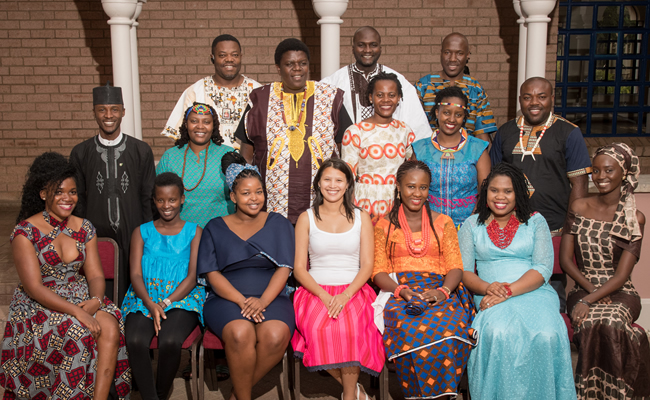
SRRA
LLM (Sexual Reproductive Rights in Africa)
The Master's degree (LLM) in Sexual and Reproductive Rights in Africa is a two-year programme that is offered as a blended learning course comprising of online interaction and residential block-weeks in Pretoria.
Read more
TILA
LLM (International Trade & Investment Law in Africa)
The Master's of Law (LLM) degree in International Trade and Investment Law in Africa is the first of its kind to be offered in Africa. It establishes a higher education and training programme based in and focused on, Africa with full exposure to the international world of trade and investment.
Read More
- Details
The Research Units of the Centre for Human Rights contribute to the realisation of human rights in Africa and beyond.

The Business and Human Rights Unit is a multi- and trans-disciplinary research unit which focuses on the extractive industries law, trade and development law, as well as general international human rights law – and is relevant to the business environment.

The Children’s Rights Unit is a pan-African platform established to carry out & support pan-African research in children’s rights, provide capacity strengthening training for government, intergovernmental and non-governmental institutions and organisations.

The Democracy and Civic Engagement Unit works with the Pan-African Parliament (PAP) – the chief legislative organ of the African Union. From its seat in South Africa, PAP provides a regional platform for Africans and their civil society organisations to have a greater impact on the decisions affecting the continent.

The Disability Rights Unit works to find ways of addressing the rights of persons with disabilities on the African continent by conducting research on international disability rights standards and instruments, building capacity among governments, national human rights institutions, academia, civil society, and communities.

The Expression, Information, and Digital Rights Unit is aimed at supporting the mandate of the Special Rapporteur on Freedom of Expression and Access to Information in Africa of the African Commission on Human and Peoples’ Rights in the promotion and protection of Freedom of Expression and Access to information on the continent.

The Freedom from Violence Unit was established in 2014 to research the incidence of unlawful killings across the African continent, working within the Centre for Human Rights and the Institute for International and Comparative Law in Africa. The Unit looks to explore the drivers of violence & the legal framework in which they operate.
The International Development Law Unit presents the LLM (International Trade and Investment Law in Africa) and its mission is to conduct and promote policy-oriented legal research on international development law topics.

The Litigation and Implementation Unit strategically uses the law through the instrumentality of judicial and quasi-judicial institutions to enforce human rights, prevent human rights violations and seek redress for human rights violations.

Established in May 2016, the SOGIESC Unit’s mandate is to advocate for and work towards equality inclusion non-discrimination, non-violence, and non-heterosexism for lesbian, gay, bisexual, transgender, intersex, queer, questioning, and asexual persons (LGBTIQ+ persons).

The Women’s Rights Unit works towards the realisation of the rights of women and girls in Africa. The Unit aims to promote the implementation & popularisation of the Protocol to the African Charter on Human & Peoples’ Rights on the Rights of Women in Africa through research, training, and advocacy.
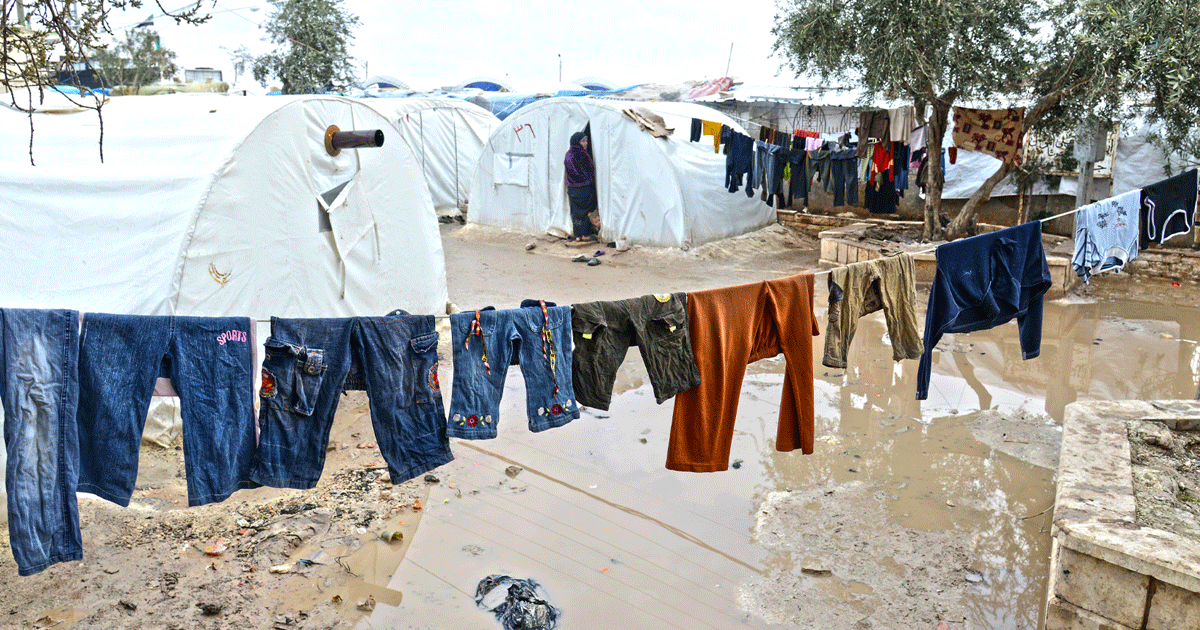
The Migration Unit at the Centre for Human Rights, University of Pretoria, engages in research and activities on migration. The migration Unit works through research, advocacy and training in contributing to the regional discussion on migrant rights. The Unit responds to the need for evidence-based work. The focus areas of the Migration Unit include the protection of migrants, refugees, internally displaced persons and stateless persons.
- Details

Dr Tresor Makunya
Postdoctoral Fellow and Publications Coordinator
+27 (0) 12 420 3810
Tresor.Makunya@up.ac.za
Areas of research: African Comparative Constitutionalism; International Human Rights Law in Africa; Democratisation in Africa; African Union Law & Public International Law
Media Publications
- 'The function of constitutional judges and judicial philosophy in Africa: Introduction to the special issue'
AfricLaw 17 December 2021 - DRC’s Constitutional Court: Broken shield in overseeing the executive in emergencies?
Originally published in ConstitutionalNet
27 May 2020 -
TM Makunya ‘Fostering a gendered approach to peacebuilding in the African Great Lakes Region: Perspectives from the Democratic Republic of Congo’ 13 October 2021 in Kujenga Amani
-
TM Makunya ‘DRC’s Constitutional Court: Broken shield in overseeing the executive in emergency?’ 27 May 2020 in ConstitutionNet
-
TM Makunya ‘An agenda for constitutional reform in Democratic Republic of Congo (DRC)’ 5 February 2019 in ConstitutionNet
-
KB Kennedy & T Makunya ‘Bringing the African human rights system into classrooms: Somes lessons drawn from a lecture delivered at the Université Libre des Pays des Grands Lacs (DR Congo’ 4 February 2019) in AfricLaw
-
EB Bope & T Makunya ‘Les conséquences juridiques de la déclaration de l’Union africaine sur les élections en République démocratique du Congo : Un simple avis ou une mesure contraignante ?’ 19 January 2019 in Club des Amis du Droit du Congo
-
T Makunya ‘Voting in the Democratic Republic of Congo (DRC) against all odds: An account of the 30 December 2018 elections in one of the polling centres’ 4 January 2019 in AfricLaw
Edited book
- TM Makunya L’État africain et la crise postcoloniale: Repenser 60 ans d’alternance institutionnelle et idéologique sans alternative économique (L’Harmattan, Paris 2021) (with JB Akilimali)
Book chapters
- TM Makunya ‘La compétence consultative de la Cour africaine des droits de l’homme et des peuples: entre restrictions organiques et limitations matérielles’ in EB Bope & M Mubiala (eds) La République démocratique du Congo et le système africain de protection des droits de l’homme (Editions CAD Kinshasa, 2021) (with SZ Bitagirwa)
- TM Makunya ‘Le rôle et l’apport des tribunaux dans la réalisation de la justice sociale en Afrique du Sud’ in JB Akilimali & TM Makunya (eds) L’État africain et la crise postcoloniale: Repenser 60 ans d’alternance institutionnelle et idéologique sans alternative économique (L’Harmattan, Paris 2021)
- TM Makunya ‘The application of the African Charter on Human and Peoples’ Rights in constitutional litigation in Benin’ in F Viljoen and others (eds) A life interrupted: Essays in honour of the lives and legacies of Christof Heyns (PULP, 2022, 468).
- TM Makunya ‘The struggle for constitutional identity in Francophone Africa’ in CM Fombad & N Steytler (eds) Constitutional identity and constitutionalism in Africa (OUP, 2022, forthcoming) (with CM Fombad)
- TM Makunya ‘Soldiers in civilian uniforms: The role of the military in supporting third-termism in Africa’ in R Adeola & M wa Mutua (eds) The Palgrave handbook of democracy, governance and justice in Africa (2022) (with K Appiagyei-Atua).
Journal articles
- ‘Overcoming challenges to the adjudication of election-related disputes at the African Commission on Human and Peoples’ Rights: Perspectives from the Ngandu case’ (2022) 22(2) African Human Rights Law Journal 379-402
- ‘The nexus between constitutionalism, peace and security in the law and practice of the African Union’ (2022) 25 Recht in Afrika – Law in Africa – Droit en Afrique 53-83.
- TM Makunya ‘Selected development in human rights and democratisation during 2020 in Africa’ (2021) 5(2) Global Campus Human Rights Journal 185-216 (with Lornah, Ruddy and Davina).
- TM Makunya ‘A commentary on the African Commission’s General Comment on the Right to Freedom of Movement and Residence under Article 12(1) of the African Charter on Human and Peoples’ Rights’ (March 2021) 65(SA) Journal of African Law (with R Adeola and F Viljoen)
- TM Makunya ‘Constitutionalism, regional economic integration and the harmonisation of business law in Francophone Africa through the lenses of state sovereignty and statehood’ (2021) 1 Congolese Review of Social Sciences Research (with B Kahombo)
- TM Makunya ‘Decisions of the African Court on Human and Peoples’ Rights in 2020: Trends and lessons’ (2021) 21(2) African Human Rights Law Journal 1230 - 1264
-
T Makunya ‘Selected developments in human rights and democratisation during 2017: Sub-Saharan Africa’ (2018) 2 Global Campus Human Rights Journal 147-173 (with MG Nyarko).
-
TM Makunya ‘State security, securitisation and human security in Africa: The tensions, contradictions and hopes for reconciliation (2017) 1(2) Global Campus Human Rights Journal 326-349 (with K Appiagyei-Atua, I Oyakhirome, EK Kabachwezi & S Buabeng-Baidoo).
Ongoing research projects
Edited book
- Commentary on the Protocol to the African Charter on Human and Peoples’ Rights on the Rights of Women in Africa (2023) (With A Rudman & C Musembi)
Journal articles
-
‘Beyond legal measures: A review of the Democratic Republic of Congo’s initial report under the Protocol to the African Charter on Human and Peoples’ Rights on the Rights of Women in Africa’ (2023) Journal of African Law (approved for publication)
-
‘Advisory procedure: African Court on Human and Peoples’ Rights’ (2023) MaxPlanck Encyclopedia of International Procedural Law (approved for publication)
Book chapters
- ‘Article 15: The right to food security’ in A Rudman, TM Makunya & CN Musembi (eds) Commentary on the Protocol to the African Charter on Human and Peoples’ Rights on the Rights of Women in Africa (2023), forthcoming (with M Bwanaisa)
- 'Article 11: Protection of women in armed conflicts' in A Rudman, TM Makunya & CN Musembi (eds) Commentary on the Protocol to the African Charter on Human and Peoples’ Rights on the Rights of Women in Africa (2023), forthcoming (with J Mumbala)
- ‘The impact of COVID-19 on human rights and democracy in the Democratic Republic of Congo’ in F Adegalu and Others Covid-19 and human rights in Africa (2023)
- ‘The implementation of the Maputo Protocol in the Democratic Republic of Congo: an account of theoretical promises and little practical impact’ in S Mutambasere (ed) The impact of the Maputo Protocol in selected African countries (2023) forthcoming (With E Katusele & O Bahoze)
- Details
Country / Where did you grow up:
Ethiopia, Dhagahbur district
Academic qualifications:
LLB (cum laude) University of Hargeisa
B.Sc Agriculture & Natural Resource Management (cum laude) Gollis University
Experience:
I have worked for a number of international & local organisations in different capacities.
Academic fields of interest:
Public International Law, International Human Rights Law & Environmental Law.
husseinabdurahman197@gmail.com
- Details
Underpinning all of the Unit’s work is the creation and maintenance of a Database of Unlawful Killings in Africa, designed as a resource initially for policy-makers and practitioners, but ultimately also for academic and other researchers.
Building on the work of a comprehensive baseline study completed in 2013/4 in collaboration with the University of Cambridge (available here) this database will contain information concerning events in the following categories:
Death Penalty
Custodial Deaths
Extrajudicial Executions
Excessive Force
Political Violence
Armed Conflict
Intercommunal Violence
Killings by Non-State Actors
In order for this database to function properly it needs material from as diverse a source-base as possible. Researchers in Pretoria would benefit greatly from partners across the continent passing them relevant information from any source, in any language, so that the resources of the database can be as comprehensive as possible.
The Unit encourages researchers and practitioners from across the continent and beyond to contribute to this process by uploading relevant information using this web form.
If you have questions about this or any other aspect of the Unit’s work we encourage you please to contact us.
- Details
Unlawful Killings in Africa
Prepared by the Centre of Governance and Human Rights (University of Cambridge) for the UN Special Rapporteur on extrajudicial, summary or arbitrary executions, June 2014
Resource Pack on the Abolition of the Death Penalty in Africa
Prepared for the Joint Meeting of the Working Group on Death Penalty and Extrajudicial, Summary or Arbitrary Killings in Africa and the UN Special Rapporteur on extrajudicial, summary or arbitrary executions, Pretoria, South Africa, 26-27 July 2013
- Details
Download this information in PDF format
The World Coalition Against the Death Penalty has recently reviewed and updated the strategy for its campaign in favour of the international and regional protocols on abolition. Over the past five years, there have been positive steps taken by several African States with respect to the Second Optional Protocol of the ICCPR (ratifications by Benin, Gabon and Guinea Bissau, signatures by Angola and Madagascar). For 2015, the World Coalition has selected several African States as priority targets: Togo (Jan-Feb), Morocco & Cote d'Ivoire (Mar-Apr), Angola (Sept-Oct), and Madagascar & Sierra Leone (Nov-Dec). More information concerning the World Coalition's campaign, including information packs for lobbying actions, can be found here."
Penal Reform International has produced a report on Strengthening death penalty standards (2015) both underlining the existing minimum standards with respect to the continued application of the death penalty and exploring a number of emerging norms. The report can be found here.

- Details
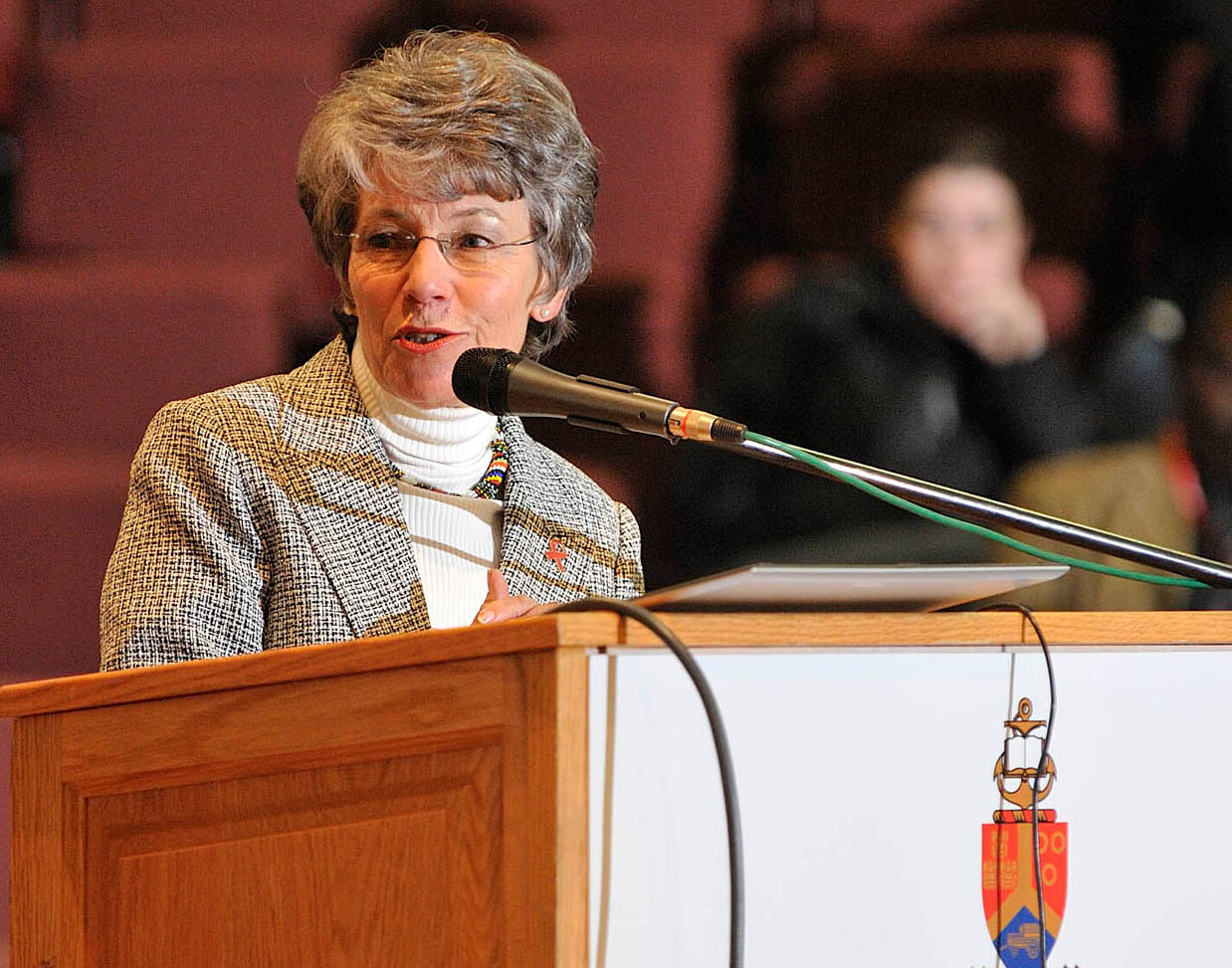
About the Gill Jacot Guillarmod Scholarship
In loving memory of Gill Jacot Guillarmod, Senior Project Manager and Liaison Officer of the Centre for Human Rights from 1 May 2001 to 15 January 2010, in deep appreciation for her role to the academic and other programmes of the Centre, and in recognition of her humanity and humour, which left a profound impression on everyone whose lives touched hers, the Centre for Human Rights in 2010 established the Gill Jacot Guillarmod Scholarship.
Scholarship Regulation document
The deadline for applications for the Gill Jacot Guillarmod Scholarship is 30 October each year.
Criteria Applicable to the Scholarship
-
The Scholarship will be awarded annually to a Masters or a Doctoral student studying towards a degree in human rights on a degree programme based within the Centre.
-
The Scholarship will be awarded annually, for a student undertaking studies in the following academic year. The Scholarship will be awarded for the first time in November 2010, for studies in 2011. The recipient of the scholarship will be publicly announced on or around 10 December every year, as part of the LLM Graduation Ceremony. The scholarship amount will only be paid to the recipient once he or she has been registered with the University of Pretoria.
-
All successful applicants for the LLM (Human Rights and Democratisation in Africa) may apply to be considered for this scholarship.
-
Any doctoral student or masters student registered on any other programme in the Centre may also apply for this scholarship.
-
The criteria for selection is:
proven commitment to human rights;
devotion to the cause of humanity;
academic excellence;
an ability to balance academic pursuit with other interests and financial need.
-
At the time of making the application, an applicant must reveal any other scholarships already awarded for the intended programme.
Procedure for Applying and the Awarding of the Scholarship
-
The Centre will advertise the Scholarship.
-
Applications must reach the Office Manager (chr@up.ac.za) of the Centre by 30 October annually. Applications must consist of a letter of motivation, at least two letters of support, and the candidate’s most recent academic results or progress report (for currently registered doctoral students).
-
Applicants should fulfil the criteria laid down by the University of Pretoria for enrolment for the field of study concerned.
-
The Selection Committee will select students for the award in accordance with the criteria for the scholarship and will submit a list of scholarship holders to the Division for Study Finance in order for the award to be made on the student’s account
-
The recipient of the scholarship is not precluded from holding other bursaries.
-
The scholarship will be utilised to cover tuition and accommodation fees should the student reside in a UP residence. The student may claim credits that arise on the student account due to the award.
Selection Committee
The selection panel, consisting of the Director of the Centre, the Assistant Director of the Centre, the HRDA Programme Manager, the Centre’s Operations Manager and Edouard Jacot Guillarmod, or his representative, will meet annually to decide on the award of the Scholarship.
Recipients of the Gill Jacot Guillarmod Scholarship
2011
- Melhik Bekele
- Japheth Biegon
- Ayalew Assefa
- Doris Sonsiama
- Meskerem Techane
2012
- Matthieu Ciaba
2013
- Rashid Dumbaya
- Bright Nkrumah
2016
- Monicah Kareithi
2019
- Eunice Sakaria
2021
- Candice Kasere
- Details
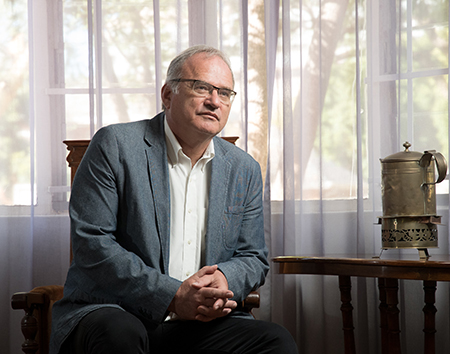
About the Christof Heyns Human Rights Scholarship
Applications are invited for the award of the first Christof Heyns Human Rights Scholarship. Applications are open to current or prospective doctoral candidates studying towards a doctoral degree in human rights at the University of Pretoria.
Download Call for Applications
The last day for submitting applications is 4 October each year. Enquiries related to the scholarship can be directed to carole.viljoen@up.ac.za.
About Christof Heyns
The Christof Heyns Human Rights Scholarship (the Scholarship) is instituted in memory of renowned human rights scholar, Christof Heyns, who was professor of human rights law at the University of Pretoria (UP) until his untimely death in March 2021. Christof was the Director of the Centre for Human Rights from 1999 to 2006; Dean of the Faculty of Law from 2007 to 2010; and was the founding Co-Director of the Institute for International and Comparative Law in Africa at UP. He was United Nations Special Rapporteur on extrajudicial, summary or arbitrary executions from 2010 to 2016; and was a member of the UN Human Rights Committee from 2017 to 2020. Prof. Heyns pioneered and supported numerous human rights education initiatives in the course of his life, including by providing opportunities to deserving students to pursue human rights education.
About the Scholarship
The Scholarship is established to continue the legacy of Prof. Heyns in expanding human rights scholarships and giving opportunities to deserving but economically disadvantaged African students to undertake human rights related postgraduate studies in human rights at UP.
The amount of the Scholarship is R180,000. It is provided for a maximum of three calendar years for doctoral studies. The Scholarship award is reviewed annually, for continued funding, on the basis of satisfactory academic progress by the recipient.
Eligibility requirements
Applicants must:
- meet all the requirements for admission to doctoral studies in human rights at UP;
- be a citizen of an African country;
- have an excellent academic record, based on previous tertiary studies; and
- demonstrate the need for economic support to achieve their academic goals.
(If the Scholarship is awarded to a student who is not currently registered for doctoral studies at UP, the award will be provisional on the student being successfully registered with UP.)
How to apply
Applications must consist of:
- a letter of motivation,
- at least two letters of support, with referees’ contact details indicated;
- for prospective doctoral students: a brief proposal of around 5 pages, setting out the research problem, locating the proposed research in the existing scholarship; the research question(s); and the proposed research method/methodology;
- for currently registered doctoral students: a progress report by the supervisor; and
- the applicant’s most recent academic results.
Submit applications to carole.viljoen@up.ac.za
Closing date
The last day for submitting applications is 4 October each year.
Scholarship Regulation
Download Scholarship Regulations
Contact details
Enquiries related to the scholarship can be directed to carole.viljoen@up.ac.za.
- Details
Gill Jacot Guillarmod Scholarship
In loving memory of Gill Jacot Guillarmod, Senior Project Manager and Liaison Officer of the Centre for Human Rights from 1 May 2001 to 15 January 2010, in deep appreciation for her role to the academic and other programmes of the Centre, and in recognition of her humanity and humour, which left a profound impression on everyone whose lives touched hers, the Centre for Human Rights in 2010 established the Gill Jacot Guillarmod Scholarship.
Read MoreChristof Heyns Human Rights Scholarship
The Christof Heyns Human Rights Scholarship (the Scholarship) is instituted in memory of renowned human rights scholar, Christof Heyns, who was professor of human rights law at the University of Pretoria (UP) until his untimely death in March 2021. Christof was the Director of the Centre for Human Rights from 1999 to 2006; Dean of the Faculty of Law from 2007 to 2010; and was the founding Co-Director of the Institute for International and Comparative Law in Africa at UP. He was United Nations Special Rapporteur on extrajudicial, summary or arbitrary executions from 2010 to 2016; and was a member of the UN Human Rights Committee from 2017 to 2020. Prof. Heyns pioneered and supported numerous human rights education initiatives in the course of his life, including by providing opportunities to deserving students to pursue human rights education.
Read More- Details
Ms Sheila Keetharuth
sheila.keetharuth@up.ac.za
Tel: +27 (0) 12 420-5092
Expertise:
Eritrea, extractive industries
- Details
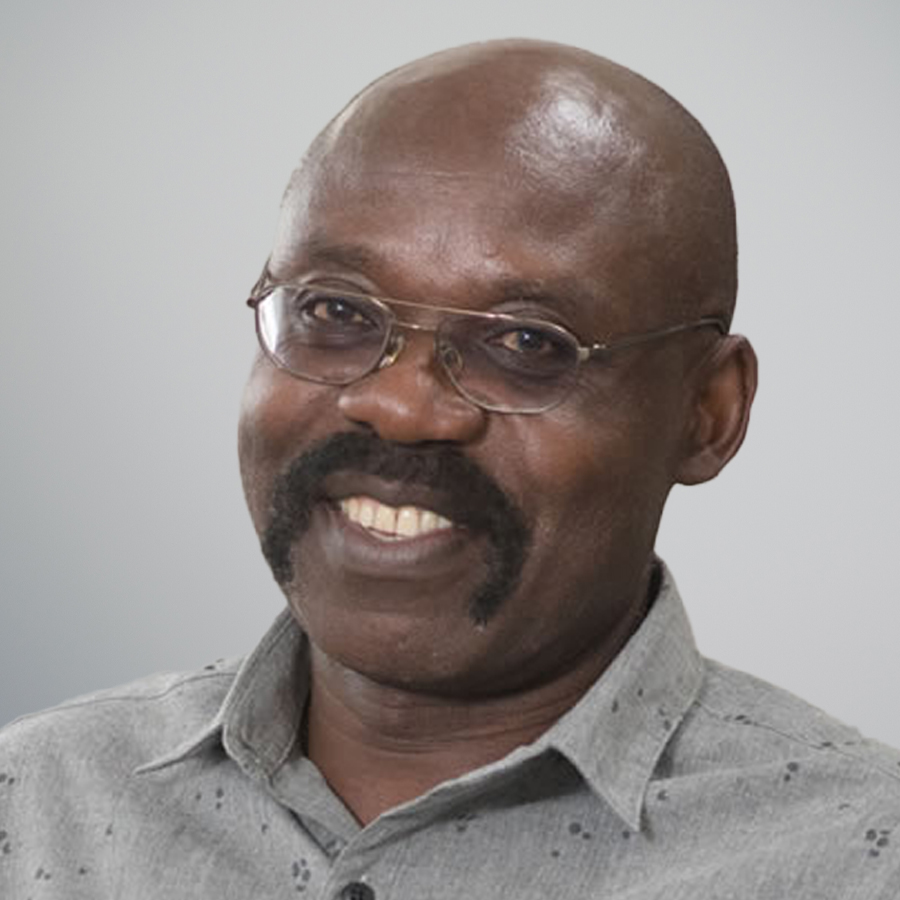
Prof Charles Fombad
Director: Institute for International and Comparative Law in Africa (ICLA)
Professor of Comparative Constitutional Law
Licence en Droit(University of Yaounde) LL.M(University of London) PhD(University of London)
ORCID
+27 (0) 12 420 3377
charles.fombad@up.ac.za
Publications
Journal Articles
- “Countering the Scourge of Unconstitutional Changes of Government in Africa” IACL-AIDC Blog (16 June 2022)
https://blog-iacl-aidc.org/transformations/2022/6/16/countering-the-scourge-of-unconstitutional-changes-of-government-in-africa - “Democracy and fake news in Africa,” 9(1) Journal of International and Comparative Law (2022), pp. 131-154.
- “Fostering a Constructive Intra-African Legal Dialogue in Post-Colonial Africa,” 66(1) Journal of African Law (2022), pp. 1-22.
- “An Overview of the State of Electoral Democracy in Africa,” 14 African Journal of Legal Studies (2022), pp. 245–268.
- Transitional Justice in Africa – The Experience with Truth Commissions by Charles Manga Fombad at https://www.nyulawglobal.org/globalex/Africa_Truth_Commissions1.html.
- “ A comparative overview of recent trends in judicial appointments: selected cases from Africa,” 55(1) Canadian Journal of African Studies (2021), pp161-182. 10.1080/00083968.2020.1802314
- (With Lukman A. Abdulrauf “Comparative overview of the constitutional framework for controlling the exercise of emergency powers in Africa’, 20 African Human Rights Law Journal (2020), pp. 376-411 http://dx.doi.org/10.17159/1996-2096/2020/v20n2a2
- “Editorial introduction to special focus: Assessing the implications of COVID-19 pandemic regulations for human rights and the rule of law in Eastern and Southern Africa,” 20 African Human Rights Law Journal (2020), pp. 368-375.http://dx.doi.org/10.17159/1996-2096/2020/v20n2a1
- “Taming executive authoritarianism in Africa; Some reflections on current trends in horizontal and vertical accountability,” 12(1) Hague Journal of the Rule of Law (2020), pp.61-91.
- (with Baboki Jonathan Dambe) The stock theft act and customary courts in Botswana: justice sacrificed on the altar of expediency? 52(1) The Journal of Legal Pluralism and Unofficial Law, (2020), pp.65-81.
- (with Christof Heyns, Pansy Tlakula and Jimmy Kainja), “ The right to political participation in Sub-Saharan Africa,” 8 Global Journal of Comparative Law (2019),pp. 128-161.
- “The separation of powers in African constitutionalism.” In Oxford Research Encyclopedia of Politics. Oxford University Press. doi: http://dx.doi.org/10.1093/acrefore/9780190228637.013.1327
- “Taming Executive Authoritarianism in Africa: Some Reflections on Current Trends in Horizontal and Vertical Accountability,” Hague Journal on the Rule Law https://doi.org/10.1007/s40803-019-00091-5
- “Constitutional literacy in Africa: Challenges and Prospects,”44(3) Commonwealth Law Bulletin (2018), pp. 492- 513.
- "Comparative research in contemporary African legal studies," 67(4) Journal of Legal Education (2018), pp.984-1004.
- “An overview of the crisis of the rule of law in Africa,” 18(1) African Human Rights Law Journal (2018), pp.213-243.
- (with Eric Kibet), “ The rule of law in sub-Saharan Africa: Reflections on promises, progress, pitfalls and prospects,” 18(1) African Human Rights law Journal (2018), pp.205-212.
- “Constitutional Entrenchment of Decentralization in Africa: An Overview of Trends and Tendencies,” 62(2) Journal of African Law (2018), pp. 175-199.
- (with Eric Kibet) “Transformative constitutionalism and the adjudication of constitutional rights in Africa,” 17(2) African Human Rights Law Journal (2017), pp. 340-366.
- (with Serges Djoyou Kamga), “ Actualising the right to development in Africa: Options and prospects,” 47(3) Africa Insight (2017), pp 6-26.
- “Designing institutions and mechanisms for the implementation and enforcement of the constitution: Changing perspectives in Africa” 25 (1) African Journal of International and Comparative Law, (2017) pp. 66–90.
- (with Lukman Abdulrauf) "Personal Data Protection in Nigeria: Reflections on Opportunities, Options and Challenges to Legal Reforms" 38(2) Liverpool Law Review, (2017), pp. 105-134.
- (With Lukman Abdulrauf), “The African Union’s data protection Convention 2014: a possible cause for celebration of human rights in Africa?” 8 (1) Journal of Media Law (2016), pp. 67-97.
- “Election Management Bodies (EMBs) in Eastern and Southern Africa: Some Reflections on their Legal Framework,” 15 African and Asian Studies (2016), pp. 289-335.
- “State, Religion and Law in Cameroon: Regulatory Control, Tension and Accommodation,” 57(1) Journal of Church and State (2015), pp.18-43.
- “Conceptualising a Framework for Inclusive, Fair and Robust Multiparty Democracy in Africa: The Constitutionalisation of the Rights of Political Parties,” 48(1) Law and Politics in Africa, Asia & Latin America (2015), pp. 3-27.
- “Strengthening constitutional order and upholding the rule of law in central Africa: Reversing the descent towards symbolic constitutionalism,” 14 African Human Rights Law Journal (2014), pp. 412-448.
- “Constitution-building in Africa: The Never-ending Story of the Making, Unmaking and Remaking of Constitutions,” 13(4) African and Asian Studies (2014), pp. 429-451.
- “Gender Equality in African Customary Law: Has the Male Ultimogeniture Rule any Future in Botswana,” 52(3) Journal of Modern African Studies (2014), pp. 475-494.
- “Appointment of Constitutional Adjudicators in Africa: Some Perspectives on How Different Systems Yield Similar Outcomes,” 46(2) Journal of Legal Pluralism and Unofficial Law (2014), pp. 249-275.
- “Africanisation of Legal Education Programmes : The Need for Comparative African Legal Studies,” 49(4) Journal of Asian and African Studies (2014), pp. 383-398.
- (with Gift Manyatera ) “An Assessment of the Judicial Service Commission in Zimbabwe's new Constitution," 67(1) Comparative and International Law Journal of Southern Africa (2014), pp. 89-108.
- (With Adem K. Abebe), “The Advisory Jurisdiction of Constitutional Courts in Sub-Saharan Africa,” 46(1) George Washington International Law Review (2013), pp. 55-117.
- (with Serges Alain Kamga) , “A Critical Review of the Jurisprudence of the African Commission on the Right to Development,” 57(2) Journal of African Law (2013), pp. 196-214.
- “Some Perspectives on Durability and Change Under Modern African Constitutions,” 11(2) International Journal of Constitutional Law (2013), pp. 382-413.
- “An Overview of the Constitutional Framework of the Right to Social Security with Special Reference to South Africa,” 21(1) African Journal of International and Comparative Law (2013), pp. 1-31.
- “Some Reflections on the Prospects for the Harmonisation of International Business Laws in Africa: OHADA and Beyond,” 59(3) Africa Today (2013), pp. 51-80.
- “Constitutional Entrenchment as an Effective and Sustainable Basis for Attacking Africa’s Endemic Corruption.” 1 Pan-African Yearbook of Law (2012), pp. 31-46.
- (with Enyinna Nwauche), “Africa’s Imperial Presidents: Immunity, Impunity and Accountability,” 5(2) African Journal of Legal Studies (2012), pp.91-118.
- “Internationalization of Constitutional Law and Constitutionalism in Africa,” 60(2) American Journal of Comparative Law (2012), pp.439-473.
- “Constitutional Reforms and Constitutionalism in Africa: Reflections on Some Current Challenges and Future Prospects,” 59(4) Buffalo Law Review (2011), pp.1007-1108.
- “African Bill of Rights in a Comparative Perspective,” 17(1) Fundamina (2011), pp.33-64.
- (with Njoku O. Ama) “Patent and research exemption: Challenges for research capacity and utilization in universities, research institutions and industry in Botswana,” 1(5) International Journal of Asian Social Science (2011), pp. 157-180.
- “The Constitution as a Source of Accountability: The Role of Constitutionalism,” 24 (2) Speculum Juris (2010), pp.41-65.
- “Mixed Systems in Southern Africa: Divergences and Convergences,” 25 Tulane European & Civil Law Forum (2010), pp.1-21.
- “Transitional Justice in Africa: The Experience with Truth Commissions,” http://www.nyulawglobal.org/globalex/Africa_Truth_Commissions.htm (2008)
- “Constitutional Reforms in France and their Implications for Constitutionalism in Francophone Africa,” (2008) http://www.afrimap.org/english/images/paper/AfriMAP_Fombad_Eng.pdf
- “Legal Modernisation in Botswana: A Critical Appraisal of the Revision of the Laws Act, 2002,” 6 University of Botswana Law Journal (2007), pp. 91-101.
- “Limits on the Powers to Amend Constitutions: Recent Trends in Africa and their Impact on Constitutionalism,” 6 University of Botswana Law Journal (2007), pp. 27- 60.
- “The Swaziland Constitution of 2005: Can Absolutism be Reconciled with Modern Constitutionalism?” 23 SAJHR (2007), pp. 93-115.
- “Researching Cameroonian Law,” (2007) http://www.ny/lawglobal.org/globalex/Cameroon.htm
- “Challenges to Constitutionalism and Constitutional Rights in Africa and the Enabling Role of Political Parties: Lessons Perspectives from Southern Africa,” 55 American Journal of Comparative Law (2007), pp.1-46.
- “A Preliminary Assessment of the Prospects for Judicial Independence in Post-1990 Africa Constitutions,” 2 Public Law (2007), pp.233-257.
- “Media Law Reform in Southern Africa: Challenges and Prospects,” 5 Openspace (2006), pp.49- 52.
- “The African Union, democracy and good governance.” 32 Current African Issues (2006), pp.9-38.
- with Zein Kebonang “The African Peer Review Mechanism: Challenges and prospects.” 32 Current African Issues (2006), pp.39-54.
- “Civil Liability for Damage Caused by Dogs in Roman-Dutch and Common Law: A comparative Appraisal” Part II .19(2) Pula Botswana Journal of African Studies, (2005), pp.158- 167.
- “Children and informed consent to HIV/AIDS testing and treatment in Botswana,” 2 University of Botswana Law Journal (2005), pp.33-72.
- “Botswana and the dynamics of legal modernisation within a dual English Common Law/Roman-Dutch Law legal heritage,” 13 African Journal of International and Comparative Law, (2005), pp.7-24.
- “The separation of powers and constitutionalism in Africa: The case of Botswana,” 25 Boston College Third World Law Journal, (2005)pp. 301-342.
- “Highest courts departing from precedents: The Botswana Court of Appeal in Kweneng Land Board v Mpofu and Nonong,” 1 University of Botswana Law Journal, (2005) pp.128- 139.
- “Protecting children’s rights in social science research in Botswana: Some ethical and legal dilemmas,” 19 International Journal of Law, Policy and the Family, (2005) pp. 102-120.
- “Civil liability for damage caused by dogs in Roman-Dutch and Common Law: A comparative appraisal” 18 Pula Botswana Journal of African Studies,(2004),pp.127-136.
- “A report on a national information and communications technology (ICT) policy in Botswana,” 1 BIAC Journal, (2004) No. 2, pp. 97-103.
- with L. Knestiioukova “Human rights and HIV/AIDS in the workplace: A Botswana perspective.”1 BIAC Journal, (2004),No. 2 pp. 72-96.
- “Customary courts and traditional justice in Botswana: Present challenges and future perspectives,” 15 Stellenbosch Law Review, (2004), pp.166-192.
- “Cameroon’s emergency powers: A recipe for (un)constitutional dictatorship?” 48 Journal of African Law, (2004), pp. 62-81.
- with Madeleine C. Fombad “The lawyer in the emerging digital environment: A Botswana perspective” 32 International Journal of Legal Information, (2004), pp.109-129.
- “The constitutional protection against discrimination in Botswana,” 53 International and Comparative Law Quarterly, (2004) pp. 139-170.
- Protecting constitutional values in Africa: A comparison of Botswana and Cameroon.” 36 Comparative and International Law Journal of Southern Africa,(2003), pp. 83-105.
- “Election management bodies in Africa: Cameroon’s ‘National Electoral Observatory in perspective,’” 3 African Human Rights Law Journal, (2003),pp. 25-51.
- “Some insights into statutory-law making in Botswana,” 27 Journal for Juridical Science, (2002), pp. 70-87.
- “The protection of freedom of expression in the public service media in southern Africa: A Botswana perspective,” 65 Modern Law Review,(2002), pp. 649-675.
- “The risk of exclusion from the digital global information age: The case of Botswana,” 49 Media Development,(2002), pp. 45-49.
- “Governmental vicarious liability for the acts of off-duty officials in Botswana,” 2 Oxford University Commonwealth Law Journal,(2001), pp. 231 –252.
- "The crisis of confidentiality in the control of the HIV/AIDS pandemic in Botswana," 170 International Social Science Journal, (2001),pp. 643-659.
- "Service providers and liability and for digital defamation: Finding the right balance," 49 Media Development, (2001), pp. 59-64.
- "The enhancement of good governance in Botswana: A critical assessment of the Ombudsman Act," 27 Journal of Southern African Studies, (2001), pp. 57-77.
- "An analysis of the constitutional protection of freedom of expression in southern African and some emerging trends," 16 South African Journal of Human Rights,(2000), pp. 173-191.
- "Curbing corruption in Africa: Some lessons from Botswana’s experience," 160 International Social Science Journal,(1999),pp. 241-254.
- “Peacebuilding in Africa: Lessons from Truth Commissions,” 12 Lesotho Law Journal, (1999), pp. 1-29.
- "Cameroonian bi-juralism: Current challenges and future prospects", (1999) 5 Fundamina: Journal of Legal History, (1999), pp. 22-43.
- "The constitutional protection of freedom of expression in Cameroon: A comparative appraisal," 14 S.A. Public Law, (1999), pp. 25-45.
- "Compensation of motor vehicles accident victims in Botswana: An appraisal of the MVA Act Fund scheme," 43 Journal of African Law, (1999), pp. 151-183.
- "Archibald v Attorney-General in Perspective: The role of actuarial evidence in the assessment of the defendant's damages for loss of support in Botswana, "AfricanJournal of International and Comparative Law,(1999), pp. 245-261.
- "Cameroon and the dilemma of media pluralism," 24 Communicatio, (1998),pp. 21-31.
- "The new Cameroonian Constitutional Council in a comparative perspective: Progress or retrogression?” 42 Journal of African Law, (1998), pp. 172-186.
- "The special ‘Ad hoc' Chamber within the International Court of Justice - A prospective appraisal," 23 Journal of Juridical Science, (1998), pp. 112-128.
- "An experiment in legal pluralism: The Cameroonian bi-jural/uni-jural imbroglio," 16 University of Tasmania Law Review,(1997), pp. 209-234.
- "The principle of unjust enrichment in international law," 30 Comparative and International Law Journal of Southern Africa, (1997),pp. 120-130.
- "Overcoming the legal and institutional challenges to implementing Cameroon's National Environmental Management Plan," 27 Environmental Law and Policy, (1997), pp. 489-498.
- "The effectiveness of environmental protection measures in Cameroon's 1994 Law, Laying Down Forestry, Wildlife and Fisheries Regulations," 9 Journal of Environmental Law, (1997),pp. 43-58.
- "Judicial power in Cameroon's amended Constitution of 18 January 1996," 9 Lesotho Law Journal, (1996),pp. 1-11.
- "Adjusting working Conditions to the economic crisis: The Cameroonian experience.” 47 Labor Law Journal, (1996), pp. 454-463.
- "The Motor Accident Compensation Ordinance 1989, of Cameroon," 39 Journal of African Law, (1995) pp. 1998-219.
- "Freedom of speech in the Cameroonian democratic transition," 33 Journal of Modern African Studies, (1995), pp. 211-226.
- "Legal aspects of the informal sector in Cameroon," 3 African Journal of International and Comparative Law, (1994), pp.504-515.
- "Equity in current international practice,” 2&3 Revue Juridique Africaine, (1994), pp.111-127.
- "The scope for uniform national laws in Cameroon,” 29 Journal of Modern African Studies, (1991), pp. 443-456.
- "Consultations and negotiations in the pacific settlement of international disputes,” African Journal of International and Comparative Law,” (1980), pp.707-724.
Chapters in Books
- (With Osy Nwebo), “Reflections on the Role of the Pan-African Parliament in Advancing Democratic Governance in Africa,” in A. Adeola and Makau Mutua (eds.), Palgrave Handbook of Democracy, Governance and Justice in Africa, Palgrave, Macmillan, Switzerland (2022), pp.85-108.
- “The state of governance in Africa,” in Charles M Fombad, Assefa Fiseha, Nico Steytler, Contemporary Governance Challenges in the Horn of Africa, Routledge, London (2022)
- “Democracy, elections and constitutionalism in Africa: Setting the scene,” in Charles M Fombad and Nico Steytler (eds.), Democracy, elections, and constitutionalism in Africa, Oxford, Oxford University Press (2021), pp.19-35.
- (With Adem Abebe), “The African Union and the advancement of democracy: The problem of unconstitutional retention of governmental power,” in Charles M Fombad and Nico Steytler (eds.), Democracy, elections, and constitutionalism in Africa, Oxford, Oxford University Press (2021), pp.61-91.
- (With O’Brien Kaaba), “Adjudication of disputed presidential elections in Africa,” in Charles M Fombad and Nico Steytler (eds.), Democracy, elections, and constitutionalism in Africa, Oxford, Oxford University Press (2021), pp.400.
- “Reversing the surging tide towards authoritarian democracy in Africa,” in Charles M Fombad and Nico Steytler (eds.), Democracy, elections, and constitutionalism in Africa, Oxford, Oxford University Press (2021), pp.463-517.
- “The struggle to defend the independence of the judiciary in Africa,” in Shimon Shetreet, Hiram Chodesh and Eric Helland, Challenged justice. In pursuit of judicial independence, Leiden, Brill Nijhoff (2021), pp. 223-248.
- “The crisis of statelessness in Africa,” in Cesar Landa (ed.), The constitutional challenges of migration processes in the 21st century,” Tirant Lo Blanch, Bogota (2020), pp. 133-150.
- “Constitutions and religion in Africa,” in Susanna Mancini (ed.), Constitutions and religion, Cheltenham, Edward Elgar (2020), pp. 157-171.
- (With Gatsi Tazo), “Cameroon’s response to the COVID-19 pandemic: Combating a deadly pandemic within a weak rule of law framework,” in Jose Serna de la Garza(ed), COVID-19 and constitutional law, Universidad Nacional Autonoma de Mexico, Mexico (2020), pp. 3-12. (being an e-book).
- “Africa and Transnational Constitutionalism.” In Oxford Bibliographies in International Law. Ed. Tony Carty. New York: Oxford University Press, DOI: 10.1093/OBO/9780199796953-0216 https://www.oxfordbibliographies.com/view/document/obo-9780199796953/obo-9780199796953-0216.xml
- (With Serges Kamga), “The Cameroonian Special Criminal Court: The Futility of Combating Corruption Where the Basics of Constitutionalism are Absent,” in Charles Fombad and Nico Steytler (eds.), Corruption and Constitutionalism in Africa. Revisiting Control Measures and Strategies (OUP, 2020), pp.417-435.
- “Corruption and the Crisis of Constitutionalism in Africa,” in Charles Fombad and Nico Steytler (eds.), Corruption and Constitutionalism in Africa. Revisiting Control Measures and Strategies (OUP, 2020), pp.15-65.
- “Reconciling legal pluralism and constitutionalism: New trajectories for legal theory in the age of globalisation in Botswana,” in Guillaume Tusseau (ed.), Debating legal pluralism and constitutionalism. New trajectories for legal theory in the global age, Switzerland, Springer (2020), pp.103-113.
- Regional and continental frameworks in Africa: The African Charter on Decentralization,” in Charles Fombad and Nico Steytler (eds), Decentralization and Constitutionalism in Africa, Oxford, Oxford University Press, 2019, pp. 70-97.
- “Cameroon and the anomalies of decentralization with a centralist mindset,” in Charles Fombad and Nico Steytler (eds), Decentralization and Constitutionalism in Africa, Oxford, Oxford University Press, 2019, pp. 326-364.
- “ National human rights institutions in eastern and southern Africa: Lessons and prospects for the future,” in Charles Fombad (ed.), Compendium of documents on National human Rights institutions in eastern and southern Africa, Pretoria, PULP, 2019, pp. 890-898.
- “An overview of NHRIs in eastern and southern Africa,” in Charles Fombad (ed.), Compendium of documents on National human Rights institutions in eastern and southern Africa, Pretoria, PULP, 2019, pp. 5-19.
- “Constitutional review and constitutional justice in Africa: Past, present and future,” in Oumarou Narey (ed.), Separation des pouvoirs et contre-pouvoirs. Dakar, L’Harmattan (2018), pp.135-157.
- “The diffusion of South African –style institutions? A study of comparative constitutionalism,” in Rosalind Dixon and Theunis Roux (eds), Constitutional triumphs, constitutional disappointments. A critical assessment of the 1996 South African Constitution’s local and international influence. Cambridge, Cambridge University Press (2018), pp. 359-387.
- “Some Perspectives on Durability and Change Under Modern African Constitutions,” in Eunice Sahle (ed.), Democracy, Constitutionalism, and Politics in Africa; Historical Contexts, Developments, and Dilemmas, (2017), Palgrave Macmillan, pp 61-100 (republication).
- “An overview of contemporary models of constitutional review in Africa,” in Charles Fombad (ed.), Constitutional adjudication in Africa, Oxford, Oxford University Press (2017), pp. 17-50.
- “The Cameroonian Constitutional Council: Faithful servant of an unaccountable system,” in Charles Fombad (ed.), Constitutional adjudication in Africa, Oxford, Oxford University Press (2017), pp. 80-96.
- “Constitutional adjudication and constitutional justice in Africa’s uncertain transition: Mapping the way forward,” in Charles Fombad (ed.), Constitutional adjudication in Africa, Oxford, Oxford University Press (2017), pp. 351-370.
- Presidential Term Limits through constitutional amendments in Africa: Deconstructing legitimacy,” in Grant Masterson and Melanie Meirotti (eds.), Checks and balances: African constitutions and democracy in the 21st Century, EISA, Johannesburg (2017), pp. 45-58.
- “Problematising the issue of constitutional implementation in Africa,” in Charles M. Fombad (ed.), The Implementation of Modern African Constitutions: Challenges and Prospects, Pretoria, PULP (2016), pp.10-24.
- “Constitutional Implementation in perspective: Developing a sustainable normative constitutional implementation framework,” in Charles M. Fombad (ed.), The Implementation of Modern African Constitutions: Challenges and Prospects, Pretoria, PULP (2016), pp.218-235.
- “The Expansion of Judicial Power in Africa and Democratic Consolidation: Opportunities, Challenges and Future Prospects,” in Muna Ndulo and Mamoudou Gazibo (eds), Growing Democracy in Africa: Elections, Accountable Governance and Political Economy, London, James Currey Publishers (2016), pp. 47-85.
- “The Evolution of Modern African Constitutions: A Retrospective Perspective”, in Charles Manga Fombad (ed.), Separation of Powers in African Constitutionalism, Oxford, Oxford University Press (2016), pp.13-57.
- “An Overview of the Separation of Powers under Modern African Constitutions” in, in Charles Manga Fombad (ed.), Separation of Powers in African Constitutionalism, Oxford, Oxford University Press ( 2016),pp. 58-92.
- “The Role of Emerging Hybrid Institutions of Accountability in the Separation of Powers Scheme in Africa,” in in Charles Manga Fombad (ed.), Separation of Powers in African Constitutionalism, Oxford, Oxford University Press ( 2016),pp. 325-344.
- (with Horace Adjolohoun), “Separation of Powers and the Role of the Public Prosecutor in Francophone Africa,” in Charles Manga Fombad (ed.), Separation of Powers in African Constitutionalism, Oxford, Oxford University Press ( 2016), pp.359-484.
- "Cameroon." Encyclopedia of Law and Religion. General Editor Gerhard Robbers. Brill Online, 2015. Reference. http://referenceworks.brillonline.com/entries/encyclopedia-of-law-and-religion/cameroon-COM_00000019
- (with Madeleine Fombad), “Rethinking Anti-Corruption Strategies in Africa: Constitutional Entrenchment as Basis for Credible and Effective Anti-Corruption Clean-Ups,” in Charles C. Jalloh and Olufemi Elias (eds), Shielding Humanity: Essays in International Law and Policy in Honour of Abdul G. Koroma (Martinus Nijhoff Brill, (2015),pp. 726-773.
- "Managing Legal Diversity: Cameroonian Bijuralism at a Critical Crossroads," in Vernon Palmer, Mohamed Mattar and Anna Koppel (eds), Mixed Legal Systems, East and West., Aldershot, Ashgate Publishing (2014), pp. 187-217.
- “Judicial and Jurisprudential Powers of African Constitutional Court Judges,” in Collection of Acts of the Seminar in Cotonou on the Theme: Constitutional Judge and Political Power,” Cotonou, pp.55-65.
- “The Context of Justice in Africa: Emerging Trends and Prospects,” in Evelyn Edroma (ed.), Rethinking the Role of Law and Justice in Africa’s Development, UNDP, Addis Ababa (2013), pp.3-24.
- “Botswana,” in Vernon Palmer (ed.), Mixed Jurisdictions Wordwide. The Third Legal Family, 2nd ed., Cambridge, Cambridge University Press, (2012), pp.481-527.
- “Special Report on Cameroon,” in Vernon Palmer (ed.), Mixed Jurisdictions Wordwide. The Third Legal Family, 2nd ed., Cambridge, Cambridge University Press, (2012),pp.632-674.
- “State and Church in Cameroon,” in Gerhard Robbers (ed.), Encyclopedia of Law and Religion http://www.iclars.org/media/state_and_church_in_cameroon.pdf.
- “The African Union and Democratization”, in Jeffrey Haynes, Routledge Handbook of Democratization, Routledge, London (2012), pp.322-336.
- (With Jimcall Pfumorodze), “Protecting the Disabled in Botswana: An Anomalous Case of Legislative Neglect,” in Grobbelaar-du Plessis and Tobias Van Reenen, Aspects of Disability Law in Africa, PULP, Pretoria (2011), pp. 85-104.
- (With Nat Inegbedion “Presidential Term Limits and their Impact on Constitutionalism in Africa,” in Charles Fombad & Christina Murray (eds), Fostering Constitutionalism in Africa, PULP, Pretoria (2010),pp.1-29.
- “Transitional Justice in Africa: The Experience with Truth Commissions,” in Chinna Reddy Potula (ed.), Transitional Justice, Amicus Books, India (2009), pp.165-191.
- “A critical assessment of the legal responses to the HIV and AIDS pandemic in Botswana,” in Fombad, Mupedziswa, Maundeni and Mookodi (eds), “HIV and AIDS, Vulnerable Groups, Human Rights and Development in Botswana. OSSREA, Cape Town ((2009).
- Enhancing the Judicial Role in Human Rights Protection in Botswana,” in E.K. Quansah & W. Binchy, The Judicial Protection of Human Rights in Botswana. Clarus Press, Dublin (2009), pp. 133-158.
- “The Challenges of Human Rights Protection in Botswana in the 21st Century,” in E.K. Quansah & W. Binchy, The Judicial Protection of Human Rights in Botswana. Clarus Press, Dublin (2009), pp.27-43.
- “The Separation of Powers and Constitutionalism in Africa: The Case of Botswana,” in M. Prabhakar, Separation of Powers: Global Perspectives, Hyderabad, Icfai University Press (2008), pp. 146-193.
- “Cameroon’s constitutional conundrum: Reconciling unity with diversity”, in Kenyan Section of the International Commission of Jurists and Konrad Adenauer Stiftung, Ethnicity, Human Rights and Constitutionalism in Africa, Kenyan Section of the International Commission of Jurists, Nairobi (2008), pp.121-156.
- “The Protection of Human Rights in Botswana: An Overview of the Regulatory Framework,” in Charles Manga Fombad (ed.), Essays on the Law of Botswana, Cape Town, Juta & Co (2007), pp.1-31.
- With David Sebudubudu, “ The Framework for Curbing Corruption, Enhancing Accountability and Promoting Good Governance in Botswana,” in Charles Manga Fombad (ed.), Essays on the Law of Botswana, Cape Town, Juta & Co (2007), pp.82-126.
- “Post 1990 constitutional reforms in Africa: A Preliminary Assessment of the Prospects for Constitutional Governance and Constitutionalism.” in A.G. Nhema and P. T. Zeleza, The Resolution of African conflicts. OSSREA & James Currey, Oxford (2008), pp. 179-199.
- “Cameroon,” in David Levinson & Karen Christensen, Global Perspectives on the United States. A Nation by Nation Survey, Vol. 1 Berkshire Publishing Co., Great Barnington (2007), pp.88-91.
- With Jonie B. Fonyam (2004), "The Social Democratic Front., the opposition and the transition" in John Mukum Mbaku and Joseph Takougang (eds.) The leadership challenge in Africa: Cameroon under Paul Biya, Africa World Press, Trenton N.J., pp. 453-488.
- "The dynamics of record breaking corruption and political opportunism in Cameroon" in John Mukum Mbaku and Joseph Takougong (eds).The leadership challenge in Africa: Cameroon under Paul Biya, Africa World Press, Trenton N.J. (2004), pp. 357-394.
- “Prospects for peace building through Truth Commissions in Africa,”in Alfred G. Nhema (ed.), The Quest for Peace in Africa: Transformations, Democracy and Public Policy. International Books with OSSREA, Addis Ababa, (2004),pp.189-219.
- “Consultations and negotiations in the pacific settlement of disputes,” in Mary Ellen O’Connor (ed.), International dispute settlement, Ashgate, Dartmouth (2003),pp.37-54.
- "The mass media and the democratization process in Africa: Lessons from Cameroon,” in John Mukum Mbaku and Julius Ihonvbere. (eds), The transition to democratic governance in Africa: The continuing struggle, Praeger, Westport, (2003), pp. 221-247.
- “Cameroon’s ‘National Elections Observatory’ and the Prospects of Constitutional Change of Government”, in Frank Columbus (ed.), Politics and Economics of Africa. Vol. 3. Nova Science Publishers Inc., New York, (2002), pp. 71-91.
- “Cameroon’s troubled democratic transition and the deconstruction of the federalist problematic,” in Frank Columbus (ed.), Politics and Economics of Africa. Vol. 3 Nova Science Publishers Inc., New York, (2002), pp.43- 69.
- "Cameroon" (The legal system) in Herbert M. Kritzer(ed.), Legal systems of the world. A political, social, and cultural encyclopaedia. ABC –CLIO, Santa Barbara, (2002), pp. 245-252.
- "Endemic corruption in Cameroon: Insights on consequences and control," in Kempe Ronald Hope and Bornell Chikulo (eds.), Corruption and development in Africa: Lessons from country case-studies, Macmillan, London,(2002), pp. 234-260.
- "Cameroonian bi-juralism: Current challenges and future prospects," in Rena van den Bergh and Gardiol van Niekerk, (eds.), Law in Africa: New Perspectives on Origins, Foundations and Transition. Conference Proceedings, South African Society of Legal Historians, (1999),pp. 41-62.
- "Cameroon" (Media law practices and policies) in Robert Martin (ed) Speaking freely: Expression and the law in the Commonwealth, Irwin Law, Toronto, (1999), pp.87-129.
- (Edited with Assefa Fiseha, Nico Steytler), Contemporary Governance Challenges in the Horn of Africa, Routledge, London (2022).
- (Edited with Nico Steytler eds.), Democracy, elections, and constitutionalism in Africa, Oxford, Oxford University Press (2021)
- (Edited with Nico Steytler eds.), Corruption and Constitutionalism in Africa. Revisiting Control Measures and Strategies (OUP, 2020).
- (With Nico Steytler (eds)), Decentralization and Constitutionalism in Africa, Oxford, Oxford University Press, 2019
- (Ed.) Compendium of documents on National human Rights institutions in eastern and southern Africa, Pretoria, PULP (2019).
- (with Tachilisa Balule), Media Law in Botswana, 2nd Ed. Kluwer Law International (2018).
- (Ed.) Constitutional adjudication in Africa, Oxford, Oxford University Press (2017).
- (Ed.) The Implementation of Modern African Constitutions: Challenges and Prospects, Pretoria, PULP (2016).
- (Ed.) Separation of Powers in African Constitutionalism, Oxford, Oxford University Press (2016).
- (with Salvatore Mancuso), Comparative Law in Africa: Methodologies and Concepts, Juta & Co, Claremont, (2015).
- The Botswana Legal System, 2nd edit. LexisNexis, Cape Town (2013).
- Constitutional Law in Cameroon, The Netherlands, Wolters Kluwer Law and Business (2012).
- Cameroon: Text of Constitution. (Monograph in Blanpain, ed., International Encyclopaedia of Laws –Constitutional Law) Kluwer Law International, The Hague(2003).
- Essays on the law of Botswana, Juta & Co, Cape Town (2007).
- Botswana Law (of Delict) (Monograph in Blanpain, ed., International Encyclopaedia of Laws –Tort Law) Kluwer Law International, The Hague (2008).
- With R. Mupedziswa, T. Maundeni & G. Mookodi (eds), HIV and AIDS, Vulnerable Groups, Human Rights and Development in Botswana. OSSREA, Cape Town (2009).
- With Christina Murray, (2010) Fostering Constitutionalism in Africa, PULP, Pretoria (2010).
- “Constitutionalism in Africa,” Paper presented at a Short Term Training on Good Governance in the Horn of Africa, Organized by Center of Excellence in Good Governance, Addis Ababa University, 7 February 2022, Addis Ababa.
- “Countering the scourge of unconstitutional changes of governments in Africa,” Paper presented at the African Union meeting, the Reflection Forum on the Unconstitutional Changes of Government, Accra, Ghana, 15-17 March 2022.
- “Judicial review of constitutional amendments in Africa,” Paper presented at International IDEA webinar on, “Judicial review of constitutional amendments: Implications for constitution-making,” 31 March 2022.
- “Approaches to human rights protection under the African human rights system” Paper presented with Ademola Jegede, at the 2022 Sokol Colloquium on Comparative Human Rights Law, University of Virginia School of Law Charlottesville, US on June 2 – 3, 2022.
- “Term limits: Insights, experiences, trajectories on central and west Africa”, Paper presented at, Summit on Constitutionalism & Democratic Consolidation in Africa in Gaborone, Botswana – July 6-8, 2022.
- Recognition and empowerment of the political opposition: Experiences and insights from Africa,” Paper presented at the International IDEA conference on, Constitutional Design towards Cooperative Democracy, held on 11 and 12 July 2022, in The Hague, The Netherlands.
- “Constitutional identity and constitutionalism in Africa: Concepts and key issues,” Paper presented at the Eighth Stellenbosch Annual Seminar on constitutionalism in Africa (SASCA 2021), 15-17 September 2021, in Stellenbosch.
- (With Tresor Muhindo), “The struggle for constitutional identity in Francophone Africa,” Paper presented at the Eighth Stellenbosch Annual Seminar on constitutionalism in Africa (SASCA 2021), 15-17 September 2021, in Stellenbosch.
- (With Carlson Anyangwe), “Cameroon and the crisis of constitutional identity: Is Anglophone identity compatible with a Cameroonian constitutional identy?,” Paper presented at the Eighth Stellenbosch Annual Seminar on constitutionalism in Africa (SASCA 2021), 15-17 September 2021, in Stellenbosch.
- “Judicial Review in Africa: Options Paper,” Paper presented at Validation Meeting of the programme, “Supporting Sudan Democratic Transition,” organized by International IDEA and the Network of African Constitutional Lawyers, Khartoum, Sudan, 6 September 2021.
- “Enhancing judicial efficiency and effectiveness through an intra-African trans-systemic legal dialogue,” Paper presented at the Fifth African judicial dialogue on building trust in African judiciaries, Dar es Salaam, Tanzania, 4-5 November 2021.
- “The state of electoral democracy in Africa,” Paper presented at a Roundtable on electoral democracy in Africa, Faculty of Law, University of Stellenbosch, 5-6 March 2020.
- “Comparative analysis of the constitutional framework for controlling the exercise of emergency powers in combating Covid-19 in Central and West Africa,” Paper presented at Webinar on Impact of Covid-19 pandemic on constitutionalism and the rule of law in Anglophone countries of Central and West Africa, organised by International IDEA on 28 May 2020.
- “The current status of the UN Basic Principles on the Independence of the Judiciary in Africa,” at the conference, “Contemporary challenges on the independence of judges and lawyers from a global perspective,” Green Tree, Long Island, New York, 9-10 February 2019.
- “African Bill of Rights from a Comparative Perspective,” at a Workshop on “Bill of Rights; Comparative Perspectives,” Khartoum, Sudan, 18-20 February 2019.
- “Bill of Rights in the South African Constitutional Framework,” at a Workshop on “Bill of Rights; Comparative Perspectives,” Khartoum, Sudan, 18-20 February 2019.
- “Is devolution a timely idea for Africa?” at a Strategic workshop for partners and collaborators, Konrad Adenauer Stiftung programme, Cape Town, 25-28 February 2019.
- ( with Prof. Bonolo Dinokopila ), “The development of international law in Botswana and the exceptionalism narrative,” at the conference on “The impact of international human rights law on constitutional democracy in Africa,” in Windhoek, Namibia, 6-8 March 2019.
- “The South African experience in constitution-making,” in workshop on, Constitutional drafting processes, Khartoum, Sudan, 7 April 2019.
- Presented paper, “Judicial power and democratic consolidation in Africa: Opportunities, challenges and future prospects,” at a meeting of the African Group of the International Association of Judges conference on “Safeguarding the independence and conditions of service of judicial officers,” Cape Town, 2-6 June 2019.
- Presented a paper, “Overview of constitutional measures and devices in Africa shaping the economy,” at the Seventh Stellenbosch Annual Seminar on Constitutionalism in Africa, 18-20 September 2019.
- Presented paper, “Adjudication of presidential election disputes in Africa: Some lessons from recent decisions,” at a conference on “ Presidential election” in Niamey, Niger, from 8-11 October 2019.
- Presented paper, “The crisis of statelessness in Africa,” Paper presented the international round table of the International Association of Constitutional Law on “The constitutional challenges of migration processes,” held in Cusco, Peru, 24-26 October 2019.
- “The corruption pandemic as a watershed moment for constitutionalism in Africa,” keynote address delivered at the Eight Forum of International Law and the African Union Law on the theme, “ Democracy, rule of law and fight against corruption,” held on 2-3 December in Addis Ababa, Ethiopia.
- “The rule of law and peace-building,” Paper presented at the training workshop for the rule of law stakeholders for the northern African region, Nouakchott, Mauritania, 11-14 December 2019.
- “Judicial power and democratic consolidation in Africa: Opportunities, challenges and future prospects,” at a meeting of the African Group of the International Association of Judges conference on “Safeguarding the independence and conditions of service of judicial officers,” Cape Town, 2-6 June 2019.
- “Separation of powers (checks and balances) from a comparative African perspective,” Paper presented at a workshop on “Strengthening the constitutional process in Sudan: Basic constitutional principles,” Khartoum, Sudan, 29-31 January 2018.
- “Accountability Institutions: The South African experience” Paper presented at a workshop on “Strengthening the constitutional process in Sudan: Basic constitutional principles,” Khartoum, Sudan, 29-31 January 2018.
- “Draft report of the horizon scanning mission in Cameroon,” at workshop on the “Validation of Focus group of the draft horizon scanning and vulnerability assessment missions reports,” Cape Town, 4-5 February 2018.
- “Conditions for objective and transparent appointment of judges,” Paper presented at Stakeholders’ workshop on the “Independence of the judiciary in Africa,” Arusha, Tanzania, 21-24 February 2018.
- “Constitutional education in Africa: Achievements, challenges and prospects,” paper presented at the International Association of Constitutional law Roundtable, Shanghai, China, 13-15 April 2018.
- “How to draft a constitution,” paper presented at the workshop on “ Strengthening the constitutional process in Sudan,” Khartoum, Sudan, 30 April to 2 May 2018.
- “African bill of rights from a comparative perspective,” paper presented at the workshop on “Strengthening the constitutional process in Sudan,” Khartoum, Sudan, 3-6 May 2018.
- “Democracy, elections and constitutionalism in Africa: The continuing challenges,” Paper presented at the Sixth Stellenbosch Annual Seminar on constitutionalism in Africa, Stellenbosch 4-7 September 2018.
- “Combating corruption in Cameroon: The role of the Special Criminal Court,” paper presented at a workshop on “The African legal frameworks for preventing, combating, investigating, prosecuting and punishing corruption,” Entebbe, 17-18 October 2018.
- “Judicial appointment practices in Africa: A comparative overview of recent trends,” Paper presented at the International Association of Constitutional Law Roundtable on “Judicial appointments and independence: Indian experience in a comparative perspective,” New Delhi, India, 2-3 November 2018.
- “Constitutional law and the economic order: The case of South Africa,” paper presented at Max Planck Foundation for International Peace and the Rule of Law workshop on “Strengthening the constitutional process in Sudan,” 29 December 2018.
- “The independence of the judiciary in Africa,” Paper presented at the conference on “independence of judiciary under threat? –Global conference in Strasbourg,” 5- 7th December 2018.
- “Case law on judicial independence of the African Court on Human and Peoples’ Right,” Paper presented at the conference on “independence of judiciary under threat? –Global conference in Strasbourg,” 5- 7th December 2018.
- “Financial authority regulation in modern African constitutions: a comparative perspective,” Paper presented at a Max Planck Foundation for International Peace and the Rule of Law workshop on “Strengthening the rule of law in Sudan, Jordan, 24-26 July 2017.
- “An overview of the rule of law crisis in Africa,” Paper presented at the conference “The rule of law in Sub-Saharan Africa: Promises, progress, pitfalls and prospects,” Pretoria, 29-30 June 2017.
- “Ensuring an enabling environment for the effective exercise of the right to participate in public affairs: the normative and institutional frameworks,” Paper presented at the Regional consultation on draft guidelines on the effective implementation of the right to participate in public affairs, Addis Ababa, Ethiopia, 6-7 September 2017.
- “Overcoming the challenges to separation of power in modern African constitutionalism,” Paper presented at Conference on “Separation des pouvoirs et contre-pouvoirs,” Niamey Congress Hall, 10-14 October 2017.
- “The crisis of corruption and constitutionalism in Africa,” Paper presented during the Fifth Stellenbosch Annual Seminar on Constitutionalism in Africa, Stellenbosch 19-22 September 2017.
- “Elections and electoral system in South Africa,” Paper presented at the workshop on “Elections and electoral systems,” 30 November – 3 December 2017, Khartoum, Sudan.
- “The semi-presidential systems: Constitutional options for genuine power-sharing,” Paper presented at workshop on “Analysis of provisions of the Interim national Constitution of the Republic of Sudan of 2005 and implementing legislation relating to systems of governance,” 4-5 December 2017, Khartoum, Sudan.
- “Administrative, financial and legislative responsibilities of central government: A comparative approach,” paper presented at the Max Planck Foundation for International Peace and the Rule of Law Capacity-building Workshop on the “Levels of government in a decentralised system: Central, provincial and municipal competences,” Khartoum, Sudan 8-9 February 2016.
- (with Lukman Abdulrauf), “ The African Union’s Data Protection Convention 2014: A possible cause for celebration of human Rights in Africa,” paper presented at the Seventh International Conference on Information Law and Ethics 2016 on the theme, “ Broadening the Horizons of Information Law and Ethics. A time for inclusion,” Pretoria, 22-23 February, Pretoria, South Africa.
- “Strengthening central and regional governmental relations through constitutional and legal reforms: A comparative approach,” paper presented at a Max Planck Foundation for International Peace and the Rule of Law capacity-building workshop on the “Design and implementation of a decentralised constitutional system: interrelationship between levels of government,” 4-7 April 2016, Pretoria.
- “Towards a judicial democracy to consolidate the rule of law in Africa,” paper presented at an International IDEA conference on “Challenges to the rule of law in Africa,”, Pretoria, 12-13 April 2016.
- “The Diffusion of SA-Style Independent Institutions? A Study in Comparative African Constitutionalism,” paper presented at the Comparative constitutional law conference on “Constitutional Triumphs, Constitutional Disappointments: A Critical Assessment of the 1996 South African Constitution’s Local and International Influence, “ at the Faculty of law, University of New South Wales, Sydney Australia, 27-28 April 2016.
- The launch of the book, “Separation of powers in African constitutionalism,” at the International Association of Constitutional Law roundtable on “The Invisible Constitution: Comparative Perspectives,” Melbourne Law School, Australia, 2-3 May 2016.
- “Substantive Jurisdiction of Constitutional Courts: A Global Comparison,” Paper presented at the workshop for Judges of the South Sudan Supreme Court on the “Foundations of Constitutional Adjudication,” Juba, South Sudan, 16-18 February 2015.
- “Some Critical Issues in Designing Institutions and Mechanisms for the Implementation and Enforcement of the Constitution,” paper presented at the Max Planck Foundation for International Peace and the Rule of Law Capacity-building Workshop on the Implementation and Protection of the Constitution, Khartoum, Sudan, 16-18 March 2015.
- “Preserving Limits on Government Powers in Africa: Some Reflections on the Past, the Present and the Future,” paper presented at the International Bar Association Conference on “Celebrating Magna Carta and the Rule of Law,” Cape Town, South Africa, 16 May 2015.
- “Re-conceptualising the Division of Powers between the Judiciary and the Legislature: Some Perspectives on Developments in Africa,” paper presented the International Association of Constitutional Law Roundtable conference on “The ‘New’ Separation of Powers: Can the Doctrine Evolve to Meet the 21st Century Context,” Johannesburg, South Africa, 28-29 May 2015.
- “An overview and evolution of African constitutional courts,” keynote presented at the Third Stellenbosch Annual Seminar on Constitutionalism in Africa, 16 September 2015.
- “Silencing the guns by 2020: Role of constitutionalism and rule of law,” Paper presented at the “Third high level dialogue on democratic governance in Africa,” Dakar, Senegal, 30-31 November 2014.
- “Priority issues to consider in drafting a new constitution for the Central African Republic,” presentation made in Bangui on 8 September 2014, at a workshop on the post-conflict intervention framework for the Central African Republic, 5-14 September 2014.
- (with Horace Adjolohoun) “Separation of powers and the role of the public prosecutor in Francophone Africa,” paper presented during the Second Stellenbosch Annual Seminar on Constitutionalism in Africa (SASCA 2014), on 17 September 2014.
- “An overview of separation of powers in Africa,” paper presented during the Second Stellenbosch Annual Seminar on Constitutionalism in Africa (SASCA 2014), on 17 September 2014.
- “Pan-African Parliament and law-making: The prospects for legal harmonisation using model laws,” seminar paper presented at STIAS, Stellenbosch on 4 September 2014.
- “Law-making by the Pan African Parliament: Model law option,” lecture given to the Pan-African Parliament at Midrand, Johannesburg on 9 August 2014.
- “Unconstitutional Changes of Government and Popular Uprisings in Africa: Some Perspectives on a Robust and Principled Response,” Paper presented at the “Constitutionalism and Rule of Law: Brainstorming and Expanding the AU Doctrine on Unconstitutional Changes of Government,” held on 14-16 July 2014 in Pretoria, South Africa.
- “Judicial and Jurisprudential Power of African Constitutional Court Judges,” Paper presented at the Conference of African Constitutional Jurisdictions of Africa (CCJA) held from 11-14 June 2014, Cotonou, Benin.
- “Strengthening constitutional order and upholding the rule of law in Africa: An overview of the situation in central Africa,” Paper presented at the High Level Panel Discussion on “Enhancing Constitutionalism and the Rule of Law in Africa,” Dakar, Senegal, 25-27 November 2013.
- “Teaching of Constitutional Law in Africa,” Paper presented at the Stellenbosch Annual Seminar on Constitutionalism in Africa, 4-6 September 2013, Stellenbosch.
- “Constitution-building in Africa: The never-ending story of the making, unmaking and remaking of constitutions,” paper presented at a seminar at the Stellenbosch Institute for Advanced Study on 26 September 2013.
- “Rethinking Anti-Corruption Strategies in Africa: Constitutional Entrenchment as a Basis for Credible and Effective Anti-Corruption Clean-ups,” paper presented at a Symposium on “Finding Solutions to Africa’s Development,” held at UNISA, Pretoria, 25-26 July 2013.
- “Religion and state relations in Cameroon: A complex history of tension, regulatory control and accommodation,” Paper presented at the International conference on law and religion in Africa: comparative practices, experiences and prospects, Accra, Ghana, 14-15 January 2013
- “Africanisation of Legal Education Programmes: The Need for Comparative African Legal Studies,” Paper presented at a Comparative Law in Africa Methodology Workshop in Cape Town, 22-24 October 2012.
- “The Cameroonian Judiciary in an Era of Expanding Judicial Power,” Paper presented at a workshop on “Constitutional Challenges in South Sudan,” 20-22 August 2012, Juba South Sudan.
- “Managing Legal Diversity: Cameroonian Bi-juralism at a Critical Crossroad,” Paper presented at a conference on Mixed Legal Systems, East and West: Newest Trends and Developments, Valletta, Malta, 14-15 May 2012.
- “The Expansion of Judicial Power in Africa and Democratic Consolidation: Opportunities, Challenges and Future Prospects,” Paper presented at the IAD Symposium on Elections, Accountability and Democratic Governance in Africa, Cornell University, New York, 19-21 April 2012.
- “Some Reflections on the Future of International Commercial Law in Africa,” Paper presented at the First African Conference on International Commercial Law, Douala, Cameroon, 13-14 January 2011.
- “The role of constitutional changes and human rights in transforming African regimes,” Paper presented at the HESP’s Regional Seminar for Excellence in Teaching in Budapest, 11-17 July 2010.
- “African bill of rights in a comparative perspective,” under the “African Scholar Lecture Series in the College of Law,” at UNISA on 4 August 2010.
- “African constitutional courts,” a report to be presented at the Konrad-Adenauer Foundation and Max Planck Institute conference on constitutional courts, human rights and democracy and development in Heidelberg Germany, 12-13 November 2009.
- “Judicial activism in Africa: Possible defence against authoritarian resurgence?” (Paper jointly presented with Prof. E.K. Quansah at annual conference of the African Network of Constitutional Lawyers’ on “Judicialism and Good Governance,” in Cape Town, 25-28 August 2009.
- “The constitution as a source of accountability: The role of constitutionalism,” paper presented at an International conference on “Sources of accountability on the African continent,” Cape Town, 20-24 July 2009.
- “Mixed systems in Southern Africa: Divergences and convergences,” paper presented at a joint colloquium hosted by the International Academy of Legal Science and the World Society of Mixed Jurisdiction Jurists at the University of Stellenbosch, 14-15 May 2009.
- “The challenges facing constitutionalism in the next decade,” Lecture delivered at UCT on Monday 20 April 2009.
- “Enhancing the Judicial Role in Human Rights Protection in Botswana,” paper presented at a conference on “Protection of Human Rights in Botswana: Emerging Issues,” Gaborone, 5 June 2008.
- “The Challenges of Human Rights Protection in Botswana in the 21st Century,” paper presented at a conference on “Protection of Human Rights in Botswana: Emerging Issues,” Gaborone, 5 June 2008.
- “A Critical Assessment of the Legal Responses to the HIV/AIDS Pandemic in Botswana,” Paper presented with Dr. K. Solo at the Conference on “HIV/AIDS, vulnerable groups, human rights and development in Botswana,” Gaborone, 15-16 November 2007.
- “Limits on the Powers to Amend Constitutions: Recent Trends in Africa and their Potential Impact on Constitutionalism,” Paper presented in Athens, Greece, during the World Congress of Constitutional Law on the theme, “Rethinking the Boundaries of Constitutional Law,” 11-15 June 2007.
- “Presidential Term Limits and their Impact on constitutionalism in Africa,” paper presented in Nairobi, Kenya, during the African Network of Constitutional Lawyers’ Conference on “Fostering Constitutionalism in Africa,” 18-20 April 2007.
- “Legal education in Botswana,” paper presented during the “Sino-African Legal Education and Legal Culture Forum,” Renmin University of China Law School, Beijing, China, 8 November 2006.
- “The Botswana legal system and its evolution,” paper presented during the “Symposium on Law and Socio-Economic Development: A Comparative Study of Law and African States,” Xiangtan University, China, 20 October – 6 November 2006.
- “Challenges to constitutionalism and constitutional rights in Africa and the enabling role of political parties: Lessons and perspectives from Southern Africa,” Paper presented at a seminar at the South African Institute for Advanced Constitutional, Public, Human Rights and International Law (SAIFAC), Johannesburg, on 21 July 2005. The research for this paper was carried out during my period as a sabbatical fellow at SAIFAC from 2 June to 30 July 2006.
- “The African Union and its institutional framework for promoting democracy and good governance: Pragmatic rhetoric or realizable goal? Paper presented at the Organisation for Social Science Research in Eastern and Southern Africa Conference on “International aid, trade and development in Africa: The search for a development paradigm,” Addis Ababa, 21-23 November 2005.
- Keynote address on “ Highest courts departing from precedents: The Botswana Court of Appeal in Kweneng Land Board v Mpofu and Nonong,” presented at the certificate award ceremony of the Certificate Programme in Law, Department of Jurisprudence, University of South Africa, on 12 May 2005.
- Presentation on the use of UPEACE teaching packages in teaching and research in gender and peace building at the Second UPEACE Faculty and Staff Development Seminar on Gender & Peace building, Kitwe, Zambia, 4-7 April 2005.
- “Post 1990 constitutional reforms in Africa: A preliminary assessment of the prospects for constitutional governance and constitutionalism,” paper presented at the Organisation for Social Science Research in Eastern and Southern Africa (OSSREA) International Conference on African Conflicts: Management, resolution, post-conflict recovery and development, 29 November – 1 December 2004, Addis Ababa, Ethiopia.
- “The peace studies project in the University of Botswana,” paper presented during the University for Peace and Dag Hammarskjöld Centre Faculty and Staff Development Seminar on Gender and Peace Building, Kitwe, Zambia 26- 30 July 2004.
- “The status of children’s rights and enforcement mechanisms in Botswana,” paper presented during the Regional Interdisciplinary course on Children’s rights, in Harare, Zimbabwe, from 1-19 March 2004.
- “Research proposal on a diagnostic survey of corruption in Botswana,” paper presented during a training course on Social science research methodology offered by the Research Methodology Training Institute of the Organisation for Social Science Research in Eastern and Southern Africa (OSSREA), from 8 to 19 December 2003.
- “Kweneng Land Board v Matlho Revisited: The predicament over certainty and flexibility in the ascertainment of customary law in Botswana,” paper presented at the Southern African Society of Legal Historians’ Conference, 15-17 January 2003, University of Stellenbosch, South Africa.
- “The prospects for peace-building through Truth Commissions in Africa,” paper presented at the Organisation for Social Science Research in Eastern and Southern Africa (OSSREA) Congress on the theme “ The Quest for Social Peace in Africa: Transformations, Democracy and Public Policy”, held in Khartoum, Sudan, 14 – 20 December 2002.
- “Protecting constitutional values in Africa: A comparison of Botswana and Cameroon,” lecture delivered at the Faculty of Law, University of South Africa (UNISA), on 13 September 2002.
- "Conflict dynamics and Botswana's exceptionality," paper presented during a specialization course on “Demobilization, Disarmament and Reintegration,” in Mozambique, 8-15 July 2001.
- "Peace-building in Africa: Lessons from Truth Commissions," paper presented during a specialization course on conflict Resolution at the Department of Peace and Conflict Research, University of Uppsala, 18 April-30 June 2001.
- “Cameroon’s troubled democratic transition and the deconstruction of the federalist problematic,” paper presented at a conference on “Cameroon: Transitions and Transformation”, Rice University, Houston, 6-8 April 2001.
- "The risk of exclusion from the digital global economy: The case of Botswana," paper presented at the International Conference on "E-Work Location in a Digital Global Economy" at Budapest, 24-25 October 2000. Http://.emergence.nu/events/octprog.html
- "Cameroonian bi-juralism: current challenges and future prospects," paper presented at the Southern African Society of Legal Historians" conference, 23-25 January 1999, at Pretoria, South Africa.
- "The legal and institutional framework for combating corruption in Cameroon," paper presented at a seminar on "Good Governance" organized by the African Association for Public for Public Administration and Management (AAPAM) Cameroon Chapter, 8 August 1997.
- “Legal and regulatory constraints to the effective functioning of a free market in Cameroon," paper presented at Seminar on "Towards a Dynamic African Association for Public Administration and Management (AAPAM) Cameroon Chapter, 25-27 September 1995.
Technical Reports
- (With Segnonna Horace Adjolohoun) Study on the impact of the COVID-19 pandemic on access to justice in West Africa (Benin, Niger and Senegal) August 2021.
- Judicial Review in Africa: Options Paper (Prepared for the African Network of Constitutional Lawyers and International IDEA). 2021
- “Guidelines for the amendment of national constitutions by African Union member states,” (Prepared for the Department of Political Affairs of the African Union).
- “Stemming the tide against corruption through Regional Economic Communities: Stories of success in fighting corruption in Africa,” Study prepared for the AU African Union Advisory Board on Corruption (AU ABC) 2019.
- “The ACDEG and AU-CPCC: Exploring the Potential Impact of Treaty Domestication on the Democratic Quality of Elections in Sub-Saharan Africa,” (2017) Paper was commissioned by the Swedish International Development Cooperation Agency (Sida), Section for Regional Development Cooperation in Addis Ababa, through Sida’s Helpdesk in Democratic Governance and Human Rights in Sub-Saharan Africa, managed by FCG Sweden.
- “Unconstitutional Changes of Government and Popular Uprisings in Africa: Some Perspectives on a Robust and Principled Response,” report submitted to International IDEA and AU, 16 June 2014.
- “The Context of Justice in Africa: Emerging Trends and Prospects,” at UNDP conference on “Empowered Lives, Resilient Nations: The Role of Law and Justice in Africa’s Development,” Pretoria, 21-23 November 2011.
- AU Model Law on Anti-Terrorism. Prepared as a consultant to the African Union.
- "Rules Governing Contracts in Cameroon" in Crosscutting Constraints and Policy Reform, USAID Cameroon and Associates in Rural Development Inc, Burlington (1994) 14 pages
- "Terms and Conditions of Work in Cameroon" in Crosscutting Constraints and Policy Reforms. USAID Cameroon and Associates in Rural Development Inc. Burlington (1994) 29 pages.
- "The Contribution of Italian Aid to the Development of Cameroon, 1962-1990" (Unpublished) 102 pages.
- (With Njoku Ama), “Patenting and its effect on Research Capacity and Utilization,” http://umconference.um.edu.my/upload/43-1/papers/099%20NjokuOlaAma_CharlesMangaFombad.pdf
- (With Njoku Ama), “Assessing the challenges of patent and research exemptions on research capacity and utilization in Universities, research institutions and industry in Botswana,” (collaborative study with Dr. Ama sponsored by the Canadian International Development Research Centre (IDRC)
http://idl-bnc.idrc.ca/dspace/handle/10625/46297
Academic Awards & Recognition
- Associate Member, International Academy of Comparative Law since 2018
- Fellow, Stellenbosch Institute for Advanced Study (STIAS)
- Recipient of University of Pretoria Chancellor's Award for Research 2021
- Received the Bobbert Association Prize for best article for the article, “Some insights into statutory law-making in Botswana,” awarded by the Editorial Board of the Journal for Juridical Science, in 2003.
- Received the Wedderburn Prize 2003 for the article, “The protection of freedom of expression in the public service media in Southern Africa: A Botswana perspective”, which appeared in the Modern Law Review, by the Modern Law Review Editorial Committee.
- Appointed as Professor Honorarius of the Department of Jurisprudence, University of South Africa 2003-2007.
- Awarded the special commendation for research excellence by the University Research Awards Committee for the year 2004 (runner up to University Researcher of the Year).
- Awarded the special commendation for research excellence by the University Research Awards Committee for the year 2005(runner up to University Researcher of the Year).
- Awarded the special commendation for research excellence by the University Research Awards Committee for the year 2007(runner up to University Researcher of the Year).
- Received a B1 rating from the South African National Research Foundation in 2016.
- Admitted as a member of the Academy of Science of South Africa in November 2016.
Member of Editorial Board of the following Journals:
- African Journal of International Affairs
- International Encyclopaedia of Laws, Belgium
- Fundamina. A Journal of Legal History.
- City University of Hong Kong Law Review.
- Journal of Eastern and Central African Studies
- Revue Doctrinale du Droit Guinéen
- Founding editor-in-chief, University of Botswana Law Journal (UBLJ), 2005-2009.
- McGill Journal of International Law & Legal Pluralism
- Africa Journal of Comparative Constitutional Law
- De Jure Law Journal
- Pretoria Students Law Review (PSLR)
- Pretoria University Law Press (PULP)
Membership of the following Scientific Professional Associations:
- Southern African Society of Legal Historians
- African Network of Constitutional Lawyers (ANCL) and member of its Advisory board
- International Association of Constitutional Law and member of its executive committee as well as Vice President of the association.
- Associate member of the International Academy of Comparative Law
Other International Positions
- Consultant to the African Union on the African Governance Architecture (AGA) cluster on constitutionalism and the rule of law.
- Consultant to the Max Planck Foundation on International Peace and the Rule of Law Programmes in Africa.
- Consultant to International Institute for Democracy and Electoral Assistance (International IDEA) programme for Sub Saharan Africa and East Asia.
- Founding member of the Transnational Advisory Group to the Association of American Law Schools (AALS),
- Fellow of the Stellenbosch Institute for Advanced Study (STIAS);
- Organizer of the Stellenbosch Annual Seminars on Constitutionalism in Africa.
- Former member of the National Research Foundation (NRF) Specialist Committee for Law and also member Member of its Review Panel for SARChI chairs.
- Details
|
The rich diversity of the activities of the Centre for Human Rights during the year 2001 is captured in this report. The central focus of the Centre for Human Rights is on human rights law in Africa. The Centre aims to make a contribution in this field through a number of projects, ranging from masters courses and short courses to moot courts and research and publications. Full report Download the 2001 Annual Report as one large file (770 Kb) Download the 2001 Annual Report as one large file (770 Kb) |
|

Individual chapters
Introduction Human Rights Law in Africa African Human Rights Law Journal Masters Programmes Integrated Bar Project African Human Rights Moot Court Competition Gender Unit Human Rights Education Unit Southern Africa Student Volunteers (SASVO) Phillip C Jessup International Law Moot Court Competition Promotion of Equality and Prevention of Unfair Discrimination Research, Publications and Activities Visitors, Lecturers and Speakers Donors
- Details
|
2002 saw the consolidation and expansion of several projects at the Centre for Human Rights. Highlights involved the following: Full report Download the 2002 Annual Report as one large file (1.35 Mb) |
|

Individual chapters
Introduction Staff Composition African Human Rights Moot Court Competition LLM Human Rights and Democratisation in Africa African Human Rights Law Journal Research Project on HIV/AIDS and Human Rights in SADC Pretoria Good Governance Academy Gender Unit Integrated Bar Project Southern Africa Student Volunteers (SASVO) Phillip C Jessup Moot Court Competition Research, Publications and Activities Visitors, Lecturers and Speakers Income Statement
- Details
|
Since its formal recognition as an academic department in the Faculty of Law, the Centre for Human Rights has been able to invest its efforts in both formal academic programmes, on the one hand, and research, advocacy and less formal human rights teaching and training, on the other. The Centre continued with the Master’s in Human Rights and Democratisation in Africa, again preparing 30 of Africa’s most talented young lawyers to make a difference within the sphere of international human rights law in Africa. - Taken from the introduction to the Centre for Human Rights Annual Report 2008 by Frans Viljoen, Director, Centre for Human Rights. Full report Download the 2008 Annual Report as one large file (2.29 Mb) |
|

Individual chapters
Introduction Directors' Message Academic Programmes Human Rights Education Research & Advocacy Publications Staff & Interns Staff Activities Funding
- Details
|
The year 2009 was dominated by the ten-year celebration of one of the flagship programmes of the Centre, the LLM (Human Rights and Democratisation in Africa). The highlight was the annual partners’ conference and graduation, which this year saw the participation of more than eighty alumni of the programme. As has become customary, the class of 2009 graduated on 10 December. Four doctoral candidates of the Centre also graduated. On that occasion, an honorary doctorate was awarded to the United Nations High Commissioner for Human Rights, Justice Navi Pillay. - Taken from the introduction to the Centre for Human Rights Annual Report 2009 by Frans Viljoen, Director, Centre for Human Rights. Full report Download the 2009 Annual Report as one large file (3.72 Mb) |
|

Individual chapters
Introduction Directors' Message Academic Programmes Human Rights Education Research & Advocacy Publications Staff & Interns Staff Activities Funding
- Details
|
The year 2010 started on a very sad note for us at the Centre for Human Rights, when Gill Jacot Guillarmod passed away on 15 January after a brief period of illness. Gill was our respected and inspirational senior liaison officer. Gill was also our dear friend, trusted confidante, the beloved grandmother to our children, and the core of our social being. More than anyone else, she symbolised the kind heart and the sincere humaneness to which we as a Centre aspire. - Taken from the introduction to the Centre for Human Rights Annual Report 2010 by Frans Viljoen, Director, Centre for Human Rights. Full report Download the 2010 Annual Report as one large file (3.9 Mb) |
|

Individual chapters
Directors' Message Academic Programmes Human Rights Education Research & Advocacy Publications Staff & Interns Staff Activities Funding
- Details
|
As this Annual Report testifies, the Centre was in 2012 as busy as ever with academic programmes and a variety of projects aimed at promoting and protecting human rights in Africa. Two highlights should be mentioned. The first is the coming of age of the African Human Rights Moot Court Competition. The Moot turned 21 in Maputo, Mozambique, as the Law Faculty of Eduardo Mondlane University became the first of the hosting institutions to organise the Moot for the second time. The second highlight is the award, by the African Commission on Human and Peoples’ Rights, of its NGO Human Rights Prize to the Centre, on the occasion of the Commission’s 25-year anniversary. Through this award, the Commission not only recognised the Centre’s role in supporting and collaborating with the African Commission (for example, by placing interns, publishing its ‘law reports’, co-hosting the Moot Court Competition, and supporting the mandate of various Special Rapporteurs), but it also acknowledged the contribution of the Centre’s extended family. This family consists of the partner institutions with whom we have over the years collaborated on the LLM (Human Rights and Democratisation in Africa) and the Moot, as well as the LLM graduates. These graduates are not only agents for change and activists for human rights all over the continent but are also the face of the Centre to the world. Full report Download the 2012 Annual Report as one large file (4.1 Mb) |
|

Individual chapters
Directors' Message Academic Programmes Human Rights Education Research & Advocacy Publications Staff Staff Activities Funders
- Details
|
The year 2013 provided numerous highlights: Another intake of students comprising 20 in total, started on the LLM (Trade and Investment Law in Africa). A final group of Master’s students completed the LLM (HIV and International Law in Africa), with 10 graduating in 2013. This programme had been presented in collaboration with the NOG, the Human Rights Development Initiative (HRDI). The Centre is a research-intensive department and, in 2013, contributed significantly to the research outputs of the Faculty of Law. Full report Download the 2013 Annual Report as one large file (6.4 Mb) |
|

Individual chapters
Directors' Message Academic Programmes Human Rights Education Research & Advocacy Publications Staff Staff Activities Funders
- Details
|
The year 2015 was another full and fulfilling year at the Centre for Human Rights. The Centre comprises a core and two ‘satellites’. The one is the International Development Law Unit (IDLU) which operates as part of the Centre. The Centre was very fortunate to welcome back Prof Danny Bradlow in 2015, as head of this Unit. He also holds the SARChI Chair on International Development Law and African Economic Relations in Africa. The Centre also continued to support the Institute for International and Comparative Law in Africa (ICLA), which is also organically linked to the Centre. Through its Unlawful Killings Unit, the Centre supported the work of the UN Special Rapporteur on Extrajudicial, Summary or Arbitrary Executions, Prof Christof Heyns. On the academic front, the highlight certainly was the ten doctoral degrees awarded to candidates registered in the Centre. - Taken from the introduction to the Centre for Human Rights Annual Report 2015by Frans Viljoen, Director, Centre for Human Rights. |
|

Full report
Download the 2015 Annual Report as one large file (5.1 Mb)
Individual chapters
Directors' Message Academic Programmes Research & Post-doctoral fellows Centre Projects Publications International Development Law Unit Centre Personnel Funding
- Details
General contact details
Centre for Human Rights
Faculty of Law
University of Pretoria
South Africa
0002
+27 (0) 12 420 3810 / +27 (0) 12 420 3034
chr@up.ac.za
www.chr.up.ac.za
Postal address
Centre for Human Rights
Faculty of Law
University of Pretoria
Private Bag X20
Hatfield 0028
Republic of South Africa
Individual contact details
Please visit the Centre for Human Rights Staff Members for individual contact details of persons associated with the Centre for Human Rights.
Directions
Campus Map
- Details
Electronic copies of the Centre for Human Rights Annual Reports are now available for download.
The following years are available:
Annual Report for 2023
We are honored by your interest in our work. This report provides a detailed account of the key activities that we undertook in the course of 2023. This report demonstrates our continued commitment to the advancement of human rights protection especially in the African context. We continued to pursue our mission through excellence in academic teaching and learning, research and publication, and advocacy to advance the promotion and protection of human rights.
Annual Report 2023
Annual Report for 2022
Dear friends of the Centre for Human Rights, Welcome to these pages, which tell the story of the activities of the Centre in 2022, as we emerged from and further adjusted from COVID-19 and a world in which human rights is continuously challenged by forces and factors as varied as populist nationalism, rising authoritarianism, lingering patriarchy and homophobia, and the questioning of human rights as a tool to achieve social justice
Annual Report 2022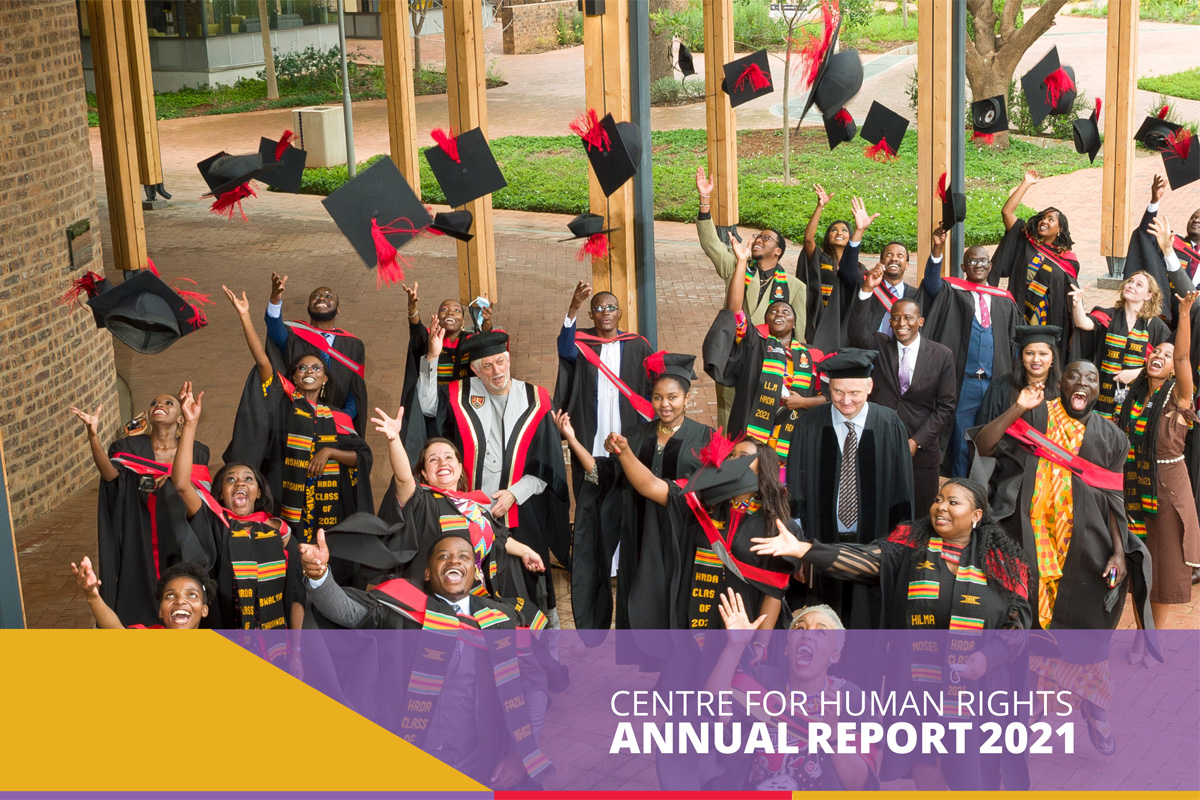
Annual Report for 2021
In 2021, the Centre marked 35 years since its establishment in 1986. The Centre has managed to accomplish much in 35 years, but only because of the support and friendship of its many partners and friends, and its growing pool of graduates who are not only advocates for human rights but also ‘ambassadors’ of the Centre.
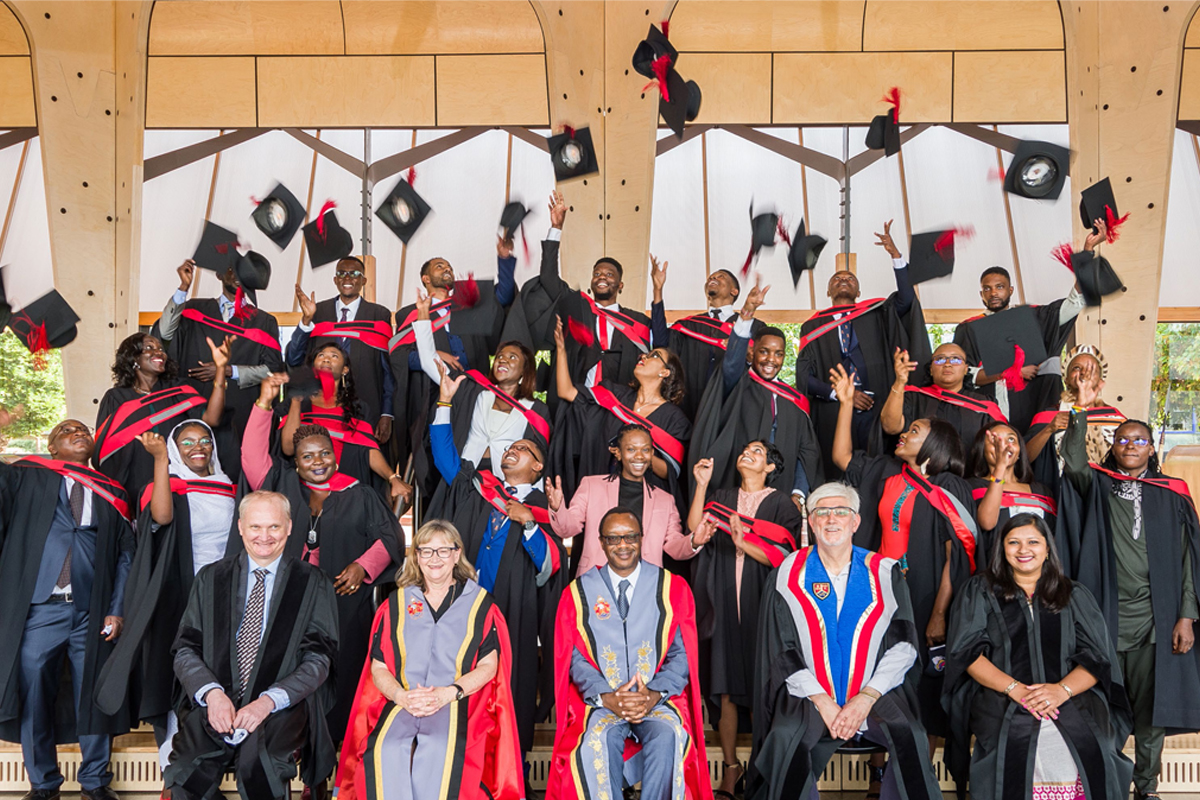
Annual Report for 2020
Despite the challenges, that came with the pandemic the, Centre staff adjusted with imagination and enthusiasm, and explored new ways of doing things and of growing in new directions. All the academic programmes were completed as scheduled, and the major events, such as the #AfricanMoot and Nelson Mandela World Human Rights Moot Court Competitions, took place through Zoom.
Annual Report 2020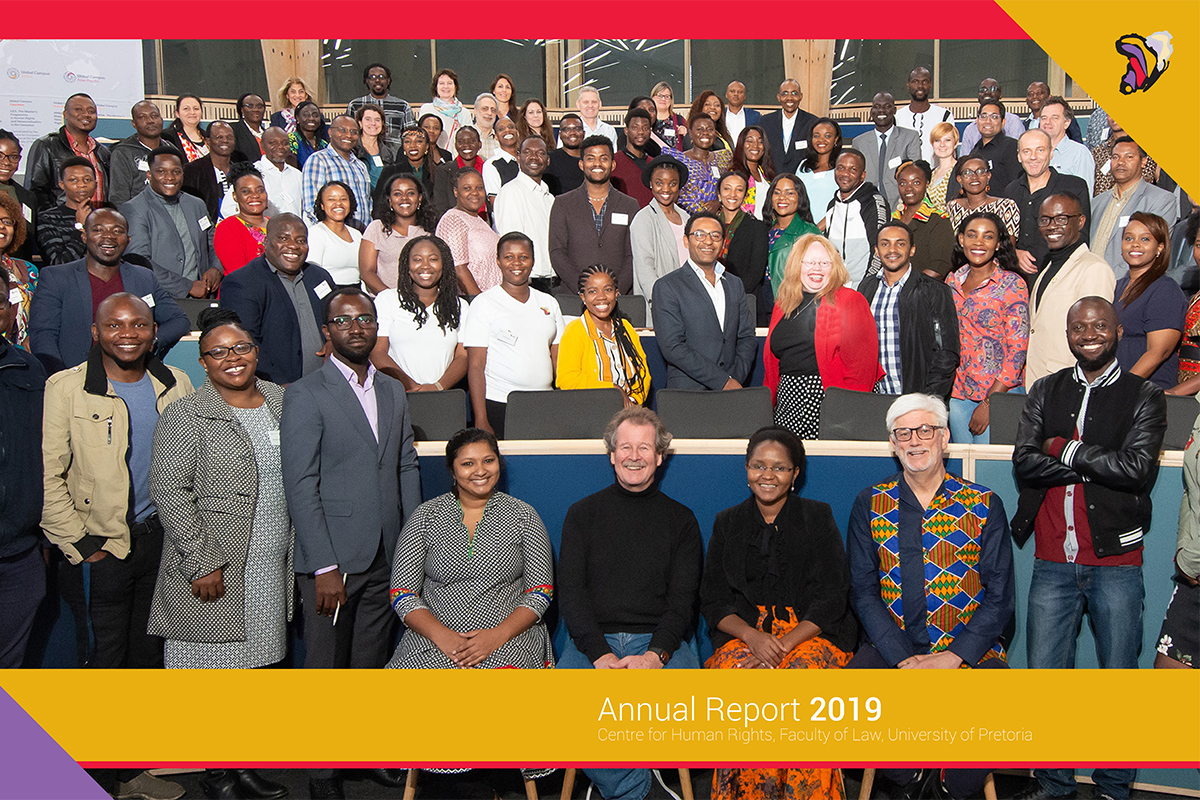
Annual Report for 2019
In an age during which human rights are increasingly intellectually questioned, and placed under political threat, it is reassuring and important that human rights institutions still prosper. In 2019, the Centre for Human Rights forged ahead to establish itself as a credible institution advancing the rights of particularly the most vulnerable among us in Africa, and to raise levels of understanding and awareness of rights on the continent.
Annual Report 2019
Annual Report for 2018
In 2018, the Centre – together with the rest of South Africa and the world – celebrated a number of human rights landmarks. We marked 100 years since the birth of one of the greatest sons of our soil and one of the greatest human rights icons, Nelson Mandela.
The Centre continued its manifold activities towards fostering a human rights culture in Africa, with academic programmes, research, contributing to the human rights discourse in Africa, advocacy and capacity building
Annual Report 2018
Annual Report for 2017
The Centre for Human Rights has over a decade established itself as a place of academic excellence. With the NRF ratings of 4 colleagues reconfirmed in 2017, all but one of the Centre’s 7 academics have a B or C rating. With 12 doctoral candidates graduating, the Centre saw the largest number of doctorates completing their studies in one year. In addition, 57 students graduated with Master’s degrees. This number included the first 5 graduates of the LLM/MPhil in Sexual and Reproductive Rights in Africa.
Annual Report 2017
Annual Report for 2016
The year 2016 was a year of remarkable coincidence and celebration. Both the Centre for Human Rights and the African human rights system commemorated 30 years of existence.
Over these three decades, both the Centre and the African human rights system grew in the scope of its activities and number of its staff, and have undergone consistent growth, strengthening and reinforcement, a process that can be described as ‘institutionalisation’
Annual Report for 2015
The highlight certainly was the ten doctoral degrees awarded to candidates registered in the Centre. This record number reflects one of the Centre’s aims, which is to contribute to the academic discourse and academic capacity in Africa. The Centre further runs four Master’s programmes, of which the LLM/MPhil in Human Rights and Democratisation in Africa has been in place the longest, with 455 alumni across the continent.
Annual Report 2015
Annual Report for 2014
In 2014 the Centre continued towards its primary aim of strengthening human rights in Africa, with a particular focus on supporting and improving the African regional human rights system, established under the auspices of the African Union (AU). In addition to working closely with a number of mechanisms of the African Commission, the Centre also supports the mandate of two UN Special Rapporteurs.
Annual Report 2014
Annual Report for 2013
The year 2013 provided numerous highlights.As an academic department, the Centre once again presented the Master’s programme in Human Rights and Democratisation in Africa. Twenty-six students from 19 countries graduated on 10 December 2013. This programme, which started as a Master’s in Law (LLM) in 2000, was changed in 2013 to also allow non-lawyers onto the programme, who graduate with the degree MPhil.
Annual Report 2013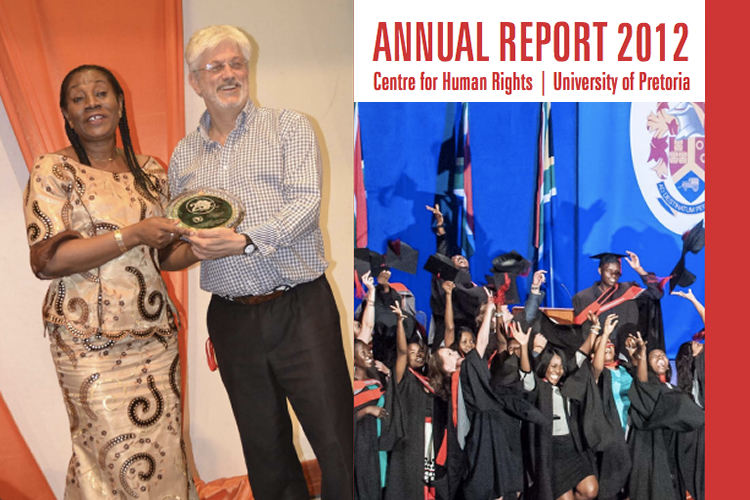
Annual Report for 2012
As this Annual Report testifies, the Centre was in 2012 as busy as ever with academic programmes and a variety of projects aimed at promoting and protecting human rights in Africa. Two highlights should be mentioned. The first is the coming of age of the African Human Rights Moot Court Competition. The Moot turned 21 in Maputo, Mozambique, as the Law Faculty of Eduardo Mondlane University became the first of the hosting institutions to organise the Moot for the second time.
Annual Report 2012
Annual Report for 2011
In 2011, the Centre looked back at its beginning, in 1986, the dark days of apartheid at a whites-only university. A conference on the possibilities of social justice, constitutionalism and a bill of rights in a future South Africa brought together an unlikely group of people, from all political perspectives – including those fiercely critical of the government of the day. Following the conference, Johann van der Westhuizen, then professor and head of department in the Faculty of Law, and other colleagues at the University of Pretoria founded the Centre.
Annual Report 2011
Annual Report for 2010
The year 2010 started on a very sad note for us at the Centre for Human Rights, when Gill Jacot Guillarmod passed away on 15 January after a brief period of illness. Gill was our respected and inspirational senior liaison officer. Gill was also our dear friend, trusted confidante, the beloved grandmother to our children, and the core of our social being. More than anyone else, she symbolised the kind heart and the sincere humaneness to which we as a Centre aspire.
Annual Report 2010
Annual Report for 2009
The year 2009 was dominated by the ten-year celebration of one of the flagship programmes of the Centre, the LLM (Human Rights and Democratisation in Africa). The highlight was the annual partners’ conference and graduation, which this year saw the participation of more than eighty alumni of the programme. As has become customary, the class of 2009 graduated on 10 December. Four doctoral candidates of the Centre also graduated. On that occasion, an honorary doctorate was awarded to the United Nations High Commissioner for Human Rights, Justice Navi Pillay.
Annual Report 2009
Annual Report for 2008
Since its formal recognition as an academic department in the Faculty of Law, the Centre for Human Rights has been able to invest its efforts in both formal academic programmes, on the one hand, and research, advocacy and less formal human rights teaching and training, on the other. The Centre continued with the Master’s in Human Rights and Democratisation in Africa, again preparing 30 of Africa’s most talented young lawyers to make a difference within the sphere of international human rights law in Africa.
Annual Report 2008
Annual Report for 2006 / 2007
During 2006 the Centre for Human Rights consolidated the shift of its focus of the last few years to a more explicit academic one, which culminated in the Centre becoming a fully-fledged academic department of the Faculty of Law. It was particularly gratifying that the work of the Centre over many years was recognised by the United Nations, when the Director-General of UNESCO announced on 10 December 2006 that the Centre had won the UNESCO Prize for Human Rights Education.
Annual Report 2006 / 2007
Annual Report for 2005
In January 2005, the Centre moved to its new offices and it now occupies two floors in the new Faculty of Law building of the UP. The move to a modern building, next to the Oliver R Tambo Law Library, was widely considered to be a huge improvement. The Masters’ programmes in human rights and trade and the short courses on good governance had full intakes, and brought outstanding lecturers and students from around Africa and abroad to Pretoria.
Read More
Annual Report for 2003
The year 2003 saw the consolidation and expansion of several projects at the Centre for Human Rights, as reflected in these pages.
The Centre now has a strong focus on academic issues, and in addition to Master’s Programmes and courses, an increasing stream of publications on Human Rights Law in Africa is emanating from the Centre.
Annual Report for 2002
2002 saw the consolidation and expansion of several projects at the Centre for Human Rights. Highlights involved the following: The African Human Rights Moot Court Competition was held for the 11th time and took place in Cairo; the continental LLM in Human Rights and Democratisation had its third intake; the Centre hosted the Jessup Competition and the Integrated Bar Project again placed about 150 senior black law students on internships with law firms.
Annual Report 2002
Annual Report for 2001
The rich diversity of the activities of the Centre for Human Rights during the year 2001 is captured in this report. The central focus of the Centre for Human Rights is on human rights law in Africa.
The Centre aims to make a contribution in this field through a number of projects, ranging from masters courses and short courses, to moot courts and research and publications.
Annual Report for 2021
In 2021, the Centre marked 35 years since its establishment in 1986. The Centre has managed to accomplish much in 35 years, but only because of the support and friendship of its many partners and friends, and its growing pool of graduates who are not only advocates for human rights but also ‘ambassadors’ of the Centre.
- Details
Institute for International and Comparative Law in Africa (ICLA)
The Institute for International and Comparative Law in Africa (ICLA) is a research institute located in the Faculty of Law of the University of Pretoria.
- Details
Constitution: Centre for Human Rights
(Faculty Board, Faculty of Law, 20 February 2023 Senate, University of Pretoria, 18 May 2023, S1828/23)
1. VISION AND MISSION
1.1 The vision of the Centre for Human Rights (“the Centre”) is a world in which everyone enjoys human rights and democratic governance.
1.2 The mission of the Centre is to work towards the realisation of human rights, particularly of the most vulnerable, with a focus on Africa, through innovative, cutting-edge and impactful teaching, training, research, capacity building, strategic litigation, advocacy and publication.
1.3 The Centre strives for ubuntu (humanity) and excellence in all its undertakings.
2. VALUES
2.1 The Centre is guided by human rights, in particular the principle of non-discrimination, equality, human dignity, and respect for everyone. It adopts a human rights-based approach to all its activities.
2.2 We are bound by and uphold all University policies. In particular, we strongly disapprove of sexual harassment, misuse of authority, racism, homophobia, and other forms of intolerance. The Centre is committed to transformation and diversity in its programmes, projects, staff composition and internal functioning.
2.3 We act with compassion to ensure the inclusion and protection of those most vulnerable to human rights violations.
2.4 We aim to provide a non-judgmental and participatory convening space where intellectual freedom prospers. We fully subscribe to the principle of academic freedom.
2.5 We commit ourselves to act with integrity in all our endeavours, by acting with fairness to all.
2.6 We consider ourselves to be accountable to everyone involved in our work, our partners, our colleagues, the Faculty and the broader University. We uphold the principle of transparency.
2.7 We commit ourselves to act with excellence and professionalism, and be effective and efficient in our use of resources and our reporting to donors, in terms of specific grant agreements.
2.8 We strive to advance the spirit of ubuntu by cultivating acceptance of diversity and difference, and by working in solidarity with each other and our partners.
2.9 We endeavour to foster a critical pan-African identity.
2.10 We commit ourselves to invest in the future of Africa’s youth.
3. STATUS
3.1 The Centre has a dual nature:
- It is an academic department within the Faculty of Law, and subject to all the academic prescripts and Regulations of the University.
- It is also a non-profit human rights institution housed by the University, with a specific focus on human rights-based research, education, capacity building, advocacy and publication. In this respect, the Centre carries out public benefit activities, in a non-profit manner and with an altruistic intent.
3.2 These two components are not separate from each other, but are inter-related and function in complementarity with each other in order to further enhance the principles of human rights in the University, domestically, regionally and globally.
3.3 The Centre will not use its resources directly or indirectly to support, advance or
oppose any political party.
3.4 The Centre reports annually to the Board of the Faculty of Law (Faculty Board) on its activities, income and expenditure.
3.5 The Centre reports annually to the Centre’s Advisory Board on the activities undertaken.
4. GOVERNANCE STRUCTURE
4.1 Board of the Faculty of Law
The Board of the Faculty of Law and the Senate of the University are the Centre’s highest decision-making bodies.
4.2 Advisory Board
The Centre has an Advisory Board, which provides strategic advice on sustainability and advocacy-related matters.
4.2.1 Composition
i. The Advisory Board consists of:
- The Dean of the Faculty of Law (who also serves as Chairperson of the Board).
- The Executive Committee of the Centre: the Director, Assistant Directors, Finance Manager, and the Office Manager.
- Two staff members of the Centre, elected by the other members of staff for a non-renewable period of four years.
- Five external members of the broader African human rights community, recognised for their experience and knowledge in the field of human rights, especially in Africa.
These members serve a four-year term, renewable once for another four years.
ii The Executive Committee, after consultation with the full-time staff members of the Centre, proposes candidates for the five external positions referred to under point 4(i)(d) above, for approval by the Faculty Board.
iii In the appointment of these five external members, the need for the Board to reflect the diversity of the African community, especially in respect of race and gender, must be taken into consideration.
iv If any of the five external members of the Board fail to reasonably exercise their duties, they may be relieved of their duties by a formal resolution of the Faculty Board. of the Faculty of Law.
4.2.2 Quorum
- Seven members of the Board form a quorum, provided that at least three external members are present at the meeting.
- Decisions are taken by consensus, and if there is a dispute, by a majority vote.
- The Advisory Board meets at least once a year.
4.3 Executive Committee
4.3.1 Composition
The Executive Committee consists of the Director, Assistant Directors, Financial Manager, and the Office Manager.
4.3.2 Functions and competencies
- The Executive Committee ensures staff development, wherever possible.
- The Executive Committee coordinates the management of the projects of the Centre.
- The Executive Committee co-ordinates fund raising.
- The Executive Committee meets at least once a month. It takes its decisions by consensus, and if there is a dispute, by a majority vote.
4.4 Managers’ Meetings
4.4.1 The Managers of Units, projects, and academic programmes meet at least four times a year. These meetings are convened by the Director. Additional meetings will be convened at the request of at least three Managers.
4.4.2 The meeting serves as a forum to discuss aspects related to the operations of the Centre. The meeting makes recommendations to the Director or Executive Committee.
5. STAFFING STRUCTURE OF THE CENTRE
5.1 Office-bearers
5.1.1 Director
- The Director is responsible for the management and financial control of the Centre.
- The Director is the academic and administrative head of the Centre, overseeing all of the academic aspects of its projects and activities.
- The Director holds the position of head of department, and represents the Centre in the Faculty and University’s management and academic structures.
5.1.2 Assistant Directors
- The two Assistant Directors’ portfolios are: ‘Programmes’ and ‘Operations’ and they oversee the administrative and financial aspects of all programmes, projects and activities of the Centre, in collaboration with the Director.
- The Assistant Directors are responsible for any duty or function delegated to them by the Director, in accordance with the prescripts of the University.
- The Director designates an Assistant Director to serve as Acting Director in his or her absence. When both the Director and the two Assistant Directors are absent at the same time for a significant period, the Executive Committee will appoint an Acting Director in consultation with the Dean of the Faculty.
5.1.3 Financial Manager
- The Financial Manager administers the Centre's funds, working with the Department of Finance of the University of Pretoria.
- The Financial Manager submits monthly financial statements to the Executive Committee, and to the Faculty and the administration of the University as required.
5.1.4 Office Manager
- The Office Manager coordinates the daily activities of the Centre and bears responsibility, at Executive Committee level, for specific projects identified by the Executive Committee.
- The Office Manager is responsible for the secretariat services to the Advisory Board and Executive Committee.
5.1.5 Staff members
- All staff members, including the office-bearers of the Centre, are appointed and remunerated in accordance with the prescripts of the University of Pretoria.
- Programme/Project Officers report to the relevant Programme/Project Manager, who reports to the assigned Executive Committee member.
6. FINANCES
6.1 The Centre raises funds from donor agencies and through courses, and is provided for in the budget of the Faculty of Law of the University of Pretoria.
6.2 The funds raised by the Centre are held by the University of Pretoria, and accounted for in accordance with the financial and audit prescripts of the University.
6.3 The use of the Centre’s funds is audited annually in accordance with the prescripts of the University.
7. AMENDMENT AND REVIEW OF THE CONSTITUTION
7.1 Amendments to the Constitution may be initiated by the Executive Committee or any staff member. Proposed amendments are sent for approval by the Faculty Board and Senate, after consultation with staff.
7.2 The Constitution will be reviewed every five years.
8. DEFINITIONS
In this Constitution, unless the context indicates otherwise:
“Centre” means the Centre for Human Rights;
“Constitution” means the Constitution of the Centre for Human Rights as adopted and approved by the Faculty of Law and Senate of the University;
“Faculty” means the Faculty for Law;
“Faculty Board” means the Faculty Board of the Faculty for Law;
“University” means the University of Pretoria.
Adopted and approved on this 20th day of February 2023.
- Details
The Centre's Advisory Board consists of:
Dean of the Faculty of Law (who also serves as Chairperson of the Board)
the Executive Committee of the Centre: the Director, Assistant Directors, Finance Manager, and the Office Manager.
Two staff members of the Centre, elected by the other members of staff for a non-renewable period of four years.


Five external members of the broader African human rights community, recognised for their experience and knowledge in the field of human rights, especially in Africa. These members serve a four-year term, renewable once for another four years.


- Details
Extraordinary Professors

Extraordinary Lecturers
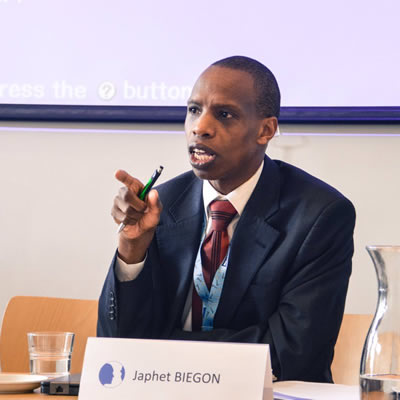




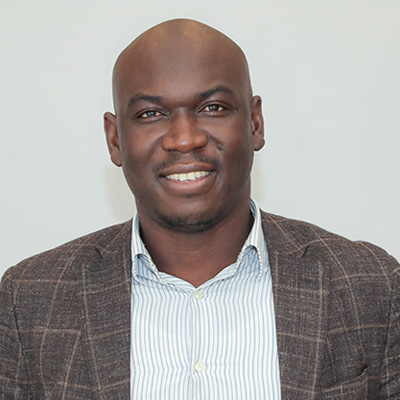

Former Extraordinary Professors
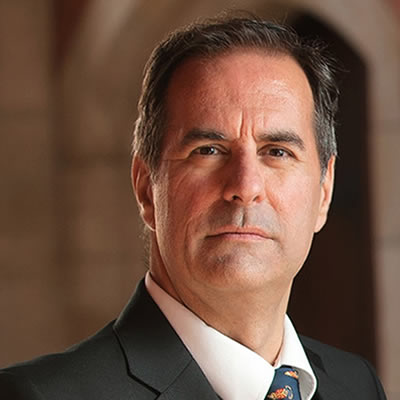
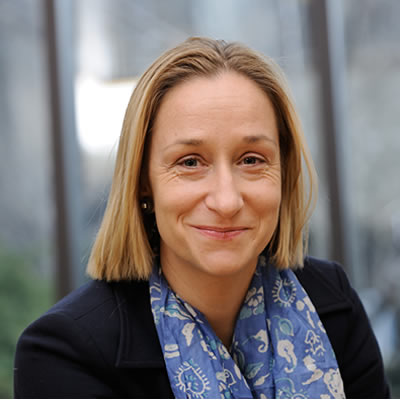

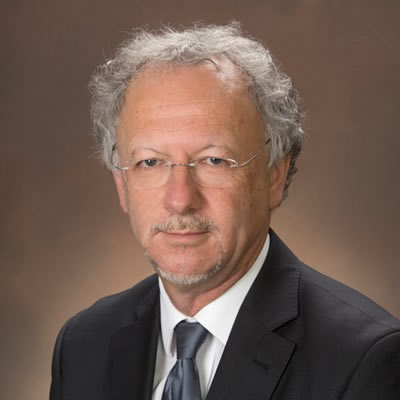

Member: United Nations Committee on the Rights of the Child (2017-2021)
UN Independent Expert on foreign debt and human rights (2008-2014)
Former Honorary Professors
Former Extraordinary Lecturers

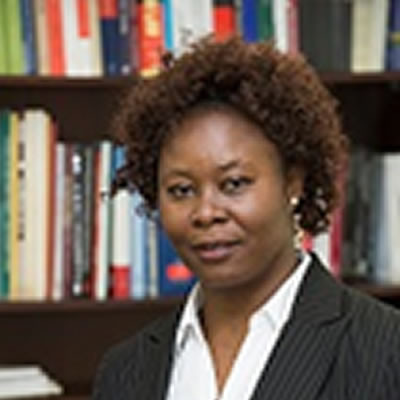
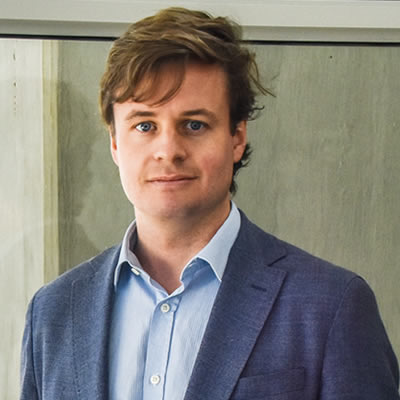


- Details
The Institute for International and Comparative Law in Africa (ICLA) is a research institute located in the Faculty of Law of the University of Pretoria. The ICLA was established at the beginning of 2011 and is located in a renovated double-story house next to the Law Building on the Hatfield Campus. The Institute houses an extensive collection of antique furniture and art and also serves as the Christo Coetzee museum.
Drawing on the extensive networks that the Faculty has established over many years in Africa and beyond, the objective of the ICLA is to become a port of call for those who wish to engage in legal research and legal reform in Africa involving comparative or international law at the advanced level.
 For more information about ICLA, click here
- Details
The mission of International Development Law Unit (IDLU) is to conduct and promote policy-oriented legal research on international development law topics. Its focus is on how international legal principles can be incorporated into the procedures, operating principles, laws and regulations, and structures required to promote sustainable and equitable development at the global, regional, national, and community level, with a particular emphasis on the needs of Africa in general and Southern Africa in particular. Its current activities include the reform of international financial governance and promoting socially and environmentally responsible infrastructure and extractive industry projects.
In addition to its research activities, IDLU also seeks to stimulate discussion and debate on topics related to international development law by arranging lectures and the publication of short articles in the media on topics of current interest relating to international development. It also sponsors doctoral students and participates in the Centre's LLM in International Trade and Investment Law for African Lawyers.
- Details
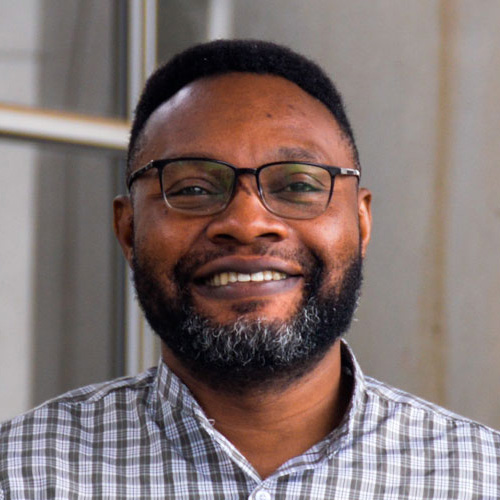
BA(Lesotho) LLB(NWU) LLM(UP)
Project Manager: Advanced Human Rights Courses (AHRC)
Tel: +27 (0) 12 420 4197
dennis.antwi@up.ac.za
Expertise:
Aviation and air law
- Details

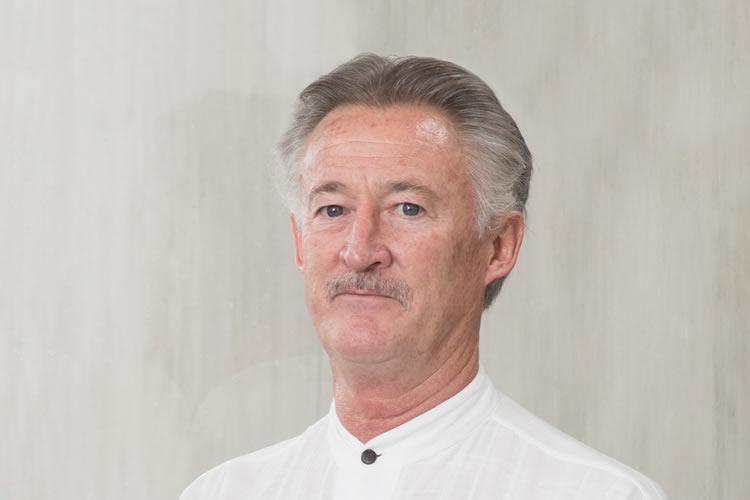
Financial Manager
Executive Committee
Tel: +27 (12) 420 4132
Fax: +27 (0) 86 580 5743
harold.meintjes@up.ac.za
- Details

LLB(UNIZIK) BA(Hons) LLM(UP) LLD Candidate(UP)
Research, Monitoring and Evaluation
Tel: +27 (0) 812654057
Fax: +27 (0) 86 269 6141
linda.ajemba@up.ac.za
- Details
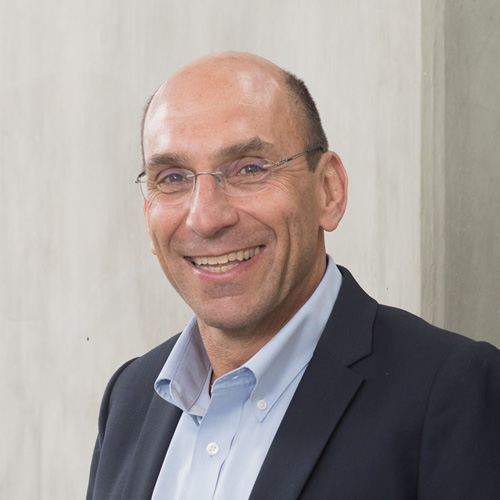
BA(Wits) JD(Northeastern) MLIC(Georgetown) LLD(UP)
Emeritus Professor of Law, American University Washington College of Law
+ 27 (12) 420 6202
danny.bradlow@up.ac.za
Expertise:
Global economic governance, International financial institutions, extractive industries and human rights, financial institutions and human rights, international development law, international economy and human rights, international trade and human rights, foreign investment law and human rights.
Links
- LinkedIn:https://za.linkedin.com/pub/daniel-bradlow/9/b32/b75
- Twitter: @dannybradlow
- Research Gate: https://www.researchgate.net/profile/Daniel_Bradlow/publications
- SSRN:http://ssrn.com/author=283289
- Academia.edu:http://independent.academia.edu/danielbradlow
Other Positions
-
Head, International Economic Relations and Policy Department, South African Reserve Bank (SARB) (February 2013—November 2014)
-
SARCHI Professor of International Development Law and African Economic Relations at the University of Pretoria, South Africa (2009—January 2013) (Extraordinary Professor January 2013—January 2015)
-
Professor of Law, American University Washington College of Law (August 1995-January 2015)
-
Director, International Legal Studies Program, American University Washington College of Law, Washington, DC (July 1996-December 2009);
-
Coordinator, S.J.D. Program (August 2000- December 2006) ,
-
Coordinator Hubert H. Humphrey Program and International Visiting Scholars Program at WCL, (August 2002-December 2009)
-
Professor of Law, American University Washington College of Law
-
Member, Roster of Experts, Independent Review Mechanism, African Development Bank
-
Member, Board of Directors, International Lawyers and Economists Against Poverty (ILEAP)
-
Member, Advisory Board, Law, Social Justice and Global Development Journal
Current Projects
-
Legal Issues in Global Financial Governance
-
Legal Issues Arising from the Social and Environmental Impacts of ExtractiveIndustry and Large Scale Infrastructure Projects
Videos
- Roundtable Discussion: What Role Should Central Banks Play in Dealing with Environmental and Social Challenges like climate change and inequality?
Prof. Daniel Bradlow made inroads in finding alternative funding models for higher education in SA - Foreign Policy during a Global Crisis
- In this edition of Editing Allowed, Hillary Joffe and the panel discuss the pros, cons and potential pitfalls of the IMF's loan to South Africa
- The South African government has asked the International Monetary Fund for $4.2 billion (eNCA 29 July 2002)
- SA Lockdown Day 15 | SA's position in IMF, World Bank virtual Spring Meetings (SABC) (09-04-2020)
- Die IMF se lenings - KN Verslag In Gesprek - 7 Augustus 2019 (KYKNet) (07-08-2019)
- IFI02 - Immunities of International Organizations - Are They Still Viable? (08-11-2017)
- United Nations Audiovisual Library of International Law: International Financial Institutions - International Law and International Financial Institutions
- Strengthening IFIs to Promote Effective International Cooperation (11-11-2012)
- Beyond Markets: Global Economic Governance Africa Project with Danny Bradlow (05-06-2012)
- US Debt - Impact on Emerging Markets with Danny Bradlow, University of Pretoria (18-07-2011)
Podcasts
- Global Summitry, Episode 3: An Interview with Danny Bradlow
Originally Published on The China Africa Project-
Originally Published on Sound Cloud
Online courses
Public Lecture
Teaching
- International Financial Law
- Legal Aspects of International Economic Governance
Media articles
- Op-Ed: Three reasons why the US Federal Reserve Bank holds the world in its hands
- Op-Ed: When the IMF comes to town: why they visit and what to watch out for
- “A Proposal for a new approach to restructuring African Eurobonds: The DOVE Fund and Principles", SouthViews No. 242, 4 Nov 2022 available at: https://www.southcentre.int/
wp-content/uploads/2022/11/ SV242_221104.pdf - Op-Ed: Central banks and climate change: how they can play a role in managing the fallout, 15 November 2021 https://theconversation.com/central-banks-and-climate-change-how-they-can-play-a-role-in-managing-the-fallout-171506
- Op-Ed: The IMF needs an ombudsman with clout, 6 September 2021, www.ft.com/content/1c4ce23e-15f2-4461-b9f7-48a198276fe1?accessToken=zwAAAXxU6Uwgkc8cTOI-FfJEYdO590ihmCdv4Q.MEUCIFJ4Nh9g6Qo0T5Uu3LgDFeXgWDAilq41CbUd6lb6Ed0nAiEAq71PLZ9bowuHsRuWhRQmj8NW1H3wi2E5Tf58JqRmGJk&sharetype=gift?token=e3b72b35-d38c-4a5a-9d07-cf20eaac220f
- Op-Ed: How Africa can seize the moment and start resetting its relationship with the IMF, 19 August 2021 https://theconversation.com/how-africa-can-seize-the-moment-and-start-resetting-its-relationship-with-the-imf-166302
- Op-Ed: Nixon’s decision to delink the dollar from gold still hounds the IMF, South Africa and Africa, 16 August 2021 https://theconversation.com/nixons-decision-to-delink-the-dollar-from-gold-still-hounds-the-imf-south-africa-and-africa-165991
- Introductory Essay: The Role of the Constitution in South Africa's Foreign Policy, 22 March 2021 https://www.afronomicslaw.org/category/analysis/introductory-essay-role-constitution-south-africas-foreign-policy
- How values, interests and power must shape South Africa’s foreign policy, 25 November 2020 https://theconversation.com/how-values-interests-and-power-must-shape-south-africas-foreign-policy-150478?
- Prudent Debt Management and Lessons from the Mozambique Constitutional Council, 5 August 2020, https://www.afronomicslaw.org/2020/08/05/prudent-debt-management-and-lessons-from-the-mozambique-constitutional-council/
- The IMF’s $4bn loan for South Africa: the pros, cons and potential pitfalls, 28 July 2020, https://theconversation.com/the-imfs-4bn-loan-for-south-africa-the-pros-cons-and-potential-pitfalls
- South Africans should accept that the IMF is neither their worst enemy nor their saviour, 22 July 2020, https://theconversation.com/south-africans-should-accept-that-the-imf-is-neither-their-worst-enemy-nor-their-saviour
- Doves, Vultures and African Debt in the Time of COVID-19, 22 May 2020, https://www.afronomicslaw.org/2020/05/22/doves-vultures-and-african-debt-in-the-time-of-covid-19/
- Deterring the Debt Vultures in Africa, 20 May 2020, https://www.project-syndicate.org/commentary/new-fund-can-deter-africa-sovereign-debt-vultures-by-daniel-d-bradlow-2020-05
- Reforming Responsibly: Why Governments Should Assess the Human Rights Impacts of Economic Reforms, 30 April 2020, https://www.southcentre.int/southviews-no-193-30-april-2020/
- "Africa Needs a DOVE Fund", Friedrich-Ebert-Stiftung,15 April 2020, https://www.fes.de/referat-afrika/neugikeiten-referat-afrika/les-etats-africains-vulnerables-ont-besoin-dun-fonds-pour-leurs-dettes [FR]
- "Africa Needs a DOVE Fund", Friedrich-Ebert-Stiftung,15 April 2020, https://www.fes.de/referat-afrika/neugikeiten-referat-afrika/africa-needs-a-dove-fund [EN]
- "Don’t Let African debt enrich the speculators”, Financial Times, 14 April 2020 available at:https://www.ft.com/content/0680d6ce-7d79-11ea-82f6-150830b3b99a?shareType=nongift
- "The big asks Africa needs to table with the IMF and World Bank: here’s the list", The Conversation, 8 April 2020
- "An IMF that works for Africa”, France: The Biarritz Summit, The Global Governance Project, 12 August 2019. The article is available at: www.globalgovernanceproject.org/2019/08/12/an-imf-that-works-for-africa
- "Why central banks need to take human rights more seriously", The Conversation, 14 July 2019.
- "Why central banks need to take human rights more seriously", Open Democracy, 9 July 2019.
- "Why the African Monetary Fund is a good idea and what can be done to get it going", The Conversation, 9 July 2019.
- "July 2019 Summit of the African Union: Jump-starting the African Monetary Fund", Global Development Policy Centre, 8 July 2019
- "Kofi Annan: a complicated legacy of impressive achievements, and some profound failures", The Conversation, 19 August 2018.
- "The BRICS summit: important small steps, but little to show on big issues"The BRICS summit: important small steps, but little to show on big issues", The Conversation, 1 August 2018.
- "How to judge the success of the BRICS summit? Three questions will do the trick", The Conversation, 8 July 2018.
- "Top job for South African gives African countries sway at the IMF", The Conversation, 29 January 2018.
- "BRICS needs a new approach if it’s going to foster a more equitable global order", The Conversation, 20 September 2017.
- "The G20: a necessary evil that can deliver some benefit", The Conversation, 20 March 2017.
- "South African universities: common problems but no common solutions", The Conversation, 26 January 2017.
- "International standards on sovereign debt and business and human rights: Can parallel lines ever meet?", RightingFinance, 19 January 2017.
- "Trump’s victory is bad – for Africa and for global stability", The Conversation, 10 November 2016.
- "Realisation of Fair and Free Access to Tertiary Education within our grasp", ANC Today, 16 October 2016.
- "What Africa should demand from the next United Nations secretary general", The Conversation, 2 October 2016.
- "Funding model plugs tuition, work and public service gaps", Business Day, 19 September 2016.
- "Draghi must accept ECB contributes to inequality", Financial Times, 19 September 2016.
- "The role of central banks is changing. What South Africans should look out for", The Conversation, 28 August 2016.
- "Public Service Would Help Graduates Pay Back Debt", Mail&Guardian, 8-14 July 2016.
- "What can be done to stop the United Nations abusing its immunity", The Conversation, 26 June 2016.
- "UN is now in a position where it can cause real harm — with immunity", Financial Times, 13 June 2016.
- "The UN secretary-general has the most impossible job in the world", Financial Times, 13 June 2016.
- "South Africa faces difficult times, but disaster is not inevitable", The Conversation, 29 February 2016.
- "Perpetual bonds can help open universities to all who qualify", The Conversation, 2 February 2016.
- "What Paris climate deal can teach us about solving the world’s most complex problems", The Conversation, 17 December 2015.
- "Educating young lawyers on their responsibilities", Financial Times, 2 December 2015.
- "World leaders aim high with transformative declaration", Business Day, 22 September 2015.
- "Action agenda can take Africa forward", Business Day, 31 July 2015.
- "Why we need to tread carefully in drawing up human rights rules for business", The Conversation, 29 July 2015.
- "Funding development: Forum aims to narrow gap between global economies", Business Day, 13 July 2015.
- "ICC: sad lesson of lofty ideals trumped by reality repeats itself", The Conversation Africa, 24 June 2015.
- "Global support for Asian bank may hand SA benefits", Business Day, 24 April 2015.
- "Europe should recall its own debt struggles, and be lenient", Business Day, 13 February 2015.
- "SA must invest in UN's 8 Millennium Development Goals", Sunday Independent, 12 August 2012.
- "Let’s help elect a female World Bank head", Businnes Day, 8 August 2012.
- "Does Kim Signal World Bank Changes?", Council on Foreign Relations, 18 April 2012.
- "Africa calls for World Bank reform after Nigerian denied top post", Los Angeles Times", 17 April 2012.
- "Lessons from L’Affaire Lagarde”, G20 UPDATE - Heinrich Böll Stiftung G20 Update Newsletter, Issue #8 - August / September 2011.
- “Positioning Africa for a Role in Global Economic Governance”, Sunday Independent, 10 June 2012.
- “Campaign for World Bank Head Offers Africa Lessons”, Mail & Guardian, 25 April 2012.
- “We Must Lead in Putting Africa First” Mail and Guardian, 9 March 2012.
Media interviews
- "Danny Bradlow on Kofi Annan's complicated legacy of impressive achievements, and some failures", PowerFM, 21 August 2018.
- "What Africa should demand from the next United Nations secretary general", PowerFM, 4 October 2016.
- "Various sides to the Brexit referendum and it's implications", 702, 23 June 2016.
- "Why creating human rights rules in the workplace is important, but sensitive", 702, 9 September 2015.
- "Why We Need To Tread Carefully In Drawing Up Human Rights Rules For Business", PowerFM, 6 August 2015.
- "Compliance Is A Reflection Of The ICC - Prof Danny Bradlow", PowerFM, 24 June 2015.
Academic Publications
Publications available on SSRN
2022
- The International Legal System: Cases and Materials (co-authors: Mary Ellen O’Connell; Naomi Roht-Arriaza, Diane Disierto) (8th Ed, 2022, Foundation Press)
2020
- Values, Interests and Power: South African foreign policy in uncertain times, Edited by Daniel D. Bradlow and Elizabeth Sidiropoulos (2020)
- A Global Leviathan Emerges: The Federal Reserve, COVID-19, and International Law, Daniel D. Bradlow and Stephen Kim Park Volume 114, Issue 4 October 2020 , pp. 657-665
- Advocating Social Change through International Law: Exploring the Choice between Hard and Soft International Law, Daniel D. Bradlow and David B. Hunter (eds, Brill 2019) https://brill.com/view/title/
39143
- "Using a Shield as a Sword: Are International Organizations Abusing Their Immunity?", 31 Temple International and Comparative Law Journal pp44-68 (2017)
- "Don't Waste a Serious Crisis: Lessons from South Africa's Debt Crisis", Sovereign Debt Crises What Have we Learned, P. Boholslavsky and K. Rafer (eds) (Cambridge University Press, forthcoming--2017)
- "Can Parallel Lines Ever Meet? The Strange Case of the International Standards on Sovereign Debt and Business and Human Rights", 41 Yale J. Int'l. L. Online 205 (2016).
- "Lessons from the Frontlines: What I Learned from My Participation in the G20", Global Summitry Advance Access published January 21, 2016 (Listen to the podcast: Global Summitry, Episode 3: An Interview with Danny Bradlow).
- “The International Legal System: Cases and Materials”, (co-authors: Mary Ellen O’Connell, Naomi Roht-Arriaza and Richard Scott)(7th Ed. 2015)
- “Negotiating International Business Transaction: A Practical Skills Approach through an Extended Simulation Module Utilizing Collaborative Teaching Methodology” (co-authored with Jay Finkelstein) (Aspen Publishers) (2013)
- “A Framework for Assessing Global Economic Governance” 36 B.C. Int'l & Comp. L. Rev. 971 (2013) and Boston College Law Review, Vol. 54, 2013 (joint issue)
- “The Operational Policies and Procedures of the World Bank and the International Finance Corporation: Creating Law-Making and Law Governed Institutions” 10 International Organization Law Review 3 (2013) (Co-authored with Andria Naude-Fourie)
- “The G20 and Africa: A Critical Assessment”, South African Institute for International Affairs Occasional Papers Series #145 (Economic Diplomacy Programme) (2013)
- “International Financial Institutions and Global Legal Governance” edited by H. Cisse, D. Bradlow and B. Kingsbury (The World Bank 2012)
- “The Reform of the Governance of the IFIs: A Critical Assessment” “International Financial Institutions and Global Legal Governance” edited by H. Cisse, D. Bradlow and B. Kingsbury (The World Bank 2012)
- “How Well Does the G20 Reflect African Interests and Priorities?: Some Thoughts Following the Los Cabos, Mexico Summit”, paper prepared for the South African Foreign Policy Initiative, Open Society Foundation (August 2012)
- “Roundup: Does Kim Signal World Bank Change?” (with 3 co-authors) Council of Foreign Relations at http://www.cfr.org/world-bank/does-kim-signal-world-bank-changes/p27994, 18 April 2012
- “Rethinking Global Financial Governance”, The World Financial Review, January-February, 2012
- “Independent Accountability Mechanisms at International and Regional Development Banks” (Co-authored with Andria Naude Fourie in Handbook of Innovations in Transnational Governance, D.Held and T. Hale (eds) (2011)
- “Public Participation and the Private Sector: The Role of the Multilateral Development Banks and the Evolving Legal Standards” 4 Erasmus Law Review”2 (2011) (Co-authored with Megan Chapman) available at: http://papers.ssrn.com/sol3/papers.cfm?abstract_id=1971695
- “Reforming Global Economic Governance: A Strategy for Middle Powers in the G20” in Going Global, AIIA and Konrad Adenauer Stiftung (May 2011)
- “Europeans Must Pay to Head IMF”, Foreign Policy in Focus, June 9, 2011 available at http://www.fpif.org/articles/europeans_must_pay_to_head_imf
- “Reforming Global Economic Governance: A Strategy for Middle Powers in the G20” Paper prepared for the workshop on “Going Global: Australia, Brazil, Indonesia, Korea and South Africa in International Affairs”, Jakarta, Indonesia, May 25-26, 2010 (forthcoming publication)
- “Independent Accountability Mechanisms at International and Regional Development Banks” (Co-authored with Andria Naude Fourie in Handbook of Innovations in Transnational Governance, D.Held and T. Hale (eds) (forthcoming)
- D. Bradlow and D. Hunter (eds) International Financial Institutions and International Law, (Kluwer Press, forthcoming). (The co-editors co-wrote the introduction and conclusion for this book.)
- “The Operations of International Financial Institutions and International Law” in “International Financial Institutions and International Law, D. Bradlow and D. Hunter (eds) (Kluwer Press, forthcoming).
- “Social Bonds: Way for Financial Institutions to Embrace Social Challenge” Business Day, 10 March 2010
- “Developing Countries Debt Crises, International Financial Institutions, and International Law: Some Preliminary Thoughts” 2008 German Yearbook of International Law (only published in 2009)
- “Reforming the Global Financial Architecture: Is Real Change Coming?” Global Dialogue, May 2009 (published by Institute for Global Dialogue)
- “Assessing International Financial Reform" to be published in INTERNATIONAL LAW, ECONOMIC GLOBALIZATION AND DEVELOPING COUNTRIES, J. Faundez, C. Tan, eds., Edward Elgar Press, 2010. (available at: http://ssrn.com/author=283289)
- “The G20 and Sustainable IMF Reform” on VOXEU on March 18, 2009, (available at: http://www.voxeu.com/index.php?q=node/3285.)
- “Fixing the IMF”, in Foreign Policy in Focus on March 30, 2009 (available at: http://fpif.org/fpiftxt/6002)
- “ Large Land Deals, Outsourcing and Responsible Development”, www.VoxEu.com, July 24, 2009 (available at: http://www.voxeu.com/index.php?q=node/3798)
- “Reconciliation financing: An Innovative Approach to Poverty, Inequality, and Social Conflict” published on VOXEU.COM, available at: http://www.voxeu.com/index.php?q=node/4051
- Written lectures for a 4-Part On-line Course on Global Financial Governance Offered by United Nations Institute on Training and Research (UNITAR) Materials available at SSRN: http://papers.ssrn.com/sol3/papers.cfm?abstract_id=1488020
- “An Experiment in Creative Financing to Promote Reconciliation and Development In South Africa” in Africa’s Finances: The Contribution of Remittances, R. Bardouille, M. Ndulo and M. Grieco (eds., 2008) ( also available at: http://papers.ssrn.com/sol3/papers.cfm?abstract_id=987506)
- “The Changing International Business Context and the Challenge it Poses for the Education of International Business Lawyers", Proceedings of the Conference on “The Law of International Business Transactions: A Global Perspective” International Association of Law Schools, Hamburg, Germany, (April, 2008) available at: http://papers.ssrn.com/sol3/papers.cfm?abstract_id=1128158
- “Training Law Students to be International Transactional Lawyers – Using An Extended Simulation To Educate Law Students About Business Transactions” (Co-authored with Jay Finkelstein) 1 Pepperdine Journal of Business, Entrepreneurship and the Law 67 (2007). (also available at: http://papers.ssrn.com/sol3/papers.cfm?abstract_id=1084071)
- “The Changing Role of the IMF in the Governance of the Global Economy and Its Consequences” 2007 South African Yearbook of International Affairs (2007)
- “Private Finance, Social Responsibility and Transitional Justice: The Case for South African Reconciliation and Development Bonds”, 15:1 Human Rights Brief 7 (2007)
- Regulatory Frameworks for Water Resource Management: A Comparative Study (Co-author with Salman Salman) (The World Bank, Law, Justice and Development Series, 2006)
- Entry on “The World Bank Group” in Robertson, Roland, and Jan Aart Scholte, (eds.) Encyclopedia of Globalization. (New York: Routledge, 2006)
- Differing Conceptions of Development and the Content of International Development Law” 21:1 South African Journal of Human Rights (2005) reprinted in Development and Economic Resources, from Encyclopedia of Life Support Systems (EOLSS), Developed under the Auspices of the UNESCO, Eolss Publishers, Oxford ,UK, available at http://www.eolss.net
- “Private Complainants and International Organizations: A Comparative Study of the Independent Inspection Mechanisms in International Financial Institutions”, 36 Georgetown J. Int’l. L 403 (2005).
- “At the Mercy of Vultures: Sovereign Creditors in the Courts”, in Ad Honorem Ion Dogaru:Studii Juridice Alese, (Rumania, 2005), (with Ruxandra Burdescu)
- “Operational Policies and Procedures and an Ombudsman”, in Accountability of the International Monetary Fund, B. Carin and A. Wood (eds., 2005)
- “Development Decision Making and the Content of International Development Law”, 27 B.C. Intl. & Comp. L. Rev. 195 (2004)
- “The Governance of the International Financial Institutions: The Need for Reform”, 43 Indian Journal of International Law,” 533 (2003).“Best Practices and Key Issues to be Addressed in a Regulatory Framework for Public Debt Management,” (UNITAR Best Practices Series No. 4) (2003).
- “The Changing Context for Negotiations with International Financial Institution and How African Countries Can Respond To It” (UNITAR Discussion Document No. 19) (2003).
- “The Governance of International Financial Institutions: The Need for Reform”, Proceedings of the 2003 Hague Joint Conference on Contemporary Issues of International Law, The Hague, Netherlands, (July 2003) (TMC Asser Press)
- “Regulatory Frameworks for Dam Safety: A Comparative Study” (Co-author with Alessandro Palmieri and Salman Salman) (The World Bank, Law Justice and Development Series, 2002) (book has been translated into Chinese, French and Russian)
- “Should The International Financial Institutions Play a Role in The Implementation and Enforcement of International Humanitarian Law?”, 50 Kansas Law Review 695 (2002)
- The Changing Dynamics of International Financial Negotiations,” MEFMI Forum (December 2001).
- “Lessons From the NGO Campaign Against The Second Review of the World Bank Inspection Panel,” 7 ILSA Journal of International & Comparative Law 247 (2001).
- “The Times They Are A ‘Changin’: Differing Conceptions of Development and the Reform of the WTO,” 33 George Washington International Law Review 503 (2001)
- “Stuffing New Wine Into Old Bottles: The Troubling Case of the IMF,” 3 Journal of International Banking Regulation 9 (2001).
- “The World Commission on Dams and Its Contribution to the Broader Debate on Development Decision-Making,” 16 American University International Law Review 1531 (2001) (reprinted reprinted as “Mediating the Traumas of Techno-Economic Change: A Case Study in Popular Input” in The Future of Peace, N. Kittrie, H. Carazo and J. Mancham (eds) (2003).
- “The Role of the World Bank in Post-Conflict Situations,” Proceedings of the 95th Annual Meeting of the American Society of International Law, Washington, DC (April 2001).
- “Some Lessons About the Negotiating Dynamics in International Debt Transactions” (UNITAR Discussion Document No. 9) (2000).
- “The Review of the IMF’s Enhanced Structural Adjustment Facility” (UNITAR Discussion Documents No. 7) (2000).
- “The Role of The Lawyer in International Debt Operations in Developing Countries” (UNITAR Discussion Documents No. 6) (2000).
- Rapidly Changing Functions and Slowly Evolving Structures: The Troubling Case of the IMF,” Proceedings of the 94th Annual Meeting of the American Society of International Law, Washington, DC (April 2000).
- Cropper, A; Bradlow, D; and Halle M. 2000 “Regulation, Compliance, and Implementation” Thematic Review Paper, Vol. 4. (Prepared as an input to the World Commission on Dams, Cape Town, www.dams.org).
Selected Other Publications
- “The World Bank, the International Monetary Fund and Human Rights,” 6 Journal of Transnational Law and Contemporary Problems 68 (1996).
- “A Test Case for the World Bank,” Am.U. J. Int'l. L. and Pol'y 247 (1996).
- “Limited Mandates and Intertwined Problems: A New Challenge for the World Bank and the IMF,” 17 Human Rights Quarterly 411 (co-authored with Claudio Grossman) (1995).
- “International Organizations and Private Complainants: The Case of the World Bank Inspection Panel,” 34 Virginia Journal of International Law 553 (1994).
- “The World Bank's New Inspection Panel: A Constructive Step in the Transformation of the International Legal Order,” 54 Zeitschrift für Ausländisches Öffentliches Recht und Völkerrecht 392 (Max-Planck Institute) (co-authored with S. Schlemmer-Schulte) (1994).
- “Are We Being Propelled Towards a People: Centered Transnational Legal Order?” 9 Am. U. J. Int'l. L. and Pol'y 1 (co-authored with Claudio Grossman) (1993).
- “The Case for a World Bank Ombudsman,” Hearings on Appropriations for International Financial Institutions, US House of Representatives Banking, Finance, Trade and Monetary policy (May 1993).
- Testimony on “The Need for a World Bank Ombudsman,” Sub-Committee on International Financial Institutions, Standing Committee on Finance, Canadian House of Commons, Ottowa, Canada (February 1993).
- Legal Aspects of Foreign Direct Investment, (co-editor), (Kluwer Press) (1999).
- Details
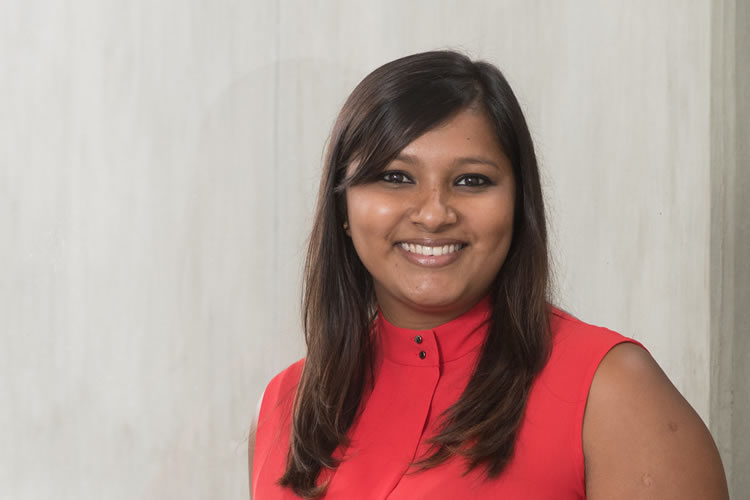
LLB(UP) LLM(HRDA)(UP) LLD(UP)
Program Manager: LLM/MPhil Human Rights and Democratisation in Africa
Tel: +27 (0)12 420 6703
Fax: +27 (0) 86 580 5743
ashwanee.budoo@up.ac.za
Media Publications
- Rights of LGBTIQ+ Persons in Africa During COVID-19
Originally published on Global Campus of Human Rights
30 July 2020 - Controls to manage fake news in Africa are affecting Freedom of Expression
Originally published in The Conversation
11 May 2020 - Constitutionality of the Regulations adopted to combat COVID-19 in Mauritius
Originally published in ANCL
2 May 2020
- Rescuing Human Rights in Mauritius During the COVID-19
Originally published in Verfassungsblog
22 April 2020
- Details
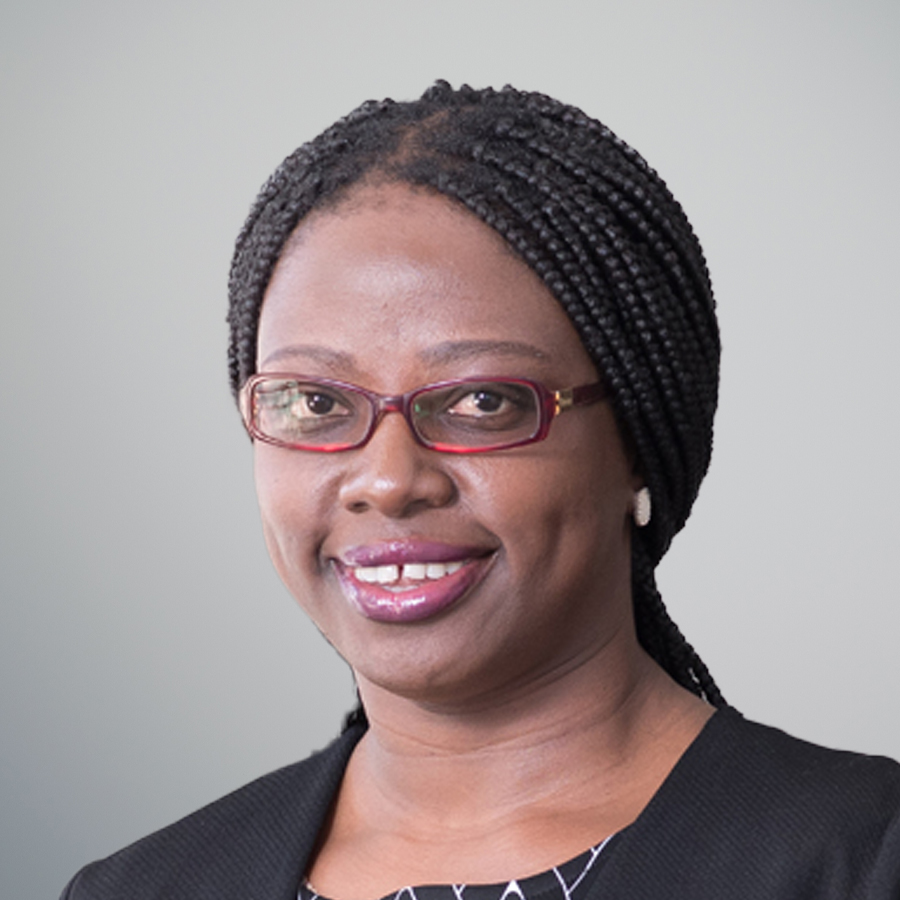
LLB(cum laude)(UFH) LLM(UP) LLD Candidate (UP)
Project Officer: LLM/MPhil (SRRA)
Tel: +27 (0)12 420 4196
rutendo.chinomona@up.ac.za
- Details
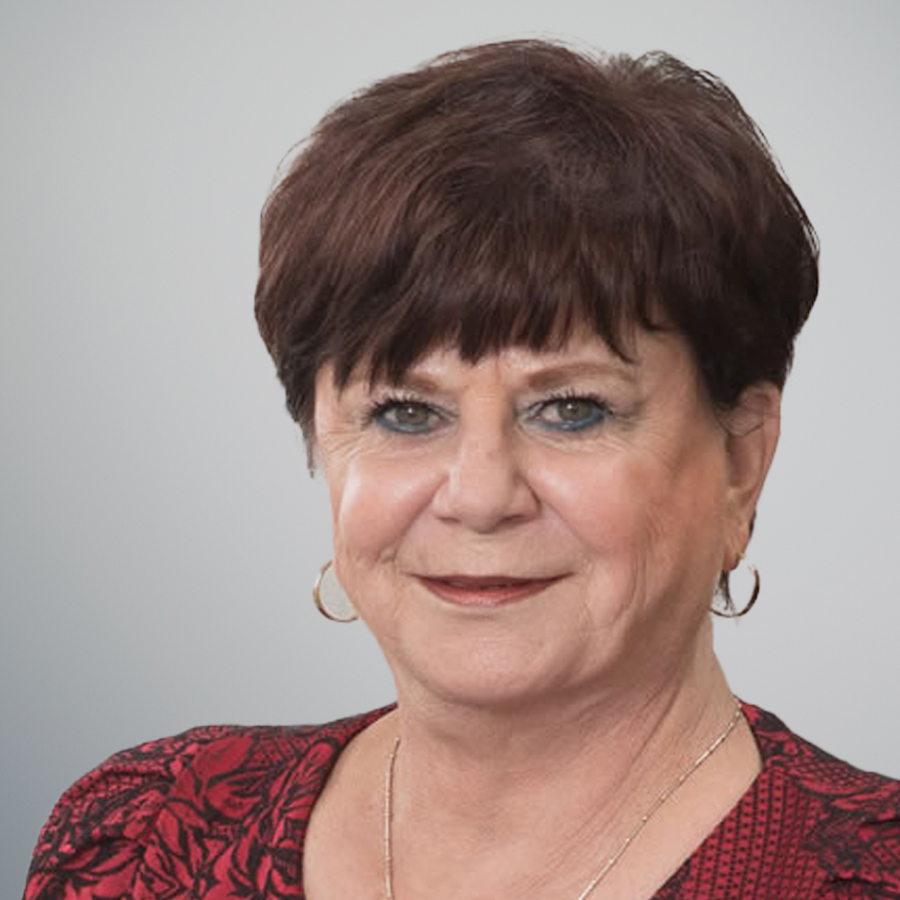
BA (Stell) LLB (UNISA)
Publication Manager: African Human Rights Law Journal
Tel: +27 (0) 12 420 3034
idemeyer1@gmail.com
- Details

Project Officer, Women’s Rights Unit
BL(Ng) LLB(Bjl) LLM(UP) LLD Candidate (UP)
Tel: +27 (0) 12 420 4532
Fax: +27 (0) 86 580 5743
henrietta.ekefre@tuks.co.za
- Details
Academic Coordinator: LLM/MPhil Multidisciplinary Human Rights (MDHR)
Tel: +27 (0) 12 420 4532
Fax: +27 (0) 86 580 5743
michelo.hansungule@up.ac.za
Expertise:
Refugee rights, socio-economic rights, SADC Tribunal, International Criminal Court, Zambia, Zimbabwe, rule of law, African Peer Review Mechanism (APRM), democracy in Africa, democratic transition, elections, children's rights, constitutional development, African Union – Political Division, United Nations human rights protection system in Africa; African Commission and Courts of human rights; African refugees under the African system; International humanitarian law in Africa; Women's rights under the African system; Committee on the Rights of the Child; Traditional Leadership and human rights; National Human Rights Institutions (NHRIs)
Although retired, Prof Hansungule will continue to engage with a number of doctoral students until their completion.

- Details
LLB(UP) MA LLM(Yale) PhD(Wits)
Professor of Human Rights Law
Director: Institute for International and Comparative Law in Africa (ICLA)
Member of the United Nations Human Rights Committee
pumeza.matwa@up.ac.za
Expertise:
United Nations, human rights in Africa, the right to life
- Details
LLB (UP) LLM Candidate (UP)
Special Projects Coordinator
Programme Manager: LLM/MPhil, LLD/DPhil Sexual and Reproductive Rights in Africa (SRRA)
Tel: +27 (0) 12 420 3587
Fax: +27 (0) 86 580 5743
thuto.maqutu@up.ac.za
- Details
LLB(Nigeria) BL(Nigeria) LLM(UP) LLD Candidate
Communications and Advocacy Officer
Tel: +27 (0) 12 420 5408
david.ikpo@up.ac.za
- Details
Project Officer: Women’s Rights Unit
Tel: +27 (0) 12 420 125
Fax: +27(0) 86 269 6141
annie.bipendu@up.ac.za
- Details
LLB(Catholic University of Eastern Africa) Advocate Dip(Kenya School of Law) LLM(UP) LLD Candidate (UP)
Project Officer: Women’s Rights Unit
Tel: +27 (0) 12 420 5408
Fax: +27 (0) 12 362 5125
mariam.kamunyu@gmail.com
- Details

BJuris LLB(UNAM) LLM(UP) LLD Candidate (UP)
Tutor/ Editorial Assistant: African Human Rights Law Reports
Tel: +27 (0) 12 420 4197
Fax: +27 (0) 86 580 5743
kennedy.kariseb@up.ac.za
- Details
BA(Hons)(UP) BAdmin(Hons)(UP) MPhil(MDHR)(UP) Dhil Candidate (UP)
Project Coordinator: Nelson Mandela World Human Rights Moot Court Competition
+27 (0) 12 420 4754
eduardo.kapapelo@up.ac.za
Media articles
- Democracy in times of COVID-19: a time for introspection?
Originally published in AfricLaw
8 April 2020
Podcast
In this episode, Dr Eduardo Kapapelo who was awarded a Doctor of Philosophy degree (DPhil) from the Centre for Human Rights at the Faculty of Law, University of Pretoria discusses his doctoral thesis. In his thesis, Dr Kapapelo identifies how reforming the state and its institutions are vital not only for the prevention of violence, but for the establishment of democratic governance. His dissertation titled “The Role of State Institutions in Preventing Violent Conflict in Angola” explores the nature of Angola’s institutions and how they have created conditions under which individual rights and liberties are undermined. This thesis argues that overly- centralised states have a hand in contributing towards the emergence of conflict and that the design of the state, through its institutions, is paramount in safeguarding individual rights and in doing so, preventing the occurrence and or resurgence of violence. Furthermore, the thesis contends that while there are both global and regional mechanisms for the protection of human rights which promote values of peace, inclusiveness and democratic governance, states are still the main actors in international politics. As such it is their responsibility to structure institutions which would reflect such values based on their local contexts and realities.
- Details

Academic Coordinator: LLM/MPhil Human Rights and Democratisation in Africa (HRDA)
Professor of Human Rights Law
jur kand (Lund) EMA (Padua) LLD (UP)
https://orcid.org/0000-0001-8728-5368
+27 (0)12 420 4507
magnus.killander@up.ac.za
Expertise:
International organisations (UN, AU, SADC etc.), relationship between international and domestic law, international human rights law, foreign policy and human rights, comparative constitutional law in Africa
- Details
BA Law(NWU) LLB(UP) LLM(UP)
Communications and Advocacy Officer
+27 (0) 12 420 5408
simphiwe.khumalo@up.ac.za
- Details

Ms Nthope Mapefane
LLD Research Assistant: International Development Law Unit
Fax: +27 (0) 86 580 5743
Tel: +27 (0) 12 420 5296
nthope.mapefane@up.ac.za
- Details
LLB(Wits) LLM(International and Comparative Disability Law and Policy (Galway)
Project Manager: Disability Rights and Law Schools ProgrammeTel: +27 (0) 12 420 6398
Fax: +27 (0) 86 580 5743
innocentia.mgijima@up.ac.za
- Details

BA Ed(University of Oradea, Romania), MPhil (MDHR) (UP)
Project Coordinator: Children’s Rights Unit
Tel: +27 (0) 12 420 6398
Fax: +27 (0) 86 580 5743
alina.miamingi@up.ac.za
- Details
LLD, LLM (University of Pretoria), LLB (University of The Gambia)
Post-Doctoral Fellow: LLM/MPhil (SRRA)
Tel: +27 (0)12 420 5485
satang.nabaneh@up.ac.za
Expertise:
Sexual and Reproductive Rights, Comparative Constitutional Law, Human Rights Law, Health and Human Rights, Women’s Human Rights, Gender Equality, Gambian Constitutional Law, Policy Analysis and Socio-Legal Empirical Research.
Links
- Research Gate: https://www.researchgate.net/profile/Satang_Nabaneh
- Twitter: https://twitter.com/DrSatangNabaneh
- Website: www.satangnabaneh.com
Current Projects
- Transforming thesis titled “Power dynamics in the provision of legal abortion: A feminist perspective on nurses and conscientious objection in South Africa" (2020) into book.
- Co-editing book “The Gambia in transition: Towards a new constitutional order’ for Pretoria University Law Press (PULP)
Teaching
- International human rights law
- Women’s Rights
- Sexual & Reproductive Rights
- Research Methodology
- Qualitative Research Methods
- African law and society scholarship
Supervision: LLM/MPhil Dissertations
Co-Supervisor (with M Killander): Husselmann, C ‘Abortion law in Namibia and South Africa’ (2019) LLM Dissertation, University of Pretoria
Academic Fellowships and Grants
- Junior Scholar Workshop Awardee, Law and Society Association (2019)
- African Doctoral Dissertation Research Fellowship, African Population and Health Research Center (APHRC), Kenya (2018-2020)
- Fellow, Comparative Law & Societies Study (CLASS), Law, Societies & Justice Department, University of Washington, USA (2017-2021)
- Doctoral Fellowship, Chr. Michelsen Institution (CMI) and Centre on Law and Social Transformation, University of Bergen, Bergen, Norway (2016-2019) as part of the project on political determinants of sexual and reproductive health in Africa (Research Council of Norway #248159).
- Winner of the Victor Dankwa Prize for the best performance in the Module: Human Rights in Africa in the 2012 LLM (Human Rights and Democratisation in Africa) program (2012)
- DAAD Scholar: German Academic Exchange Service Scholarship to pursue a Master of Laws (LLM) in Human Rights and Democratization in Africa at the Centre for Human Rights, University of Pretoria. (2012)
- Gambian government Scholarship to study law at the University of The Gambia (2007-2011)
Publications:
2021
-
Nabaneh, Satang: The Use of Emergency Powers in Response to COVID-19 in The Gambia, VerfBlog, 2021/5/06, https://verfassungsblog.de/the-use-of-emergency-powers-in-response-to-covid-19-in-the-gambia/, DOI: 10.17176/20210506-111540-0.
- S Nabaneh ‘Abortion and ‘conscientious objection’ in South Africa: The need for regulation’ in E Durojaye, G Mirugi-Mukundi & C Ngwena (eds) Advancing Sexual and Reproductive Health and Rights in Africa Constraints and Opportunities (Routledge, Forthcoming 2021)
- S Nabaneh (with E Durojaye) ‘Addressing Female Genital Cutting/Mutilation (FGC/M) in The Gambia: Beyond Criminalisation’ in E Durojaye, G Mirugi-Mukundi & C Ngwena (eds) Advancing Sexual and Reproductive Health and Rights in Africa Constraints and Opportunities (Routledge, Forthcoming 2021)
2020
- S Nabaneh, G Sowe & M Saine, ‘Gambia’ in R Albert et al (eds). The I·CONnect-Clough Center 2019 Global Review of Constitutional Law (November 26, 2020), pp. 129-133. Available at: https://papers.ssrn.com/sol3/papers.cfm?abstract_id=3736382.
- S Nabaneh ‘Maintaining the Independence of the African Commission On Human And Peoples’ Rights: A Commentary On The Rules Of Procedure, 2020’ (August 24, 2020) Coalition for the Independence of the African Commission. Available at: (English) https://achprindependence.org/wp-content/uploads/2020/08/CIAC_RoP_Nabaneh_Rules-of-Procedure.pdf; (French): https://achprindependence.org/wp-content/uploads/2020/08/CIAC_FRRoP_Nabaneh_Rules-of-Procedure.pdf.
- S Nabaneh ‘Becoming an African Feminist Parent’ in RS Dieng & A O’Reilly (eds.) Feminist Parenting: Perspectives from Africa and Beyond (Demeter Press, 2020), pp. 99-106.
2019
- S Nabaneh (with E Durojaye) ‘Human Rights and access to health care for Persons with Albinism in Africa’ 7 (2019) African Disability Rights Yearbook 35-58. Available at: https://www.adry.up.ac.za/index.php/articles-2019/ebenezer-durojaye-satang-nabaneh.html.
- S Nabaneh ‘The Gambia’s Political Transition to Democracy: Is Abortion Reform Possible?’ (December 2019) 21(2) Health and Human Rights Journal 167-179. Available at: https://www.hhrjournal.org/2019/12/the-gambias-political-transition-to-democracy-is-abortion-reform-possible/.
- S Nabaneh & G Sowe ‘The Gambia: The state of liberal democracy’ in R Albert et al (eds) The I·CONnect-Clough Center 2018 Global Review of Constitutional Law (October 21, 2019), pp. 107- 111. Available at: https://papers.ssrn.com/sol3/papers.cfm?abstract_id=3471638.
- S Nabaneh & A Muula ‘Female Genital Mutilation/Cutting: A complex legal and ethical landscape’ (2019) 145 (2) International Journal of Gynecology & Obstetrics 253-257. Available at: https://obgyn.onlinelibrary.wiley.com/doi/10.1002/ijgo.12792.
2018 - 2014
- S Nabaneh ‘Country report: The Gambia’ (2018) 6 African Disability Rights Yearbook 232-248. Available at: https://www.pulp.up.ac.za/images/pulp/books/journals/ADRY_2018/Gamia%20country%20report_2018.pdf.
- S Nabaneh ‘The Gambia: Commentary’ in R Wolfrum, R Grote & C Fombad (eds.) Constitutions of the World (Oxford University Press, 2017).
- S Nabaneh ‘The impact of the African Charter and the Maputo Protocol in The Gambia’ in V Ayeni (ed) The impact of the African Charter and Maputo Protocol in selected African States (Pretoria University Law Press, 2016). Available at: http://www.pulp.up.ac.za/edited-collections/the-impact-of-the-african-charter-and-the-maputo-protocol-in-selected-african-states.
- S Nabaneh ‘Litigating the Right to Health in Mozambique: A Critical Analysis in E Durojaye (ed) Litigating the Right to Health in Africa: Challenges and Prospects (Ashgate: 2015).
- S Nabaneh (et al.) ‘The African Women’s Rights Protocol and HIV: Delineating the African Commission’s General Comment on articles 14(1)(d) and (e) of the Protocol’ (2014) 14(2) African Human Rights Law Journal 681-704. Available at: http://www.ahrlj.up.ac.za/images/ahrlj/2014/ahrlj_vol14_no2_2014_chapter17.pdf.
Media/ Blog Articles:
- ‘Why The Gambia’s quest for a new constitution came unstuck – and what next’ The Conversation (October 6, 2020).
- ‘Attempts at Constitutional Reform in The Gambia: Whither the Draft Constitution?’ IACL-AIDC Blog (September 29, 2020).
- S Nabaneh 'Promoting sexual and reproductive health and rights for women with albinism in Africa' AfricLaw (September 11, 2020)
- S Nabaneh “#IAmToufah Makes the Message Clear: We Will Not Wish the Rape Crisis Away,” Impakter, (July 24, 2019)
- S Nabaneh ‘The role of sexual and reproductive health in gender equality’ Observer Research Foundation (July 17, 2019).
- S Nabaneh ‘Ending Female Genital Mutilation (FGM) by 2030: Harnessing National and Regional Laws to Protect Women and Girls’ Human Rights Brief, American University, Washington College of Law (May 3, 2019).
- S Nabaneh ‘Op-Ed #BalanceforBetter: Investing in African women and girls’ rights will lead to their empowerment’ Centre for Human Rights, (March 8, 2019)
- S Nabaneh “The need for an independent Gambian judiciary,” Law Hub Gambia Blog, (December 14, 2018)
- S Nabaneh “The changing politics of Gambian citizenship debate,” Law Hub Gambia Blog, (November 29, 2018)
- S Nabaneh (with Marion Stevens & Lucía Berro Pizzarossa “Let’s call ‘conscientious objection’ by its name: Obstruction of access to care and abortion in South Africa,” Oxford Human Rights Hub Blog, (October 24, 2018)
- S Nabaneh “New Gambia and the Remaking of the Constitution” ConstitutionNet, (March 16, 2017)
- S Nabaneh “The unspoken: Unsafe abortion in The Gambia and the necessity for legal reform,” AfricLaw, (March 13, 2018)
- S Nabaneh “Suppressing dissent: The Gambian reality,” AfricLaw, (April 19, 2016)
- S Nabaneh “Banning female circumcision in The Gambia through legislative change: The next steps,” AfricLaw, (January 19, 2016)
Videos
- Centre for Human Rights ‘Validation of the shadow reporting guidelines to the African Commission on Human and Peoples’ Rights’ (October 1, 2020). Available at: https://youtu.be/7sK63HS-CCw.
- ‘Researching intersectionality of gender, ability, class and caste’ (August 19, 2020) during the 2020 Bergen Exchanges of the UiB-CMI Centre for Law and Social Transformation. Available at https://www.youtube.com/watch?v=1D5dZSXRKAM
- Video: ‘Academic Freedom Issues in Sub-Saharan Africa’ March 28, 2020 at the Scholars at Risk's Global Congress. Available at: https://www.scholarsatrisk.org/resources/academic-freedom-issues-in-sub-saharan-africa-panel/.
- Video: National Discussion on The Final Draft Constitution of The Gambia, May 16, 2020. Available at https://www.youtube.com/watch?v=_bkgyH4iago.
- Video: ‘Constitutional reform process in Gambia,’ Centre on Law & Social Transformation, Christian Michelsen Institute (CMI), University of Bergen, Norway, November 27, 2019. Available at https://www.lawtransform.no/news/video-constitutional-reform-process-in-gambia/.
- Video: ‘Multi-Stakeholder Workshop on Constitutional and Electoral Reform in The Gambia’ Kerr Fatou, November 13, 2019. Available at https://www.youtube.com/watch?v=DqOEOm5oqHw.
- African Peer Review Mechanism ‘Ms Satang Nabane - African Governance Seminar Series (AGOSS): Interviews’ (December 2, 2018). Available at: https://www.youtube.com/watch?v=7ITO_4Qo4qA.
- Details
LLB(Wales) LLM(Wales) LLD(UFS)
Sexual and Reproductive Health Rights; Disability Rights; Race and Cultural Studies
Professor of Human Rights Law
Tel: +27 (0)12 420 3801
charles.ngwena@up.ac.za
Expertise:
Constitutional Law, Human Rights Law, Health and Human Rights, Sexual and Reproductive Rights, Disability and Human Rights and Race and common citizenships
Links
• Research Gate: https://www.researchgate.net/profile/Charles_Ngwena
• SSRN: https://papers.ssrn.com/sol3/cf_dev/AbsByAuth.cfm?per_id=1664600
Other Positions
Professor, Department of Constitutional Law, University of the Free State (2002-2012)
Senior Researcher, Centre for Health Systems Research & Development, University of the Free State (1997)
Associate Professor, Department of Procedural Law, Vista University (1997)
Lecturer, Department of Procedural Law, Vista University (1996-1997)
Lecturer, Department of Law, University of Swaziland (1995-1996)
Lecturer, Cardiff Law School, University of Wales (1988-1995)
Tutor-in-Law, Cardiff Law School, University of Wales (1986-1988)
Current Projects
1. Wring book on women’s inclusion, the reproductive economy and the promise of second-wave African constitutions for Routledge.
2. Co-editing proceedings of a colloquium on ‘Reading the LBGTI category at the locale: overcoming status subordination of African sexualities and genders.’
Teaching
• Medical Law, Health and Human Rights
• Sexual & Reproductive Rights
• African Disability Rights Studies
• Race and common citizenships
Supervision: LLD students
Diana Msipa (LLD)
Access to justice and consent: Responding appropriately to sexual violence against persons with disabilities in Zimbabwe
Chigudu R (DPhil)
State regulation of sexualities and the construction of lesbian identity: A study of contemporary Zimbabwe
Sibande C (LLD)
Enforcement of the human rights of sex workers in Malawi
Holness W (LLD)
Support for the parental rights and responsibilities of mothers with intellectual disabilities 2017.
Oluchina WA (LLD)
Using supported decision-making to realise the right to vote for persons with intellectual disabilities in Kenya
Satang Nabaneh S (LLD)
Power dynamics in the provision of legal abortion in South Africa: A feminist perspective on nurses and conscientious objection
Moses Mulumba M (LLD)
Developing a human rights-based approach to community participation in the healthcare systems with special reference to Uganda
Ofuani A (LLD)
Intersection between contraceptive decision-making and intellectual disability. Expected to complete in 2018
Ngozi Umeh N (LLD)
Realising access to inclusive education for hearing-impaired learners in Nigerian primary schools. Completed in 2017
Larissa Heuer (DPhil)
Sex work and human rights South Africa: Towards a human rights-based reform of the Sexual Offences Act
Maurice Odour (LLD)
Informal justice structures and the protection of matrimonial property rights of widows in rural Kenya

Editorships and membership of editorial boards
Member of Editorial Advisory Board, African Journal of Disability (current)
Associate Editor, International Journal of Obstetrics & Gynecology (current)
Member of the Editorial Board, Journal of African Law (current)
Convening Editor, African Yearbook on Disability Rights (current)
Section Editor (Law & Bioethics), Developing World Bioethics (current)
Member of Editorial Board, Stellenbosch Law Review (current)
Member of the Editorial Board, Medical Law International (current)
Member of the Editorial Board, Journal for Juridical Science (2013-2014)
Member of Editorial Board, Constitutional Court Review (2008-2012)
Chief Editor, Journal for Juridical Science (2003-2012)
Advisory Editor, Butterworths Medico-Legal Reports, Butterworths (1997-2008)
Co-editor, Butterworths Medico-Legal Reports, Butterworths (1992-1996)
Editorship of Special Issues in peer-reviewed journals
- CG Ngwena & C Albertyn (eds) Special issue on ‘Disability, equality and transformation in post-apartheid South Africa’ South African Journal on Human Rights Vol. 30 (2014)
- CG Ngwena & RJ Cook (eds) Special Issue on HIV/AIDS, ‘Pregnancy and Reproductive Autonomy: Rights and Duties’, Developing World Bioethics Vol. 8(1) (2008).
Visiting Fellowships
2014: O’Brien Fellow, Centre for Human Rights and Legal Pluralism, McGill University.
2009: Distinguished Visiting Professor, Faculty of Law, University of Toronto.
1997: Senior Visiting Fellow, Centre for Professional Ethics, University of Central Lancashire
2009: 10: Eleanor Roosevelt Fellow, Harvard Human Rights Program, Harvard Law School.
2009: Frances Lewis Law Centre’s Scholar-in-Residence, School of Law, Washington and Lee University
2007: Visiting Senior Research Fellow, International Health and Human Rights Program, Harvard School of Public Health
2007: Visiting Scholar, Center for Reproductive Rights, New York
2006: Visiting Fellow, Irish Centre for Human Rights, National University of Ireland, Galway 2004: Visiting Fellow, Institute of Advanced Legal Studies, University College London
2005: Distinguished Visiting Professor, Faculty of Law, University of Toronto
2005: Visiting Fellow, Faculty of Law & Centre for Disability Studies, University of Leeds
2004: Visiting Fellow, Faculty of Law & Centre for Disability Studies, University of Leeds
Committee Membership
2008-2011: Member of Stellenbosch Institute for Advanced Study (STIAS) Advisory Committee
2008 : Member of the Ethics Research Committee of the World Health Organisation
2007 : Member of Technical Task Team on Law and Human Rights to the South African National AIDS Council
2007 : Temporary Adviser to the WHO’s Gender and Rights Advisory Panel
2006 : Member of Steering Committee: Review of South African National Research Evaluation and Rating System
2005-2006: Member of the National Research Foundation (NRF) Rating Panel for Law
2005: Member of the University of the Free State HIV/AIDS Forum.
2004 : Member of Board of Trustees, Association of University Legal Aid Clinics (AULAI)
2004-2005: Member of the Scientific Advisory Committee to the South African AIDS Vaccine Initiative
2003-2004: Member of Wellcome Trust Biomedical Ethics Panel
2003-: Member of the Advisory Board of the International Programme on Reproductive and Sexual Health Law, Faculty of Law, University of Toronto
2002-: Member of the Scientific and Ethical Review Group of the Special Programme of Research, Development and Research Training in Human Reproduction of WHO
2001-2003: Member of the Advisory Board of the Joint Center for Political and Economic Studies
2000-2004: Member of the Board of Trustees of the Progressive Primary Health Network (Free State Province)
2000-2001: Member of the Advisory Task Team to the South African National AIDS Council
1998-2001: Member of the Advisory Panel on History, Law, Political Science and
Philosophy of the Division for Social Science and Humanities (DSS&H) (formerly CSD) of the National Research Foundation (NRF)
1997-2001: Member of Free State Provincial Government Legislative Task Team on Health
1996-1999: Member of Free State Provincial Team on HIV/AIDS
Grants Awarded
Recipient of research grants from the following institutions and foundations: Health Systems Trust; National Research Foundation; Ipas; Ford Foundation; Wellspring Foundation; and Open Society Foundation.
Academic Publications
2018
- Ngwena CG (2018) What is Africanness? Constesting nativism in race, culture and sexualities Pretoria University Law Press.
- Ngwena CG. 2018. Reproductive autonomy of women and girls under the Convention on the Rights of Persons with Disabilities. International Journal of Obstetrics and Gynecology 140(1): 128-133.
2016
- Ngwena CG. 2016. Taking women’s rights seriously: using human rights to require state implementation of domestic abortion laws in African countries with special reference to Uganda Journal of African Law 60(1): 110-140.
2015
- Ngwena CG, Brookman-Amissah E & Skuster P 2015. Human rights advances in women’s reproductive health in Africa. International Journal of Obstetrics and Gynecology 129: 184-87.
2014
- Ngwena, CG & Durojaye ET (eds) (2014) Strengthening the protection of sexual and reproductive health through human rights in the African region. Pretoria: Pretoria University Law Press.
- Mavundla S & Ngwena CG 2014. ‘Access to abortion for rape as a reproductive health right: a commentary on the abortion regimes of Case study of Swaziland and Ethiopia’ in Ngwena CG & Durojaye ET (eds) Strengthening protection of sexual and reproductive health through human rights in the Sub-Saharan region. Pretoria: Pretoria University Law Press: 61-78
- Ngwena CG. 2014. Reforming African Abortion Laws: The Place of Transparency’. RJ Cook, J Erdman & BM Dickens Abortion law in transnational perspective: Cases and controversies University of Pennsylvania Press: 166-186.
- Ngwena CG & Durojaye ET 2014. ‘Introducing protection of sexual and reproductive health through human rights in the African region’ in Ngwena CG & Durojaye ET (eds) Strengthening protection of sexual and reproductive health through human rights in the Sub-Saharan region. Pretoria: Pretoria University Law Press: 1-30.
- Ngwena CG 2014. Case T-388/09: A Commentary on a Decision of the Constitutional Court of Colombia from an African Regional Perspective. in Women’s Link Worldwide and O’Neill Institute for National and Global Health Law (eds) T-388/2009 Conscientious Objection and Abortion: A Global Perspective on the Colombian Experience Women’s Link Worldwide and O’Neill Institute for National and Global Health Law (2014): 157-176.
- Ngwena CG. 2014. Conscientious objection to abortion and accommodating women’s reproductive health rights: reflections on a decision of the Constitutional Court of Colombia from an African regional human rights perspective. Journal of African Law 58: 183-209.
- Ngwena CG. 2014. Developing juridical method for overcoming status subordination in disablism: the place of transformative epistemologies. South African Journal on Human Rights 30: 275-312.
2013
- Ngwena CG, Cook RJ & Durojaye ET 2013. ‘Right to Health in Post-apartheid era South Africa’ in Zuniga JM, Marks SJ Gostin LO (eds) Advancing the human right to health Oxford University Press: 129-142.
- Ngwena CG 2013. Human right to inclusive education: exploring a double discourse of inclusive education. Netherlands Quarterly of Human Rights 31(4): 473-504.
- Ngwena CG. 2013. Western Cape Forum for Intellectual Disability v Government of the Republic of South Africa: A Case Study of Contradictions in Inclusive Education. African Disability Rights Yearbook 2013 1:129-164
- Ngwena CG 2013. Scope and limits of judicialisation of the constitutional right to health in South Africa: an appraisal of key cases with particular reference to justiciability. Journal of Health Law (Revista De Direito Sanitário) 14(2): 43-64.
- Ngwena CG 2013. Promoting access to safe abortion as human right in the African region: Drawing lessons from emerging jurisprudence of United Nations treaty monitoring bodies’. South African Journal on Human Rights 29: 399-428.
- Ngwena CG. 2013. Reforming African abortion laws to achieve transparency: arguments from equality. African Journal of International and Comparative Law 21(3): 398-426.
- Ngwena CG. 2013. A Commentary on L.C. v Peru: The CEDAW Committee’s First Decision on Abortion. Journal of African Law 57(2): 310-324.
- Ngwena CG. 2013. Developing regional abortion jurisprudence: comparative lessons for African Charter organs. Netherlands Quarterly of Human Rights 31(1): 9-40.
2012
- Ngwena CG 2012. State obligations to implement African abortion laws: Employing human rights in a changing legal landscape. International Journal of Gynecology & Obstetrics 119: 189-202.
- Ngwena CG & Pretorius JL 2012. Substantive Equality for Disabled Learners in State Provision of Basic Education: A Commentary on Western Cape Forum for Intellectual Disability v Government of the Republic of South Africa and Another. South African Journal on Human Rights 28: 81-115.
2010
- Ngwena CG 2010. The New Disability Convention: Implications for Disability Equality Norms in the South African Workplace in OC Dupper & C Garbers (eds) Equality in the Workplace Cape Town: Juta & Co Ltd: 181-203
- Ngwena CG 2010. Inscribing Abortion as a Human Right: Significance of the Protocol on the Rights of Women in Africa. Human Rights Quarterly 32: 783-864.
- Ngwena CG 2010. Protocol to the African Charter on the Rights of Women: Implications for Access to Abortion at the Regional Level. International Journal of Gynecology and Obstetrics 110(2): 163-166.
2009
- Ngwena CG 2009. ‘Introduction to the Symposium Issue: Reproductive and Sexual Health and the African Women’s Protocol Washington and Lee Journal of Civil Rights and Social Justice 16: 1-10.
2007
- Cook RJ & Ngwena CG (eds) (2007) Health and Human Rights Aldershot: Ashgate Publishing Ltd.
- Ngwena CG & JL Pretorius 2007. Conceiving Disability and Applying the Constitutional test for Fairness and Justifiability: A Commentary on IMATU v City of Cape Town Industrial Law Journal 28: 747-768.
- Ngwena CG 2007. Deconstructing the Definition of ‘Disability’ under the Employment Equity Act: Legal Deconstruction. South African Journal on Human Rights 23: 116-156.
2006
- Ngwena CG 2006. Deconstructing the Definition of ‘Disability’ under the Employment Equity Act: Part 1 Social Deconstruction. South African Journal on Human Rights 22: 613-646.
- Cook RJ and Ngwena CG 2006. Women’s access to health care: The Legal Framework International Journal of Gynecology and Obstetrics 94(3): 216-225.
2005
- Ngwena CG. 2005. Synchronising Traditional Legal responses to Non-consensual Sexual Experiences with Contemporary Human Rights Jurisprudence. In Jeejeeboy S, Shah I and Thapa S (eds) Sex Without Consent: Young People in Developing Countries. Zed Books: 227-235.
- Ngwena CG 2005. Interpreting Aspects of the Intersection between Disability, Discrimination and Equality: Lessons for the Employment Equity Act from Comparative Law: Part II (Reasonable accommodation). Stellenbosch Law Review 16(3): 534-561.
- Ngwena CG 2005. Interpreting Aspects of the Intersection between Disability, Discrimination and Equality: Lessons for the Employment Equity Act from Comparative law: Part I (Defining Disability). Stellenbosch Law Review 16(2): 210-243.
- Ngwena CG 2005. The Development of the South African Health System: from Privilege to Egalitarianism. In Van der Walt AJ (ed) Theories of Social and Economic Justice Stellenbosch: Sun Press 179-189. Revised and Edited from Ngwena CG 2004. The development of the South African health system: from privilege to egalitarianism. De Jure 290-311.
- Ngwena CG & Cook RJ 2005. Rights Concerning Health. In Brand D and Heyns CH (eds.) Socio-economic rights in South Africa (2005) Pretoria: Pretoria University Law Press: 107-151.
- Ngwena CG 2005. Internally displaced persons. In Yamin AE (ed) Learning to Dance: Advancing Women’s Reproductive and Sexual Well-being from the Perspectives of Public Health and Human Rights. Cambridge, Massachusetts: Harvard University Francois-Xavier Bagnoud Centre for Public Health and Human Rights: 70-82.
2004
- Ngwena CG 2004. Access to health care services as a human right: an appraisal of Treatment Action Campaign & Others v Minister of Health and Others. In Okpaluba MC (ed) Law and Contemporary South African Society, Johannesburg: New Africa Education: 17-37.
- Pelser AJ, Ngwena CG & Summerton J 2004. The HIV/AIDS epidemic in South Africa: trends, impacts and policy responses. In Van Rensburg HCJ (ed) Health and Health Care in South Africa. Pretoria: Van Schaik: 275-314.
- Ngwena CG. 2004. An Appraisal of Abortion Laws in Southern Africa from a Reproductive Health Rights Perspective. Journal of Law, Medicine and Ethics 32(4): 708-717.
- Ngwena CG 2004. Access to Abortion: Legal Developments in Africa from a Reproductive and Sexuality rights Perspective. SA Public Law 19(2): 328-350
- Ngwena CG 2004. Domestication of International Strategies in Tobacco Control: The Case of South Africa. Obiter 25(2): 425-442.
- Ngwena CG 2004. The Development of the South African Health System: From Privilege to Egalitarianism. De Jure 290-311.
- Ngwena CG 2004. Equality for People with Disabilities in the Workplace: An Overview of the Emergence of Disability as a Human Rights Issue Journal for Juridical Science 29(2): 167-197.
2003
- Ngwena CG 2003. Socio-economic Rights – Transforming South Africa: A Response to Linda Janse van Rensburg’ Potchesfstroom Electronic Law Journal 6(2): 71/167-79/167.
- Ngwena CG & Pretorius JL 2003 Code of Good Practice on the Employment of People with Disabilities: An Appraisal. Industrial Law Journal 24: 1816-1839.
- Ngwena CG 2003. Equity and the Development of the South African Health Care System: From the Public Health Act of 1919 to the Present day. Fundamina 9: 124-133.
- Ngwena CG & Matela S 2003. Hoffmann v South African Airways and HIV/AIDS in the Workplace: Subjecting Corporate Ideology to the Majesty of the Constitution. SA Public Law 18(2): 306-330.
- Ngwena CG 2003. Responses to AIDS and Constitutionalism in South Africa. Obiter 24(2): 299-313.
- Ngwena CG 2003. AIDS in Schools: Mapping the Parameters of Sexuality Education from a Human Rights Perspective. Acta Academica 35(2): 184-204.
- Ngwena CG 2003. Right of Access to Antiretroviral Therapy to Prevent Mother-to-Child Transmission of HIV: An Application of Section 27 of the Constitution. SA Public Law 18(1): 83-102.
- Ngwena CG 2003. Conscientious Objection to Abortion in South Africa: Delineating the Parameters. Journal for Juridical Science 28(1): 1-18
- Ngwena CG 2003. Access to Health Care Services as a Justiciable Socio-economic Right under the South African Constitution. Minister of Health and Others v Treatment Action Campaign and Others. Medical Law International 6: 13-23
2002
- Ngwena CG 2002. Access to Health Care and the Courts: A Note on Minister of Health and Others v Treatment Action Campaign and Others. SA Public Law 17(2): 449-458.
- Ngwena CG 2002. Sexuality Rights in Southern Africa with a Particular Reference to South Africa. SA Public Law 17(2): 1-21.
2001
- Singh J & Ngwena CG. 2001. Bioethics. In McQuoid-Mason, D & Dada MA (eds) Introduction to Medico-legal Practice. Durban: Butterworths: 33-52.
- Van Rensburg HCJ & Ngwena CG 2001. Health and Health Care in South Africa against an African Background. In Cockerham WC (ed.) The Blackwell Companion to Medical Sociology, Oxford: Blackwell: 365-391.
- Ngwena CG 2001. Reasonable Accommodation. In Pretorius, JL, Klink E & Ngwena C (eds) 2001 Employment Equity Law. Durban: Butterworths: 7-1 – 7-34.
- Ngwena CG. 2001. Discrimination in Employment Policies and Practices. In Pretorius, JL, Klink E & Ngwena (eds) 2001. Employment Equity Law. Durban: Butterworths: 8-34 – 8-57.
- Ngwena, CG 2001. Equality for people with disabilities; the limits of the Employment Equity Act of 1998. Acta Juridica: 186-193.
- Pretorius JL, Klink E & Ngwena CG (eds) 2001. Employment Equity Law. Durban: Butterworths (2018 Annual Revision Service).
- Cook RJ, Dickens BM, Ngwena, C & Plata MI. 2001. The Legal Status of Emergency Contraception. International Journal of Gynecology and Obstetrics 75: 185-191.
- Ngwena CG 2001. Constitutional values and HIV/AIDS in the Workplace. Developing World Bioethics 1: 42-56.
2000
- Ngwena, CG. 2000. Accessing Abortion under the Choice on Termination of Pregnancy Act: Realising Substantive Equality. Journal for Juridical Science 25(3): 19-44.
- Heunis JC, van Rensburg HCJ & Ngwena, CG. 2000. A ‘Youth Multi-Function Centre’ in the Free State: An Envisaged Alternative to Clinic-Based HIV Prevention and Care. Curationis 23(4): 54-62.
- Ngwena CG 2000. Recognition of Access to Health Care as a Human Right in South Africa: Is it enough? Health and Human Rights 5(1): 27-44.
- Engelbrecht MC, Pelser AJ, Ngwena CG & Van Rensburg HCJ. 2000. The Operation of the Choice on Termination of Pregnancy Act: Some Empirical Findings. Curationis 23(2): 4-14.
- Ngwena CG 2000. AIDS in Africa: Access to Health Care as a Human Right. SA Public Law 15(1): 1-25.
- Ngwena CG 2000. Substantive Equality in South African Health Care: The Limits of Law. Medical Law International 4: 1-21.
- Ngwena CG 2000. Access to Health Care as a Fundamental Right: The Scope and
- Limits of Section 27 of the Constitution. Journal for Juridical Science 25(1): 1-32.
- Ngwena CG 2017. Book review of E Barnes E. Minority body: A theory of disability. Oxford: Oxford University Press (2016) (5) African Disability Rights Yearbook 218-224.
- Ngwena CG 2017. Respecting your patient: The constitutional imperatives. Sensitive Midwifery Magazine 8.
- Ngwena CG, Grobbelaar-du Plessis I, Combrinck H & Kamga SD ‘Editorial’ 2015. African Disability Rights Yearbook 2: v-vii.Ngwena CG, Grobbelaar-du Plessis I, Combrinck H & Kamga SD ‘Editorial’ 2014. African Disability Rights Yearbook 3: v-vi.
- Ngwena CG & Albertyn C. 2014. ‘Introduction’ to Special Issue on disability’ South African Journal on Human Rights 30: 210-220.
- Ngwena CG, Grobbelaar-du Plessis I, Combrinck H & Kamga SD. 2014. ‘Editorial’ African Disability Rights Yearbook 1: vii-viii.
- Ngwena CG. 2013. ‘Constitutionalising the right to health: South Africa’ World Association for Medical Law Newsletter 17: 2-4.
- Ngwena CG. 2012. Using human rights to combat unsafe abortion: what needs to be done? Available at <www.chr.up.za/africlaw>.
- Ngwena CG Preface to Legal Grounds. Reproductive and Sexual Rights in African Commonwealth Countries Volume II (2010) 10-11.
- Ngwena CG & RJ Cook ‘Editorial: ‘HIV/AIDS, Pregnancy and Reproductive Autonomy: Rights and Duties’ (2008) 8(1) Developing World Bioethics iii-vi.
- Ngwena CG 2007. Book Review of Hassim A, Heywood M & Berger J (eds) Health & Democracy Cape Town: Syberlink (2007). South African Law Journal 4: 889-896.
- Ngwena CG 2006. Book Review of Chavkin W & Chesler E (eds), Where Human Rights Begin: Health Sexuality and Women in the New Millennium New Brunswick, NJ: Rutgers Press (2005). Studies in Family Planning 2006, 3: 3-6.
- Ngwena CG 2006. Book review of Bastos, C. Global Responses to AIDS: Science in Emergency. Bloomington and Indianapolis: Indiana University Press, 1999. Developing World Bioethics 6: 54-56.
- Ngwena CG. 1997. South Africa’s New Abortion Law: A Break with the Past. International Association of Bioethics News, Issue No. 6, pp. 3-5.
- Ngwena CG. Headnote and report on Korf v Health Professions Council of South Africa (1999) 55 Butterworths Medico-Legal Reports 245-253.
- Ngwena CG. Headnote and report on Mistry v Interim National Medical and Dental Council of South Africa and Others in (1998) 53 Butterworths Medico-Legal Reports 190-214
- Ngwena C. Headnote and report on Mukheiber v Raath and Another in (1999) 52 Butterworths Medico-Legal Reports 49-64.
- Ngwena CG. Headnote and report on Christian Lawyers Association of SA and Others v Minister of Health and Others in (1998) 50 Butterworths Medico-Legal Reports 241.
- Ngwena CG. Headnote and report on B and Others v Minister of Correctional Services and Others in (1997) 50 Butterworths Medico-Legal Reports 206.
- Ngwena CG. Headnote and report on Soobramoney v Minister of Health, KwaZulu-Natal in (1997) 50 Butterworths Medico-Legal Reports 224.
- Ngwena CG 1995. Book review of Children, Ethics and the Law, GP Koocher & PC Keith-Spiegel. Lincoln and London: Nebraska University Press, 1993, xii + 229pp. Medical Law Review 3: 111-113.
- Ngwena CG. (1994) The Human Genome Project, Predictive Testing and Insurance Contracts: An Overview of the Legal Implications. Euroscreen, Issue No. 2: 1-2.
- Ngwena CG. Headnote and report on Dennis v UK Central Council for Nursing, Midwifery and Health Visiting in (1993) 13 Butterworths Medico-Legal Reports 146-155.
- Ngwena CG. Headnote and report on O (minors) (medical examination), Re (1992) 15 Butterworths Medico-Legal Reports 54-59.
- Ngwena CG. Headnote and report on A-G v X in (1992) 15 Butterworths Medico Legal Reports 104-154.
- Ngwena CG. Headnote and report on R v HM Coroner for Greater London, ex p Thomas (1992) 11 Butterworths Medico-Legal Reports 37-45.
- Ngwena CG. Headnote and report on Airedale NHS Trust v Bland in (1993) 12 Butterworths Medico-Legal Reports 64-143.
- Ngwena CG. Headnote and report on B v Islington Health Authority in (1990) 6 Butterworths Medico- Legal Reports 13-24.
- Ngwena CG. Headnote and report on R v Gwynedd CC, ex parte B in (1991) 7 Butterworths Medico Legal Reports 120-124.
- Ngwena CG. Headnote and report on J (a minor) (wardship: medical treatment), Re (1990) 6 Butterworths Medico-Legal Reports 25-43.
Selected Other Publications
- Ngwena CG 1999. HIV in the Workplace: Protecting Constitutional Rights to Equality and Privacy. South African Journal on Human Rights 15(4): 513-540.
- Ngwena CG. 1999. South Africa’s Employment Equity Act and HIV in the Workplace: Balancing Business Imperatives with Workers’ Dignity. International Association of Bioethics News, Issue No. 10: 4-9.
- Ngwena CG 1998. History and Transformation of Abortion Law in South Africa. Acta Academica 30(3): 32-68.
- Ngwena CG 1998. Legal Responses to AIDS: South Africa. In Frankowski SJ (ed.) 1998. Legal Responses to AIDS in Comparative Perspective. The Hague: Kluwer Law International: 117-167.
- Ngwena CG 1997. HIV Testing in Swaziland: A Human Rights Framework. In Okpaluba C et al (eds.) 1997. Human Rights in Swaziland: The Legal Response. Kwaluseni: Department of Law, University of Swaziland: 210-268.
- Ngwena, CG 1996. Health Care Decision-Making and the Competent Minor in Keightley R (ed.) 1996. Children’s rights. Kenwyn: Juta & Co, Ltd: 132-147. Reprinted from Ngwena, CG 1996. Health Care Decision-Making and the Competent Minor. Acta Juridica, pp. 132-147.
- Ngwena CG 1996. Health Care Decision-Making and the Competent Minor. Acta Juridica, pp. 132-147.
- Chadwick R & Ngwena CG 1995. The Human Genome Project, Predictive Testing and Insurance Contracts: The Legal Response. Res Publica 1(2): 115-129.
- Ngwena CG & Chadwick R 1994. Confidentiality and Nursing Practice: Ethics and Law Nursing Ethics 1(3):136-150.
- With R Chadwick et al. 1993. Human Genome Analysis, Genetic Counselling and Ethics. Global Ethics: 37-45.
- Ngwena CG & Chadwick R 1993. Genetic Diagnostic Information and the duty of confidentiality: Ethics and Law. Medical Law International 1(1): 73-95.
- Chadwick R & Ngwena CG 1992. The Development of a Normative Standard in Counselling for Genetic Disease: Ethics and Law. Journal of Social Welfare and Family Law 4: 276-295.
- Fennell P, Harpwood V & Ngwena C 1992. Medical Law. The All England Reports, Annual Review, London: Butterworths: 285-311.
- Fennell P, Harpwood V & Ngwena, CG 1991. Medical Law. The All England Law Reports, Annual Review, London: Butterworths: 231-254.
Media/ Blog Articles
- “Where is democracy?: Reflections on the ascendancy of Manangawa as president of Zimbabwe,” AfricLaw, 27 November 2017
- “The fall of Mugabe: Could this be the dawn of a new era for Zimbabwe?” University of Pretoria, 27 November 2017
- “What is colonialism to us?” Pretoria News24, 6 April 2017
- Op-Ed “What is colonialism (to us)? Western Cape Premier reveals a Truth,” University of Pretoria, 31 March 2017.
- “Brotherly advice for Zille: don’t become SA’s Trump,” Sunday Times, 23 April 2017.
- “A time to reclaim female identities and equality,” Cape Argus, 7 August 2017
- “What is women’s day to me?: Re-membering Saarjtie Baartman and the place of memory,” University of Pretoria, 8 August 2017
- “Taking the right to equality seriously,” University of Pretoria, 8 March 2016
- Op-Ed “The message of the International Day of Persons with Disabilities: Call to Action!” University of Pretoria, 13 December 2016
- Details
LLB(Ambrose Alli) BL(NLS) LLM(UP) LLD Candidate (UP)
Tutor on the LLM/MPhil Human Rights and Democratisation in Africa (HRDA)
+27 (0)12 420 4196
+ 27 (0)86 580 5743
chairman.okoloise@up.ac.za
- Details


Mr Jehoshaphat John Njau
LLB, LLM (UP)
Project Coordinator: Disability Rights UnitTel: +27 12 420 5408
Fax: +27 (0) 86 580 5743
jehoshaphat.njau@up.ac.za
- Details
LLB(UP) LLM(UP)
Project Coordinator: Disability Rights Unit
Tel: +27 12 420 5408
Fax: +27 (0) 86 580 5743
jehoshaphat.njau@up.ac.za
- Details

LLB BL(GH) LLM(UP) LLD Candidate (UP)
Manager: Litigation and Implementation Unit
+27 (0) 12 420 3151
+27 (0) 86 580 5743
michael.nyarko@up.ac.za
Publications
- MG Nyarko ‘The impact of the African Charter and Maputo Protocol in Ghana’ in VO Ayeni (ed) The impact of the African Charter and Maputo Protocol in selected African states (2016) 95 available at http://www.pulp.up.ac.za/edited-collections/the-impact-of-the-african-charter-and-the-maputo-protocol-in-selected-african-states
- MG Nyarko & H Ekefre ‘Recent advances in children’s rights in the African human rights system: A review of the decision of the African Committee of Experts on the Rights and Welfare of the Child in the Talibés Case’ (2016) 15 Law and Practice of International Courts and Tribunals 385, available at https://brill.com/view/journals/lape/15/2/article-p385_10.xml?rskey=nwT07x&result=6
- N Hachez, VG Hegde, B Lein & MG Nyarko ‘The impact of international global governance and regulatory frameworks in trade’, (2016) FRAME Deliverable 9.3, available at https://doi.org/20.500.11825/115
- MG Nyarko & AO Jegede ‘Human rights developments in the African Union during 2016’ (2017) 17 African Human Rights Law Journal 294, available at http://www.ahrlj.up.ac.za/index.php?option=com_content&view=article&id=545&Itemid=672
- MG Nyarko ‘Selected developments in human rights and democratisation during 2016: Sub-Saharan Africa’ (2017) 1 Global Campus Journal of Human Rights 423, available at https://repository.gchumanrights.org/bitstream/handle/20.500.11825/415/16_art._GC_%20Journal%202017_2.pdf?sequence=3&isAllowed=y
- M Adaney & MG Nyarko ‘Governance and human rights in twenty-first Century Africa: An introductory appraisal’ in M Adaney & MG Nyarko (eds) Ghana @60: Governance and human rights in twenty-first Century Africa (2017) 1, available at http://www.pulp.up.ac.za/edited-collections/ghana-60-governance-and-human-rights-in-twenty-first-century-africa
- M Adaney & MG Nyarko (eds) Ghana @60: Governance and human rights in twenty-first Century Africa (Pretoria University Law Press, 2017), available at http://www.pulp.up.ac.za/edited-collections/ghana-60-governance-and-human-rights-in-twenty-first-century-africa
- M Addaney, E Boshoff & MG Nyarko ‘Protection of environmental assets in urban Africa: Regional and Sub-Regional Human Rights and Practical Environmental Protection Mechanisms’ (2018) 24 Australian Journal of Human Rights 282-200, available at https://www.tandfonline.com/doi/full/10.1080/1323238X.2018.1480235
- MG Nyarko & T Makunya ‘Selected developments in human rights and democratisation during 2017: Sub-Saharan Africa’ (2018) 2 Global Campus Journal of Human Rights 147, available at https://repository.gchumanrights.org/bitstream/handle/20.500.11825/683/Global%20article%20Nyarko%202018.pdf?sequence=4&isAllowed=y
- M Killander & MG Nyarko ‘Human rights developments in the African Union (January 2017 – September 2018’ (2018) 18 African Human Rights Law Journal 732, available at http://www.ahrlj.up.ac.za/index.php/killander-m-nyarko-m-g
- MG Nyarko ‘The right to property and compulsory land acquisition in Ghana: A human rights perspective’ (2019) 27 African Journal of International and Comparative Law 100, available at https://www.euppublishing.com/doi/abs/10.3366/ajicl.2019.0261
- M Addaney, MG Nyarko & E Bossof ‘Enhancing the Legal Protection of the Environment and Natural Resources during Armed Conflict in Africa’ (2019) 3 Chinese Journal of Environmental Law 85, available at https://brill.com/view/journals/cjel/3/1/article-p85_4.xml
- MG Nyarko ‘Towards effective implementation of the African Charter on the Rights and Welfare of the Child in Egypt’ (2018) 11 African Journal of Legal Studies 141, available at https://brill.com/view/journals/ajls/11/2-3/article-p141_2.xml
- MG Nyarko, A Addaney & E Bossof ‘Historical context of governance and human rights in Africa’ in A Addaney, MG Nyarko & E Bossof (eds) Governance, human rights and political transformation in Africa (2019) 1
- MG Nyarko ‘The role of the judiciary in protecting the right to protest in Africa: Lessons from Ghana’ in M Addaney, MG Nyarko & E Bossof (eds) Governance, human rights and political transformation in Africa (2019) 247
- M Addaney, MG Nyarko & E Bossof (eds) Governance, human rights and political transformation in Africa (Palgrave Macmillan, 2019)
- Details


BSocSci(UKZN) BA(Hons)(UKZN) MA(UP)
Project Coordinator: African Coalition for Corporate Accountability (ACCA)
Tel: +27 (0) 12 420 4531
Fax: +27 (0) 86 580 5743
damain.oakes@up.ac.za
- Details

LLB(Unilorin) BL LLM(HRDA)(UP) LLD Candidate (UP)
Alumni and Advocacy Coordinator
Tel: +27 (0) 12 420 3151
Fax: +27 (0) 86 580 5743
adebayo.okeowo@up.ac.za

- Details
LLB (Nairobi)
Project Coordinator: African Human Rights Moot Court Competition
Tel: +27 (0) 12 420 4841
yusuf.sayaad@up.ac.za
- Details

BA(PolSci)(UP)
Assistant Financial Manager
Tel: +27 (0) 12 420 4200
sarita.pienaar-erasmus@up.ac.za
- Details
Administrative Assistant: International Development Law Unit (IDLU)
Tel: +27 (0) 12 420 5296
Fax: +27 (0) 86 580 5743
thandeka.rasetsoke@up.ac.za
- Details
Professor of International Human Rights Law
BLC LLB(UP) LLM(Cantab) MA LLD(UP)ORCID
+27 (0) 12 420 3228
frans.viljoen@up.ac.za
Expertise:
Human rights in Africa, international human rights law, rule of law, constitutionalism, South African constitution, democratisation, democracy in Africa, democratic transition, elections, human rights violations, African Union, African Charter, LGBTI law, discrimination based on sexual orientation, African regional integration law, international human rights monitoring mechanisms, sexual minority rights in Africa; comparative constitutional law
- Details
BCom Law(UP) LLB Candidate (UP)
Research Assistant
Tel: +27 (0) 12 420 4196
Fax: +27 (0) 86 580 5743
thomas.white@up.ac.za
- Details
LLB(UP) LLM Candidate (UP)
Research Assistant
Tel: +27 (0) 12 420 6398
Fax: +27 (0) 86 580 5743
linda.yotamu@up.ac.za
- Details
LLB (University of Venda), LLM HRDA (UP), PhD Candidate (UP)
Acting Manager: Children's Rights Unit
Tel: +27 (0) 12 420 5214
Rotondwa Mashige@up.ac.za
- Details
Project Officer and PhD Candidate
LLM/MPhil Sexual Reproductive Rights in Africa
Tel: +27 (0) 12 420 3810
danielle.visser@up.ac.za
- Details
Recognised internationally for excellence in human rights law in Africa, the Centre for Human Rights is uniquely positioned as both an academic department and a non-governmental organisation. A leader in human rights education in Africa, the Centre works towards a greater awareness of human rights, the wide dissemination of publications on human rights in Africa, and the improvement of the rights of women, migrants, indigenous peoples, sexual minorities and other disadvantaged or marginalised persons or groups across the continent.
The Centre for Human Rights at a glance in 2025
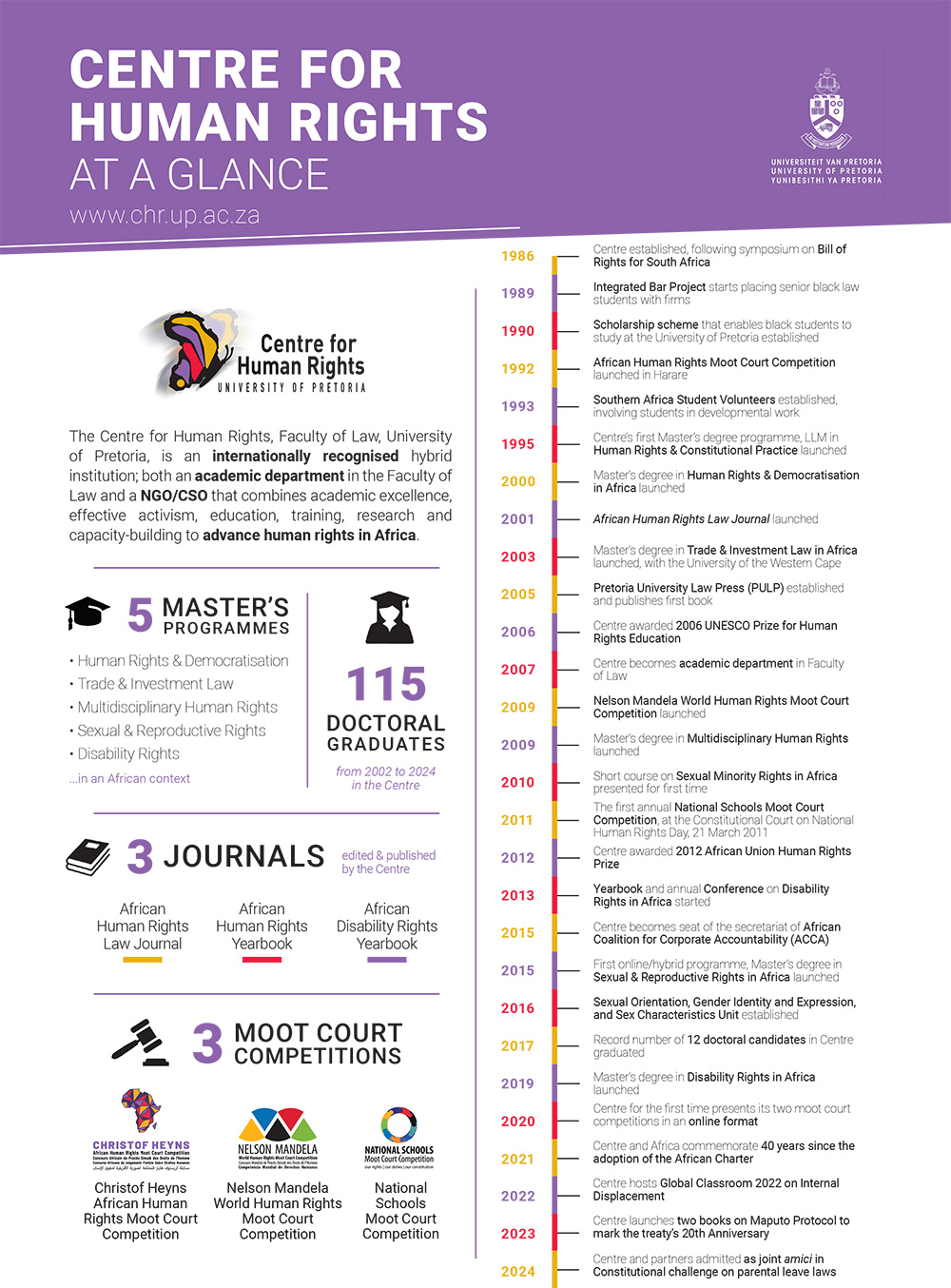
 History
The Centre was established in the Faculty of Law, University of Pretoria, in 1986, as part of domestic efforts against the apartheid system of the time. Members of the Centre participated in meetings with the liberation movements outside the borders of South Africa, organised conferences and participated in efforts to promote human rights in South Africa, and, when the transition came, served as technical advisors in the constitution-writing processes.
Over the years, the Centre’s focus broadened to encompass diverse issues of human rights law in Africa, and international development law in general. Today, the Centre is at the hub of an unmatched network of practising and academic lawyers, national and international civil servants and human rights practitioners across the entire continent. An ever-growing cadre of Centre graduates now contributes in numerous ways to the advancement of human rights and democracy and the strengthening of institutions all over the African continent, and beyond.
In 2006, the Centre for Human Rights was awarded the UNESCO Prize for Human Rights Education, with particular recognition for the African Human Rights Moot Court Competition and the LLM/MPhil in Human Rights and Democratisation in Africa. On the occasion of marking 25 years of its existence in 2012, the African Commission on Human and Peoples’ rights awarded its Human Rights Prize for civil society oranisations to the Centre.
Centre for Human Rights Values
- The Centre is guided by human rights, in particular the equal dignity of and respect for everyone. It adopts a human rights-based approach to all its activities.
- We are bound by and uphold all UP policies. In particular, we strongly disapprove of sexual harassment, misuse of authority, racism, homophobia, sexism, xenophobia, religious and other forms of intolerance.
- We act with compassion to ensure the inclusion and protection of those most vulnerable to human rights violations.
- We aim to provide a non-judgmental and participatory convening space where intellectual freedom prospers.
- We commit ourselves to act with integrity in all our endeavours, by acting with fairness to all.
- We consider ourselves to be accountable to everyone involved in our work, our partners, our colleagues, the Faculty and broader University, and our donors. We uphold the principle of transparency.
- We commit ourselves to act with professionalism, and be effective and efficient in our use of human and material resources.
- We strive to advance the spirit of Ubuntu by cultivating acceptance of diversity and difference, and by working in solidarity with each other and our partners.
- We endeavor to strengthen pan African institutions and to foster a pan African identity.
- We commit ourselves to invest in the future of Africa’s youth.
Celebrating 30 years in 2016
Centre for Human Rights Milestones
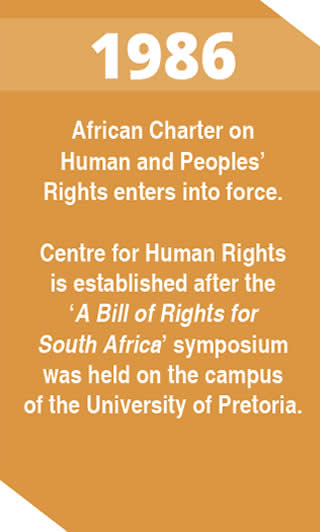
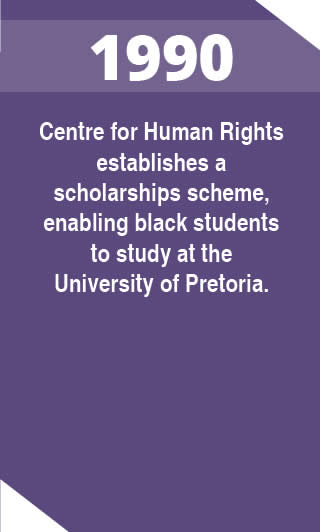
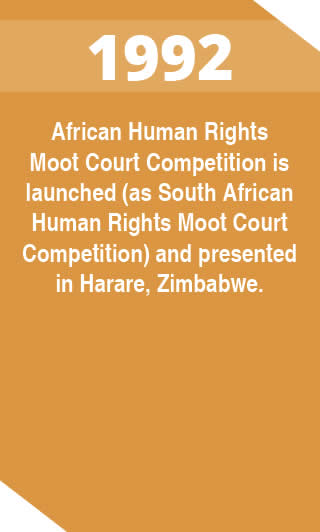
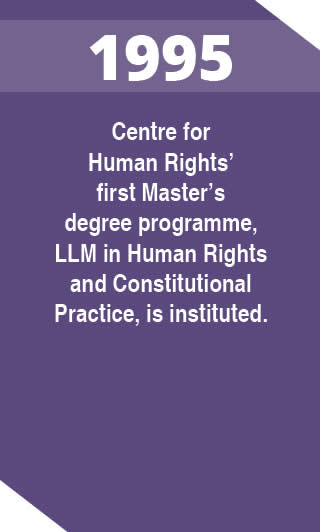
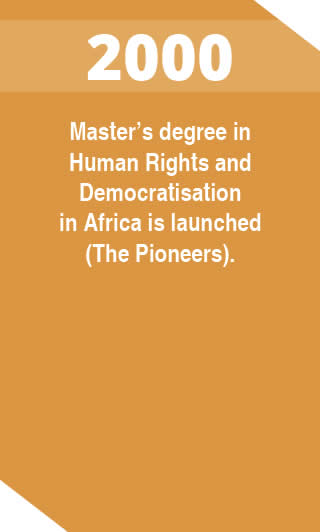
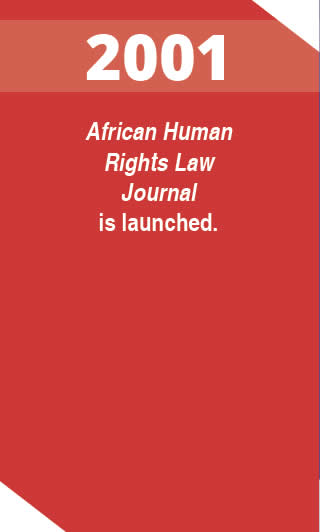
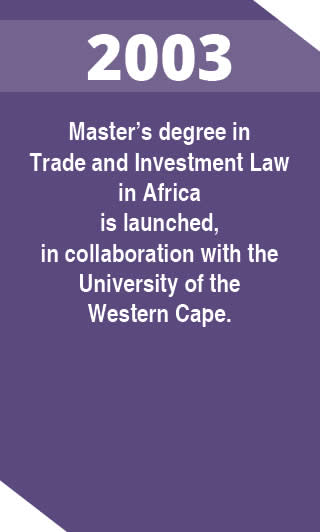
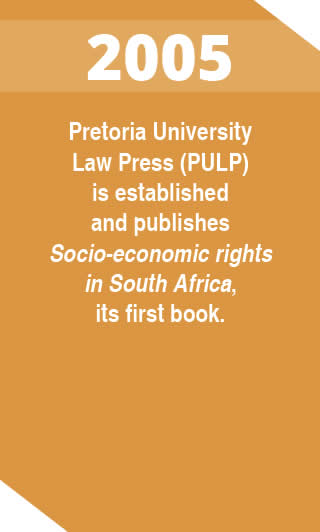
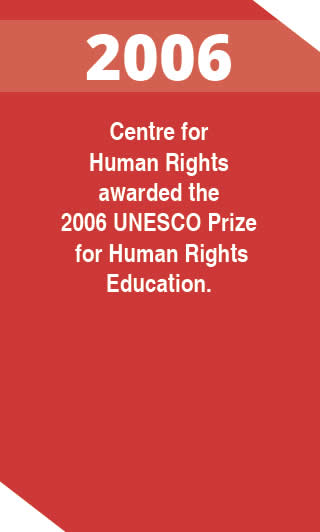
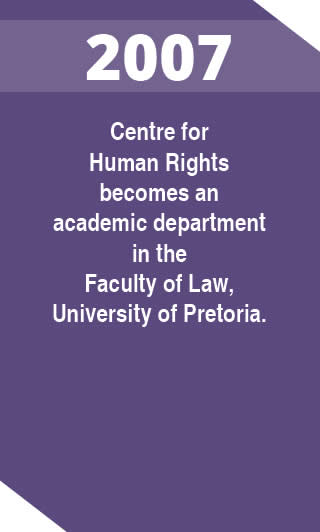
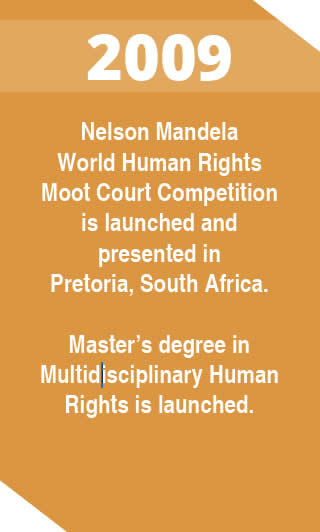
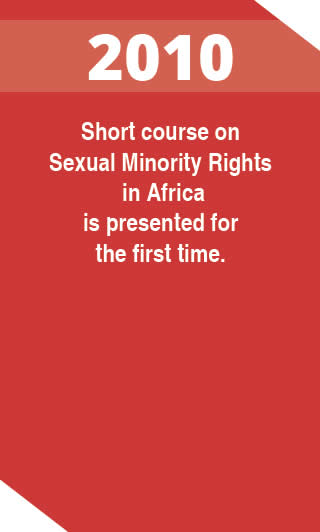
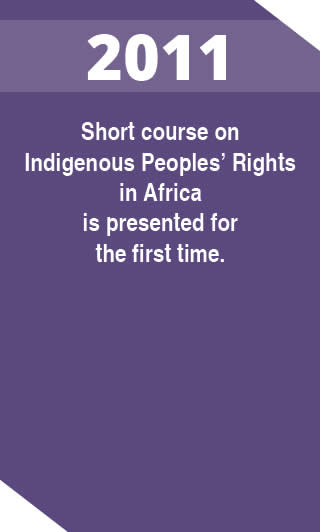
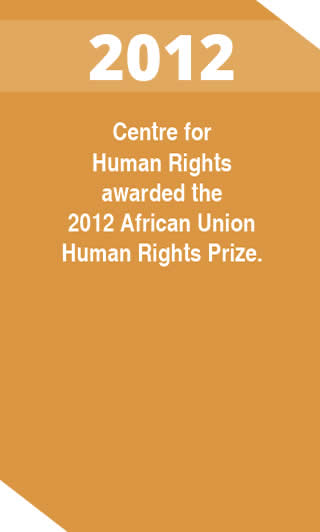
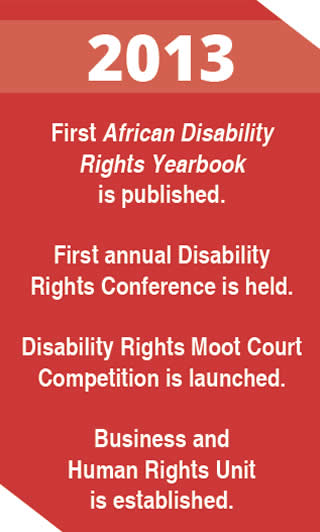
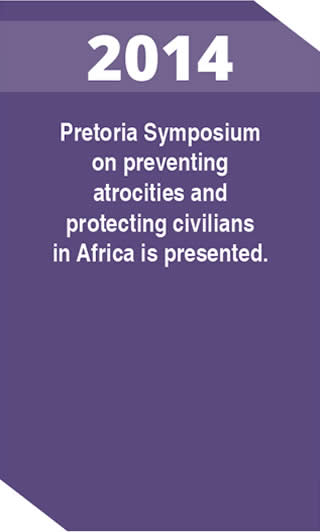
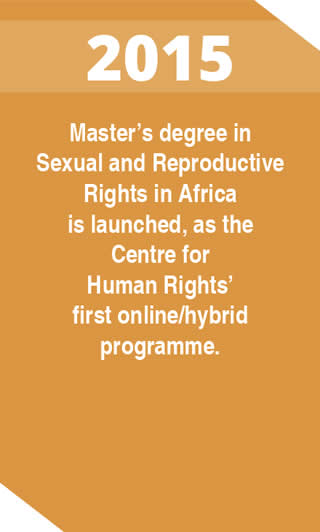
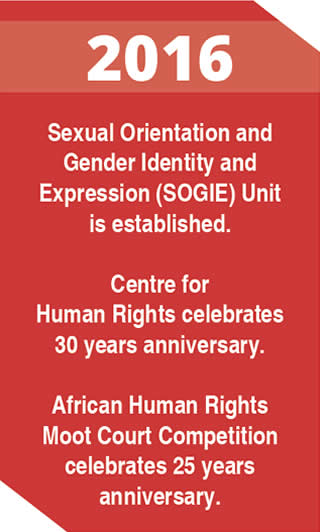
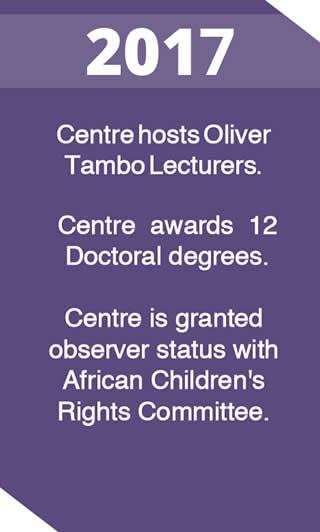
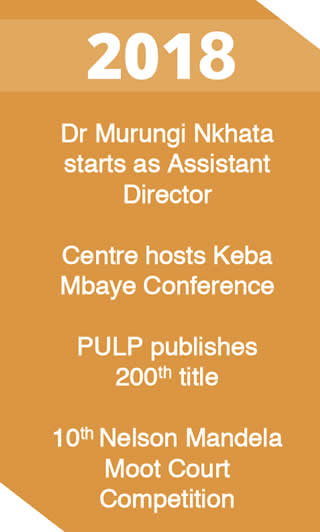
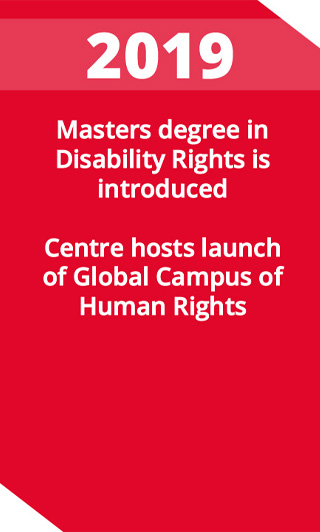
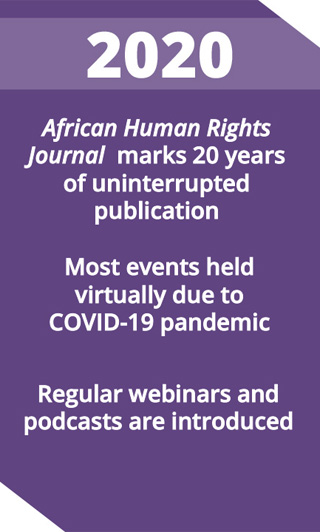
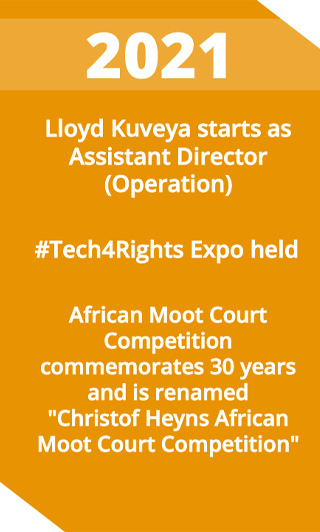
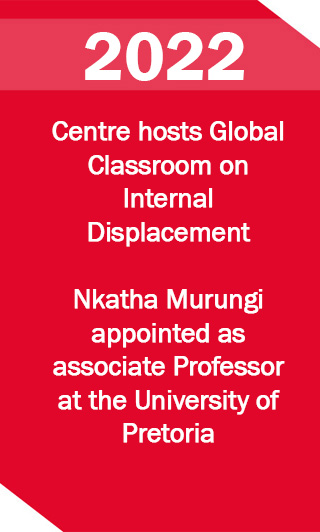
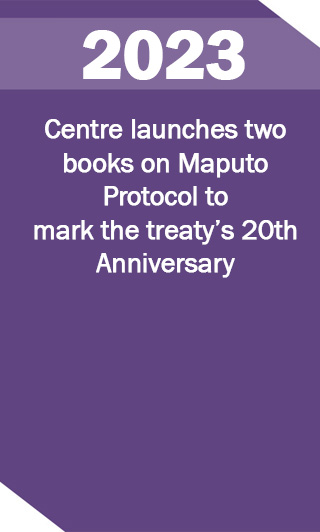
- Details
Prof Charles Fombad
Licence en Droit(University of Yaounde) LL.M(University of London) PhD(University of London)
Director: Institute for International and Comparative Law in Africa (ICLA)
Professor of Comparative Constitutional Law
Tel: +27 (0) 12 420 3377
charles.fombad@up.ac.za
Prof Magnus Killander
jur kand(Lund) EMA(Padua) LLD(UP)
Academic Coordinator: LLM Human Rights and Democratisation in Africa (HRDA)
Professor of Human Rights Law
Tel: +27 (0) 12 420 5407
magnus.killander@up.ac.za
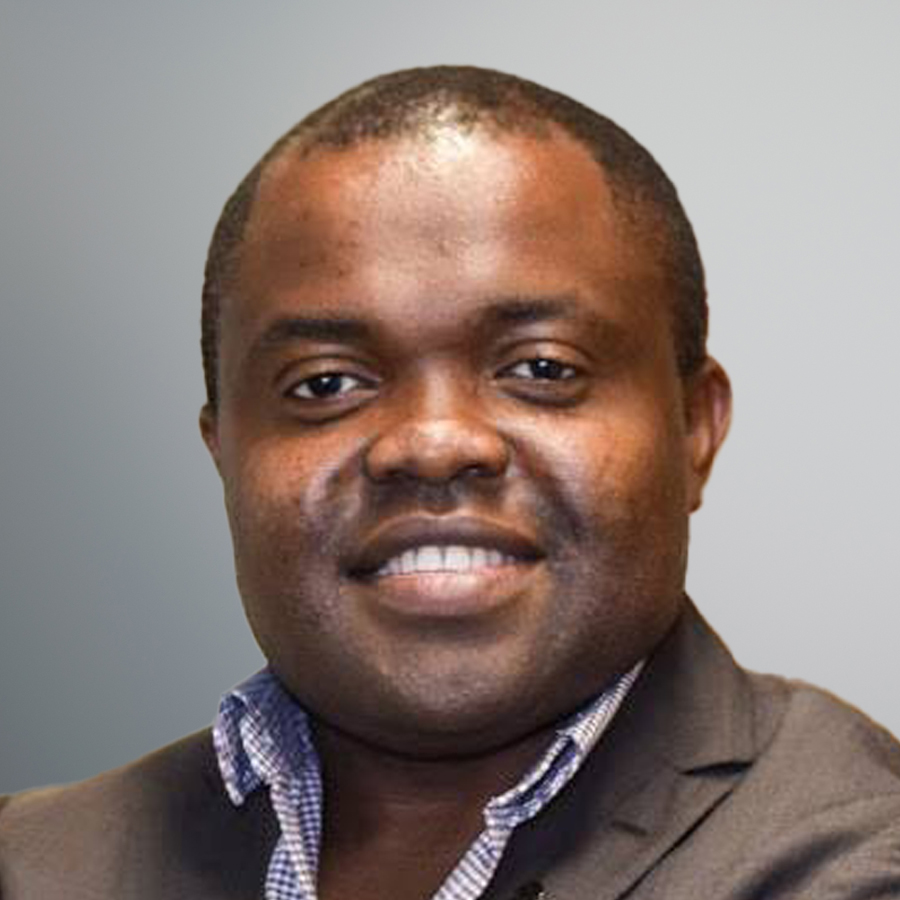
Prof Elvis Fokala
LLB(University of Buea), LLM(UP), PhD(Åbo Akademi University)
Academic Coordinator: Multidisciplinary Human Rights and Research expertise (Child and Family Law)
+27 (0) 12 420 3587
elvis.fokala@up.ac.za
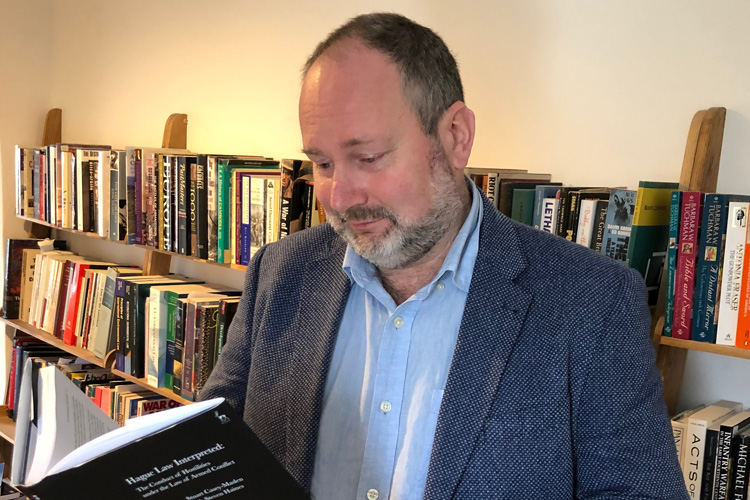
Dr Stuart Maslen
LLB (Bristol) LLM (Essex) MSc (Cranfield) PhD (Tilburg)
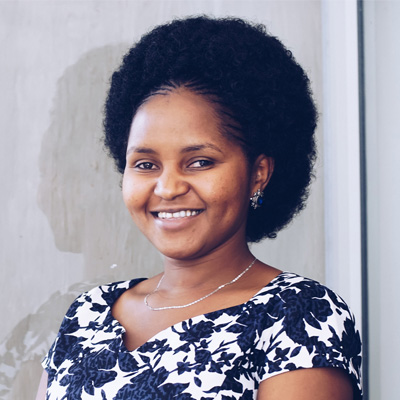
Prof Nkatha Murungi
LLB (Moi) LLM (UP) LLD (UWC)
Assistant Director: Centre for Human Rights
Member: Executive Committee
+27 (0)12 420 4684
Nkatha.Murungi@up.ac.za

Dr Thomas Probert
MA M.Phil. Ph.D. (Cantab)
Extra-ordinary Lecturer
Prof Frans Viljoen
BLC LLB(UP) LLM(Cantab) MA LLD(UP)
Professor of International Human Rights Law
Tel: +27 (0) 12 420 3228
frans.viljoen@up.ac.za
- Details

Tel: +27 (0) 12 420 4197
dennis.antwi@up.ac.za


Project Manager: LLM/MPhil (SRRA)
Tel: +27 (0)12 420 4196
rutendo.chinomona@up.ac.za
ivy.gikonyo@up.ac.za
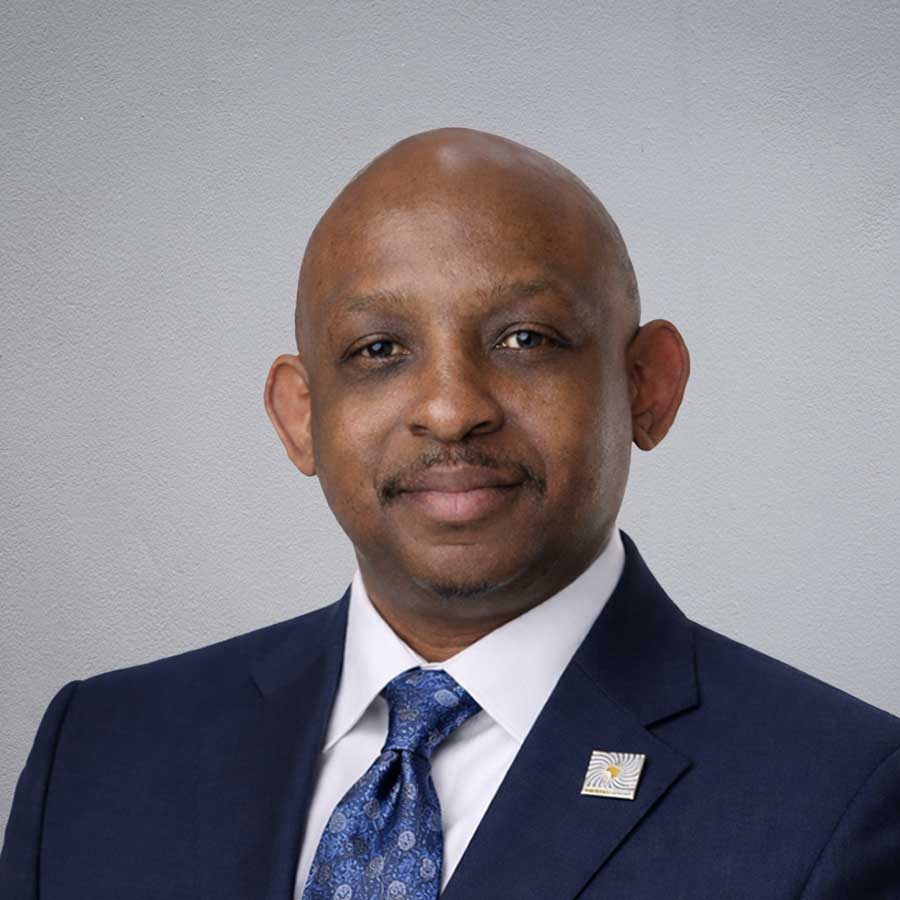
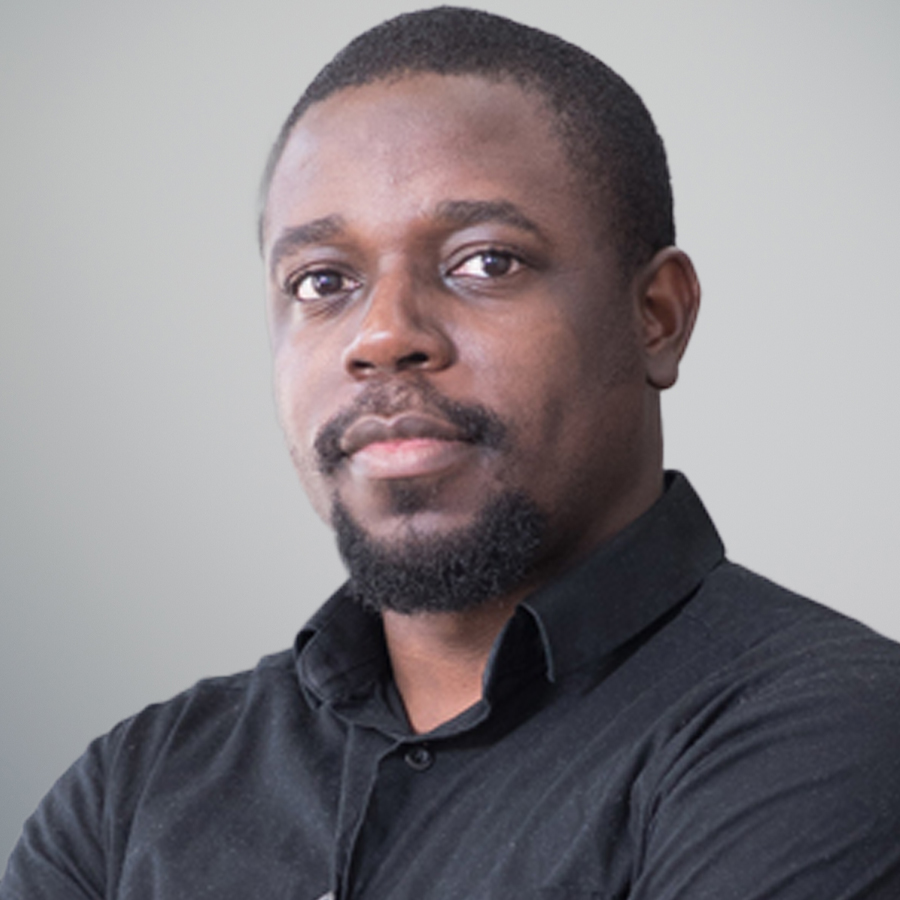
Communications and Advocacy Officer
Tel: +27 (0)12 420 5408
david.ikpo@up.ac.za

Manager: Litigation and Implementation Unit
Tel: +27 (0)68 031 8715
brian.kibirango@up.ac.za

Project Officer: Expression, Information and Digital Rights Unit
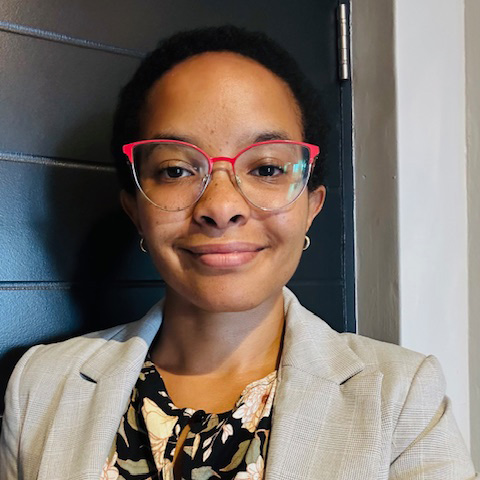
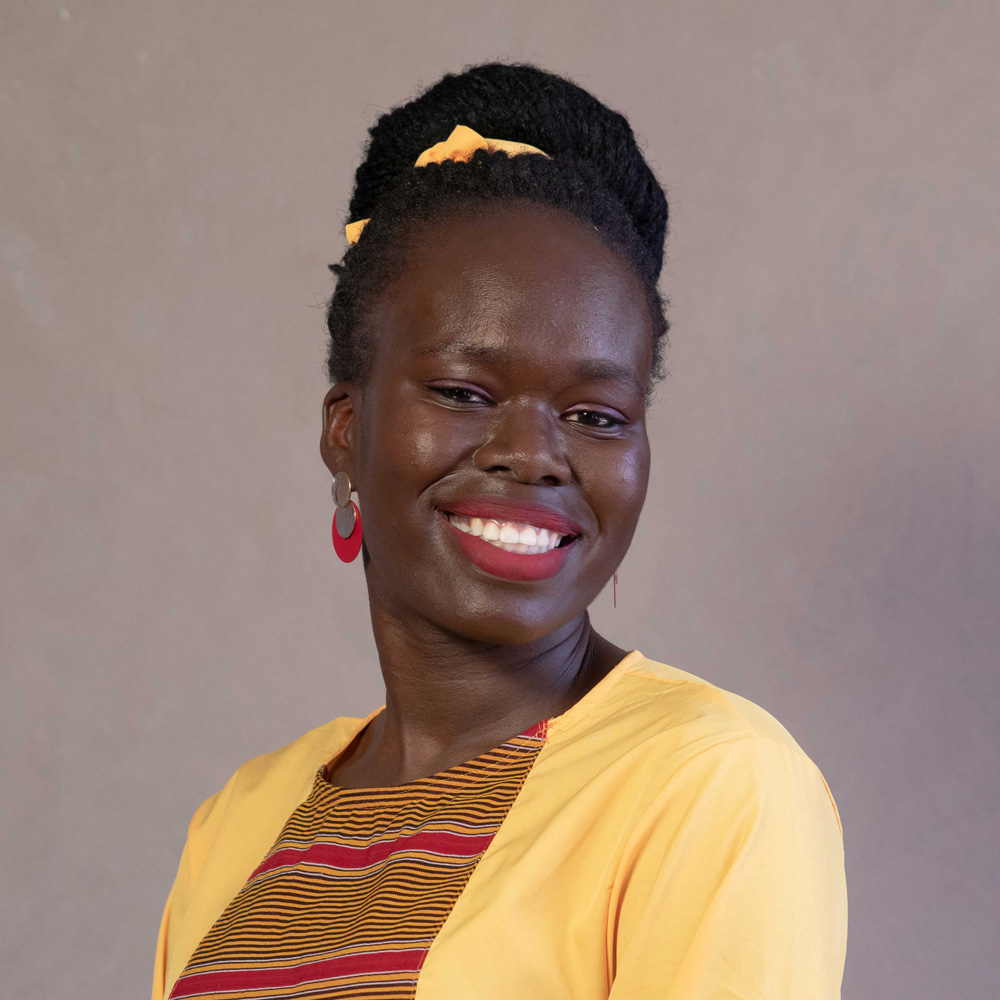

Tel: +27 (0)12 420 4199
bonolo.makgale@up.ac.za

Tel: +27 (0)12 420 3801
tinyiko.malope@up.ac.za
Project Officer: Childrens' Rights Unit
Tel: +27 (0)12 420 5214
Rotondwa.mashige@up.ac.za




Moyo.ntandoyenkosi@up.ac.za




Tel: +27 (0)12 420 3810
ntokozo.sibanyoni@up.ac.za

Project Officer: Women's Rights Unit
Tel: +27 (0)12 420 4306
oluwaseyitan.solademi@up.ac.za


Project Officer: LLM (SRRA)


In Memoriam