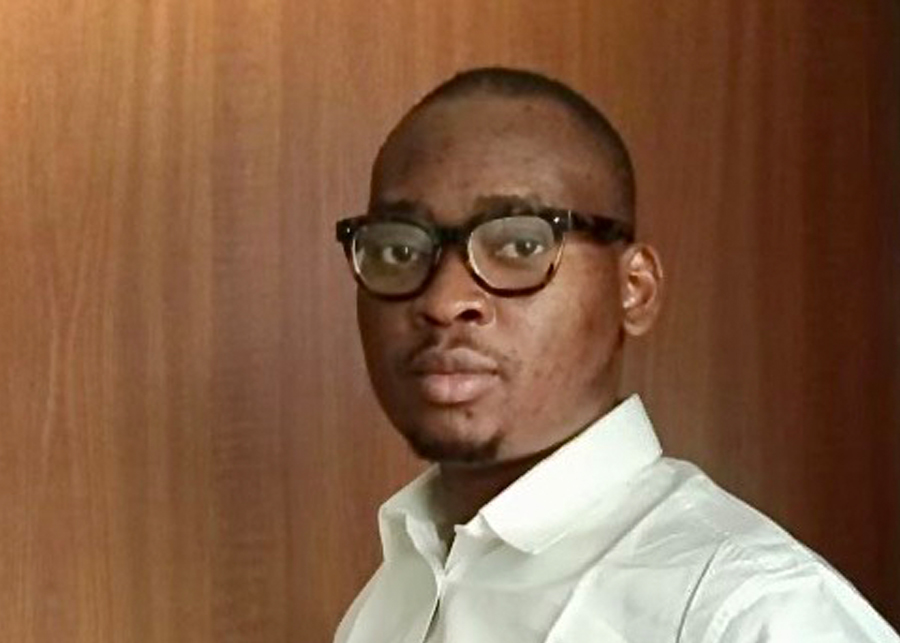
Adeboye Opeyemi Adegoke | Nigeria
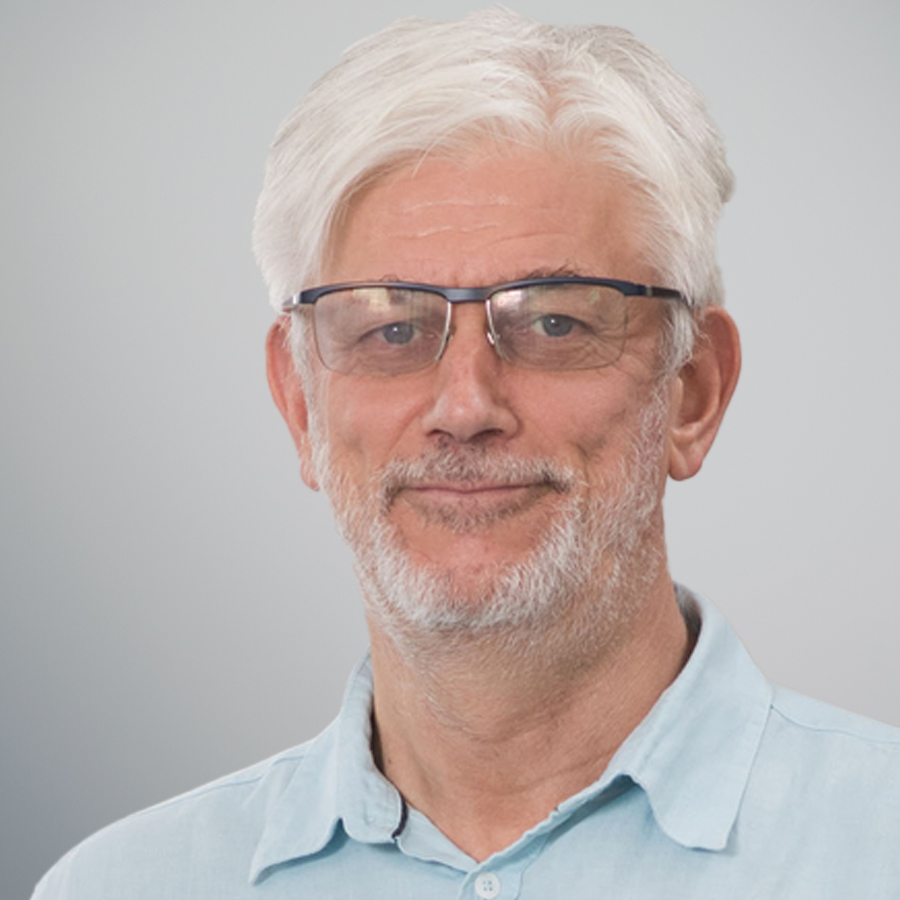
Adeboye Adegoke is Senior Program Manager at Paradigm initiative where he works at the intersection of technology and human rights, leading on strategic advocacy engagements, research and capacity building programs. He is an alumnus of the African School on Internet Governance, a member of the Advisory Network for the Freedom Online Coalition and a member of the Taskforce on Artificial intelligence and Human Rights. He holds a Bachelor of Science Degree in Politics, Philosophy and Economics from Obafemi Awolowo University, OAU, Nigeria.

Olum Lornah Afoyomungu | Uganda
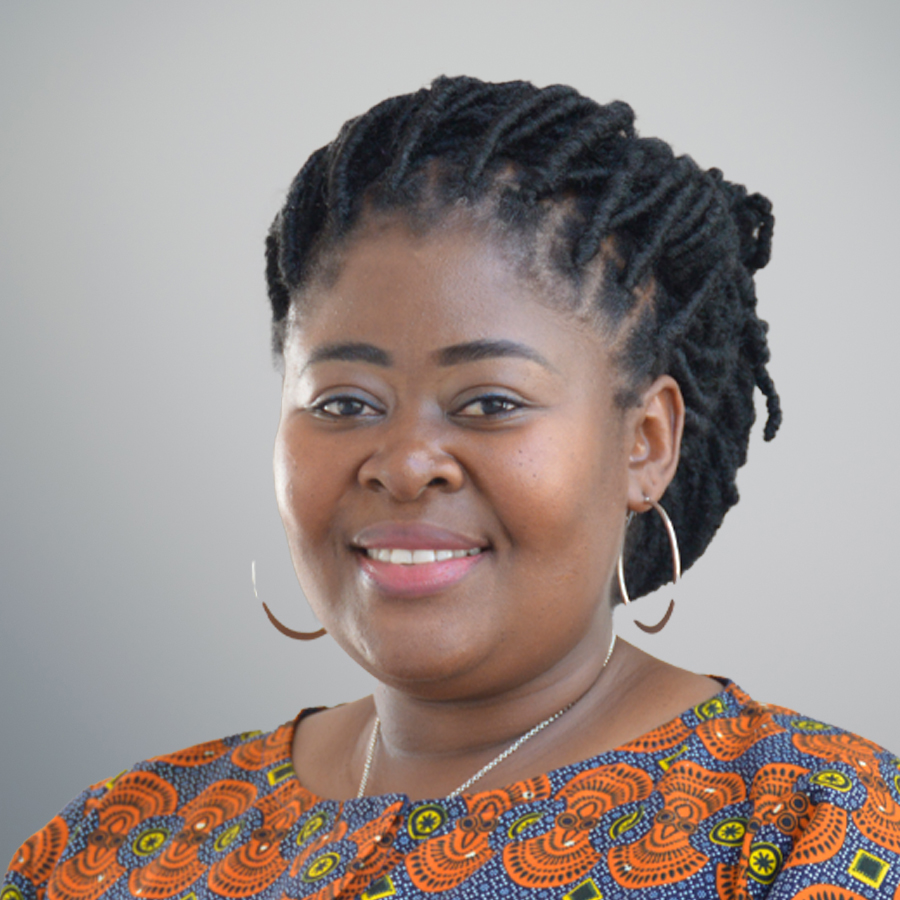
Olum Lornah Afoyomungu is a Ugandan lawyer and writer working as a Programme Manager, Training and Curriculum Developer at the African Development Law Institute. Her role involves conceptualizing, planning and delivering seminars in the area of international law and development to a variety of stakeholders. She holds a Bachelor of Laws (LLB) from Makerere University and a Post-Graduate Diploma in Legal Practice from the Law Development Centre, Kampala. She is committed, through her scholarly works, to surfacing the voice of the African woman in international law and highlighting the ways in which international law reproduces the marginalization of women. Her articles have been published by Makerere Law Journal and the Leaders’ Journal under the auspices of Akina Mama Wa Afrika.
The Global Campus Policy Observatory is a 'virtual hub' which comprehends a team of seven researches from the regional programmes to produce, publish and publicly present seven different policy analyses in form of policy briefs, with the aim of making of each regional programme a solid focal point for policy expert advisory in human rights issues.
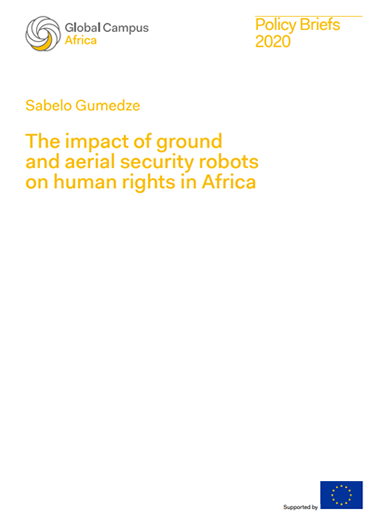
Latest Global Campus (Africa) Policy Brief
The impact of ground and aerial security robots on human rights in Africa by Sabelo Gumedze (2020)
The objective of this policy brief is to make a case for addressing the impact of the use of ground and aerial security robots on human rights in Africa.
The African continent is witnessing a rapid growth of the robotics industry and the use of ground and aerial robots is steadily increasing in the security sector. Whilst the exponential growth on the use of security robots arguably augment safety and security, many African countries have not enacted frameworks for their regulation. The introduction of security robots and their interface with human beings automatically bring the subject of human rights to the fore. The use of security robots impact on the enjoyment of a plethora of human rights. These include the following: labour and/or employment rights; the rights to privacy and freedom of expression; the rights to assembly and freedom of movement; and the rights to life and human dignity. As a result of the impact of security robots on the enjoyment of human rights, this policy brief makes the case that attention is required from policy makers at the level of the African Union (AU).
The policy brief suggests that as the use of security robots will pose a serious threat in terms of cyber security, and especially on cybercrime, Africans states must ratify the AU’s Convention on Cyber Security and Personal Data Protection, which was adopted in 2014. In order to comprehensively address the concerns relating to the use (and misuse) of security robots and the enjoyment of human rights, the policy brief advocates for a comprehensive regional instrument that will provide guidance to African states. Such a regional instrument must be informed by cutting-edge research on the use (and potential use) of unmanned ground and aerial vehicles in Africa.
Country / Where did you grow up:
Ebonyi State, Nigeria
Academic qualifications:
1. LLB, Civil Law, Ahmadu Bello University, Zaria Nigeria.
2. BL, Nigerian Law School Lagos, MSC Oil and Gas Management, South American University, Delaware, United States of America.
Experience:
I have served as President and Secretary General of Nigeria Model United Nations. I have equally in the recent pasts represented Nigeria in international youth debates in United States of America (Washington, New York, Philadelphia), London, and Qatar, Middle East Asia. Prior to my coming here, I was a practising human rights lawyer based in Abuja, Nigeria.
Academic fields of interest:
Human Rights, Good Governance, Oil and Gas
Position prior to the programme:
Associate Counsel, F.M Ofoku & Associates, Life Camp, Abuja, Nigeria.
Lecturer and Legal Research Assistant, Cavendish University, Uganda
Country / Where did you grow up:
Kampala, Uganda
Academic qualifications:
Bachelor of Laws Degree(LLB), Uganda Christian University(Uganda), Post Graduate Diploma in Legal Practice(Advocates Training Programme), Kenya School of Law, Kenya
Experience:
Advocate-W.J.Ithondeka & Co. Advocates, Intern lawyer-W.J.Ithondeka & Co. Advocates
Academic fields of interest:
Transitional Justice, International Human Rights, International Law, Legislative Drafting, Moot Court, International Criminal Law
Position prior to the programme:
Associate Advocate-W.J.Ithondeka & Co. Advocates
Through conducting research on a number of issues related to Migration and Refugee law, I was able to gain all round knowledge about the challenges, gaps and untapped opportunities in the field of refugee law and Migration that African states can adopt to deal with the unending refugee/migrant crisis in Africa. As a lecturer, I have been able to advise and train my students on matters related to Refugee law.
Working with the clinic taught me practical challenges migrant workers experience while away from their home countries since nobody will ever see your plight as a migrant/refugee as depicted in our song entitled ‘Away from Home’, a project of the Migration clinic. However, this song also taught me how to use the art of music and every tool around me to speak against the injustices around us like Xenophobia.
The Migration clinic is a fundamental tool in the fight against the injustices faced by African Migrants and the refugee crisis in Africa.
Country / Where did you grow up:
Nairobi, Kenya
Academic qualifications:
Bachelors of Law( LLB) Catholic University of Eastern Africa
Experience:
An advocate of the High Court of Kenya practising in the form of Mereka and Company Advocates undertaking litigation in human rights, constitutional, environmental and judicial review matters. Before joining the firm of Mereka, I did pupillage at Waweru Gatonye Advocates. I also interned at the Kenya Human Rights Commission.
Academic fields of interest:
Human rights, social legal theories, constitutional law, transitional justice, critical legal theories, disarmament and political theory.
Position prior to the programme:
An associate at Mereka and Company Advocates.
Country / Where did you grow up:
Kampala, Uganda
Academic qualifications:
Bachelor of Laws, Makerere University, Uganda. Post Graduate Diploma in Legal Practice, Law Development Centre, Uganda.
Experience:
I have previously worked as a Senior Researcher in the Supreme Court of Uganda where I drafted judicial opinions, researched and reviewed domestic and international legislation, advising on its applicability, as well as recommending cases for arbitration and other alternative dispute resolution mechanisms. Prior to this, I worked with Development Law Associates, a consultancy firm in Uganda where I contributed to the preparation of proposals related to human rights and constitutional law policies. Additionally, I am a member of the Network of Public Interest Lawyers at the Centre for Health, Human Rights and Development where we periodically analyse the constitutionality of bills and Acts related to the right to health and institute litigations or prepare lobby papers on the same. I have also worked in a voluntary capacity with the Uganda Human Rights Commission, the International Centre for Transitional Justice, and the Community Law Programme and Legal Aid Clinic (CLAPMOC), under the Public Interest Law Clinic (PILAC) of Makerere University.
Academic fields of interest:
Health and Human Rights, Taxation and Human Rights, Democracy, Transparency and Digital Rights.
Position prior to the programme:
Senior Researcher, Supreme Court of Uganda.
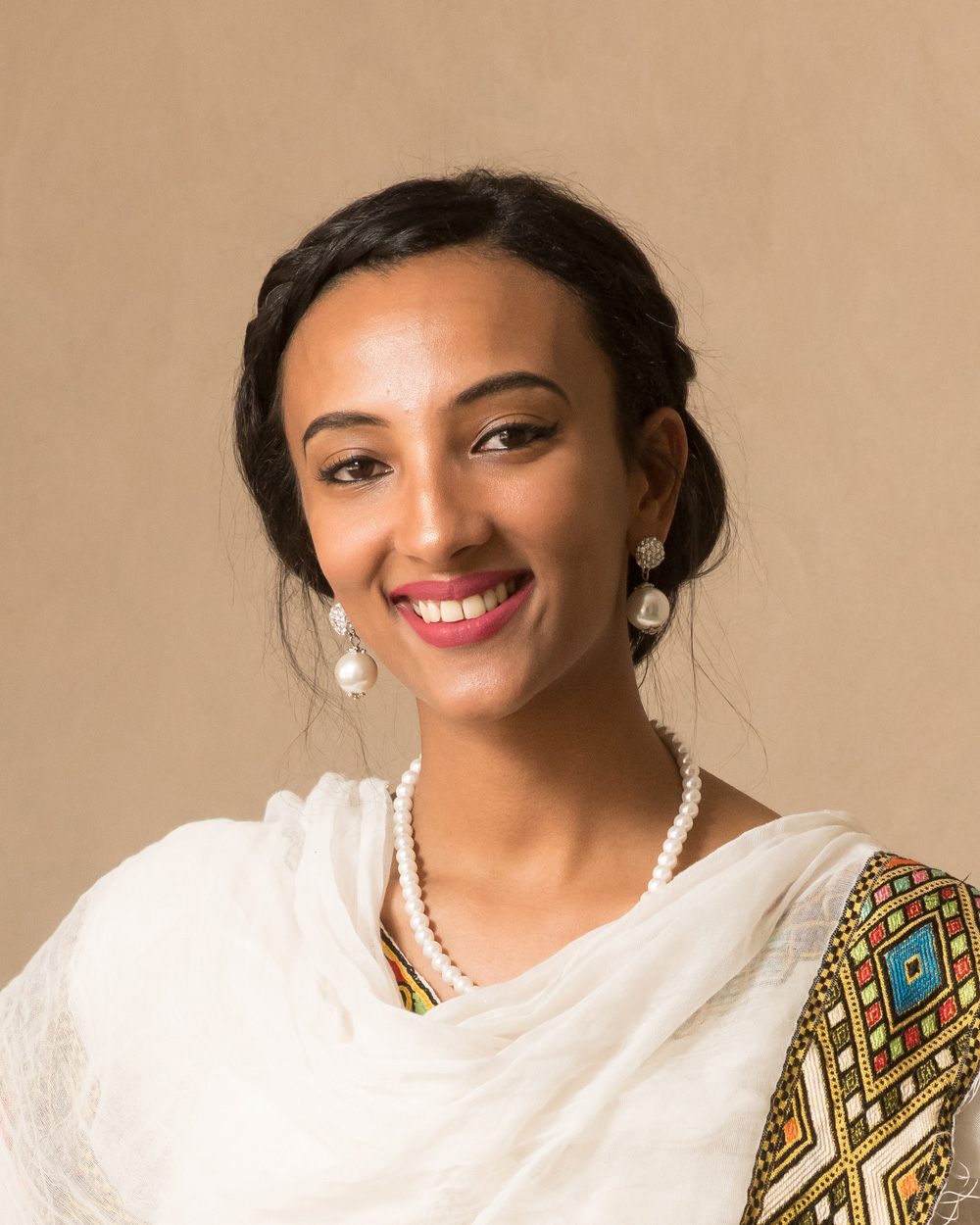
Country / Where did you grow up:
Addis Ababa, Ethiopia
Academic qualifications:
LLB, Addis Ababa University, Ethiopia
Experience:
Graduate Assistant II at Addis Ababa University School of Law
Junior Associate Lawyer at KDLO, Addis Ababa, Ethiopia
Academic fields of interest:
International Criminal Law
Position prior to the programme:
Graduate Assistant II, Addis Ababa University School of Law

Legal Assistant, African Commission on Human and Peoples’ Rights (ACHPR)
Country / Where did you grow up:
Calabar, Nigeria
Academic qualifications:
LLB, Addis Ababa University, Ethiopia
Experience:
Legal Officer I - Federal School of Medical Laboratory Science & Technology, Jos, Nigeria.
Volunteer - House of Recap, Jos, Plateau State, Nigeria.
Volunteer - Voluntary Services Overseas, FCT, Abuja, Nigeria.
Legal Associate - Kanu G. Agabi (SAN) & Associates, FCT, Abuja, Nigeria.
Law Reporter - Akaraiwe & Associates, Enugu, Nigeria.
Volunteer - Conscience International, Bakau, The Gambia.
Academic fields of interest:
Refugees/Internally displaced persons with a specific focus on children & unaccompanied minors
Position prior to the programme:
Prior to my enrollment in the HRDA programme, I volunteered as an English instructor at a shelter for children displaced due to the Boko Haram crisis in Jos, Plateau State, Nigeria. As such, when I joined the migration clinic in 2019, I had already seen first-hand the challenges faced by persons forced to flee their homes. The migration clinic therefore gave me the opportunity to learn at an in-depth level, established rights, principles and international practices for the protection of migrants in Africa. This knowledge has been instrumental, as I am able to research and formulate specific thematic questions on States’ obligations as it relates to the rights of migrants, particularly during the African Commission’s consideration of State Parties’ periodic reports.
My experience interning at the migration clinic was indeed ‘transformative’ as it enabled me improve my knowledge and skills in an environment that was suitable for my academic and practical competence as an advocate of human rights.
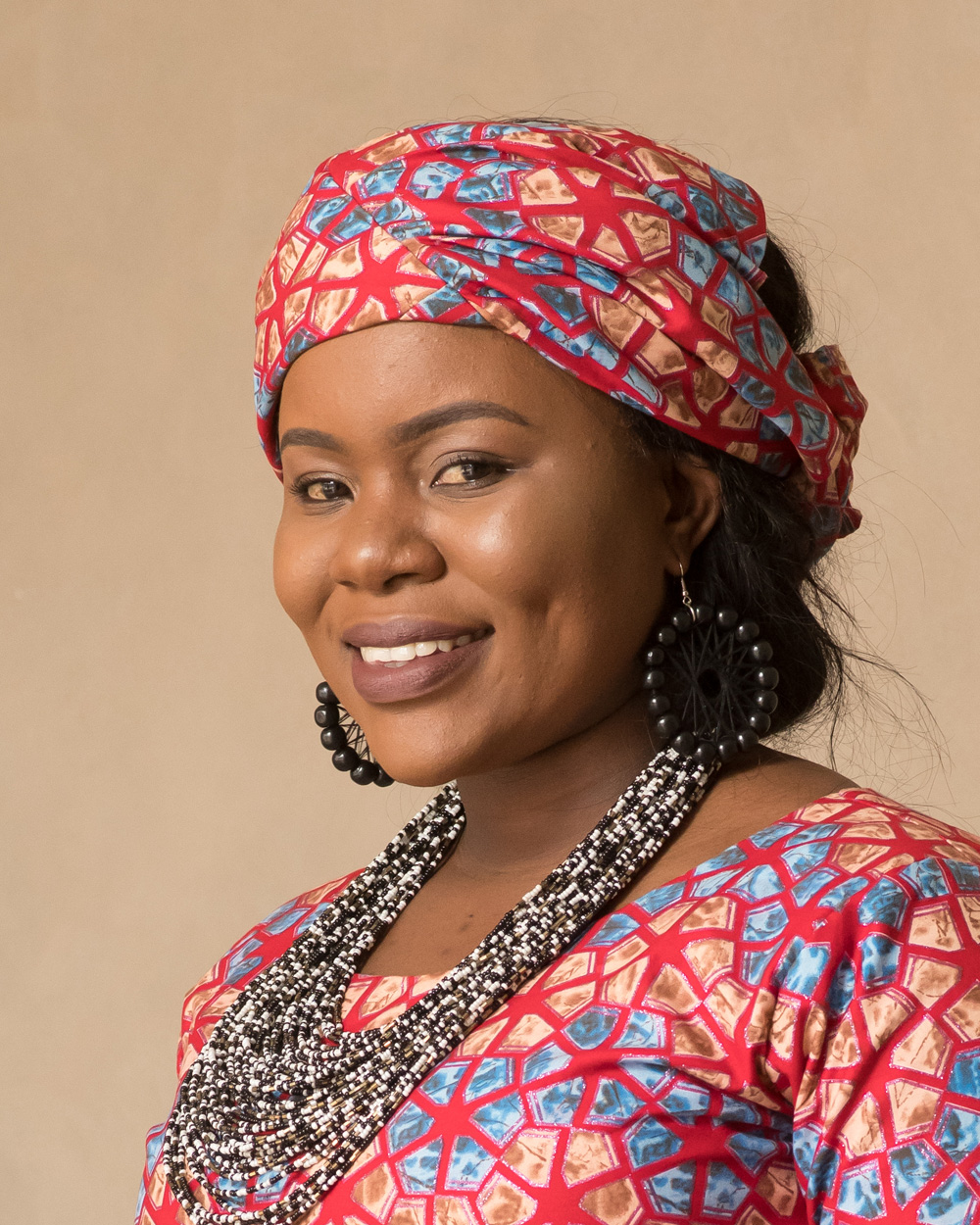
Country / Where did you grow up:
Blantyre, Malawi
Academic qualifications:
Bachelor of Laws (Honours) Degree, University of Malawi, Chancellor College, Malawi
Experience:
Legal practitioner at a private law firm in Malawi; Trial advocacy trainer, Justice Advocacy Africa; Legal aid coordinator, Women Lawyers' Association; Intern, Ministry of Justice; Research assistant, University of Maryland Global Health Interdisciplinary Research Team.
Academic fields of interest:
Public interest and strategic litigation; Access to justice; women's rights; business and human rights; technology and human rights.
Position prior to the programme:
Legal Practitioner
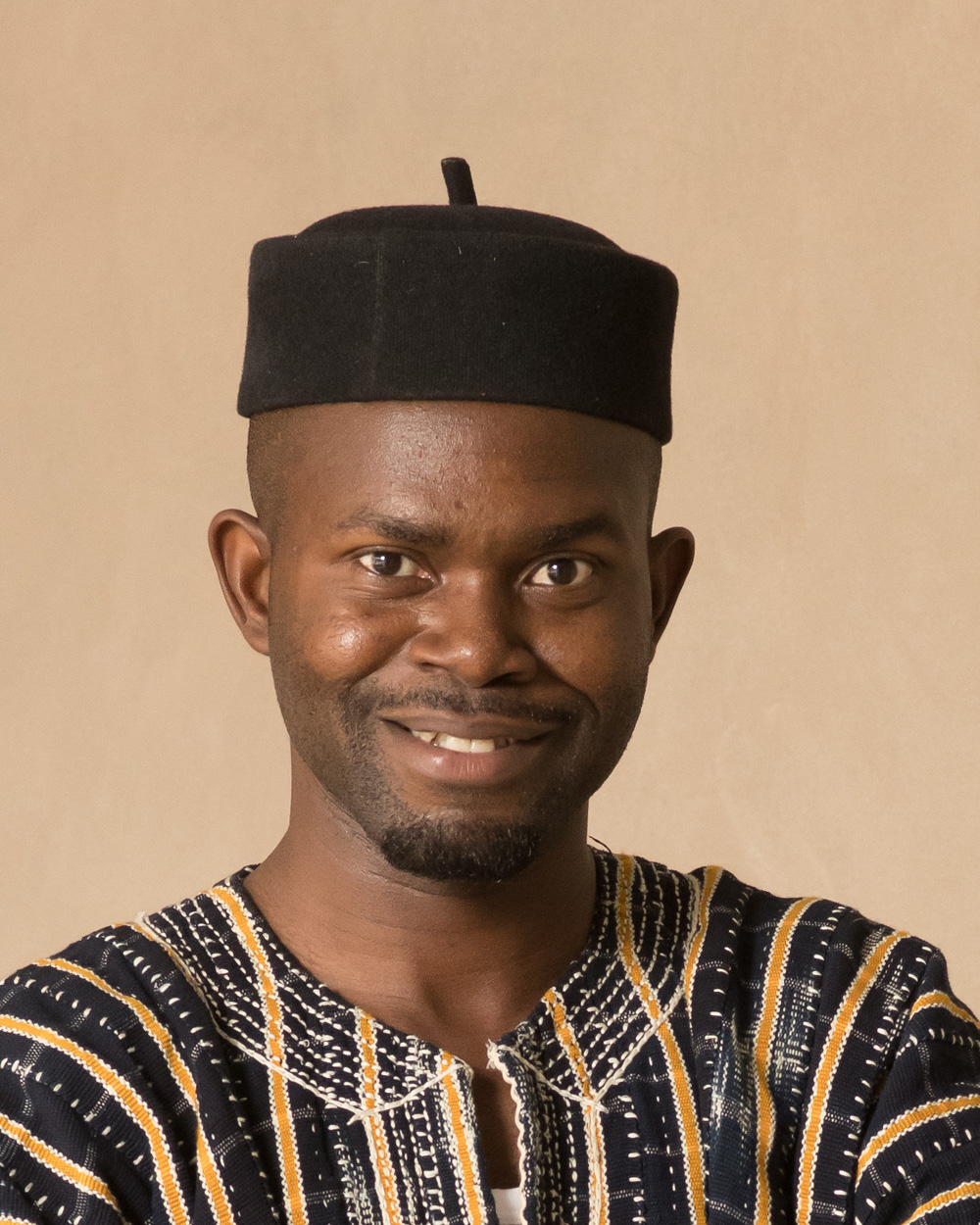
Country / Where did you grow up:
Western Region of the Republic of Ghana
Academic qualifications:
BA(Political Science), University of Ghana, Legon Ghana
Experience:
My experiences include human rights advocacy, investigations, the decision as well as report writing. Also work as a resource person for international NGOs such as World Vision, Action Aid, Inclusion Ghana etc as well as governance NGOs such as Ghana Integrity Initiative, SEND-GH etc. Provides human rights lectures to nursing training institutions, professionals and the entire public on the need to promote the culture of respect for human rights. Conduct state of human rights monitoring as in inspection of detention centres such as hospitals, police stations, prisons to ascertain whether they are conforming to international human rights standards.
Academic fields of interest:
Children's rights, women's rights, human rights investigation and the African human rights system
Position prior to the programme:
I was the District Officer of the Commission on Human Rights and Administrative Justice(CHRAJ) in the Jirapa district of the upper west region of Ghana.
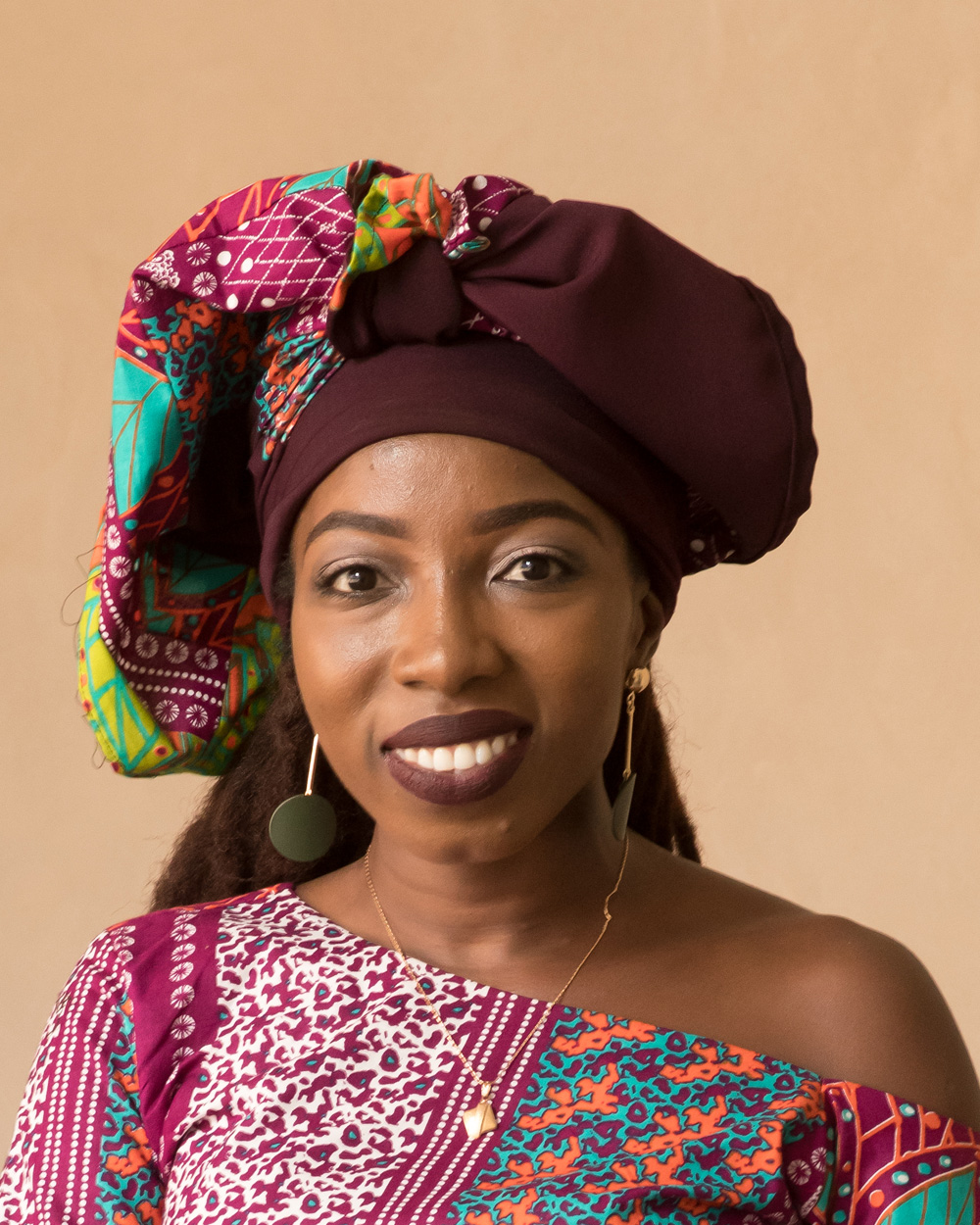
Country / Where did you grow up:
Dakar, Sénégal
Academic qualifications:
Master of Arts in International Affairs and Diplomacy, Legon centre for international affairs and diplomacy, LECIAD, University of Ghana
Experience:
I hold a Master of Arts in International affairs and diplomacy and a bachelor in political science and international relations. Over the past 3 years, I have gained professional experience by working with various organisations such as ActionAid International Senegal as women's rights officer, McCann Dakar as traffic coordinator and Wanep Senegal as a communication officer.
Academic fields of interest:
Social sciences and human rights
Position prior to the programme:
Women's Rights Officer ActionAid International Senegal

Country / Where did you grow up:
Asmara, Eritrea
Academic qualifications:
LL.B, Adi Keih College of Arts and Social Sciences, Eritrea
Experience:
Staff Attorney, Ministry of Justice
Judge, Court of Central Region
Academic fields of interest:
Human rights, international law, constitutional law
Position prior to the programme:
Judge, Court of Central Region
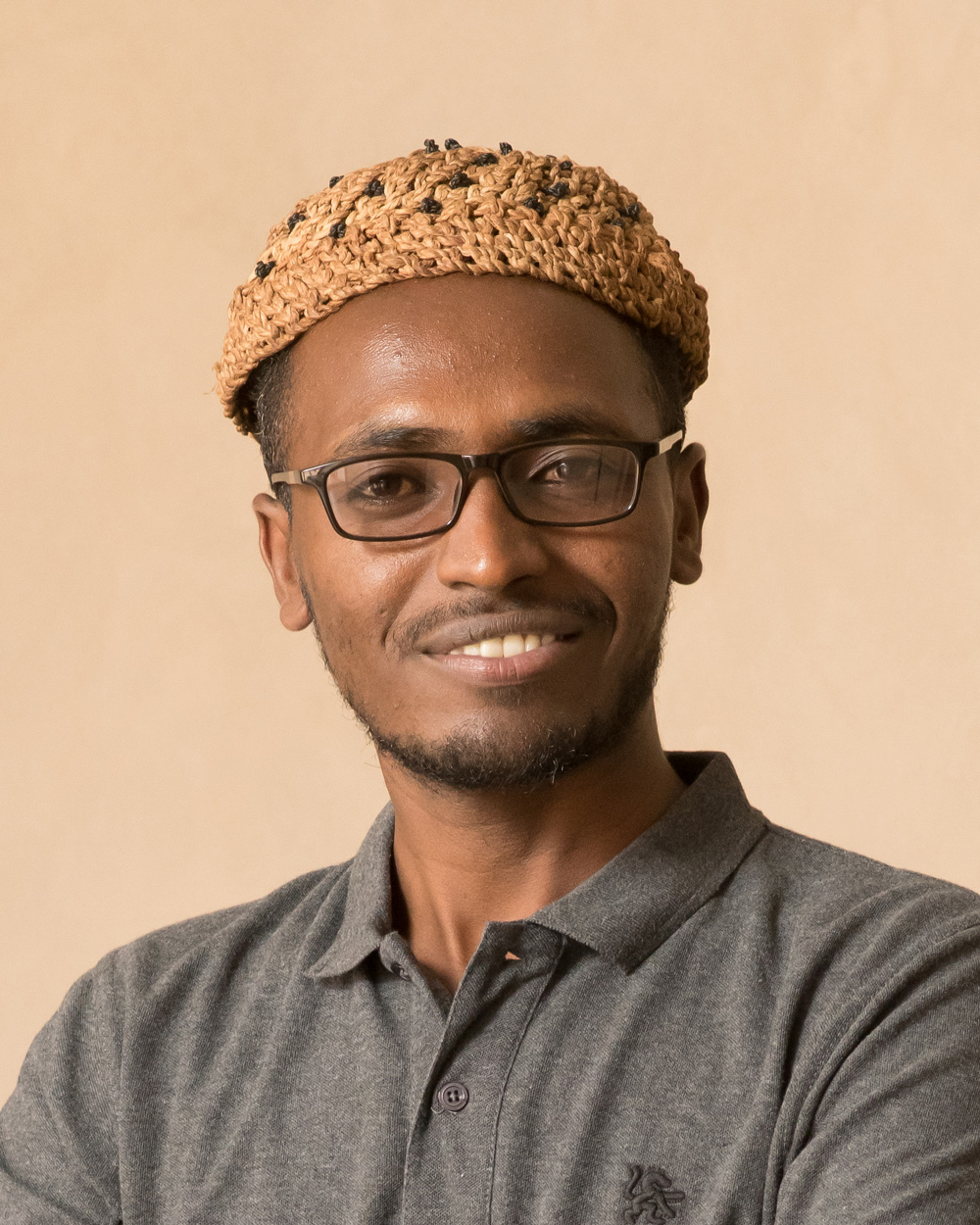
Country / Where did you grow up:
Adama, Ethiopia
Academic qualifications:
LLB Degree from Adama University, Ethiopia
Experience:
Imad Abdulfetah is graduated with an LLB degree from Adama University, Adama Ethiopia in 2014. I Interned with International Committee of Red Cross and Federal High court of the Democratic Republic of Ethiopia. Since 24 November 2014, I have worked as Attorney and legal advisor at Ethiopian Ministry of Revenue and Customs Authority. Starting from 08 July 2016 I have been serving as Federal attorney at Federal Attorney General and Assistant lecturer at Arsi University.
Academic fields of interest:
Exceptionally interested in refugee, children and humanitarian law.
Position prior to the programme:
Federal Attorney and Assistant lecturer
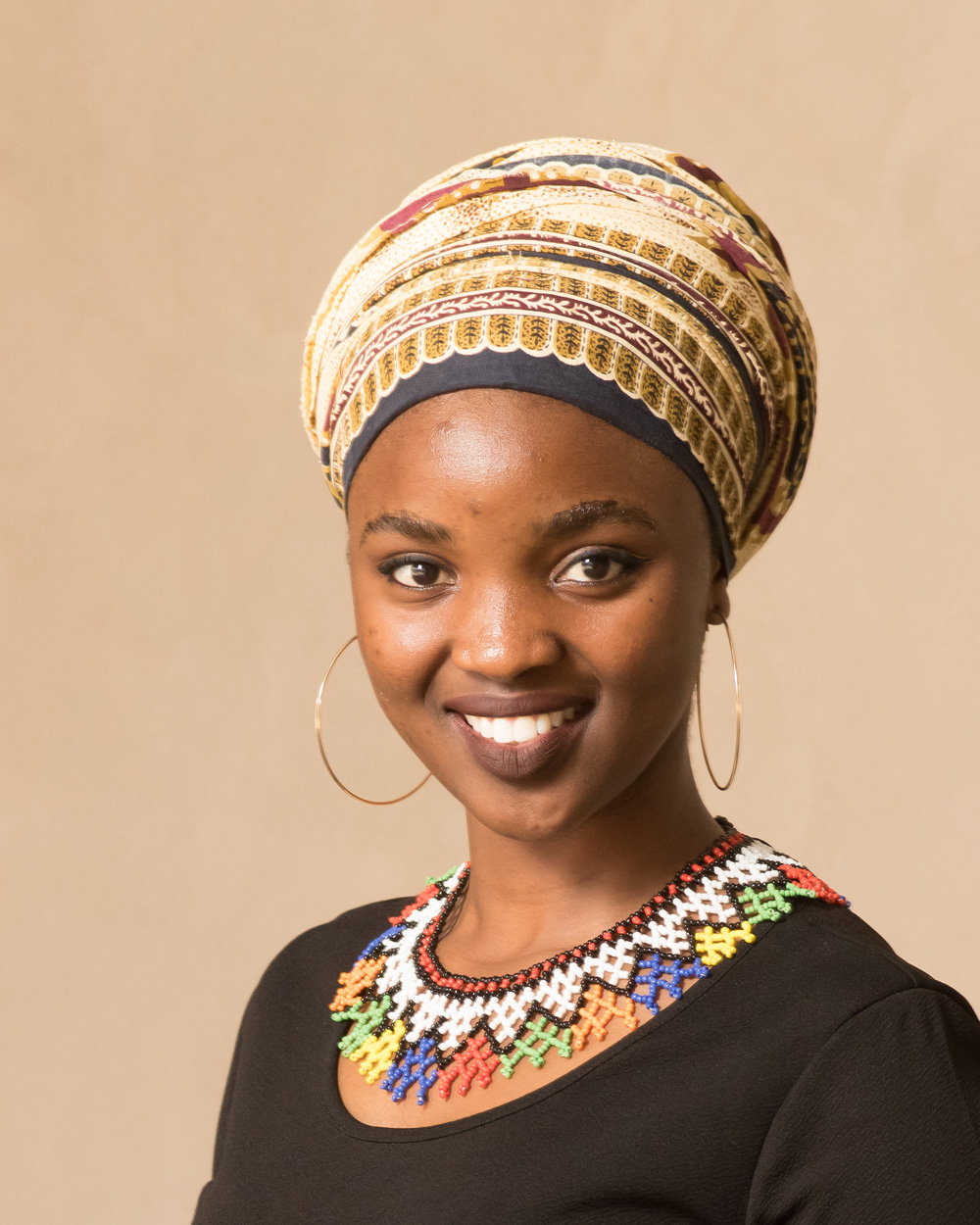
Country / Where did you grow up:
South Africa
Academic qualifications:
LLB (University of Pretoria), South Africa
Experience:
Research Assistant, Disability Rights Unit, Centre for Human Rights
Student Consultant, Law Clinic, University of Pretoria
Coordinating committee member, National Schools Moot Court Competition, Department of Education & International Centre for Institute for International Comparative Law in Africa
Student intern, Maponya Attorneys Inc.
Academic fields of interest:
Disability Rights and Women's Rights
Position prior to the programme:
Research Assistant, Disability Rights Unit, Centre for Human Rights
 The Global Campus Human Rights Journal is established as a peer-reviewed bi-annual publication dedicated to serving as a forum for rigorous scholarly analysis, critical commentaries, and reports on recent developments pertaining to human rights and democratisation globally, particularly by adopting multi- and inter-disciplinary perspectives, and using comparative approaches.
Editorial committee and International editorial advisory board
The Editorial Committee is composed of academics from the different Global Campus Regional Programmes, working under the guidance of Convening editor Frans Viljoen (University of Pretoria).
An interdisciplinary International Editorial Advisory Board assists the editors in the review process and in guiding policy.
The students on the LLM/MPhil programme in human rights and democratisation in Africa are assigned to human rights clinics which contributes to the work of the Centre’s research units and give the students practical experience and advance the Centre’s mission towards the realisation of human rights in Africa.
Mandate:
- Synopsis of Refugee Act
- Collection of refugee acts for database
- Legal analysis on AU-EU migration crisis
- Pamphlet for migration class
Members 2019
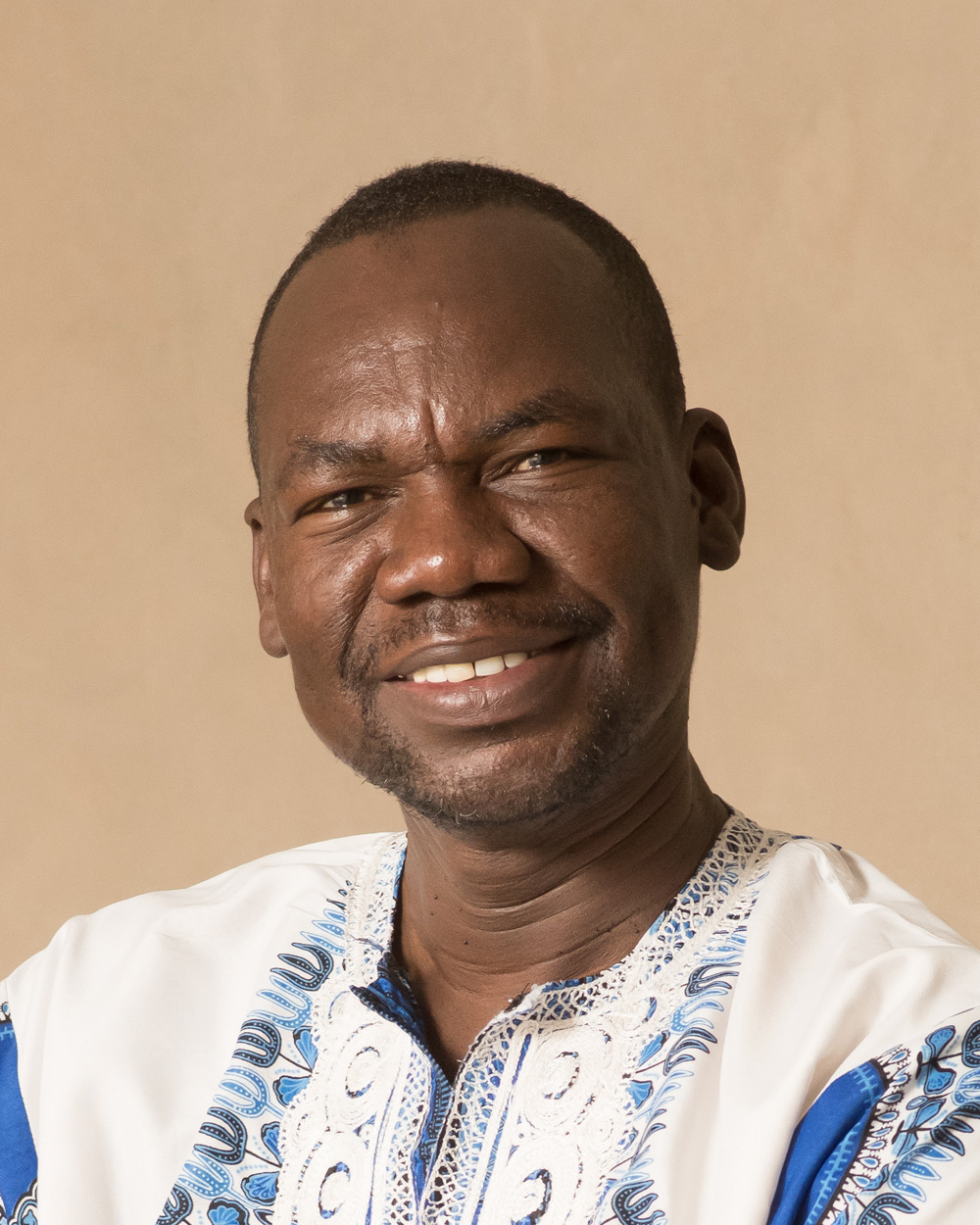
Country / Where did you grow up:
Khartoum, Sudan
Academic qualifications:
LLB Al nailein University Sudan
Experience:
Legal officer of Darfur Bar Association
Co-founder and Future Perspectives Organization (FPO) Khartoum - Sudan
Academic fields of interest:
Law
Position prior to the programme:
General Secretary of the Future Perspectives Organization (FPO)
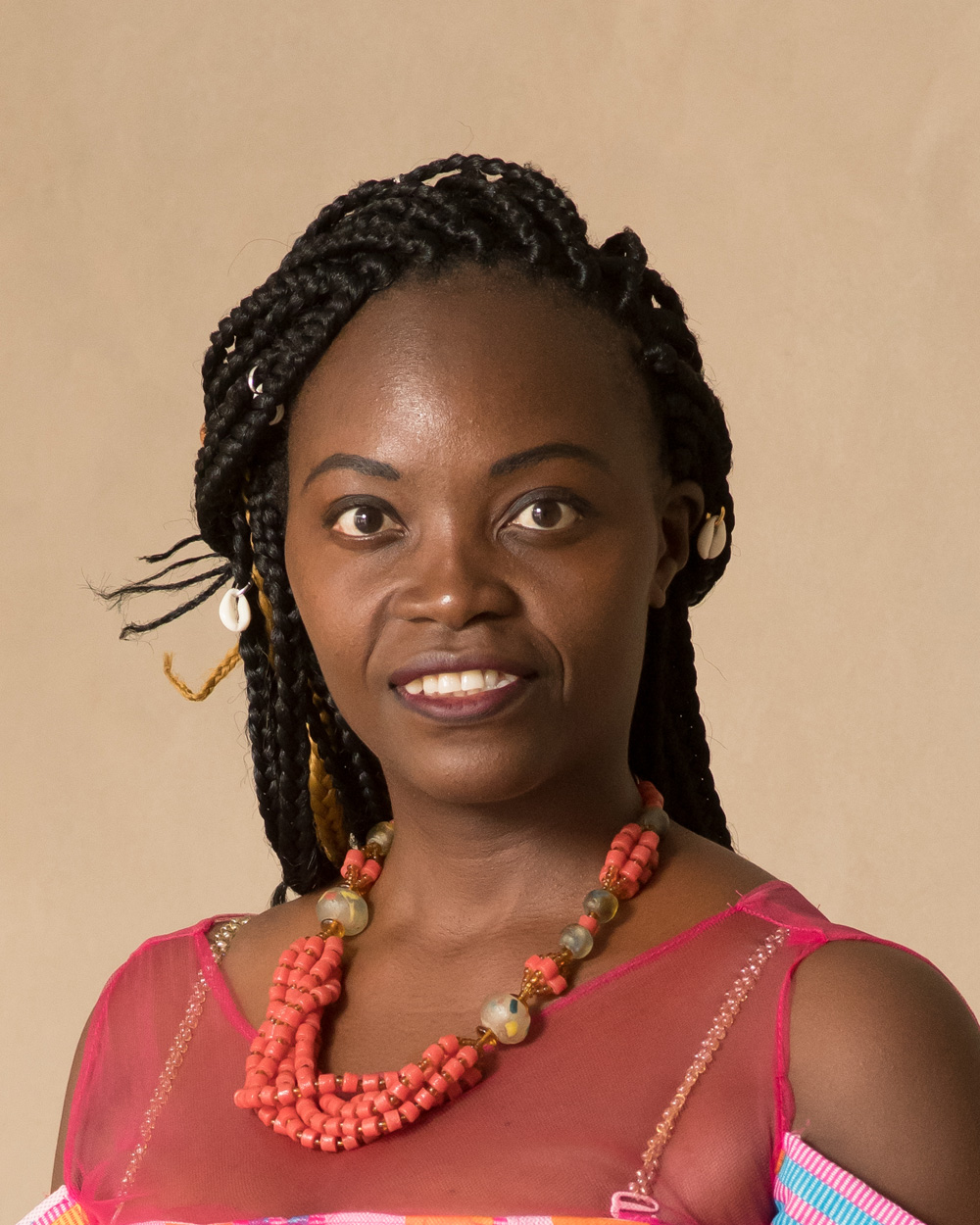
Country / Where did you grow up:
Abidjan, Côte d'Ivoire
Academic qualifications:
Bachelor of Arts in Communication Studies (Journalism), Ghana Institute of Journalism, Ghana
Master of Arts in Conference Interpreting, Pan African University Institute of Governance, Humanities and Social Sciences, hosted by the Advanced School of Translators and Interpreters (ASTI), Cameroon.
Experience:
Human rights advocate; freelance journalist (human rights and environment); planning team member for the African Youths SDGs Summit; Media Relations Officer at Alliance Française Accra.
Academic fields of interest:
Disability studies and women's rights.
Position prior to the programme:
Human rights advocate; freelance journalist.

Country / Where did you grow up:
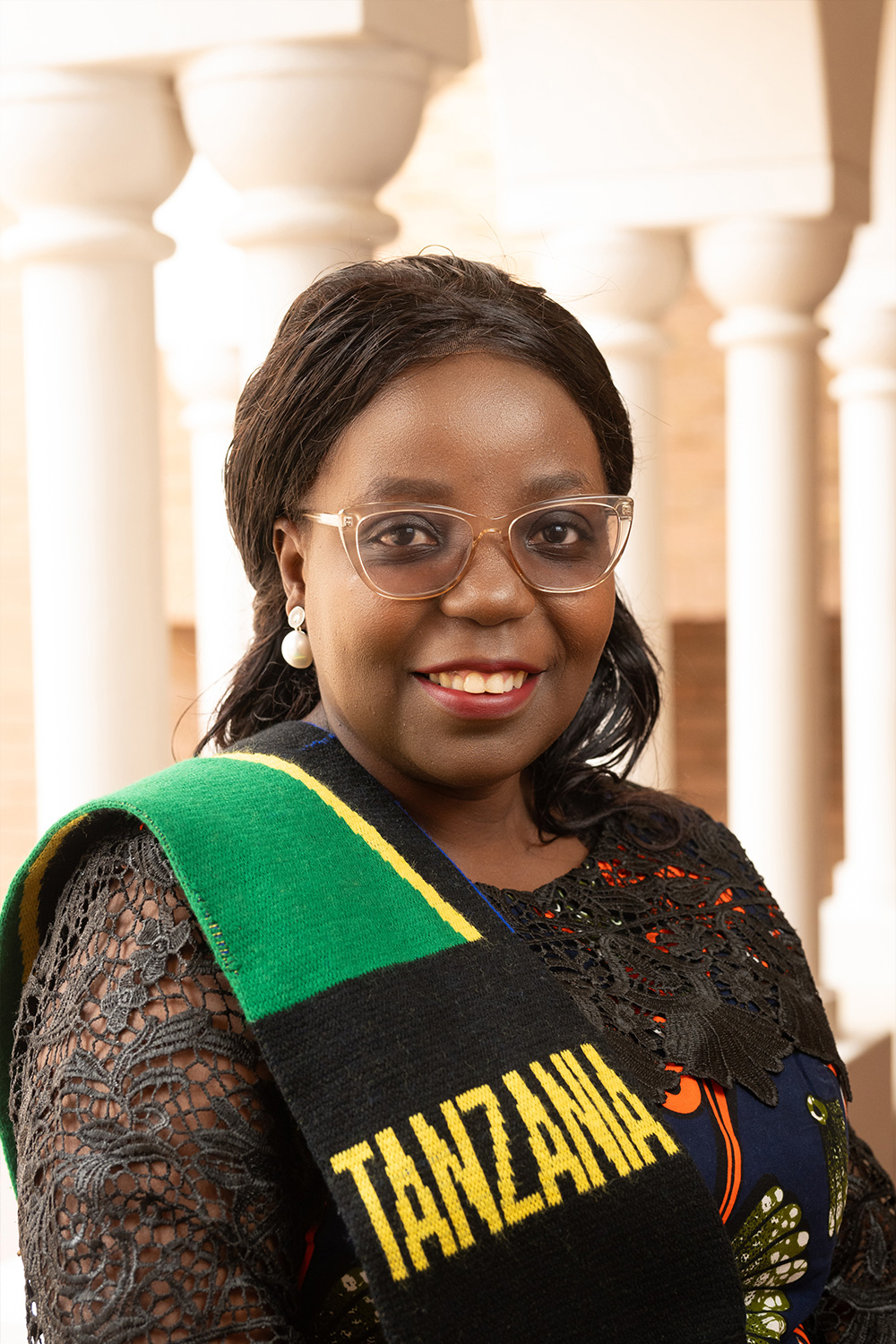
Dar-Es-Salaam, Tanzania
Academic qualifications:
LLB (Honors) University of Cape Town
Experience:
Model United Nations: I have been an avid participant in MUN since high school and throughout my university career, placing second at the conference held and adjudicated by DIRCO. I have also participated in conferences in both Germany and the Hague.
During my gap year, I worked for an NGO in Tanzania called 'Africa- Inside-Out' which used media and performance as a platform to bring to light social causes.
In my final year of law, I volunteered for a program known as CLASI where we went into improvised areas with the aim of educating high school leaners on their Constitutional rights.
Academic fields of interest:
Gender, Law and African Customary Law.
Position prior to the programme:
Student.

Country / Where did you grow up:
Harare, Zimbabwe
Academic qualifications:
MSc Refugee and Forced Migration Studies, University of Oxford, United Kingdom
Experience:
I worked for eight years in Syria, Lebanon and Jordan in the humanitarian sector in relation to the Iraqi and Syrian crises. I also worked with minority refugee communities from Sudan and Somalia. Areas of work include protection of humanitarian workers/ civilians; private fundraising and donor relations; education in emergencies; rapid response team; communications; advocacy and policy.
Academic fields of interest:
Socio-legal and historical fields around social justice and human rights issues
Position prior to the programme:
Syrian Crisis Policy Advisor for Humanity and Inclusion (formerly Handicap International)

Country / Where did you grow up:
Gaborone, Botswana
Academic qualifications:
Bachelor of Laws (LLB), University of Botswana
Experience:
Candidate Attorney
Youth Activist for Ignite the Youth and Southern African Aids Trust (SAT)
Academic fields of interest:
Women's Rights, Rights of LGBTQI+ persons and Right of People Living with Disabilities.
Position prior to the programme:
Candidate Attorney
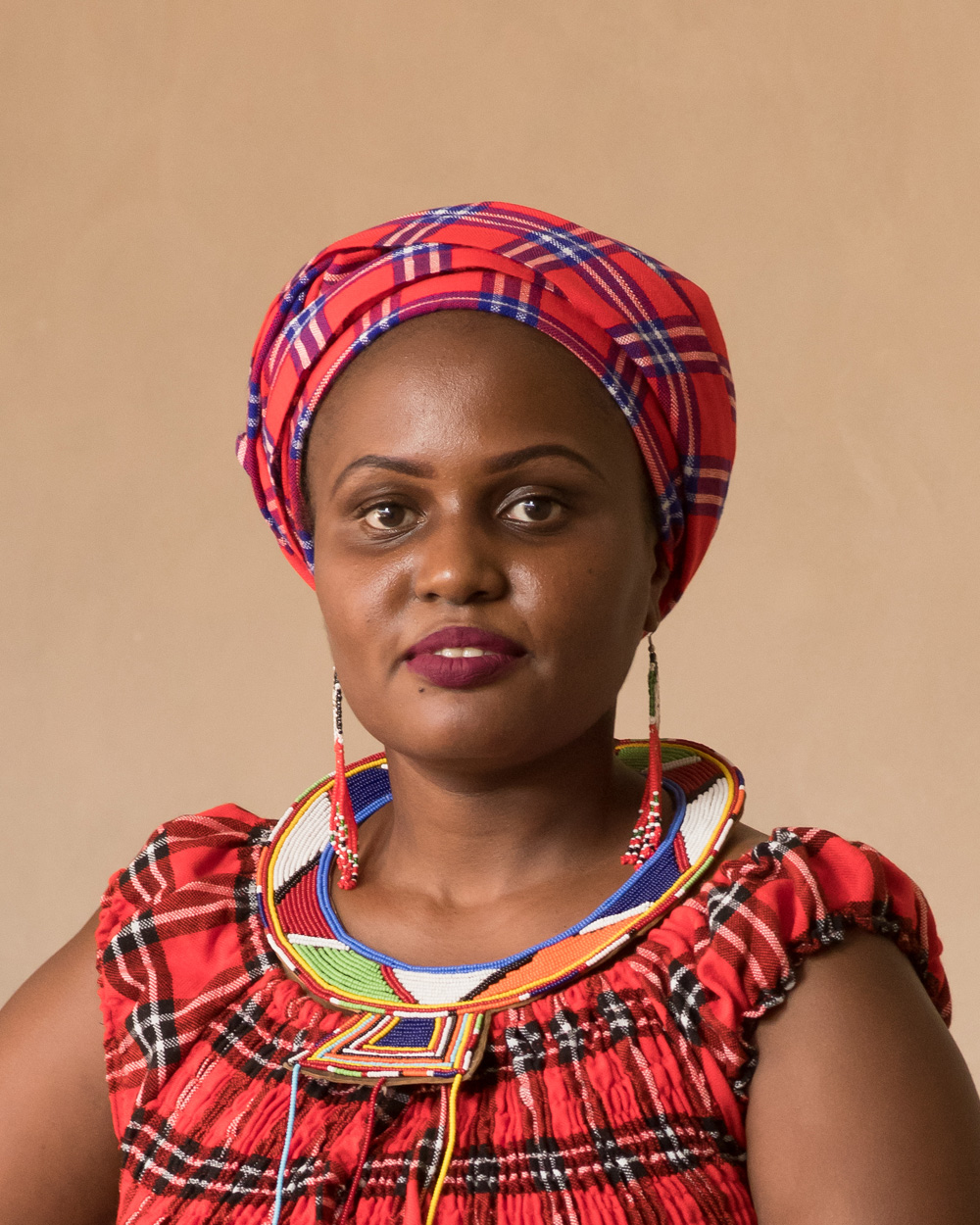
Country / Where did you grow up:
Nyeri, Kenya
Academic qualifications:
Bachelor of Laws (LLB), Kenyatta University Kenya;
Post-Graduate Diploma in Law (Advocates Training Program), Kenya School of Law;
International Training Program (Sustainable Development and Human Rights), University of Antwerp, Belgium.
Experience:
Assistant Programme Officer-Legal and Social Justice Programme, Refugee Consortium of Kenya;
Intern Lawyer-Kenya Human Rights Commission; Trainee Advocate-Manyonge Wanyama & Associates Advocates; Intern-The National Legal Aid (and Awareness) Programme;
Judicial Attachee-Kikuyu Law Courts
Academic fields of interest:
The right to (sustainable) development;
The justiciability of economic, social and cultural rights;
Forced migration;
The rights of women;
The rights of sexual and gender-identity minorities;
Transitional justice; Constitutional law and constitutionalism.
Position prior to the programme:
Assistant Programme Officer-Legal and Social Justice Programme, Refugee Consortium of Kenya
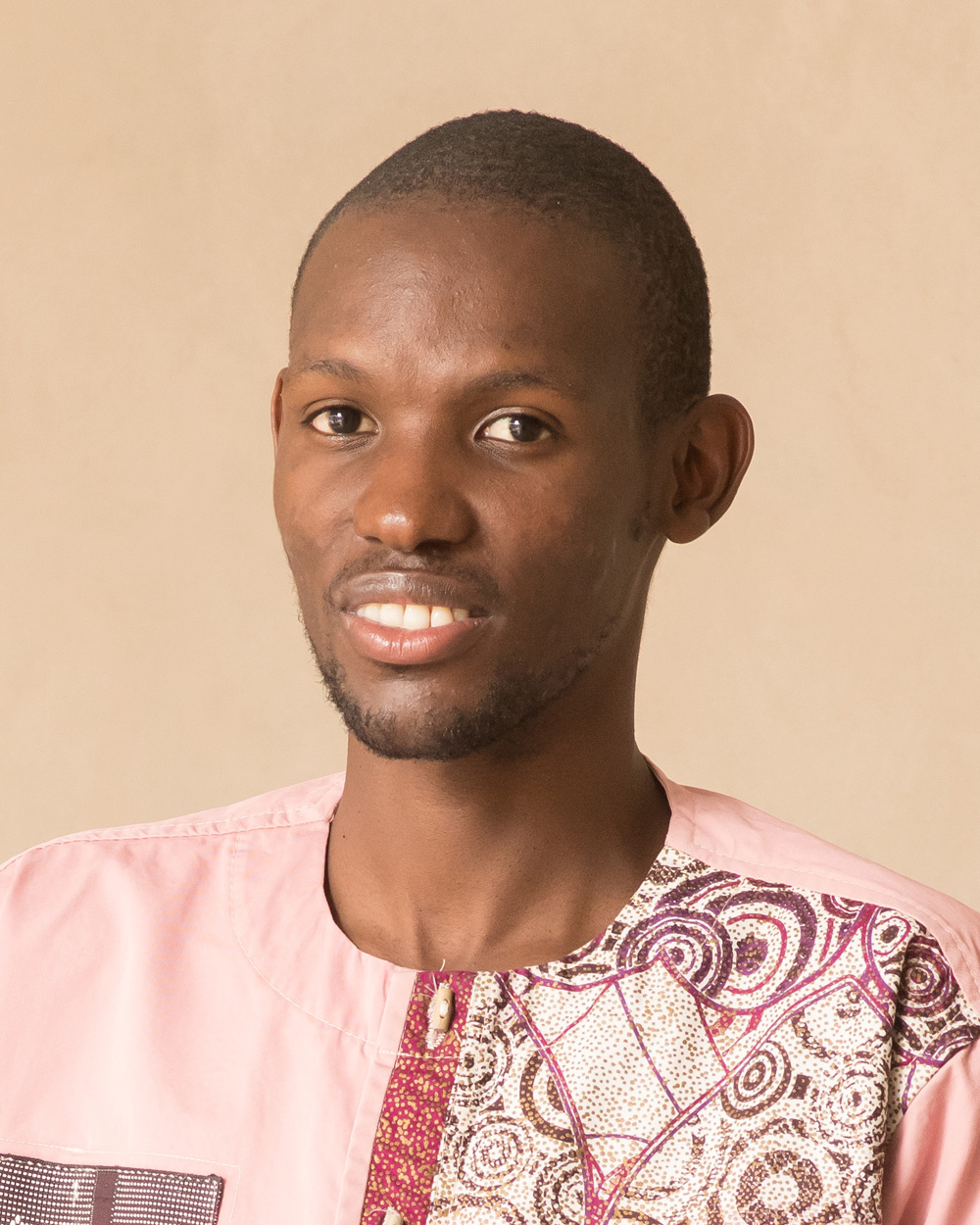
Country / Where did you grow up:
Gaborone, Botswana
Academic qualifications:
Bachelor of Social Work, University of Botswana, Botswana
Experience:
Oabona Sepora is the Executive Director and Founder for Friends of Diversity graduated with a Bachelor of Social Work from the University of Botswana in 2014. Oabona currently studies Master’s Degree in Human Rights and Democratization in Africa at the University of Pretoria In addition, he is an alumnus for Young African Leadership Initiative (YALI) and has over 8 years’ experience in the human rights movement in Botswana and internationally, particularly standing for the rights of LGBTI+ person rights. Mr Sepora has worked with various NGO(s) is Botswana being LEGABIBO, Ditshwanelo-The Botswana Centre for Human Rights, SRHR Africa Trust, Young African Leadership and Development in Africa (YALDA), among others. He has represented LGBTI+ community in numerous international forums such International Aids Conference in the Netherlands, International Conference on AIDS and STI in Africa (ICASA) in Harare, Zimbabwe and Abidjan, Ivory Coast, SADC Queer Youth exchange among others. In addition, in 2014, Oabona was hosted by the Center for Human Rights and Rehabilitation in Lilongwe, Malawi and he also has done several abstract presentations on sexual reproductive health rights in Nairobi, Kenya and other African countries. In 2018, Oabona was named a global peace ambassador for 2018/2020 by Global Peace Chain Organization.
Academic fields of interest:
Strategic litigation, Mental health discourse and Jurisprudence
Position prior to the programme:
Executive Director, Friends of Diversity
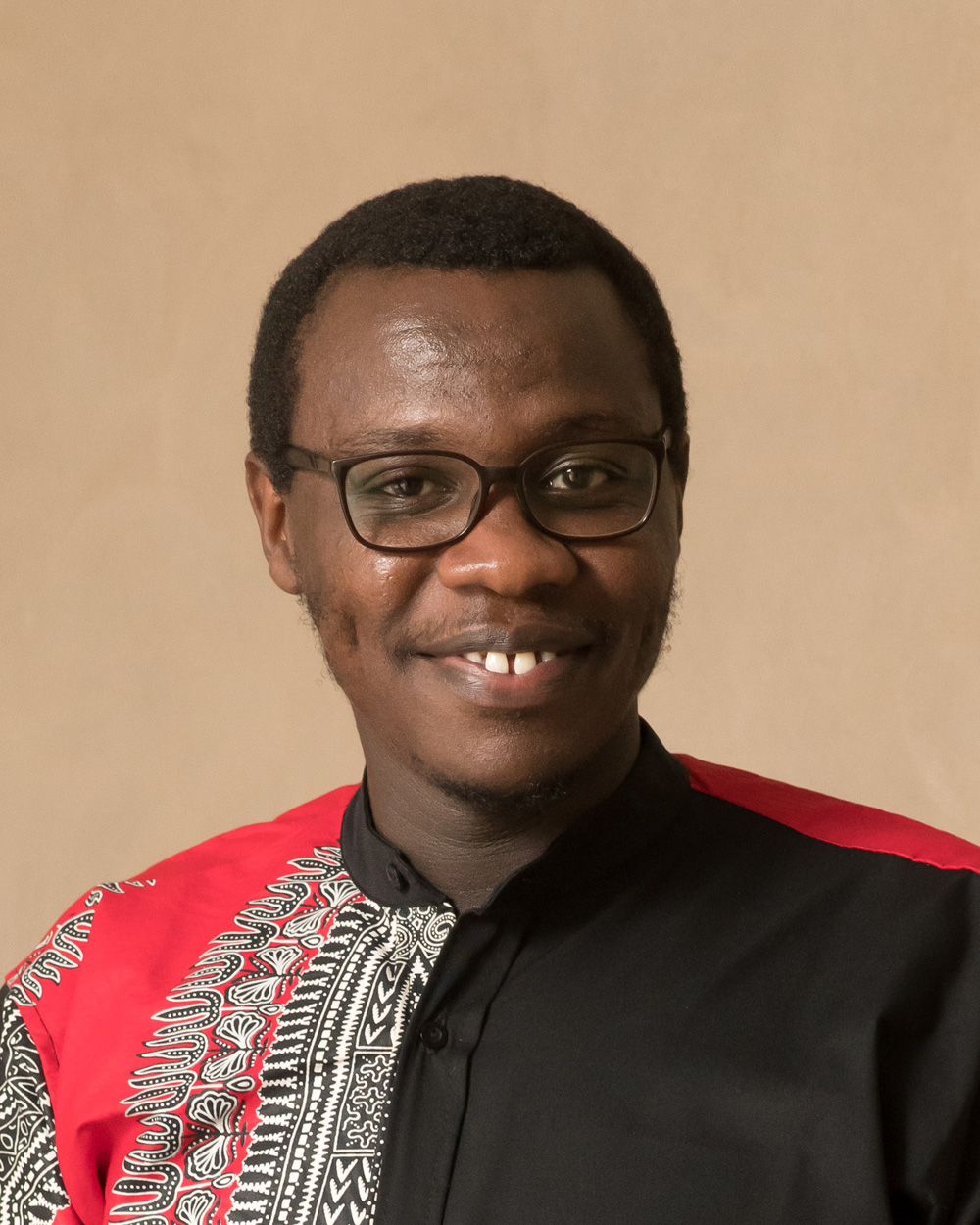
Country / Where did you grow up:
Nairobi, Kenya
Academic qualifications:
Bachelor of Laws (LLB) (Hons) Mt Kenya University, Kenya, Post Graduate Diploma(Advocates Training Programme), Kenya School of Law, Kenya
Experience:
Prior to joining the programme, I was a Legal Researcher at ICJ Kenya, where I was tasked with carrying on research for diverse issues to include human rights and issues around access to justice in Kenya. Prior to becoming a Legal Researcher, I was a Legal Intern, Access to Justice Programme, ICJ Kenya. I was also a pupil at the Office of the Attorney General and Department of Justice attached to the Civil Department and the Legislative Drafting Department. Prior to KSL was a Legal Volunteer at the Refugee Consortium of Kenya (RCK). Being to these different places, I have learnt and gained significant experience. I am also an Advocate of the High Court of Kenya.
Academic fields of interest:
My academic and research interests are in human rights specifically the rights of sexual minorities and environmental law.
Position prior to the programme:
Legal Researcher - Kenyan Section of the International Commission of Jurists (ICJ Kenya).
Country / Where did you grow up:
Calabar, Cross River State, Southern Nigeria
Academic qualifications:
LLB, University of Calabar, Nigeria.
BL, Nigeria Law School, Abuja, Nigeria.
Experience:
Corporate/Commercial legal practice, Punuka Attorneys & Solicitors. Legal consultant, Dorothy Njemanze Foundation (for the protection of the rights of victims of sexual and domestic abuse, sexual minorities, etc)
Academic fields of interest:
Children's right, LGBTQI rights, Business and human rights.
Position prior to the programme:
Head of corporate practice (in private legal practice), Legal Consultant to a local NGO in Nigeria
Country / Where did you grow up:
Zambia and South Africa (Pietermaritzburg, East London, and Pretoria)
Academic qualifications:
Bachelor of Arts in Law (BA Law UP SA)
Bachelor of Laws (LLB UP SA)
Experience:
I have worked as an Academic Assistant at the Disability Unit of the University of Pretoria, primarily assisting students with disabilities to utilise the reasonable accommodation mechanisms put in place for their academic advancement. I have also worked as Teaching Assistant for the module Language and Study Skills at the University of Pretoria, Mamelodi campus. Here I was primarily tasked with assisting first-year learners in improving their academic research and writing in line with what is required for tertiary-level academics. I have worked as a Production Assistant on two human rights films concerning the rights of older persons and sexual violence against women. I have also written and directed my own short human rights film dealing with gender-based violence.
Academic fields of interest:
I am interested in the right to education of girl children in Africa and the intersectional analysis of socio-economic and political factors that continue to hamper their access to education. I am also interested in investigating the role that creative media can play in advancing or jeopardising pro-human rights initiatives in Africa.
Position prior to the programme:
I was a Teaching Assistant for the module Language and Study Skills at the University of Pretoria, Mamelodi campus. Here I was primarily tasked with assisting first-year learners in improving their academic research and writing in line with what is required for tertiary-level academics
Country / Where did you grow up:
Kinshasa, Democratic Republic of Congo
Academic qualifications:
Licence en Droit, option: Droit économique et social, Université technologique Bel Campus, The Democratic Republic Of Congo
Experience:
4 years experience as Legal assistant at Associate Law Firm President of the Bar Alain MAVAMBU, DRC.
Academic fields of interest:
The Rights of Refugees, Migration Law and Environmental Law
Position prior to the programme:
I was a Legal Assistant.
Country / Where did you grow up:
Uganda Kampala
Academic qualifications:
Bachelor of Development Studies from Makerere University, Uganda
Experience:
Am a social worker Trans activist and Human Rights Activist and I have worked with 3 LGBTQ organisations in Uganda but currently working with Tranz Network Uganda a network organisation that facilities coordination and collaboration amongst Trans led organisations in Uganda.
Academic fields of interest:
Human Rights and Leadership. Sexual and Gender Minority Issues
Position prior to the programme:
Assistant Programs officers at Tranz Network Uganda
Media Publications
- Free the 19 Remanded LGBTQ+ Persons Under Pretext of COVID-19 Regulations
Originally published in Kuchu Times
25 April 2020
Country / Where did you grow up:
Bulawayo, Zimbabwe
Academic qualifications:
BA Law and LLB at the University of Pretoria, South Africa
Experience:
Worked as an intern at Mathonsi Ncube Law Chambers, and Legal consultant at C.Gauche Pty(Ltd)
Academic fields of interest:
International Human Rights Law and International Relations
Position prior to the programme:
LLB Student at the University of Pretoria
 luyanda17@gmail.com
Media Publications
- COVID-19 exposes bad governance in Zimbabwe
Originally published in Politico Online
27 April 2020
Country / Where did you grow up:
Arusha, Tanzania
Academic qualifications:
Bachelor of Laws(LL.B) from Mzumbe Main-Campus University Morogoro, Tanzania. Post-graduate Diploma in Legal Practice from Law School of Tanzania, Dar es salaam Tanzania, Bachelor of Arts in Philosophy from Uganda Martyrs University, Uganda.
Experience:
I work as an assistant researcher for Dr Elifuraha Laitaika who is an expert member of the United Nations Permanent Forum for indigenous issues (UNPFII)
Academic fields of interest:
International Humanitarian Law, Litigation, indigenous rights, and democracy and constitutional law, and international human rights law
Position prior to the programme:
Assistant researcher for Dr Elifuraha Laitaika who is an expert member of the United Nations Permanent Forum for indigenous issues(UNPFII)
Country / Where did you grow up:
Addis Ababa, Ethiopia
Academic qualifications:
Bachelor degree in law, Haramaya University, Ethiopia
Experience:
I hold a Bachelor degree in Laws from the University of Haramaya, Ethiopia. After completing my first degree, I worked with the Human Rights and Transitional Justice Unit at the African Union Commission.
Academic fields of interest:
Migration and Transitional Justice in Africa.
Position prior to the programme:
I was a junior consultant in Human Rights and Transitional Justice Unit at the African Union Commission.
Country / Where did you grow up:
Bukavu, Democratic Republic of Congo
Academic qualifications:
LLB Private and judicial law, Université Catholique de Bukavu (UCB), DRC
Experience:
Assistant Teaching at UCB and Legal Aid Officer at CADDHOM-NGO
Academic fields of interest:
LGBTIQ rights
Position prior to the programme:
Legal Aid Officer at CADDHOM-NGO
Country / Where did you grow up:
Oromia Regional State, Ethiopia
Academic qualifications:
I have earned an LLB degree from Haramaya University in Ethiopia and LLM Degree in Criminal Justice from the University of the Western Cape in South Africa.
Experience:
I have served as an Assistant Lecturer at Haramaya University for more than two years. In addition, I have been a volunteer for more than three years on a project called AJLA (Access to Justice and Legal Aid) by giving free legal service to the marginalized group of people.
Academic fields of interest:
I am interested in human rights with a particular focus on children's rights. I am also interested in transitional justice and anti-corruption areas.
Position prior to the programme:
Prior to joining the HRDA programme, I have been working as an Assistant Lecturer at Haramaya University.
Country / Where did you grow up:
Nairobi, Kenya
Academic qualifications:
Bachelors of Law (LLB) (Hons) Jomo Kenyatta University of Agriculture and Technology Kenya; Postgraduate Diploma in Law (Advocates Training Program), Kenya School of Law.
Experience:
I was an advocate of the High Court of Kenya practising as an associate advocate at CM Advocates LLP undertaking litigation in children, women, constitutional and judicial review matters. Previously, before joining CM Advocates, I undertook my pupillage at R.W. Mbanya & Co. Advocates.
Academic fields of interest:
Human rights, women and children rights, constitutional and constitutionalism, access to justice and transitional justice.
Position prior to the programme:
Associate advocate at CM Advocates LLP, Nairobi, Kenya. carolrono92@gmail.com
Country / Where did you grow up:
Windhoek, Namibia
Academic qualifications:
Bachelor of Laws at the University of Namibia, Namibia.
Experience:
Intern at the Law Reform and Development Commission of Namibia;
Academic fields of interest:
Social Justice and Strategic Litigation
Position prior to the programme:
Enrolled at the Justice Training Centre to be admitted to the High Court of Namibia
Country / Where did you grow up:
Bobo-Dioulasso, Burkina Faso
Academic qualifications:
Bachelor's degree in legal science at Université Privée de Ouagadougou and master 1 degree in public law at Universitée Privée de Ouagadougou
Experience:
After my master 1 degree in public law, I worked as intern at the ''Centre Africain de Droit International Pénal et du droit Humanitaire'' (CADIPH).
Academic fields of interest:
I am interested in human rights, especially women and children rights. I am also interested in humanitarian law and international criminal law.
Position prior to the programme:
Student and Intern
Country / Where did you grow up:
Makeni City, Sierra Leone.
Academic qualifications:
BA (Hons) in Mass Communication, Fourah Bay College (University of Sierra Leone)
Experience:
Mustapha Dumbuya is a Sierra Leonean international journalist and human rights media trainer. Before coming to pursue the MPhil in Human Rights and Democratisation in Africa at the Centre for Human Rights, University of Pretoria, Mustapha was based in South Sudan where he worked as journalism trainer. His stories have appeared in various international media outlets such as the New Internationalist, News Deeply, the BBC World Service, and Inter Press Service among others (IPS).
Prior to joining JHR in South Sudan, Mustapha worked for BBC Media Action in Sierra Leone as a producer and community radio mentor/trainer. One of the pinnacle events of his career was covering the 2014-2015 Ebola outbreak in West Africa as its ravaged communities in Sierra Leone, particularly affecting the women who cared for the sick.
It was then that he realized the power of radio to educate entire communities on their human rights and help change the mindsets of the public.
This passion fueled him through three years working as a media trainer for JHR in South Sudan, training journalists and civil society activists on human rights reporting and empowering them to speak out on critical issues that need to be addressed by the authorities.
Academic fields of interest:
I am interested in the intersection between media and transitional justice in Africa. I am particularly interested in the role the media play plays in the promotion of human rights in a post-conflict context.
Position prior to the programme:
Senior International Media Trainer, Journalists for Human Rights in South Sudan.
Media Publications
- The impact of technology on mental health during COVID-19
Originally published on AfricLaw
22 May 2020 - Ruling out violence as a means to achieving compliance with COVID-19 measures
Originally published in Politico Online
22 April 2020
Country / Where did you grow up:
Sierra Leone
Academic qualifications:
Bachelor of Arts with Honours in Political Science. Fourah Bay College, University of Sierra Leone. Sierra Leone.
Experience:
I have been working towards improving the lives of the most vulnerable people.
Academic fields of interest:
Human Rights
Position prior to the programme:
Supervisor
Country / Where did you grow up:
Bulawayo, Zimbabwe
Academic qualifications:
Bachelor of Laws Honours Degree, University of Zimbabwe
Experience:
Opal is a registered Legal Practitioner and Conveyancer. She completed her Law Degree at the University of Zimbabwe in 2014 and worked as a Legal Officer at Justice for Children. She has 5 years of experience working in the child rights sector. She has expertise in both criminal and civil litigation in child-related matters. She has been actively involved in strengthening the capacity of stakeholders, children and communities on child protection laws. Opal has also been actively involved in lobbying and advocating for policy reform on issues affecting children in Zimbabwe.
Academic fields of interest:
Children's Rights
Position prior to the programme:
Legal Officer at Justice for Children
Country / Where did you grow up:
Mbale, Uganda
Academic qualifications:
Bachelor of Arts in Mass Communication (Hons), Uganda Christian University (Uganda).
Experience:
Johnson's career started in 2010 as an intern at a local radio station where he worked as a talk show co-host for a weekly news round-up. He later joined Monitor Publications Ltd, a Nation Media Group company, as a reporter. He has also worked as Chief Sub-editor at Red Pepper Publications Ltd, News Editor at The Standard, National Vice Chairman of the Executive Board of Directors at Human Rights Network for Journalists – Uganda, and Chairman of the Board of Directors at Uganda Journalists’ Network, among others. Besides, he has won several awards, most notable being the Best Overall Winner of Uganda Media Rights Award in 2016 and first runner-up for the same award in 2017.
Academic fields of interest:
Strategic advocacy and litigation, international human rights law, Sexual minorities' rights, Forced migration and refugee law, Freedom of the press and other media, Women and children's rights, and transitional justice.
Position prior to the programme:
Editor at Monitor Publications Ltd, a Nation Media Group company in Uganda.johnsonmayamba@gmail.com
Media Publications
- The impact of technology on mental health during COVID-19
Originally published on AfricLaw
22 May 2020
Country / Where did you grow up:
Imo State, Nigeria
Academic qualifications:
1. Bachelor of Laws (University of The Gambia) The Gambia,
2. Barrister at law (Nigerian Law School) Nigeria
Experience:
I represented the University of The Gambia at the 2016 Philip C. Jessup World Moot Court Competition. Following my graduation, I worked as a legal intern at the Secretariat of the African Commission (ACHPR), where among other things, I drafted decisions and presented the same at its sessions.
Academic fields of interest:
Human Rights, Democracy, and Governance
Position prior to the programme:
A Legal Practitioner
Country / Where did you grow up:
Beira, Mozambique
Academic qualifications:
LLB at University Catholic of Mozambique - Mozambique Beira
Experience:
I have a degree in Law. I did some internships in law offices. I also did some years of volunteer work in the community. I am also an advocate for many causes of minorities rights.
Academic fields of interest:
Human Rights - Women rights, child rights and all minorities rights.
Position prior to the programme:
I was doing an internship to become a professional lawyer.
Country / Where did you grow up:
Guinea
Academic qualifications:
Master in Private Law Univerity Gamal Abdel Nasser of Conakry Guinea
Experience:
Attorney Foromo Frédéric Loua is founding president and the senior trial lawyer of Mêmes Droits pour Tous (MDT), one of main Guinean Non-governmental organization which provides legal assistance to prisoners throughout the country. Attorney Loua also works towards reducing the prevalent use of torture during investigations. As a practicing lawyer, He collaborates with Human Rights Watch on its reports on Guinea, in particular on torture and the excessive use of force by the Guinean security forces. He is an active member of the Guinean human rights commission and has collaborated with the United Nations High Commissioner for Refugees to provide legal assistance to refugees in Guinea. From September 2008 to February 2009, he acted as “resident expert” for the International Forum for Democracy studies at the National Endowment for Democracy (NED), where he conducted research on the legal system reform and the democratization process in Guinea. As it pertains to the reformation of the Guinean security forces, Attorney Loua has worked with the High Commissioner of Human Rights by providing training to the guinea security forces on human rights and international humanitarian law. In the end, Attorney Loua has been increasingly focused on the reform of criminal laws in accordance with Guinea's international commitments, the promotion of a legal environment favourable to populations affected by mining projects and democratic governance issues.
Academic fields of interest:
Human Rights and Democratisation
Position prior to the programme:
President and Senior Trial Lawyer of Mêmes Droits pour Tous
Media Publication
- The impact of technology on mental health during COVID-19
Originally published on AfricLaw
22 May 2020 - Quand l'obstination du président de la République à dérouler
Originally published in Mosaiqueguinee
17 April 2020
Country / Where did you grow up:
Western Division, The Gambia
Academic qualifications:
LLB, University of The Gambia
Experience:
I hold a Bachelor of Laws (LLB) from the University of The Gambia and was subsequently called to the Gambian Bar in 2017. I also have a post-graduate diploma in Peace and Security Studies from the African Leadership Centre, King’s College London. Professionally, I worked with the Truth, Reconciliation and Reparations Commission of The Gambia as an Assistant Women Affairs Coordinator. My previous stints include working as a Consultant with UN Women, Nigeria Country Office under the Women, Peace and Security unit and briefly, as a Magistrate at the Judiciary of The Gambia.
Academic fields of interest:
Feminist theories, gender equality, transitional justice, state-building, conflict transformation, and sexual violence in conflict settings.
Position prior to the programme:
Assistant Women Affairs Coordinator; Truth, Reconciliation and Reparations Commission of The Gambia
Country / Where did you grow up:
Pakwach, Uganda
Academic qualifications:
Bachelor of Social Work and Social Administration (Hons), Uganda Christian University, Mukono, Uganda.
Experience:
I have been working with the Uganda Human Rights Commission since 2010 as a Human Rights Officer-in-charge of Complaints and Investigations at the Arua Regional Office. I am also an Accredited Mediator with the Judiciary of Uganda where I conduct court-annexed mediations.
Academic fields of interest:
I am interested in Children's Rights, Women's Rights and Transitional Justice.
Position prior to the programme:
Human Rights Officer/ Complaints and Investigations at the Uganda Human Rights Commission.
HRDA Tutor and Doctoral Candidate
Tel: +27 (0) 12 420 3810
clement.agyemang@up.ac.za
Country / Where did you grow up:
Elubo, Western Region, Ghana
Academic qualifications:
Bachelor of Arts (Honours) in Political Studies at Kwame Nkrumah University of Science and Technology(KNUST), Ghana.
Experience:
Teaching experience, active politics and political activism
Academic fields of interest:
International relations, constitutionalism, human rights, democratisation and decentralisation.
Position prior to the programme:
Politician, political activist and political communicator










Abena Asare





The students on the LLM programme in human rights and democratisation in Africa are assigned to human rights clinics which contributes to the work of the Centre’s research units and give the students practical experience and advance the Centre’s mission towards the realisation of human rights in Africa. Students on the Centre's master's programmes work in these clinics under the supervision of a Centre staff member or doctoral student.
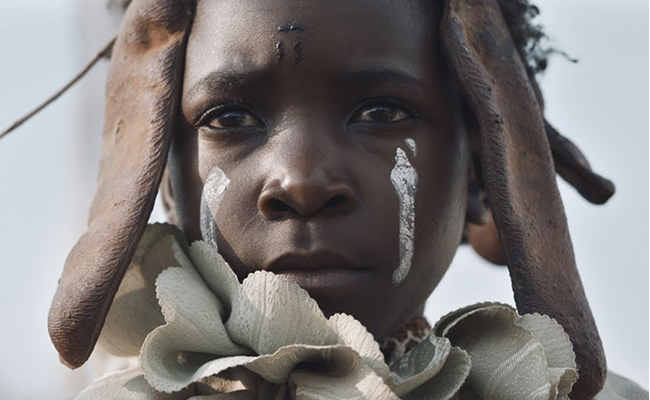
Advocacy Human Rights Clinic
The advocacy clinic has three mandates for this year which include online sensitisation campaign on the Rights of Older persons producing a
Read More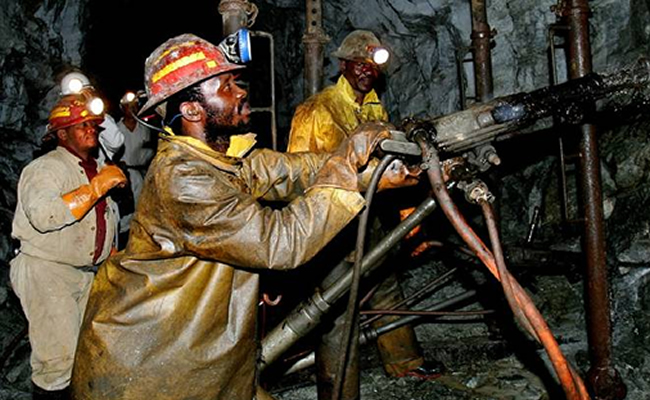
Business and Human Rights Clinic
The mandate of the business and human rights clinic in 2018 is to Document cases before international bodies on extractive industries and human rights for a database prepared by the African Commission’s working group on extractive industries secondly to facilitate a dialogue with SAHRC focusing on extractive industries.
Read More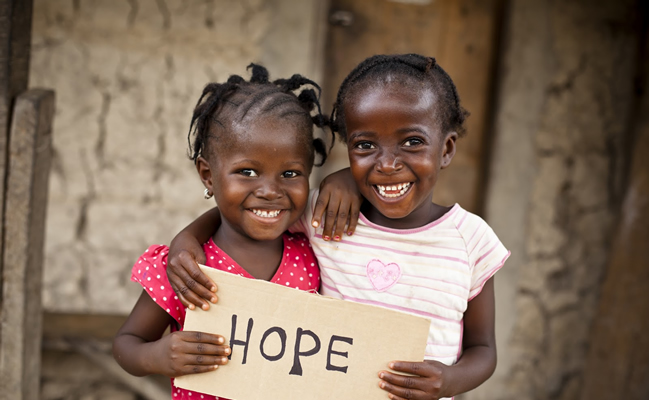
Children's Rights Clinic
The mandate of the Children’s Rights Clinic is to prepare a shadow report on Zambia state report to the African Committee on the Rights and Welfare of the Child secondly to prepare advocacy material around Agenda 2040 of the African Committee on the Rights and Welfare of the Child for states and CSOs.
Read More
Democracy Transparency and Digital Rights Clinic
The mandate of the Democracy Transparency and Digital Right Clinic is to shadow reports to the African Commission on Human and Peoples’ Rights on Nigeria and Eritrea and prepare data protection course which will be available online.
Read More
Disability Rights Clinic
The mandate of the Disability Rights clinic is to draft a research paper on domestication strategies that member states can adopt to ensure that Africans with disabilities enjoy the rights enshrined in the Protocol and
Develop a ‘Know your rights under the African Disability Protocol’ information pamphlet for persons with disabilities that raises awareness about the rights they are entitled to.
Migrant Rights Clinic
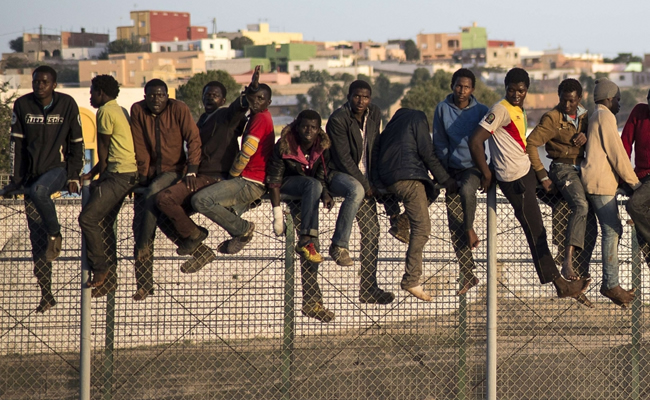
The Migrant clinic has four mandates for 2018 which include producing a synopsis of Refugee Act, collecting refugee acts for a database, analysis the AU-EU migration crisis and design a pamphlet for migration class.
Read More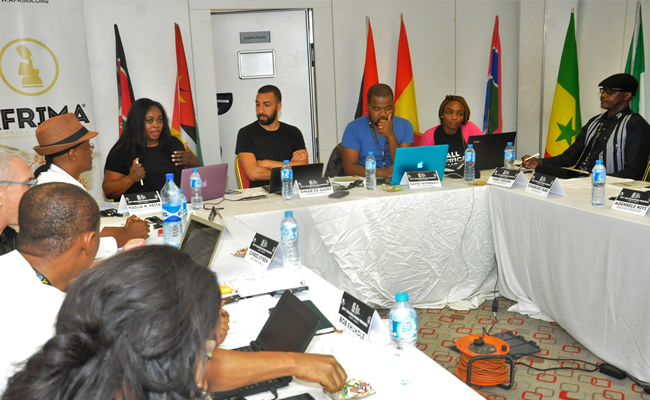
Implementation & Litigation Clinic
The mandate of the Implementation & Litigation Human Rights Clinic includes developing a strategy to implement decisions of the African Commission on Human and Peoples’ Rights against Zimbabwe and draft a concept note, engaging with civil society. Further to contribute a framework for updating the book on the impact of international treaty monitoring bodies in selected states.
Read More
SOGIESC Clinic
The mandate of the SOGIE Clinic is to conduct research into equality litigation and effectiveness of statutory bodies dealing with equality in Kenya, South Africa and Uganda further to implement resolution 275 of the African Commission on Human and Peoples’ Rights and produce guidelines on transgender persons in correctional services.
Read More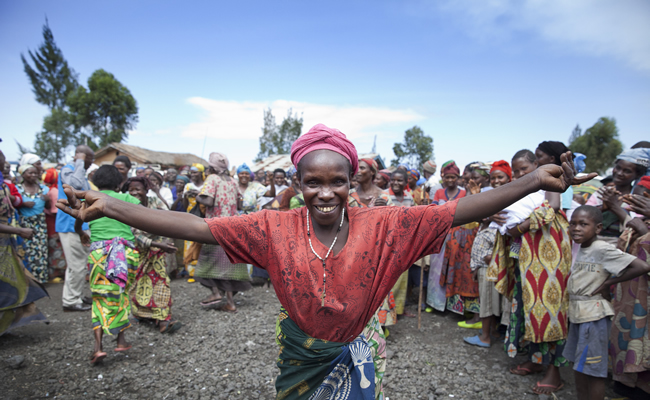
Women's Right Clinic
The mandate of the Women's Right Clinic is to shadow report Nigeria, collaborate with advocacy clinic on rights of older persons design a fact sheet on older persons
Read MoreHuman Rights Clinic Coordinators
Human Rights Clinics Archives
- Advocacy Human Rights Clinic
- Business and Human Rights Clinic
- Children's Rights Clinic
- Disability Rights Clinic
- Migrant Rights Clinic
- Democracy Transparency and Digital Rights Clinic
- Migrant Rights Clinic
- Implementation & Litigation Human Rights Clinic
- Sexual Orientation, Gender Identity and Expression, and Sex Characteristics Clinic
- Women's Rights Clinic
Class of 2018
LLM/MPhil
- Hanna Abebe Demissie (Ethiopia)
- Henok Ashagrey Kremte (Ethiopia)
- Hawi Asfaw Amena (Ethiopia
- Basiru Bah (The Gambia)
- Laurah Arudi Maina (Kenya)
- Marystella Auma Simiyu (Kenya)
- Jonathan Ombati Obwogi (Kenya)
- Thabang Ramakhula (Lesotho)
- Oluwatomiwa Timothy Ilori (Nigeria)
- Oluwaseyitan Ayotunde Solademi (Nigeria)
- Nimrod Muhumuza (Uganda)
PHDs/LLD
- Victor Ayeni (Nigeria)
- Henrietta Ekefre (Nigeria)
- Chairman Macaulay Okoloise(Nigeria)
Class of 2017
LLM/MPhil
- Kahbila Ulrike Mbuton (Cameroon)
- Tressor Muhindo Makunya (DRC)
- Asrar Adem Gebeyehu (Ethiopia)
- Tsion Woldu (Ethiopia)
- Sainey Bah (Gambia)
- Stephen Baubeng-Baidoo (Ghana)
- Henry Paul Omboto (Kenya)
- Muuo Josephat Kilonzo (Kenya)
- Urias The Pour (Liberia)
- Mansha Mohee (Mauritius)
- Lily Iruebafa Oyakhirome (Nigeria)
- Richard Ntakirutimana (Rwanda)
- Jackline Nixon Hakim (South Sudan)
- Lindi-K Nokwanda Matse (Swaziland)
- Winfred Apio (Uganda)
- Roseline Nsenge (Uganda)
PHDs/LLD
- VictorAyeni (Nigeria)
- Henrietta Ekefre (Nigeria)
- Chairman Macaulay Okoloise (Nigeria)
Class of 2016
LLM/MPhil
- Samrawit Damtew (Ethiopia)
- Elsie Anietie Ewang (Nigeria)
- Nyarangi Jared Gekombe (Kenya)
- Alban Wisel Gouet (Ivory Coast)
- David Nnanna C Ikpo (Nigeria)
- Vivian Methord Ishengoma (Tanzania)
- Johannes Donavan Kariseb (Namibia)
- James Paywala Monibah (Liberia)
- Rachel Njoki Njuguna (Kenya)
- Ahmed Omar Omar (Djibouti)
- Rodger Lameck Owiso (Kenya)
- Chrissie Patrick Phiri (Malawi)
- Bright Sefah (Ghana)
- Adiam Tsighe (Ethiopia)
- Tilahun Zewudie (Ethiopia)
- Geoffrey Zulu (Zambia)
PHD/LLD
- Victor Ayeni (Nigeria)
- Henrietta Ekefre (Nigeria)
- Chairman Macaulay Okoloise (Nigeria)
Class of 2015
LLM/MPhil
- Didier Iradukunda (Burundi)
- Kago Rapula Mokotedi (Botswana)
- Abiy Alemu Ashenafi (Ethiopia)
- Hibo Mahad Mohamoud (Somaliland)
- Henrietta Markfre Ekefre (Nigeria)
- David Mufuayia Achero (Kenya)
- Aminnata Awa Bousso Ly (Senegal)
- Geofrey Femi Ogwaro (Uganda)
- Michael Addaney (Ghana)
- Gloria Alinafe Kalebe (Malawi)
- Mwabi Mphombo Kaluba (Malawi)
- Juliet Kekimuli (Uganda)
- Juma Khamis Khamis (Tanzania)
- Chairman Macaulay Okoloise (Nigeria)
Class of 2014
LLM/MPhil
- Ramy Samy Abdou (Egypt)
- Muleta Bacha Daba (Ethiopia)
- Musu Bakoto Sawo (Gambia)
- Michael Gyan Nyarko (Ghana)
- Mariam Kamunyu Wambui (Kenya)
- Christopher Ben Nyabira (Kenya)
- Darsheenee Singh Raumnauth (Mauritius)
- Diana Ricardo (Mozambique)
- Bamisaye Olawaye Oyetola (Nigeria)
- Sheikh Tejan Deen (Sierra Leone)
- Alphonce Paul Mbuya (Tanzania)
- Lucius Njiti (Tanzania)
- Kudzani Ndlovu (Zimbabwe)
Class of 2013
LLM/MPhil
- Tshepiso Seth Ndzinge-Makhamisa (Botswana)
- Rahel Seife Hassen (Ethiopia)
- Miriam Azu (Ghana)
- Solomon Tsiwah Cobbinah (Ghana)
- Duncan Okubasu Munabi (Kenya)
- Majalihloho Getrude Matsoha (Lesotho)
- Nora Christabelle Ho Tu Nam (Mauritius)
- Noah Matthew Ayibakuro (Nigeria)
- Precious Annabel Eriamiatoe (Nigeria)
- Thierry Kevin Gatete (Rwanda)
- Rashid Dumbuya (Sierra Leone)
- Adrian Jjuuko (Uganda)
- Daphine Agaba Kabagambe (Uganda)
Class of 2012
LLM/MPhil
- Aderomola Adeola (Nigeria)
- Benedicta Armah(Ghana)
- Dennis Nii Okai Armah (Ghana)
- Albab Tesfaye Ayalew (Ethiopia)
- Ashwanee Budoo (Mauritius)
- Yankam Lemdjo (Cameroon)
- Esete Berile Faris (Ethiopia)
- Barbara Kitui (Uganda)
- Onthatile Olerile Moeti (Botswana)
- Satang Nabaneh (Gambia)
- Walter Khobe Ochieng (Kenya)
- Paul Ogendi (Kenya)
- Tabitha Griffith Saoyo (Kenya)
- Seth Muchumu Wekesa (Kenya)
- Thabiso Siza Ceaser Mavuso (Swaziland)
Class of 2011
LLM/MPhil
- Oluwatomilola Adewoye (Nigeria)
- Ayalew Getachew (Assefa)
- Thompson Chengeta (Zimbabwe)
- Gift Mileje (Zambia)
- Emma Charlene Lubaale (Uganda)
- Roopanand Mahadew (Mauritius)
- Sylvie Namwase (Uganda)
- Charles Beautrel Nguena (Cameroon)
- Berry Didier Nigobora (Burundi)
- Gina Nyampachila Nyalungwe (Zambia)
- Ivy Irene Nyarango (Kenya)
- Alberta Mesie Sonsiama (Sierra Leone)
- Isabela Moses Warioba (Tanzania)
Class of 2010
LLM/MPhil
- Mr Lahyerou Ag Aly (Mali)
- Mr Ernest Yaw Ako (Ghana)
- Ms Melhik Abebe Bekele (Ethiopia)
- Ms Bubala Chibbonta (Zambia)
- Ms Rumbidzai Dube (Zimbabwe)
- Ms Martha Bedane Guraro (Ethiopia)
- Mr Emerson Casimiro Uassuzo Lopes (Mozambique)
- Mr Bruno Menzan (Côte d'Ivoire)
- Mr Jonas Obonye (Botswana)
- Ms Ajibike Yemisi Okunbolade (Nigeria)
- Mr Nicholas Wasonga OrAGO (Kenya)
- Ms Desset Abebe Teferi (Ethiopia)
- Mr Tem Fuh Mbuh (Cameroon)
CLASS OF 2009
LLM/MPhil
- Mr James Nkuubi (Uganda)
- Ms Mercy Waithira Njoroge (Kenya)
- Ms Lucyline Nkatha Murungi (Kenya)
- Ms Chongo Vanessa Chitupila (Zambia)
- Ms Marie Sylvie Kawera (Rwanda)
- Mr Rishi Kumarsingh Hardowar (Mauritius)
- Mr Conrad Mugoya Bosire (Kenya)
- Ms Patricia Atim (Uganda)
- Ms Usang Maria Assim (Nigeria)
- Ms Evelyne Asaala (Kenya)
- Mr Abdi Jibril Ali (Ethiopia)
- Mr Adem Kassie Abebe (Ethiopia)
- Ms Uchechukwu Victoria Okwor (Nigeria)
- Ms Anchinesh Shiferaw Mulu (Ethiopia)
Class of 2008
LLM/MPhil
- Ms Adda Kaone Angula (Namibia)
- Ms Peace Gifty Sakyibea Ofei (Ghana)
- Mr Charles Joseph Mmbando (Tanzania)
- Ms Ngcimezile Mbano (Malawi)
- Mr Benedict Nchalla Maige (Tanzania)
- Mr Victor Jere (Malawi)
- Ms Rhoda Nkirote Igweta (Kenya)
- Mr Dumsani Christian Dlamini (Swaziland)
- Ms Lagua Clara Ukuni (Uganda)
- Mr Bonolo Ramadi DiNOKOPILA (Botswana)
- Mr Tareri Avwomakpa (Nigeria)
- Ms Itumeleng Tšoloshale (Lesotho)
- Mr Mesenbet Assefa (Ethiopia)
- Ms Matilda Lasseko (Kenya)
CLASS OF 2007
LLM/MPhil
- Mr Syldie Bizimana (Burundi)
- 2. Mr Chima Anthony Diala (Nigeria)
- 3. Mr Buhle Angelo Dube (Swaziland)
- 4. Mr Dejene Girma Janka (Ethiopia)
- 5. Ms Grace Kamugisha Kazoba (Tanzania)
- 6. Ms Virginia Njeri Kamau (Kenya)
- 7. Ms Estelle Nkounkou (Congo-Brazzaville)
- 8. Mr Polycarp Ngufor Forkum (Cameroon)
- 9. Ms Gladys Wanjiru Mwariri (Kenya)
- 10. Mr Innocent Maja (Zimbabwe)
- 11. Mr Victor Okoth Lando (Kenya)
- 12. Ms Rosemary Sengendo (Uganda)
- 13. Ms Ololade Olakitan Shyllon (Nigeria)
Class of 2006
LLM/MPhil
- Mr John Osogo Ambani (Kenya)
- Ms Rebecca Amollo (Uganda)
- Mr Jean-Baptiste Baribonekeza (Burundi)
- Mr Sonkita Conteh (Sierra Leone)
- Mr Chimobi Kenechukwu Esom (Nigeria)
- Ms Mariam Hamidu (Ghana)
- Ms Roselyn Hanzvi (Zimbabwe)
- Mr Benjamin Jonas (Tanzania)
- Ms Inonge Kwenda (Zambia)
- Mr Phebe Clément Mavungu (DRC)
- Ms Irene Desiree Mbengue Eleke (Cameroon)
- Mr Edward Odhiambo OKello (Kenya)
- Ms Mbololwa Wamunyima (Zambia)
Class of 2005
LLM/MPhil
- Ms Nyasha Constance Chingore (Zimbabwe)
- Mr Nadjita Francis Ngarhodjim (Chad)
- Mr Tarisai Mutangi (Zimbabwe)
- Mr Christian Nsabimana (Rwanda)
- Mr Mwiza Joy Nkhata (Malawi)
- Ms Sarai Eunice Chisala (Malawi)
- Ms Opeoluwa Adetoro Ogundokun (Nigeria)
- Ms Onyinye Iruoma Obiokoye (Nigeria)
- Mr Benyam Dawit Mezmur (Ethiopia)
- Mr Chacha Bhoke (Tanzania)
- Mr Ken Otieno Obura (Kenya)
- Ms Marie Saine (Gambia)
- Mr Jamil Mujuzi (Uganda)
- 14. Mr Michel Ndayikengurukiye (Burundi)
Class of 2004
LLM/MPhil
- Mr Sisay Alemahu Yeshanew (Ethiopia)
- Mr Tsafack Jean Beafils Fokwa (Cameroon)
- Ms Attiya Waris (Kenya)
- Mr Yonatan Tesfaye Fissha (Ethiopia)
- Mr Redson Kapindu (Malawi)
- Ms Salima Namusobya (Uganda)
- Mr Abraham Mwansa (Zambia)
- Ms Rofiah Ololade Oyero (Nigeria)
- Mr Yonas Debesai Gebreselassie (Eritrea)
- Mr Solomon Frank Sacco (Zimbabwe)
Class of 2003
LLM/MPhil
- Ms Leda Hasila Limann (Ghana)
- Mr Christian Chofor Che (Cameroon)
- Mr Takele Bulto (Ethiopia)
- Mr Christopher MbazirA (Uganda)
- Mr Epimaque Rubango Kayihura (Rwanda)
- Ms Waruguru Kaguongo (Kenya)
- Mr George Mukundi WachiRA (Kenya)
- Mr Solomon Dersso (Ethiopia)
- Mr Terence Machawira (Zimbabwe)
Class of 2002
LLM/MPhil
- Ms Julie Soweto Aullo (Kenya)
- Ms Rachel Nyaguthi Irura (Kenya)
- Mr Kealeboga Bojosi (Botswana)
- Mr Simeneh Assefa (Ethiopia)
- Mr Fikremarkos Birhanu (Ethiopia)
Class od 2001
LLM/MPhil
- Mr William Olenasha (Tanzania)
- Mr Eric Ngonji (Cameroon)
- Mr Frederick Musungu (Kenya)
- Ms Adiam Woldeyohannes (Eritrea)
- Mr Firew Kebede (Ethiopia)
Class of 2000
LLM/MPhil
- Mr Evarist Baimu (Tanzania)
- Mr Martin NsibirwA (Uganda)
- Mr Idi Gaparayi (Rwanda)
- Ms Helen Kanzira (Uganda)
- Ms Rakeb Aberra (Ethiopia)
Welcome to the LLM (HRDA) Alumni Association
Although it was officially formulated during the Alumni Conference which took place at the University of Pretoria on 10 December 2009, on the occasion of the 10th anniversary of the programme, the idea of creating an LLM/MPhil HRDA Alumni Association has gained ground in a number of events and testimonies over the years.
Since the pioneers completed the programme in December 2000, class or country networks have been established and exist informally.
Alumni Diaries: 2000-2017
This publication commemorates 18 years of the Master’s programme in Human Rights and Democratisation in Africa (HRDA).
 Download the Alumni Diaries: 2000 - 2017
It gives a snapshot of the HRDA programme; the Centre for Human Rights where it is based, and the partner universities in collaboration with which it is presented The reader will find comprehensive information on the donors, to whom the HRDA owes its very existence, and the administrative and academic staff whose competence and expertise have set high standards and given it world wide recognition.It gives a snapshot of the HRDA programme; the Centre for Human Rights where it is based, and the partner universities in collaboration with which it is presented The reader will find comprehensive information on the donors, to whom the HRDA owes its very existence, and the administrative and academic staff whose competence and expertise have set high standards and given it world wide recognition.Above all, this publication recognises the work of the alumni whose achievements in the field are contributing to advancing human rights and democracy, primarily in Africa, but also in other parts of the world. They are the manifestation of a momentum to move Africa forward; the vindication of the idea that expertise and a common understanding are important tools in addressing today’s development challenges.
The LLM in Human Rights and Democratisation in Africa programme is funded by a number of organisations.
The Centre for Human Rights appreciates the funding provided by:
- The European Union (Main donor)
- Royal Norwegian Embassy in Pretoria
- The Kingdom of the Netherlands
- The Deutscher Akadmischer Austauschdienst (DAAD)
- General Representation of the Government of Flanders
- Open Society Initiative of Southern Africa (OSISA).
European Union
Human rights, democracy and the rule of law are core values of the European Union. Embedded in its founding treaty, they have been reinforced by the adoption of a Charter of Fundamental Rights. Respect for human rights is a prerequisite for countries seeking to join the Union and a precondition for countries who have concluded trade and other agreements with it.
Royal Norwegian Embassy in Pretoria
The Royal Norwegian Government has been involved in sponsoring the LLM programme for a number of years.
The Ambassador of Norway and other officials from the Norwegian Embassy in South Africa are very supportive and closely involved with the programme.
The Kingdom of the Netherlands
The Government of Netherlands has been involved in sponsoring the LLM programme for a number of years. The Ambassador of Netherlands and other officials from the Netherlands Embassy in Pretoria are often invited to Centre events.
DAAD - Deutscher Akademischer Austausch Dienst
The German Academic Exchange Service is one of the world's largest and most respected intermediary organisations in its field. Scores of students, teachers, researchers and scientists supported by the DAAD have been able to gain valuable experience abroad.
General Representation of the Government of Flanders
The General Representation of the Government of Flanders fund advanced human rights short courses at the Centre for Human Rights, with the rights of sexual minorities rights being one of them. Students from the Master's in HRDA class attend the one-week intensive course on the rights of sexual minorities.
Open Society Initiative of Southern Africa
Three students from Malawi, Mozambique and Zimbabwe have been funded in 2011 in an effort to implement disability teaching programmes at the institutions where they are lecturers.
Previous Sponsors
- Embassy of France (South Africa)
- Embassy of Finland (South Africa)
- Raoul Wallenberg Institute of Human Rights and Humanitarian Law (Sweden)
- Association of African Universities (Ghana)

Personne à contacter:
Dr Jean Didier Boukongou
Professeur de Droit
Tel: +237 330 5498
Fax: +237 330 5501
boukongou@yahoo.fr
Contact person:
Ms Orquidea Massarongo-Jona
Tel: +258 1 494630
Fax: +258 1 494631
Emaorquidea.massarongo@uem.mz


HRDA Tutors
Alumni Coordinator
On this page, prospective students are able to find answers to general questions relating to the programme.
- Application and selection process
- Nature of academic programme and opportunities upon completion
- Costs of programme, sponsored and self-sponsored students
- Accommodation facilities and family assistance
- Medical aid, state of health
- Second-semester selection process
Programme Coordinator
Please contact the Programme Coordinator if you have any other queries:
Ntandoyenkosi Moyo
Programme Coordinator: LLM Human Rights and Democratisation in Africa
+27 (0)12 420 5214
moyo.ntandoyenkosi@up.ac.za
A. Application and selection process
- Who can apply?
Applications are welcome particularly from students in Africa. Citizens of African countries are the main target group for this programme. Special consideration will also be given to African students who can fund their studies. Applicants from Africa, therefore, qualify for sponsorship consideration if selected for the programme. Applications are also welcome from other parts of the world and a few students have been admitted from the United States of America, Spain and Finland. However, applicants who are not citizens of African countries do not qualify for financial sponsorship and must cover all expenses to attend the programme. - Can I receive application materials through the post?
There are no brochures or application paraphernalia which are sent by post. All information about the programme is available on the website of the Centre for Human Rights (CHR) - www.chr.up.ac.za - Is there an application fee?
There is no application fee. - In the selection process is preferential treatment given to female candidates and other minorities?
The programme pays attention to issues of gender balance, the inclusion of LGBTI persons and persons from indigenous and minority groups. In doing so, the issue of non-discrimination is taken very seriously so that other candidates are not unfairly or unjustly treated. The overriding criterion in the selection process remains academic excellence, the need to select candidates who are able to complete the programme successfully and work in the field of human rights and democratisation. - How many students are admitted to the programme?
A maximum of 25 sponsored students are admitted to the programme every year. Five additional students may be admitted if they are self-sponsored. The total number cannot exceed 30 students for pedagogical reasons. Also, there are limitations in terms of numbers that can be accommodated in the classrooms and the residences. - Is there a maximum number of students who are admitted from each country?
The aim of the programme is to admit as many nationalities to the programme as possible. Attempts are made to ensure that 25 countries are represented but this is not always possible. In instances where a country has very good applications and other countries did not apply, then generally not more than 3-4 individuals from any one country are admitted. - How does one apply for funding and is one assured of a scholarship?
When you submit your application you should motivate why you should be considered for financial assistance.
The 30 selected students have in the past been assured of full scholarships. However, the programme is donor-funded and the situation could change if the required amount of money is not raised.
Non-African students, i.e. students who are not citizens of African countries, do not qualify for scholarships. This is on the basis of conditions laid down by the funding institutions. - My university does not give transcripts to former students yet I am required to submit all my documentation together, what should I do?
Submit whatever information you have and make sure that you enclose a letter explaining the fact that your former or current university cannot allow you access to your transcript. You should however make arrangements for your university to send your transcript directly to the CHR. It is the applicant’s responsibility to ensure that the transcript has reached the CHR. The CHR cannot assist applicants to retrieve their transcripts or other official documents.
- Is it only academics who should write my recommendations
The applicant is free to get references from anyone who can vouch for the applicant’s suitability for the programme. Ideally one of the referees should be an academic but if not possible it will not prejudice an applicant who does not submit a reference. - Is the selection process very strict on the length of documentation submitted in the application, e.g. letters of motivation and curriculum vitae (CV)?
In view of the large number of applications received and in order to ensure equality of arms when assessing applications, the length of documents submitted is taken seriously. Unless the documents are official and therefore the applicant has no control on their length, or unless it is a letter of recommendation, applicants must respect the limitation on the length which has - After submission of my application, when should I expect feedback?
After the closing date of the application, it takes approximately two months before the selection process is complete and candidates are informed. Unsuccessful candidates are also notified.
- .How many stages do applications go through during the selection process?
Applications go through four (4) stages of selections. All applications are considered at the same time. There is no provision for rolling admissions. Short-listed candidates are required to write an essay which is assessed and forms part of the selection process.
- Can I apply for admission to the programme if I never studied law?
Yes you can. To be eligible to apply for the programme, applicants should have the following degrees:
Law students - A degree allowing access to the legal profession (eg LLB or licence en droit)
Other students (non-law students) - An Honours degree in a discipline relevant to human rights and democratisation - Will I be admitted if I did not undertake my undergraduate studies in English?
Yes, you can be admitted. You will, however, be required to prove that you are competent in the English language. This can be proved through submission of International English Language Testing System (IELTS) or the Test of English as a Foreign Language (TOEFL) test results. This is a requirement for admission at the University of Pretoria. - How are applications for admission assessed?
In assessing applications a number of criteria are taken into consideration. These include academic performance, human rights experience or interest, writing skills and ability to cope with the intense nature of the programme. - Does the programme admit only students from Africa?
Students from other parts of the world are welcome to apply and can be admitted to the programme. However, such students do not qualify for sponsorship by the CHR.
B. Nature of academic programme and opportunities upon completion
- The programme is advertised as “intensive”, what does “intensive” mean?
The programme is extremely intensive. It is perhaps one of the most demanding Masters degree programmes in the world. Students spend eight (8) hours in class every working day of the week. They have to write numerous assignments and are assigned to clinical groups. They are trained in debating techniques, presentation techniques and research methodologies. They write exams at the end of the first and second semesters. Some of the exams are 24 hour-take-home-exams which require candidates to submit typewritten work with proper citation of authorities. The work must be of publishable quality. Only persons who are able to dedicate the entire year to the programme should apply. Individuals who are working or who are engaged in other activities that will result in divided attention cannot be admitted to the programme as chances of successfully completing the programme will be greatly reduced. The programme requires full dedication during the year in order for a candidate to succeed. - Who are the lecturers on the programme?
Lecturers are experts in the fields of human rights and democratisation. They are drawn from different parts of the world and usually teach on the programme for a few days. Lecturers from partner universities are also involved in teaching on the programme. - During the programme how are assignments, tests and examinations assessed?
Please check the student guide which gives a comprehensive explanation of how this is done. - What happens if I fail a course/s during the first semester, can I proceed to the second semester or repeat the course in the following year?
If a student fails during the first semester s/he is immediately discontinued from the programme. There are no arrangements for a student to repeat the course. - What career opportunities exist upon completion of the programme and what is the level of employment of past students?
Career opportunities include working with national, regional and international non-governmental organisations (NGOs), working with governments, working as legal practitioners, teaching at academic institutions and working as consultants. The rate of employment among former students is currently at over 98%.
C. Costs of programme, sponsored and self-sponsored students
- How much does it cost to attend the Master's programme if I am self-sponsored?
The cost to attend the programme is estimated at US$15 000. This amount covers the following:
(a) Tuition at the University of Pretoria and the partner university where the student spends his/her second semester.
(b) Monthly stipend of R1650.
(c) Accommodation as provided to students on the programme.
(d) Medical aid with a University approved company.
(e) Prescribed textbooks.
(f) Travel and related expenses during the programme, e.g. study visits and travel to and from the partner university.
(g) Photocopying of study materials as identified by lecturers. - Those students who are sponsored by the CHR, what do their scholarships cover?
Among others the scholarships cover the following:
(a) Tuition at the University of Pretoria and the partner university where the student spends his/her second semester.
(b) Monthly stipend of R1650.
(c) Accommodation as provided to students on the programme.
(d) Medical aid with a University approved company.
(e) Prescribed textbooks.
(f) Travel and related expenses during the programme, e.g. study visits and travel to and from the partner university.
(g) Photocopying of study materials as identified by lecturers.
D. Accommodation facilities and family assistance
- What type of accommodation is available during the first semester in Pretoria?
Students live in University of Pretoria residences. Depending on what the University allocates these could either be flat in which case 3 students (each with their own bedroom) share an apartment. Same-sex share an apartment. They share common amenities such as the kitchen, bathroom, toilet and a living area. Alternatively, the University allocates the programme houses which are commonly known as communes. These are houses where everyone has their own room. The communes are reserved for the Master's programme. Students share bathrooms and toilets, the kitchen and have a common living area. Male students live in separate communes from female students. All the communes are within walking distance of each other and therefore students can easily interact. All students have access to washing machines. Both the apartment and communes are cleaned at regular intervals by cleaners who are employed by the University of Pretoria. Students are responsible for cleaning their own rooms, making their beds and ensuring that the rooms are kept neat. Each student is provided with a bed, mattress, reading table, blankets and bed sheets. Each apartment of a commune is equipped with a stove and cooking utensils which are supplied by the University. Each apartment or commune has access to a computer with a printer. In terms of distance from the residences to the main campus, it takes less than 10 minutes to walk from the apartment or communes to the main campus of the University of Pretoria. - What type of accommodation is available during the second semester?
The accommodation at the partner universities differs:
(a) Addis Ababa University – students live in a house where each has a room and they share facilities.
(b) Eduardo Mondlane – students live in apartments where each has a room and they share common facilities.
(c) University of Mauritius – students live in shared accommodation, usually an apartment.
(d) Makerere University – students live in shared accommodation. The female students live at the Human Rights and Peace Centre’s guest house while male students live in apartments.
(e) University of the Western Cape – students live in university residences.
(f) University of Ghana – students live in the International Hostels on campus.
(g) Catholic University of Central Africa – students live in university residences on the main campus. - I have a family, can I move with them to Pretoria and if so can I be assisted in relocating them?
Unfortunately, the facilities at the University of Pretoria and the partner universities cannot accommodate anyone else besides the Master's candidate. Neither the CHR nor the partner universities can assist or make any undertakings concerning anyone else besides the Master's candidate.
E. Medical aid, state of health
- What company provides medical aid?
While at the University of Pretoria medical aid is taken out for each student with a company called Ingwe Momentum. This is a requirement of both the University of Pretoria and the South African Ministry of Home Affairs. During the second semester, those students who go to the University of the Western Cape will remain on Ingwe Momentum medical aid. Students who go to other partner universities are placed on medical aid schemes in the countries where they will be based. In instances where host countries do not have well organised medical aid schemes, students will have access to the medical facilities which are used by students and staff at the host institution. However, much effort is made to ensure that every student is on some medical aid or scheme during the programme. - What does the medical aid cover?
The medical aid during the first semester is meant to cover emergencies only. In the event of hospitalisation, the student would be admitted to a private hospital. In terms of other covers it covers urgent dental attention but cosmetic dentistry or expensive procedures eg root canal treatment are excluded. Pre-existing conditions (ie conditions which a person comes with when enrolled to the programme) are also excluded from coverage. The medical aid covers accidents and visits to the general practitioner for ordinary ailments that might afflict a student during the course of the year. - Can I attend the programme if I will need constant medical attention?
The programme is extremely intensive and is not suitable for anyone who would need constant medical attention. Students are required to work for long hours. They are also required to travel during the course of the programme and the medical aid cover is limited. If you need constant medical attention and if you will be hospitalised from time to time, this programme would be highly unsuitable and it might not be possible to complete the programme successfully. - Are there facilities to accommodate students with physical disabilities?
The programme welcomes persons with disabilities and would be able to accommodate a student/s with disabilities. Access to most facilities will be possible.
Should you be admitted and you have a disability you should notify the CHR as soon as possible so that necessary arrangements are put in place to cater for you specific needs. The partner institution where the student would spend the second semester would also need to be informed to ensure that adequate preparations are made in this regard.
F.Second-semester selection process
- Can a student return to a country near his/her country during the second semester?
Students cannot be posted to countries in the region where they come from. The idea of the programme is to expose students to new experiences and new environments. - Who decides where I spend the second semester?
All students on the programme are asked to select and motivate the institution where they would like to spend the second semester. The CHR and partner universities make the final decision on where students will spend the second semester. In view of the fact that certain institutions can only host a limited number of students, there will be instances when a student cannot get their first, second or third choice. The decision of the CHR in placing students at the institutions where they spend the second semester is final and binding. - During the course can I travel to attend short courses in other countries?
Due to the intense nature of the course, students are required to dedicate themselves fully to the Master's programme. Students are not expected to travel unless such travel is related to the programme or undertaken during holidays. - What is the procedure of deciding where students go for the field trips?
Students are asked to motivate their choices for study visit destinations. The CHR takes the final decision while taking into consideration criteria such as their motivations, gender balance, a maximum number of students that can be sent to each destination (in view of costs).
UPSpace
View all the LLM dissertations from previous years on UPSpace
Class of 2020 - Topics
- Bowoulo Taylor Kelley
Access to justice for older women in rural Liberia - Carolyne Chepchumba Rono
The legal and policy framework in Kenya related to children imprisoned with their mothers - Clement Agyemang
Realising the right to development in Ghana through its Parliament - Daisy Kissa
The role of the Uganda Human Rights Commission in enhancing state compliance with international treaty obligations - Emmanuel Chibuike Njoku
A critique of the judicial subversion of the right to vote in Nigeria - Fatou Bintou Sallah
Prospects for transitional justice in gendering social change in The Gambia - Finh Moniuque Carine Traore
Access of internally displaced persons to socio-economic rights in Burkina Faso - Foromo Frédéric Loua
Questioning democratic achievements in Africa: The case of Guinea from 2010 to 2020 - Girma Gadisa Tufa
The implications of state parties' withdrawal of direct access declarations for the effectiveness of the African Court on Human and Peoples’ Rights - Hari Tesfaye Kerga
Inter-African burden sharing as an effective way of dealing with the refugee crisis in Africa - Itunu Omolara Oriye
A feminist perspective on the Nigerian Constitution - Johnson Mayamba
Media freedom and the protection of human rights: A case study of Uganda and Namibia - Kelvin Christopher Vries
Ubuntu as a constitutional value in Namibia: Lessons from South African case law - Luyanda Sibanda
The impact of military interference in African politics: The case of Zimbabwe - Mai Mamoun Mubark Aman
The realisation of transitional justice in Sudan - Masalu Naphtali Masanja
The relevance of Karl Popper’s conception of democracy in addressing electoral authoritarianism in Tanzania - Micaela Carina Da Graça Nhapulo
The rights of children with albinism in Mozambique - Michael-Khalif Elie Cideka
Implications of the right to equality for the recognition of same-sex marriages in the Democratic Republic of Congo - Mustapha Dumbuya
The constitutionality of Sierra Leonean citizenship law - Opal Masocha Sibanda
Protection of children's rights to privacy and freedom from online exploitation and abuse in Southern Africa: A case study of South Africa and Zimbabwe - Sohela Karisma Surajpal
Prison abolition as a decolonial and human rights imperative in Africa - Sorie Bangura
The teaching of comprehensive sexuality education: Perspectives from Sierra Leone and Uganda - Sylvester Nakazibwe
The right to work of lesbian, gay, bisexual and transgender persons in Uganda - Tshegofatso Sehoole
A race against injustice: The Caster Semenya case from a decolonial perspective - Wilson Nderitu Macharia
Access to justice for persons with disabilities in Kenya: From principle to practice
Class of 2019 - Topics
- Ady Namaran Coulibaly
The media and civil societies as partners in furthering transitional justice in Côte d’Ivoire - Aline Nininahazwe
Addressing gender discrimination with respect to women’s right to landed property in Burundi rural areas - Amerti Solomon
Freedom of expression online and internet shutdowns in Ethiopia - Auma Mary Immaculate Dinymoi
A critical analysis of the right to decision-making for persons with mental disabilities in Uganda in the wake of the Mental Health Act, 2018 - Chisomo Tsankho Nyemba
Right to data privacy in the contexts of proliferation of ICT and socio-economic vulnerabilities: A critical assessment of Malawi’s data privacy protection regime - Choolwe Nsanzya
Internet restrictions and the implications of gender-blind laws on the right to freedom of political expression for women in Africa - Deborah Nyokabi Mburu
The vision of a visa free Africa: An analysis of the right of entry in the African Union Free Movement Protocol - Eric Traschel
‘The Mandate of National Human Rights Institutions to Enforce Environmental Clauses – Appropriate Institutions to Protect Human Rights against Climate Change? - Friday Okeoga Darlington
The effects of populism on human rights and African democracies: Lessons from Nigeria - Godfrey Ayeranga
The role of Courts in the enforcement of the right to maternal health care in Uganda - Ian Mathenge
Transformative constitutionalism and social change: locating the issue of leadership and integrity in Kenya - Imad Abdulfetah Tune
A critical analysis of the legal framework of the Ethiopian Human Rights Commission: Challenges and prospects - Louisa Yokmme Ntaji
Interactive Institutional Framework: Realizing The Right To Access Healthcare For Internally Displaced Children In Nigeria - Moyahabo Thoka
Addressing the barriers to accessing education for children with disabilities in low-income countries: A case of Sierra Leone, drawing inspiration from Rwanda - Naa Diallo
Reflections on the centrality of procreation and the preference for male child in Senegal: Origins and implications for women and girls - Nahom Abraham Woldeabzghi
Responding to the massive and systematic human rights violations in Eritrea through the African Union human rights mechanisms - Nozizwe W Ntesang
Abortion in Botswana: The Socio-Legal Argument for Decriminalisation - Oabona Sepora
Situational analysis of socio-economic experiences of transgender persons in Mauritius: Application of the African human rights framework - Osman Eisa
The potential role of federalism as a conflict resolution mechanism in the post-Omar Hassan al-Bashir era - Raphael Birindwa Rukundabahizi
Mining company’s duty to contribute to the development of local communities in the Democratic Republic of Congo: An appraisal of domestic legal mechanisms - Samuel Ogbe Nokolawe
Towards the promotion and protection of women socio-economic rights in Ghana and Uganda: The role of national human rights institutions (NHRIS) - Tayba Hernler
The Nature and Scope of Article 17: Lessons from Kenya - Thomas Kagiso White
Stopping the spies: Defining the limits of peacetime espionage in international law - Usani Nicholas Odum
Revisiting cases of human rights violations in Liberia through the implementation of the African Union Transitional Justice Policy - Wallace Mbugua Nderu
Religion, (homo)sexuality and human rights: The role the church can play in protecting and promoting the rights of sexual minorities in contemporary Africa: Case of Ghana - Zerene Haddad
Mission-driven well-being: Ethical responsibility within human rights organizations
Class of 2018 - Topics
- Abdurahman Hussein Ismail
The realisation of a free private media in Somaliland - Basuru Bah
Transitional justice mechanisms in Africa: Lessons for the Gambia - Chaan Koang Tutlam
Prosecution or persecution: Examining the right to fair trial of suspected members of Boko Haram - Chisomo Chaweza
(De) criminalisation of consensual same-sex conduct and impact on violence and access to health: A comparative study of Nigeria and South Africa - Essa Njie
Fixing a broken butterfly wing: Challenges and prospects of security sector reform in the ‘New’ Gambia - Hana Abebe Demissie
Child marriage a tool for entrenching patriarchy: An analysis of Northern Ethiopia and Northern Ghana - Hawi Asfaw Amena
The right to freedom of expression and legitimate limitation - Henok Ashagrey
The right to freedom of movement in the Ethiopian ethnic federation: Examining the adequacy of the existing constitutional protection for ‘Exogenous’ peoples - Jonathan Ombati Obwogi
Protection of human rights through the responsibility to rebuild - Joseph Geng Akech
Prosecution or reconciliation? Perspectives on the Commission for Truth, Reconciliation, and Healing and the independent Hybrid Court for South Sudan - Juliet Logose
The right to an effective remedy: An assessment of government compensation for human rights violations awarded by the Uganda Human Rights Commission, 2000-2017 - Laurah Arudi Maina
An analysis of the inclusivity of the women’s movement towards women of diverse sexual orientation, Gender identity and expression (LBQ Women) in Africa - Marystella Auma Simiyu
The role of election technology in promoting free, fair and credible elections in Africa: A case study of Kenya, Nigeria and Ghana - Mulishid Muwonge
Cameroon’s civic space and the impact on the work of human rights defenders - Ndasi Samuel Ade
Secession and the right to self-determination under Article 20 of the African Charter: the case of Southern Cameroon’s struggle for independence
- Nelly Philis Akinyi Warega
Sexual violence in Kenya: Understanding the legal and socio-cultural contexts
- Nimrod Muhumuza
The constitutionality of religious education in Uganda
- Oluwaseitan Ayotunde Solademi
The role of African Union policy organs regarding the observer status of civil society organizations in the African Commission on Human and Peoples’ Rights: The case of the status of Coalition of African Lesbians
- Oluwatomiwa Timothy Ilori
Digital rights in Africa: Perspectives from Nigeria and Uganda
- Reshoketswe Blantinah Mapokgole
African feminist and human rights perspective on the representation of black women in the media: Analysis of SABC television shows
- Susan Chenai Mutambasere
Maternal health as a human right: Zimbabwe under the spotlight
- Thabang Ramakhula
Gender-responsive governance for women’s empowerment and political representation in Lesotho
- Thandeka Nokwanda Khoza
The Ethiopia that is and should be: A look at the role of the law in contributing to access of the right to education for the girl child
- Theophilus Michael Odaudu
The role of the legislature in realising Agenda 2063 and the right to work in Nigeria
- Thuto Gaboipone Senwedi
An inquiry into the legality of executive assurances in the implementation of the Botswana-South Africa extradition treaty: the death penalty question
- Urerimam Raymond Shamaki
Right to life in counterterrorism operations: Perspectives from Nigeria and Kenya
- Xolile Pertunia Fakudze
Implementation of article 5 of the African Charter on Human and Peoples’ Rights: A case study of Mauritius
Class of 2017 - Topics
-
Clotilde Pauvert
A human rights-based approach to wildlife crime in Benin -
Lara Coetzee
Digital financial inclusion: The right to privacy of mobile money consumers - Kahbila Ulrike
The role of the African Committee of Experts on the Rights and Welfare of the Child in the follow-up of its decisions on communications -
Lindi-K Matse
Analysis of the legal, policy, and strategic framework for HIV/AIDS prevention among women in Swaziland: A human rights-based analysis -
Estella Kabachwezi
Analysis of implementation of recommendations from the Universal Periodic Review Mechanism: Explaining Uganda’s low rate of compliance in the context of theoretical factors -
Monica Tabengwa
Being gay in Senegal: Arrests, detention and discrimination against LGBT persons -
Sainey Bah
The role of Uganda Human Rights Commission in the implementation of economic, social and cultural rights: Opportunities and lessons -
Paul Mudau
The role of the African Charter on Values and Principles of Public Service and Administration in promoting good governance in Africa: A comparative analysis on Uganda and South Africa -
Iruebafa Oyakhirome
Right to independent living and community inclusion: A case for persons with psychosocial disabilities in Kenya and Nigeria -
Vera Mutoni
The contribution of economic and smart sanctions to the realisation of human rights: Case study of Burundi -
Nqobani Nyathi
The role of the Peace and Security Council in protecting human rights in Africa: Prospects and challenges -
Stephen Buabeng-Baidoo
Establishing a right ‘to’ ‘public space’: an appraisal of the ‘privatisation of public space’ and its impact on the right to freedom of peaceful assembly in South African cities -
Apio Winfred
Bridging the gender digital divide to combat gender-based violence in Nigeria: Trends, challenges and opportunities for reform -
Tsion Woldu
Human rights of women and the phenomenon of marital rape in Ethiopia: A critical analysis -
Richard Lusimbo
The protection of LGBTI persons’ right to privacy in Uganda -
Urias Pour
The crisis of pretrial detention: Challenges and opportunities for the right to fair trial in post-war Liberia -
Richard Ntakirutimana
‘Equality versus equity’: The impact of Rwanda’s national identity on the ‘Batwa’ indigenous people -
Trésor Makunya
Presidential third- terrorism and human rights in the Democratic Republic of Congo: A critical appraisal -
Asrar Gebeyehu
The duty of reasonable accommodation in the context of access to justice for persons with disabilities in Ethiopia: an analysis of the law and the practice -
Ayo Sogunro
Deepening the right to dignity of sexual minorities in Nigeria: An analysis of state obligations and responsibilities -
Roseline Nsenge
The role of the judiciary in the enforcement of socio-economic rights: The Ugandan case -
Khanya Mase
Enforcing the rights of informal traders through the right to development: A comparative study of South Africa and Kenya - Rotondwa Mashige
The role that poverty and the right to information play on forced and coerced sterilization of women living with HIV in Kenya
- Jackline Hakim
The realisation of the right to maternal healthcare of migrant and refugee women in South Africa and Uganda -
Mansha Mohee
International humanitarian organisations and the nexus between neutrality and human rights accountability: A case study of médecins sans frontiers in Africa -
Henry Omboto
Sub-regional organisations and the responsibility to protect: Towards a normative framework for intervention for the East African Community -
Josephat Kilonzo
Politics of memory and the realisation of transformative constitutionalism in Kenya
Class of 2016 - Topics
-
Elsabe Boshoff
The best interest of the child in the context of climate change adaptation: towards general principles for sub-Saharan Africa -
Guillain Cirhuza koko
A legal analysis of the implementation of the non-refoulement principle as applied to claim based on sexual orientation and gender identity in terms of article 2 of the South African refugee act of 1998 -
Imo Eno Ekpo
Towards realising the right to access public services for persons with physical disabilities; a case study of Nigeria -
Elsie Aniette Ewang
The Impact of land tenure systems on the right to housing: an analysis of the Nigerian land use act of 1978 -
Stahmili Gama
Sexual and reproductive health and rights of women in Tanzania; an analysis of the laws and policies towards effective protection -
Dumiso Gatsha
An African Commonwealth perspective through a case study of Mauritius on HIV prevention and sexual orientation -
Nyarangi Jared Gekombe
Breaking the glass ceiling in women’s representation: an analysis of the electoral system and gender quotas in Kenya -
Alban Wisel Gouet
United Nations convention against corruption and stolen asset recovery; an African perspective -
David Nnanna Ikpo
Against the legality of Nigeria’s same-sex marriage prohibition act of 2013 -
Vivian Methord Ishengoma
Election grievance resolution mechanism; an analysis of the Tanzania process -
Johannes Donovan Kariseb
The role of the African governance architecture (secretariat) and the platform in realising human rights in Africa: trends, challenges and opportunities -
Kyoung-Hwa Lee
A strategy based approach to the realisation of the right to development in Africa -
Vanessa Mulesa Lumina
The impact of Illicit financial outflows on the right to a healthy environment; The case study of the mining sector in Zambia -
Tapiwa Mamhare
The place of legal recognition at birth in enhancing the realisation of the rights of intersex persons: a comparative analysis of Kenya and Malta -
James Paywala Monibah
Citizen’s participation in constitution-making processes; a case study of Liberia -
Teddy Namatovu
The relevance of resources in the realisation of the right to maternal health care in Uganda -
Betty Enangu Nangoli
Mapping the scope of adolescent right to access information and services on contraceptives in Uganda: lessons from South Africa, Kenya, Swaziland, Chille, Romania and Pakistan -
Rachel Njoki Njuguna
Kenya refugee crisis; reconciling security concerns with refugee rights protection -
Ahmed Omar
One person one vote; assessing the electoral framework of Djibouti in line with international and regional electoral standards -
Rodger Lameck Owiso
Sustainable transitional justice in South Sudan and the role of the African Union in the context of the 2015 peace agreement -
Tshepo Cyril Phanyane
The right to inclusive primary education in South Africa -
Chrissie Patrick Phiri
The right to legal capacity and supported decision making of persons with mental disabilities; a Malawian perspective on health care decision making -
Bright Sefah
The role of electoral management bodies in enhancing democracy in Africa: a case study of the electoral commission of Ghana -
Miao-Ying Cheng Biau-Im Tin
The realisation of the rights of indigenous peoples in Taiwan; lessons from the African values of “ubuntu” -
Adiam Tsighe
Statelessness and children’s rights in Africa: prospects in the African human rights systems -
Tilahun Zewudie
Towards an effective African human rights system; a critical analysis of the relationship between the African union policy organs and human rights bodies -
Geoffrey Zulu
The human rights-based approach to budgeting and its interplay with good governance: a Zambian perspective
Class of 2015 - Topics
- Addaney Michael
Protecting the rights of urban refugees in Uganda: An analysis of the laws and policies toward effective protection -
Ashenafi
Elections beyond rituals. Rethinking the Independence of Electoral Commissions in Africa: The case of Ethiopia -
Boubacar Borgho Diakite
The impact of Bilateral Investment Treaties on Socio-Economic RightsinAfrica: A case study of the Chad‐Cameroon Pipeline Project -
Merga Yadesa Dibaba
The implications of Article 12 of the Convention on the Right of Persons with Disabilities for the legal capacity of persons with psycho-social and intellectual disabilities in Ethiopia -
Hlengiwe Dube
Socio-economic rights in the African Peer Review Mechanism. An analysis of the APRM’s focus the right to education and the right to health in South Africa and Zambia -
Henrietta Markfre Ekefre
Implementation of the decisions of African human rights treaty bodies: A case study of the Endorois and Nubian decisions -
Didier Iradukunda
The realization of the right to a fair trial before the Tribunaux de Grande Instance in Burundi -
Isuan Mary Funke Izobo
Elections as a determinant to democratic governance in Africa: A case study of Ghana and Zimbabwe -
Gloria Alinafe
KalebeMultipartism and the right to education: the case of Malawi and Nigeria -
Mwabi Mphombo Kaluba
Realising the right of widows to inherit property: A comparative study of Malawi and South Africa -
Juliet Kekimuli
An assessment of the implementation of the right to health of children with disabilities in Uganda -
Juma Khamis Khamis
The conflict between the AU and the ICC about the impunity of African leaders: Understanding the roots and proposing the possibilities of a way out -
Valerie Lyaka Kutima
Party politics and ethnicity: A case study of Kenya and Nigeria -
Aminata Awa Bousso Ly
Child pregnancy and its human rights implications for the girl child: A case study of Senegal -
Ibo Mahad Mohamoud
Both refugees but different status: Case study of Somaliland -
Kago Rapula Mokotedi
Constitutional design and the realisation of human rights in Botswana: Challenges and prospects -
Nonhlanhla Mokwena
Harmful cultural practices in the Eastern Cape and KwaZulu Natal provinces of South Africa: The cases of Ukuthwala and Ukungena - Achero David Mufuayia
The role of the Commission on revenue allocation in addressing the needs of marginalised communities in Kenya: A comparative approach with reference to the South African financial and fiscal commission -
Grace Mukulwamutiyo
The global financial crisis and its impact on human rights: A case study of Ghana & Zambia -
Edward Kahuthia Murimi
Slum upgrading in Kenya: A double-edged sword for the right to adequate housing -
Joshua Kembero Ogega
Reconceptualising stakeholders in corporate governance to realise the right to development: A case study of Kenya and Botswana -
Geoffrey Ogwaro
Road accident deaths and the right to life: the case of South Africa and Uganda -
Chairman Macaulay Okoloise
Corporate violation of the right to health of gold miners and local communities in Ghana and Nigeria: Coupling multileveled standards for enhanced protection -
Khuraisha Patel
Realising the right to equality in refugee law: A call for the inclusion of gender as a ground of persecution in refugee law -
Lamoussa Sawadogo
The implementation of socio-economic rights of the children in street situation in Mauritius: the rights to health and education - Masekara Valeria Sekoanketla
Gender inequality in private sector employment in Lesotho: A call for intervention -
Bouillon Nastasia Thebaud
Producing equality. Women’s Land Tenure and the Right to Food in Africa: Insights from Ethiopia and Kenya -
Annalena Wuerz
An African cure to the cancer in our system‐Using the Malabo Protocol to fight sexual exploitation by UN Peacekeepers on a regional basis?
Class of 2014 - Topics
-
Ramy Abdou
The protection of personal data: a comparative analysis between the European Union, African Union and South Africa data protection framework -
Bacha Muleta
Trafficking and smuggling of Ethiopian women and children to the Middle East: fundamental rights and freedoms at stake and responses from the Ethiopian government -
Musu Sawo
Child marriage: The Gambian response -
Michael Nyarko
The right to property and compulsory land acquisition in Ghana: An analysis of the laws and policies towards greater protection. -
Nyabira Christopher
Devolution and the political inclusion of ethnic minorities: The Kenyan case -
Mariam Kamunyu
Negotiated management: advancing the right to demonstrate in Kenya and Nigeria -
Lucyann Thuo
A call for inclusion: implementing universal standards on political participation for persons with intellectual disabilities in Kenya -
Darsheenee Raumnauth
The interplay of international human rights law and politics: An analysis of the responsibilities of UK and Mauritius towards the Chagos Islanders -
Diana Ricardo
The African standby force and transnational armed groups in Africa -
Seun Bakare
The impact of activities of armed groups on the realisation of the child’s right to education: Boko Haram as an example -
Adebayo Okeowo
A binding treaty on business and human rights a critique of the Human Rights Council's resolution -
Bamisaye Oyetola
Protection of right to life of demonstrators: An analysis of Nigerian law -
Denyse Amahirwe
Children’s right to a name: some lessons from Africa -
Tejan Deen
Freedom of expression and international limitation standards: Seditious libel in Sierra Leone -
Sally Hurt
Facilitating trade but trading rights? Formulating a human rights-based approach to trade agreements in Africa - Petronell Kruger
An analysis of the consequences of social and economic rights on domestic tax policy: A case study of the South African tax pegging policy -
Pearl Mehlo
Reigniting the universalism debate in the context of trokosi -
Boutros Biel
Transitional justice beyond criminal trials: The case of South Sudan -
Victor Lowilla
Calls for better INGO accountability: Romantic sentiments or a loud siren? -
Agne Hyera s
Examining child mortality as a violation of children’s rights to health and to life, survival and development: a comparative study of Tanzania and Nigeria - Alphonce Mbuya
An examination of economic, social and cultural rights in the Tanzanian constitution -
Lucius Njiti
The relationship between the Protocol Establishing the Criminal Jurisdiction of the African Court on Human and Peoples’ Rights and the Rome Statute Establishing the International Criminal Court: A critical analysis of the treatment of the question of immunity from prosecution -
Opoka Akello
Environmental protection in oil exploration and production: A case study of Nigeria and Uganda -
Mugambe Nalumansi
Rights of children with primary caregivers In prison: A critical examination of Uganda’s obligations -
Bakasa Gamuchirayi Mandangu
Interception of communication by the state and the right to privacy and freedom of expression: A case study of Zimbabwe -
Kudzani Ndlovu
From independence to ashes: Disarmament, demobilisation, reintegration, military transformation and the civil war in South Sudan
Class of 2013 - Topics
-
Ntabaza Akonkwa
The role of elections in the realisation of the right to democratic governance in Africa: A case study of Ghana and the Democratic Republic of Congo -
Nadeche Andrianasolo
The girl child marriage practice in Madagascar: A critical analysis -
Miriam Azu
The role of the judiciary in strengthening democratic governance in Africa: An examination of the resolution of the recent presidential election disputes in Ghana and Kenya -
Eric Bizimana
Assessing the protection of child offenders in Burundian criminal law: International human rights law perspective -
Solomon Cobbinah
Labelling and framing disability: A content analysis of newspapers in Uganda -
Linette Du Toit
Unemployment in South Africa: Is a constitutional right to work the answer? -
Rashid Dumbuya
Access to maternal healthcare in Sierra Leone: A critical examination of Sierra Leone’s free health care programme and its impact on maternal mortality -
Precious Eriamiatoe
Business and children: Ensuring corporate accountability for violations of children’s rights in Nigeria -
Ali Farah
The realisation of gender equality in Somalia conflict between culture, religion and the constitution -
Thierry Gatete
Strategic advocacy as a means to realise human rights in Africa: An analysis of three prevalent advocacy models as applied by non-government organisations in Mozambique, Rwanda, South Africa and Uganda -
Anwar Gubara
Impact of violating the right to life, safety and security during armed conflicts, the case of Darfur -
Rahel Hassen
The right to language in international human rights law and its protection under the federal and regional constitutions in Ethiopia -
Nora Ho Tu Nam
The autonomous status of Rodrigues and its impact on development: a comparative analysis -
Lizwe Jamela
Criminal law responses to HIV status or perceived status: An analysis of the effects of HIV specific criminal law provisions in Zimbabwe -
Adrian Jjuuko
In a quest for the realisation of the right to health in Uganda: The case for strengthening the existing anti-corruption regulatory framework - Daphine Kabagambe
An analysis of the legal, policy and institutional frameworks on the right to water in Uganda -
Modi Kenyi
The need for enhanced protection from child abuse: A comparative study of the legal framework in South Sudan and Senegal -
Majalihloho Matsoha
Going beyond access to primary education: An examination of the right to primary education in Lesotho and lessons from Ghana -
Ticklay Mukosiku
Balancing the protection of freedoms of expression and assembly and the imperative for public order management: insights from Uganda and Zambia -
Duncan Munabi
Examining the obligation to protect the right to food for pastoralists in northern Kenya -
Tshepiso Ndzinge-Makhamisa
Disability and Botswana 17 years after the 1996 national policy on the care of people with disabilities: Are we at crossroads? -
Ruusa Ntinda
The Namibian disability framework: A critical analysis for the effective implementation of the International Convention on the Rights of Persons with Disabilities -
Obiageli Oraka
Assessing the AU/ICC relationship towards greater collaborations in promoting peace and security in Africa: A case study of Sudan -
Jane Serwanga
Enhancing judicial capacity for adjudication of human rights disputes in the extractive industry-lessons for Kenya -
Celly Valla
Enhancing the right to education of the girl-child in Uganda by addressing sexual and reproductive health issues -
Cyphas Williams
Cultural dilemma: case studies of the ‘poro’ and ‘bondo’ secret societies in Sierra Leone
Class of 2012 - Topics
-
Freda Apio
The doctrine of political question and the judicial protection of the right to health in Uganda -
Benedicta Armah
The right of women with psycho-social disabilities to access mental health care in South Africa: A critical analysis -
Dennis Armah
The prospects and challenges of a regional human rights mechanism for corporate responsibility in Africa - Ashwanee Budoo
The protection of the rights of unaccompanied migrant children in Mozambique -
Albab Ayalew
African Court of Justice and Human and Peoples’ Rights: Prospects and challenges of prosecuting unconstitutional changes of government as an international crime -
Johannes Banda
Protection of the rights of persons living with cognitive disabilities in the context of HIV & AIDS under the African human rights system -
Samuel Abraha
The protection of stateless persons in the African human rights system -
Djibril Cher
Assessing the legality of the use of force by Ethiopia and Kenya in Somalia - Esete Faris
The impact of party dominance on the role of parliamentary oversight for the protection of human rights in Ethiopia -
Megan Geldenhuys
The effectiveness of competition law as a mechanism for the protection of the right to food in an African context -
Chisomo Kaufulu
Strengthening the design and implementation of economic sanctions within the framework of international human rights law: A critical appraisal -
Barbara Kitui
The apprehended right: prisoners’ right to vote in Africa -
Henry Komakech
The role of the East African Court of Justice in the promotion, protection and enforcement of human rights in Uganda -
Josua Loots
The World Bank and human rights: The potential of the safeguard policies -
Thabiso Mavuso
The African Union’s right of intervention to restore legitimate order: Human protection or regime entrenchment? -
Onthatile Moeti
The implications of the international trade in hazardous waste on the right to a satisfactory environment: the need for reform -
Ofentse Motlhasedi
Tackling politically motivated sexual violence: A case study of violence against women in Zimbabwe -
Patience Musonda
Human rights assessment on the reintegration of child soldiers in Uganda -
Tadala Muyaya
Protecting the right to adequate housing - the duty of the state to provide protection over arbitrary execution on mortgaged residential property in Malawi -
Satang Nabaneh
A purposive interpretation of article 14(2)(c) of the African Women’s Protocol to include abortion on request and for socio-economic reasons -
Walter Ochieng
Devolution of government in Kenya as a means of engendering public participation in governance -
Paul Ogendi
Safeguarding access to essential generic medicines in Kenya’s anti-counterfeit Act: implementing P.A.O & 2 others v AG decision -
Ibrahim Nurudeen
Paved with good intentions? The African union counter-terrorism agenda -
Romola Adeola
State responsibility to prevent development-induced displacements – implementing article 10 of the Kampala Convention -
Tabitha Saoyo
Prospects and challenges of enforcing presidential term limits in Africa through regional instruments -
Peter Shughuru
Sexual violence and access to justice for persons with disabilities in Tanzania and South Africa -
Melanie Smuts
Analysing the negotiation and implementation process of the Comprehensive Peace Agreement on the Sudan question: Lessons learnt -
Seth Wekesa
County government and rights of marginalised ethnic minorities in Kenya: Evaluating the potential benefits and challenges of devolution -
Frank Yankam Lemdjo
Examining the human rights implications of the political prohibition clause of the world bank operations in Africa
Class of 2011 - Topics
-
Abdurazak Abdu
The need for the political representation of persons with disabilities in Ethiopia -
Oluwatomilola Adewoye
Socio-economic rights litigation as a means to engendering social change in South Africa: An introduction and context. -
Nkeiruka Aduba
Million flickering embers: A multidisciplinary analysis of child mortality in Uganda -
Ayalew Assefa
The impact of the African Charter on Human and Peoples’ Rights and the Protocol on the Rights of Women on the South African judiciary -
Victor Ayeni
Domestic impact of the African Charter on Human and Peoples’ Rights and the Protocol on the Rights of Women in Africa: A case study of Nigeria -
Johannes Buabeng-Baidoo
‘Human rights do not stop at the border’: A critical examination of the fundamental rights of irregular migrants to South Africa -
Thompson Chengeta
Are U.S. drone targeted killings within the confines of the law? -
Enoch Chilemba
A critical appraisal of the right to primary education of children with disabilities in Malawi -
Busisiwe DeyI
When rights collide with reality: An argument for a dialogic approach by the Africa Court on Human and Peoples’ Rights to the ‘effective remedy’ principle based on a distributive justice ethos -
Emma Lubaale
A human rights-based approach to child labour in Africa: Challenges and prospects in South Africa -
Roopanand Mahadew
The African Union’s responsibility to protect in the Libyan crisis 2011 -
Esau Mandipa
A critical analysis of the legal and institutional frameworks for the realisation of the rights of persons with disabilities in Zimbabwe -
Frank Mchomvu
Prevalence of conflicts over the legitimacy of elections in Africa: Can the regional economic communities (RECs) provide a panacea? A case study of ECOWAS and SADC -
Gift Mileji
‘Power-sharing government mechanisms’ are they a solution or an obstacle to democratisation in Africa? A focus on South Africa and Zimbabwe -
Sylvie Namwase
The principle of legality and prosecution of international crimes in domestic courts: Lessons from Uganda -
Charles Nguena
The role of the economic community of Centre African states in the maintenance of peace and security in Central Africa -
Paulo Nhancale
Reform of legal protection of persons with disabilities in Mozambique -
Berry Nibogora
The right to reparations in the context of transitional justice: Lessons for Burundi from South Africa, Chile, Peru and Colombia - Akho Ntanjana
Millennium Development Goals (MDGs) and women – The implementation of Article 10(3) of the Protocol on the Rights of Women in South Africa -
Gina Nyalugwe
A human rights-based approach to the psychiatric treatment of mental illness among prisoners in Uganda -
Ivy Nyarang’o
The role of the judiciary in the protection of sexual minorities in Kenya -
Charlotte Oloya
Decentralisation as a tool in managing the ethnic question: A case study of Uganda -
Kevashinee Pillay
The effectiveness of local integration as a durable solution: The situation of Mauritanian refugees in Senegal -
Jean Rubagumya
Application of international human rights instruments (IHRIs) by domestic courts: A comparative study of Rwanda and Ghana -
Diana Salewi
The killing of persons with albinism in Tanzania: A social-legal inquiry -
Ella Scheepers
A framework convention on global health: A tool for empowering the HIV/AIDS movements in South Africa and Senegal -
Doris Sonsiama
A critical analysis of the jurisprudence of the Special Court for Sierra Leone on the use of child soldiers -
Meskerem Techane
Where is the African Charter?: Assessing the impact of the African Charter on Human and Peoples’ Rights in Mauritius -
Christine Umubyeyi
Access to justice in civil matters: A critical analysis of legal representation of minors under guardianship in Rwanda -
Isabela Warioba
The first-past-the-post electoral system versus proportional representation in Africa: A comparative analysis
Class of 2010 - Topics
-
Lahyerou Ag Aly
The rights of the indigenous peoples to self Determination: Attempts to address the violation of human rights with specific reference to Mali -
Ernest Ako
The debate on sexual minority rights in Africa: A comparative analysis of the situation in South Africa, Uganda, Malawi and Botswana -
Marian Atta-Boahene
Divorce in Ghana: An examination of women’s ‘property rights -
Melhik Bekele
Counter-terrorism and the suppression of political pluralism: An examination of the Anti-terrorism Proclamation of Ethiopia -
Bubala Chibonnta
A comparative analysis of judicial independence in Zambia and South Africa: Security of tenure, appointment and removal procedures -
Rumbidzai Dube
Fighting unconstitutional changes of government or merely politicking? A critical analysis of the African Union response -
Mohamed Farah
The tension between the right to external self-determination and territorial integrity in Africa: Somaliland as a case study -
Melody Ginamia
Access to land and land rights in post-conflict societies in Uganda: A perspective on women’s and children’s rights -
Martha Guraro
Furthering justice or promoting impunity? A critical analysis of the proposed criminal jurisdiction in the African Court of Justice and Human Rights -
Obonye Jonas
A critical appraisal of the mutual engagement of African states in the African Peer Review and universal periodic review mechanisms: A human rights perspective - Ophilia Karumuna
Protection of witnesses in cases referred by the ICTR to Rwanda -
Lindiwe Khumalo-Matse
The right to development: A collective African response to China’s modus operandi in Africa? -
Ivy Kihara
The Impact of terrorism and counter-terrorism on the right to education -
Mathias Kisegu
Constitutional protection of the right to education in Tanzania and South Africa: A comparative study -
Emerson Lopes
Human rights in tourism: Effectiveness of the legal framework for tourism in Mozambique upon the realization of the right to development of local communities -
Mandala Mambulasa
The non-regulation of the health insurance industry and Its potential impact on the rights to health and life: A comparative analysis of Malawi and South Africa -
Americo Marindze
Diplomatic protection and xenophobic violence in South Africa: The case for reparation to Mozambican victims -
Marrah Augustine
Enquiring into the contributions of African philosophic conceptualisations of human rights to the modern discourse of human rights -
Tem Fuh Mbuh
Election management in Cameroon: Can elections Cameroon (ELECAM) turn the tide of flawed elections? -
Bruno Menzan
Determining the impediments to the efficiency and effectiveness of the national human rights commission of Côte d’Ivoire: are the Paris Principles a panacea? -
Linda Mtshali
The protection of women’s rights in Africa through national human rights institutions (NHRIs): A case study of Ghana and the Republic of South Africa -
Wanjiku Nyoike-Mugo
The power of song: An analysis of the power of music festivals or concerts as a tool for human rights education in Africa -
Beatrice Odallo
An analysis of the post-2007 general election conflict mediation process in Kenya -
Flora Ogbuitepu
Seeking an effective national supervisory institution on the implementation of children’s rights in Africa -
Ajibike Okunbolade
A comparative analysis of the role of sub-national parliaments in international human rights law in Nigeria and South Africa -
Nicholas Orago
Interrogating the competence of the African Court of Justice and Human Rights to review the African Union Assembly’s decisions for compliance with human rights - Desset Teferi
The role of civil society organisations in the realisation of human rights in Africa and the effect of regulatory mechanisms on their functions: Ethiopia and Ghana in perspective -
Dieu-Donne Wedi-Djamba
Bread and peace for the Democratic Republic of Congo: Is decentralisation the answer? -
Nicole Whittaker
Human rights implementation and compliance: Prospects for realising the AU convention on internally displaced persons in Uganda
Class of 2009 - Topics
-
Kassie Abebe Adem
The power of indigenous peoples to veto development activities: The right to free, prior and informed consent (FPIC) with specific reference to Ethiopia -
Abdi Jibril Ali
The African Commission on Human and Peoples' Rights and the regional economic communities: The need for co-operation -
Evelyne Asaala
Exploring transitional justice as a vehicle for social and political transformation in Kenya -
Maria Usang Assim
In the best interest of children deprived of a family environment: A focus on Islamic kafalah as an alternative care option -
Patricia Atim
‘The prodigal child’: A legal inquiry into the mechanisms for rehabilitation and reintegration of juvenile detainees: Lessons from Mauritius -
Conrad Mugoya Bosire
A dry udder in the milk season? Natural resource exploitation in Africa: Realising the right to economic benefit for host communities -
Mitiku Mekonnen Chere
The recognition of language rights under international human rights law: Analysis of its protection in Ethiopia and Mauritius -
Chongo Chitupila
Gold between their legs? Trafficking in women for sexual exploitation: An analysis of the SADC response at national and regional level -
Claudio Castigo Foquico
Trade liberalisation and human rights protection under the SADC -
Rishi Kumarsingh Hardowar
Improving domestic enforcement of socio-economic rights through international law: Ratification of the International Covenant on Economic, Social and Cultural Rights by South Africa -
Bernadette Iyodu
Culture, participation and the right to development: the pastoralist dilemma – The Karamoja case study -
Sylvie Kawera
Proportional representation electoral system and conflict management in divided societies. The case of Rwanda and Kenya -
Kamara Kone
Pollution in Africa: A new toxic waste colonialism? An assessment of compliance of the Bamako Convention in Cote d’IvoireZwelibanzi Lunga
Yielding to Marketocracy? Assessing the ruggie framework on business and human rights -
Farida Aligy Ussen Mamad
Forced sterilization of women living with HIV/AIDS in Africa -
Simangele Mavundla
Access to legal abortion by rape victims as a reproductive health right: Case study Swaziland and Ethiopia -
Mwajuma Kitoi Msangi
A socio-legal analysis of the challenges to a durable return and reintegration of refugees: The case of Rwanda -
Tom Mulisa
Public participation in constitution-making: A critical assessment of the Kenyan experience -
Anchinesh Shiferaw Mulu
Legal protections to victims of transnational trafficking: The case of Ethiopia and Mozambique - Lucyline Nkatha Murungi
Revisiting the role of sub-regional courts in the protection of human rights in Africa -
Joao Valentim Nhampossa
Challenges to the implementation and enforcement of socio-economic rights in Mozambique -
Mercy Waithira Njoroge
Ships passing in the night? Opportunities to integrate the African Peer Review Mechanism early warning findings within the African Union peace and security Architecture -
James Nkuubi
When ‘messiahs’ turn ‘persecutors’: reflecting on the blocked transition of liberation movements in Africa-case study of ZANU-PF -
Norton Fleur
The role of the law in confronting marital rape (a case study of Ghana) -
Chinedu Yves Nwagu
Counter-terrorism and human rights protection in Uganda: Preventing wrongs without violating rights -
Victoria Uchechukwu Okwor
Where are the mothers? Interrogating maternal mortality as a violation of the rights to life and health: A Nigerian and Ethiopian perspective -
Krishna Sham Seegobin
The human rights implications of the ‘best loser system’ in Mauritius and prospect of reform -
Bright Theu
The law of self-determination (secession in perspective): Way forward after Kosovo and Southern Sudan -
Nicole Ismene Zarifis
The realization of victims’ rights to reparations: Assessing the need for a comprehensive reparations program in Uganda
Class of 2008 - Topics
-
Adda Kaone Angula
Partakers or spectators? An analysis of civil society participation in the formulation of environmental policy and legislation in Uganda -
Tareri Avwomakpa
A rights-based approach to indigenous minorities: Focus on the Urhobo and Ogoni peoples of the Niger Delta in Nigeria -
Rosemary Ngabirano Bareebe
Alternative sentencing of parent offenders and implications on the rights of the child in Uganda’s criminal justice system -
Japheth Kiplangat Biegon
The advent of unholy alliances? Coalition governments in the aftermath of disputed elections and electoral violence in Africa: A case study of Kenya -
Bonolo Ramadi Dinokopila
Beyond affiliate status: Extrapolating the participation of national human rights institutions in the Workings of the African Commission on Human and Peoples’ Rights - Dumisani Dlamini
The right to freedom of association in Swaziland: A critique -
Fernandez Todd
Corruption, no rule of law, no democracy: Could separately elected attorneys general in a divided executive give Africa new hope? -
Fasil Gessesse
A human rights approach to solving water conflicts over the use of trans-boundary rivers: Focus on the Nile Basin -
Mohamed Hersi
The possibilities of international prosecution against the former Somali military regime for human rights abuses in Somaliland from 1981 to 1991: Establishing individual criminal and civil responsibility under international law -
Rhoda Igweta
The African Commission on Human and Peoples’ Rights and the promotion and protection of prisoners’ rights: An analysis -
Oluborode Jegede Ademola
The African Union peace and security architecture: Can the Panel of the Wise make a difference? -
Victor Jere
The right to equality in the workplace for persons with physical disabilities in Malawi: Does the convention on the rights of persons with disabilities offer any hope? -
Mohamed Kamara
Law enforcement and human rights in post-conflict African societies. The case of Sierra Leone -
Matilda Lasseko
Human rights implications of including services in economic partnership agreements: The case of banking services in Ghana -
Hadiza Mahaman
The use of human rights model to address the problem of health care and reproductive rights of women, most importantly victims of obstetric fistula in Africa - Aquinaldo Mandlate
Democracy in practice: Exploring parliamentary elections in Mozambique -
Ngcimezile Mbano
Whether it should be a legally enforceable duty to disclose one’s HIV status to a sexual partner: Critical analysis of Article 14(1)(e) of the African Women’s Protocol -
Remember Miamingi
Inclusion by exclusion? An assessment of the justiciability of socio-economic rights under the 2005 Interim National Constitution of The Sudan -
Charles Mmbando
Towards the realisation of the right of access to justice: A comparative analysis of the legal aid schemes in Tanzania and Ghana - Tazorora Musarurwa
Creating sustainable democracy in Africa: An African supranational body for the effective supervision of elections in Africa -
Benedict Nchalla
The impact of foreign direct investment on socio-economic rights of indigenous peoples: A case study of the Barabaig of Tanzania and the Basarwa of Botswana -
Peace Ofei
The International Criminal Court and the principle of complementarity: A comparison of the situation in the Democratic Republic of the Congo and the situation in Darfur -
Hilary Ogbonna
Growing without poverty: The role of good governance and pro-poor growth in the realisation of socio-economic rights and human development in Africa -
Azubike Onuora-Oguno
Assessing the rights of the indigenous child to education- a case study of the Batwa in Uganda -
Angela Padua
An analysis of African Union mechanisms for women participation in peacebuilding and decision making after post-conflict situations: The case of Mozambique and Rwanda -
Itumeleng Shale
Who is watching who? Regulation of media and freedom of expression in Uganda: A critical analysis of the Press and Journalists Act 1995 -
Sarah Swart
Unaccompanied minor refugees and the protection of their socio-economic rights under human rights law -
Mensenbet Tadeg
The right to development as a normative framework for the human rights obligations of international financial institutions -
Tessema Samuel
Competition to attract foreign direct investment through tax Incentives as a threat for the realisation of socio-economic rights in Africa -
Clare Ukuni
Un-triggering the jurisdiction of the International Criminal Court: The Ugandan referral of the situation concerning the Lord’s Resistance Army in Northern Uganda to the International Criminal Court -
Wilhelmina Wicomb
Testing the water while the house is on fire: A critical approach to the African Union conflict management system -
Serge Zelezeck
Popular participation for disempowerment? Democratic constitution-making in the context of African liberal democracy
Class of 2007 - Topics
-
Patricia Okiria Achan
The internal displacement crisis in Africa: Implementation of national and international law on the child marriage phenomenon in Uganda -
Ruth Esemeje Adegbola
Children’s rights in Africa: An appraisal of the African Committee of Experts on the Rights And Welfare of the Child -
Horace Segnonna Adjolohoun
The ‘right to reparation’ as applied under the African Charter by Benin’s Constitutional Court -
Akinola Ebunolu Akintayo
The role of human rights lawyers in rights based approach to reduction of poverty in Sub-Saharan Africa -
Tikikel Tadele Alemu
The African Charter on Democracy, Elections And Governance: A normative framework for analysing electoral democracy in Africa -
Bizimana Syldie
A critical analysis of the right to education for refugee children in Great Lakes: The case study of Burundi -
Chabane Polo Evodia
Enforcement powers of national human rights institutions: A case study of Ghana, South Africa and Uganda -
Anthony Chima Diala
Judicial activism in South Africa’s Constitutional Court: Minority protection or judicial illegitimacy? -
Buhle Angelo Dube
Protection of the rights of persons living with disabilities under the African human rights system -
Geraldine Geraldo
Labour rights and free trade zones in Mozambique and Namibia: A crippling cocktail? -
Girma Dejene Janka
The realization of the right to housing in Ethiopia -
Virginia Njeri Kamau
Achieving sustainable development and indigenous rights in Africa: Tensions and prospects -
Rino Kamidi
A legal response to child trafficking in Africa: A case study of South Africa and Benin -
Grace Kazoba Kamugisha
Exploring the legal implications of the trips trademark rules on the consumers’ right to health in Africa -
Victor Okoth Ogwang Lando
Rethinking Kenya’s anti-corruption strategies: Lessons from Botswana - Innocent Maja
Towards the protection of minority languages in Africa -
James Kinyasi Millya
The impact of direct foreign and local investment on indigenous communities in East Africa: A case study of the Maasai of Kenya and Tanzania -
Gladys Wanjiru Mwariri
The impact of international trade and investment policies on the labour rights of export processing zones’ workers: The case of Kenya - Kameldy Neldinjaye
Challenging impunity in northern Uganda: the tension between amnesties and the principle of international criminal responsibility -
Polycarp Forkum Ngufor
Police corruption in Cameroon and Uganda: a comparative analysis
-
Estelle Nkounkou Ngongo
Protection of children’s rights in peacekeeping missions: Analysis of sexual exploitation and sexual abuse - Lerato Rammule
International parental child abductions- remedial mechanisms within the African human rights system
-
Rosemary Sengendo
Exploring, understanding and finding solutions to the conflict in Northern Uganda through the African democratic audit -
Ololade Olakitan Shyllon
The right to the return of African cultural heritage: A human rights perspective -
David Charles Simonsz
In search of international tort law: Civil liability of arms manufacturers for indirect sales to embargoed conflict zones -
Douglas Karekona Singiza
Exorcising the antiquity spirit of intolerance: possibilities and dilemmas of decriminalising sodomy laws in Uganda - Mizanie Abate Tadesse
HIV testing from an African human rights system perspective: An analysis of the legal and policy framework of Botswana, Ethiopia and Uganda -
Armand Tanoh
The role of the Peace and Security Council and the Assembly of Head of States and Government of the African Union in pursuit of democratisation in Africa
Class of 2006 - Topics
-
John Osogo Ambani
Oval slides in triangular spaces? Anchoring national human rights institutions in ‘tripartite’ Commonwealth Africa -
Rebecca Amollo
A critical reflection on the African Women's Protocol as a means to combat HIV/AIDS among women in Africa -
Jean-Baptiste Baribonekeza
Political participation of refugees as a means to realize the right to repatriation: The search for a durable solution to the refugee problem in Africa -
Jennifer Nellie Beckley
Towards the realisation of the right to a fair hearing of child offenders in post-conflict Sierra Leone -
Eskedar Abebe Bekele
Implications of ECOSOCC’s mandate for the promotion and protection of human rights in Africa: Inquiry into the relationship between ECOSOCC and the human rights organs of the African Union -
Sonkita Conteh
Inhibiting ‘progressive realisation’? The effect of privatisation on the right to water in Senegal and South Africa -
Solomon Tamarabrakemi Ebobrah
Towards effective realisation of the right to a satisfactory environment in the African Charter on Human and Peoples’ Rights: A case for domestic horizontal application -
Kenechukwu Chimobi Esom
Twice traumatised: Assessing the unaccompanied refugee child’s rights to family unity and reunification -
Mariam Hamidu
The open-door approach to locus standi by the African Commission on Human and Peoples’ Rights in respect of its non-state complaints procedure: In need of reform? -
Roselyn Hanzi
Sexual abuse and exploitation of the girl child through cultural practices in Zimbabwe: A human rights perspective -
Sehen Bekele Hirpo
The Pan-African Parliament: Its promise for human rights and democracy in Africa -
Luis Edgar Francisco Huamusse
The right of sexual minorities under the African human rights system -
Lloyd Kuveya
The effectiveness and propriety of friendly settlements in the African regional system: A comparative analysis with the Inter-American and European regional systems -
Inonge Kwenda
Infrequent and inadequate reporting under the African Charter on Human and Peoples’ Rights: The African Peer Review Mechanism as a solution -
Grace Wakio Maindi
The African Union’s Economic, Social and Cultural Council: An evaluation of its mandate of facilitating civil society participation in the African Union -
Thabang Masingi
Academic freedom in Africa: A case for the interpretation of the African Charter on Human and Peoples’ Rights as providing protection for the human right to academic freedom -
Phebe Clement Mavungu
For an effective implementation of reparation of the victims of gross and systematic human rights violations: The case study of Sierra Leone and lessons for the Democratic Republic of Congo -
Eleke Irene Desiree Mbengue
Effective reintegration of female child soldiers: Reality or rhetoric? Case study of Northern Uganda -
Gladys Thitu Mirugi-Mukundi
The impact of corruption on governance: An appraisal of the practice of the rule of law in Kenya -
Benjamin Jonas Motika
Towards effective implementation of children’s rights in Tanzania: Lessons and opportunities from Ghana and South Africa -
Florence Mwananyanda Muleya
Fumbling under the veil: Access to information and democracy: The Zambian case -
Anganile Willie Amon Mwenifumbo
Silver bullet or not?: The impact of agricultural biotechnology on the right to food in Africa -
Maurice Kouadio N'dri
Critical analysis of victims’ rights before international criminal justice -
Edward Odhiambo Okello
Guaranteeing the independence of election management bodies in Africa: A study of the electoral commissions of Kenya and South Africa -
Herbert Rubasha
Accommodating diversity: Is the doctrine of margin of appreciation as applied in the European Court of Human Rights relevant in the African human rights system? -
Ibrahima Sidibe
Freedom of belief at the crossroad of civilisations, an Islamic perspective, and its impact on Africa: the cases of Egypt and Nigeria -
Tebello Thabane
Bridging the gap between de jure and de facto parliamentary representation of women in Africa: Lessons from Rwanda and South Africa -
Tesfamicael Negash Tsegay
Accomplishments, shortcomings and challenges: Evaluation of the Special Court for Sierra Leone -
William Tumwine
The role of public opinion in court decisions on the legality of the death penalty: A look at Uganda and South Africa -
Mbololwa Wamunyima
Constitution making in Zambia: The need for a new perspective -
Simon Mebrahtu Weldehaimanot
New architecture for the un human rights treaties monitoring mechanisms: Merging and partitioning the committees
Class of 2005 - Topics
-
Prudence Acirokop
Pitied and then ignored: International response to the plight of children in armed conflict: The case of Uganda -
Anti Okyerebea Ampofo
The impact of intra-party democracy on democratisation in Africa: A case study of Ghana -
Yoseph Mulugeta Badwaza
Public interest litigation as practised by South African human rights NGOs: Any lessons for Ethiopia - Frenesh Tessema Belay
A critical analysis of the non-derogable rights in a state of emergency under the African system: The case of Ethiopia and Mozambique -
Chacha Bhoke
Genocide: A critical analysis of the Darfur conflict in Sudan -
Janet Apelles Chambo
The principle of non-refoulement in the context of refugee operation in Tanzania -
Nyasha Constance Chingore
Rethinking the right to vote: HIV/AIDS and its impact on electoral participation in sub-Saharan Africa -
Sarai Eunice Chisala
Protecting traditional healing practices in Malawi: Are there lessons to be learnt from South Africa? -
Joao Miguel Fernandez
Enforcement of international human rights law in domestic courts in Mozambique and Ghana -
Zandile Sebenzile Gabela
The Treatment Action Campaign (TAC) case as a model for the protection of the right to health in Africa, with particular reference to South Africa and Cameroon -
Tafadzwa Mapfumo
Whither to, the judiciary in Zimbabwe? A critical analysis of the human rights jurisprudence of the Gubbay and Chidyausiku Supreme Court benches in Zimbabwe and comparative experiences from Uganda -
Thulani Rudolph Maseko
The writing of a democratic constitution in Africa with reference to Swaziland and Uganda -
Monica Mbaru
“Disabled women” and the right to work: The case of Kenya -
Beyam Dawit Mezmur
Children at both ends of the gun: Towards a comprehensive legal approach to the problem of child soldiers in Africa -
Jamil Mujuzi
Safeguarding the right to freedom from torture in Africa: The Robben Island Guidelines -
Tarisai Mutangi
Fact-finding missions or omissions: A critical analysis of the African Commission on Human and Peoples’ Rights and lessons to be learnt from the Inter-American Commission on Human Rights -
Michel Ndayikengurukiye
The international human rights law as a source of law in the Burundian judicial system -
Francis Nadjita Ngarhodjim
Sub-regional integration and democratisation in Africa: Critically analysing the approach of the ECOWAS in West Africa -
Jo Mwiza Nkhata
The social trust and leadership roles: Revitalising duty bearer accountability in the protection of social and economic rights in Malawi and Uganda -
Christian Garuka Nsabimana
The concept of power sharing in the Constitutions of Burundi and Rwanda -
Iruoma Onyinye Obiokoye
Eradicating delay in the administration of justice in African courts: A comparative analysis of South African and Nigerian courts -
Ken Otieno Obura
Development as a human right: An examination of the right to development under the African Charter on Human and Peoples’ Rights -
Ope Adetoro Ogundokun
A human rights approach to combating corruption in Africa: Appraising the AU Convention using Nigeria and South Africa -
Steve Odero Ouma
Federalism as a peacemaking device in Sudan’s interim National Constitution -
Marie Firdaus Saine
Protecting the rights of children in trouble with the law: A case study of South Africa and The Gambia -
Messelo Boris-Ephrem Tchoumavi
A critical assessment of the possible role of the African Union in Achieving the right to national and international peace and security in Africa -
Diaz Liliana Trillo
Protection of access to essential treatment for people living with HIV/AIDS in Uganda from a human rights perspective
Class of 2004 - Topics
-
Divine Afuba
The enforcement of detainees´ rights in Africa: A comparative study between Cameroon and South Africa -
Omowumi Asubiarov
www.crimesagainstchildren.com: Addressing child pornography via the Internet in Africa -
Nyaradzo Chari
Reconceptualising prostitution: Placing prostitutes in Africa within the human rights discourse -
Maushami Chetty
The reparation process: Does South Africa live up to its human rights obligations? - Christele Diwouta Tiki
The place of women in the political sphere: A comparative study of Cameroon and South Africa -
Patrick Eba
‘The sins of the saviours’: Formulating a comprehensive and effective response to violations of human rights and humanitarian law committed by ECOMOG peacekeepers -
Yonatan Fessha
Who interprets the constitution: A descriptive and normative discourse on the Ethiopian approach to constitutional review -
Jean Fokwa Tsakack
In search for direct corporate responsibility for human rights violations in Africa: Which way forward? -
Edmund Foley
Taking a critical look at conflict resolution and human rights from the Organisation of African Unity to the African Union -
Yonas Gebreselassie
The United Nations and the African Union in the prevention of war crimes, crimes against humanity and genocide in Africa: Lessons from Rwanda -
Isatou Harris
The protection of the right of women under the African human rights system in light of the HIV/AIDS pandemic: A case study of Mozambique -
Carmel Jacobs
New wine in old wineskins? Defining the role of the Women’s Protocol in the protection of widows’ inheritance rights: South Africa and Uganda in focus -
Redson Kapindu
The role of poverty reduction strategies in advancing economic and social rights: Malawian and Ugandan experiences -
Frank Kayitare
Respect of the right to a fair trial in indigenous African criminal justice systems: The case of Rwanda and South Africa -
Paul Mugemangango
Immunity from prosecution for genocide, a crime against humanity and war crimes: the case of heads of state -
Bernard Mugisha
The rights of women and children as internally displaced persons: The case of Uganda and the Democratic Republic of Congo (DRC) -
Godfrey Musila
Whistling past the graveyard: Amnesty and the right to an effective remedy under the African Charter: The case of South Africa and Moçambique -
Abraham Mwansa
Election politics and the New Partnership for Africa’s Development (NEPAD): Comparing the 2001 elections in Zambia and Uganda -
Henry Mwebe
The impact of privatisation on socio-economic rights and services in Africa: The case of water privatisation in South Africa -
Cheggy Mziray
The right to peaceful assembly and demonstration in Tanzania: A comparative study with Ghana and South Africa -
Salima Namusobya
Helpless within borders: The case for adequate international human rights protection for IDPs in Northern Uganda and the Darfur region of Sudan -
Rofiah Oyero
An appraisal of the right to dignity of prisoners and detainees with disabilities: A case study of Ghana and Nigeria -
Solomon Sacco
A comparative study of the implementation in Zimbabwe and South Africa of the international law rules that allow compulsory licensing and parallel importation for HIV/AIDS drugs -
Folusho Shado
The torn veil: Access to information as a tool for combating corruption with reference to Uganda -
Kounkine Some
Governance assessment, a tool for human rights promotion: A critical look at the African Peer Review Mechanism -
Attiya Waris
The freedom of the right to religion of minorities: A comparative case study between Kenya and Egypt -
Joseph Katshung Yav
Prosecution of grave violations of human rights in light of challenges of national courts and the International Criminal Court: The Congolese dilemm -
Sisay Yeshanew
Towards effective human rights education in Africa.
Class of 2003 - Topics
-
Samuel Amponsah-Frimpong
Truth commissions and the perpetuation of the culture of impunity in Africa: A case study of Ghana and South Africa -
Priscilla Ankut
Balancing parental responsibility and state obligation in fulfilling the socio-economic rights of children under the African Charter on the Rights and Welfare of the Child -
Abiola
The African Union (AU) human rights agenda: The panacea to the problem of non-compliance with human rights norms in Africa -
Takele Bulto
The efficacy of the state reporting procedure under the African Charter on Human and Peoples’ Rights -
Che Chofor
Christian Educational opportunities for the girl child in Africa: A necessary revisit of the discrimination factor with reference to Egypt, South Africa and Cameroon -
Solomon Dersso
Institutionalising the right to self-determination as a human right solution to the problems of ethnic conflict in Africa: The case of Ethiopia and South Africa -
Lansana Dumbuya
The Truth and Reconciliation Commission in post-conflict Sierra Leone -
Amani EjamI
The role of human rights non-governmental organizations in the Africa Union and the New Partnership for Africa’s Development -
Tarikua Getachew
Implementation of the right to food and the poverty reduction papers in perspective: The Ethiopian and the South Africa examples -
Warugurul Kaguongo
Prisoners’ rights: The role of national human rights institutions in Africa -
Donnah Kamashazi
Dealing with rape as a human rights violation under Gacaca justice system -
Rose Karugonjo
An analysis of capital punishment in Uganda in light of international standards and comparable case law -
Piet Letsebe
Providing for the independence of the judiciary in Africa: A quest for the protection of human rights -
Leda Limann
Widowhood rites and the rights of women in Africa: the Ugandan experience -
Eva Luswata-Kawuma
Reinvigorating women’s rights in Africa: The case for the special rapporteur and additional protocol -
Terence Machawira
The conduct of periodic elections in SADC: An epitome for democracy or a misnomer? -
Revai Makanje
Human rights monitoring in Africa: The African peer review and the African Commission on Human and Peoples’ Rights -
Isaac Matlawe
The impact of culture on the right of women to participate in public affairs: A comparative analysis of Swazi and Buganda Kingdoms -
Christopher Mbazira
The enforcement of socio-economic rights in the African human rights system: Drawing inspiration from the International Covenant on Economic, Social and Cultural Rights and South Africa’s evolving jurisprudence -
Boitumelo Mmusinyane
Africa’s environmental protection challenge: Social responsibility and liability of non-state actors -
Benson Olugbuo
Implementing the Rome Statute of the International Criminal Court domestically: A comparative analysis of strategies in Africa -
Nimatalie Othman
The African Union and the right to peace and security -
Mianko Ramaroson
The human right of HIV positive persons to non-discrimination in getting life insurance in South Africa -
Epimaque Rubango Kayihura
The principle of universal jurisdiction as a tool of international criminal justice: Challenges for Africa -
Gina Snyman
Balancing the need to eradicate terrorism while safeguarding human rights: An assessment of the protection of human rights under measures adopted to combat terrorism -
Lindlyn Tamufor
Ensuring an effective compensation system for human rights violations by transnational corporations: A case study of apartheid South Africa -
George Wachira
Refugee status determination in Kenya and Egypt -
Debebe Wendimgezahu
Prosecution of genocide at international and national courts
Class of 2002 - Topics
-
Simeneh Assefa
The relationship between international human rights law and international human rights before the international tribunals -
Julie Aullo
The African Union and conflict management -
Adeola Bello
The complementarity between the African Commission and the African Court -
Fikremarkos Birhanu
Balancing the right of the accused with measures for protection of victims and witnesses in the international criminal tribunals: The case of the International Tribunal for Rwanda -
Kealeboga Bojosi
A critical analysis of the death row phenomenon -
George Buadi
The legislature and good governance from a human rights perspective: A comparative study of Ghana and South Africa -
Paile Chabane
Exploring the use of alternative dispute resolution mechanisms to guarantee rights protected under Article 3 of the African Charter -
Lilian Chenwi
National human rights institutions: Comparative study of the national commissions of human rights in Cameroon and South Africa -
Annette Christmas
The legacy of AIDS: Mother Africa’s orphans: An analysis of the extent to which the South African and Ugandan governments have fulfilled their legal, socio-economic obligations to AIDS orphans -
Paul Gadenya
Realising the right to an adequate standard of living through the New Partnership for Africa’s Development -
Sizakele Hlatshwayo
The impact of the cultural practices on the advancement of women in Africa: A study of Swaziland and South Africa -
Bienvenu Houngbedji
Cooperation of African states with the International Criminal Tribunal for Rwanda (ICTR) -
Rachel Irura
Trafficking of women and children in West Africa: Ghana, a case study -
Thokozani Kaime
The protection of children from child labour within SADC: Human rights challenges of the regional integration initiative -
Justin Katushabe
Justice, truth and reconciliation under Rwandan domestic courts: Specific reference to the traditional Gacaca courts -
Kifle Daniel
The international criminal court and the national courts: The principle of complementarity -
Tshepo Madlingozi
Moving away from the exclusive reliance on the human rights discourse: Towards sustainable and consolidated democracy in Africa -
Yvonne Masarakufa
Discrimination against women in traditional land tenure system – case study of Zimbabwe and Ghana -
Lungowe Matakala
Widows in Africa at the crossroads of customary inheritance law and human rights in Africa: The case of Cameroonian and Zambian women -
Martha Mazhude
Reconciling domestic labour practices with international standards: A critical look at child labour practices in Zimbabwe and Ghana -
Sanaty Mohamed
Le droit a la vie dans les pays Musulmans d’Afrique -
Mmatsie Mooki
A critical evaluation of the Draft Protocol to the African Charter on Human and Peoples’ Rights on the Rights of Women -
Lydia Mugambe
The exceptions to patent rights under the WTO-TRIPs agreement: Where is the right to health guaranteed? -
Allehone Mulugeta
Emerging rights language and community knowledge discourse in Africa’s biodiversity protection regime: A case study -
George Mwaisondola
The jurisprudential contribution of the International Criminal Tribunal for Rwanda to the development of international humanitarian and human rights law -
Gloria Nyaki
Response mechanisms to the sexual violence in refugee camps: Case study of Kibondo Refugee Camps, Tanzania -
Godfrey Odongo
Making non-state actors accountable for violations of socio-economic rights: A case study of transnational corporations in the African context -
Gabriel Shumba
International standards and the 2000/2 elections in Zimbabwe and Ghana: A critique -
Magrietha Steyn
The African Charter: Rights, obligations and responsibilities in the context of HIV/AIDS -
Lee Stone
The cultural relativism/universalism debate revisited: Female genital mutilation in Africa.
Class of 2001 - Topics
-
Ehsan Abdelgadir
Gender violence in conflict situations: The case of abductions of women and children in Sudan -
Leopoldo Amaral
Access to the Africa Court on Human and Peoples’ Rights: Comparative analysis with the Inter-American and European human rights systems -
Nana Bampoe-Addo
Strengthening women’s legislative participation in a democratic Africa: A comparative analysis of implementation of international and regional norms on political rights of women by Ghana and South Africa -
Aarti Brijlall
Humanitarian intervention under the auspices of the African Union: A solution to the human rights violations in Africa? -
Manfred Chinamasa
The Human right to land in Zimbabwe: The legal and extra-legal resettlement processes -
Danwood Chirwa
A critical analysis of penalties of the international criminal justice system: A case study of ICTY and the ICTR -
Kobina Daniel
Amnesty as a tool of transitional justice: The South African Truth and Reconciliation Commission in profile -
Yvonne Dausab
Rape and related sexual offences in conflict situations: An examination of existing protection mechanisms at the international level: An African perspective -
Mashabane Doctor
Addressing historic and past injustices and imbalances in land ownership in South Africa: An evaluation of the restitution of land rights process -
Sabelo Gumedze
The relationship between the African Court and the African Commission -
Jean Desire Ingange-Wa-Ingange
Comparative study of common thematic special rapporteurs of the UN Commission on Human Rights and the African Commission on Human and Peoples’ Rights -
Christina John
Transitional justice in the DRC: Dealing with gross human rights violations committed during the conflict -
Lirette Louw
Hate speech in Africa: Formulating an appropriate legal response for a racially and ethnically divided continent with special reference to South Africa and Rwanda -
Shenard Mazengera
Making human rights of the poor people practical in Malawi through a rights based approach to development -
Fahamu Mtulya
Human rights and investment in Tanzania: The case study of land rights -
Robert Mugisha
The legal response to the 1994 Rwanda genocide: A critical analysis of international and national responses -
Fredrick Musungu
The right to health in the global economy: Reading human rights obligations in the patent regime of the WTO-TRIPs agreement -
Eric Ngonji
The possible impact of the International Criminal Court on human rights in Africa -
William Olenasha
The enforcement of environmental rights: A case study of the new South African constitutional dispensation -
Oladejo Olowu
Socio-economic rights in Africa: A critical evaluation of legal protection mechanisms and implementation strategies -
Julius Osega
Transitional justice in Rwanda – A case study of fair trial process -
Ngaitila Phiri
The contribution of the International Criminal Tribunal for Rwanda to the development and enforcement of international humanitarian law in Africa -
Miatta Samba
The proposed Special Court for Sierra Leone and human rights: A comparison with other ad hoc tribunals -
Ahmed Sidali
Globalisation and peoples’ right to self-determination: Case study of Western Sahara -
Sam Sserwanga
The right to vote and its implementation in Uganda -
Firew Tiba
Protection of human rights under Ethiopian federalism and the challenges of legal pluralism -
Adiam Woldeyohannes
Female genital mutilation in Eritrea: How best can it be eradicated? -
Ibrahim Yillah
Towards a human rights approach to refugee protection in Africa.
Class of 2000 (The Pioneers) - Topics
-
Amir Abdallah
An analysis of the individual communications mandate of the African Commission on Human and Peoples’ Rights -
Rakeb Aberra
Modern enslavement of women: Legal redress for trafficking in domestic workers in Africa -
Ekow Baiden
Litigating socio-economic rights in Ghana -
Evarist Baimu
The challenges of implementing the right to education of children with disabilities in Africa: The case study of South Africa -
Abdullai Charm
The importance of the domestic protection and promotion of human rights: An examination of the Uganda judiciary and Human Rights Commission since 1995 -
Nono Dihemo
A critical analysis of state reporting under the ACHPR -
Aruna Dukhi
The impact of HIV/AIDS on the rights of AIDS orphans in South Africa – A human rights perspective -
Tahani El Mobasher
The Advisory Council for Human Rights as a tool for promoting and protecting human rights in Sudan -
Idi Gaparayi
Justice and social reconstruction in the aftermath of genocide in Rwanda: An evaluation of the possible role of the Gacaca tribunals -
Nega Girmachew
Using international human rights commissions in augmenting the international and regional mechanisms for the promotion and protection of human rights -
Stephen Kafumba
A study of the application of the doctrine of margin of appreciation in the African human rights system -
Anthony Kafumbe
Property rights of customary law wives in domestic relations: A study of the Fanti (Ghana) and Baganda (Uganda) -
Helen Kanzira
The independence of national human rights commissions in Africa: A comparative study of the CHRAJ, UHRC and SAHRC -
Sheila Karani
Towards strengthening the regional protection of women’s rights in Africa: An analysis of the proposed “Draft Protocol to the African Charter on the Rights of Women in Africa” and the “Draft OAU Convention on the Elimination of all Forms of Harmful Practices Affecting the Fundamental Human Rights of Women and Girls” -
Kithure Kindiki
Humanitarian intervention: An investigation of its legality and application to internal conflicts in Africa -
Abla Masoperh
International justice for African women caught in armed conflict: The case study of the ICTR and the promise of the ICC -
James Matshekga
The independence of national human rights institutions: A comparative study of the Ugandan and South African human rights commissions -
Florence Mukamugema
The role of the International Criminal Tribunal for Rwanda in prosecuting crimes of sexual violence committed against Rwandese women in the 1994 Rwanda genocide -
Ummy Mwalimu
The socio-economic rights of refugees in Africa: Special focus on children -
Hope Ndhlovu
The judiciary in the promotion and protection of human rights: A look at the Zambian and Ugandan experiences -
Jean Pierre Nkwa
Corruption and its effects on human rights in Africa -
Sena Noukpo
Investigating the independence of national human rights institutions in Africa: Case study of Benin and South Africa -
Martin Nsibirwa
Realising the right of children in South Africa to be protected against exploitative child labour -
Enos Tshivhase
The impact of import liberalization on the fundamental human right to work: A case study of textiles, clothing and motor vehicle sub-sectors of the manufacturing sector in South Africa and Ghana -
Morne Van Der Linde
Holistic Overview: Enhancing international election observations in Africa
The LLM/MPhil in Human Rights and Democratisation in Africa is a unique programme to which 25 to 30 individuals from African countries are admitted.
During an intensive one-year course, they are taught by eminent lecturers in the field of human rights and gain invaluable practical exposure. It is the only course of its kind in Africa.
The class of 2021 comprises 28 students (15 women and 13 men) drawn from 15 Countries in Africa. The students are from the following countries: Botswana, Burundi, Cameroon, DRC, Ghana, Kenya, Madagascar, Malawi, Mauritius, Namibia, Nigeria, South Africa, Uganda, Zambia and Zimbabwe.
The class of 2021 is the twenty-second LLM/MPhil class since the inception of the programme in 2000.
The graduation ceremony will take place on 10 December 2021
Geographical distribution of the 2020 class

Map showing the countries of origin of the 2021 Class
Student Guide
Download 2021 Student/Course guide
Weekly Programmes
Study Trips
Students will go on study visits in April and the destinations may include Lesotho, Mozambique, Venda and Zimbabwe.
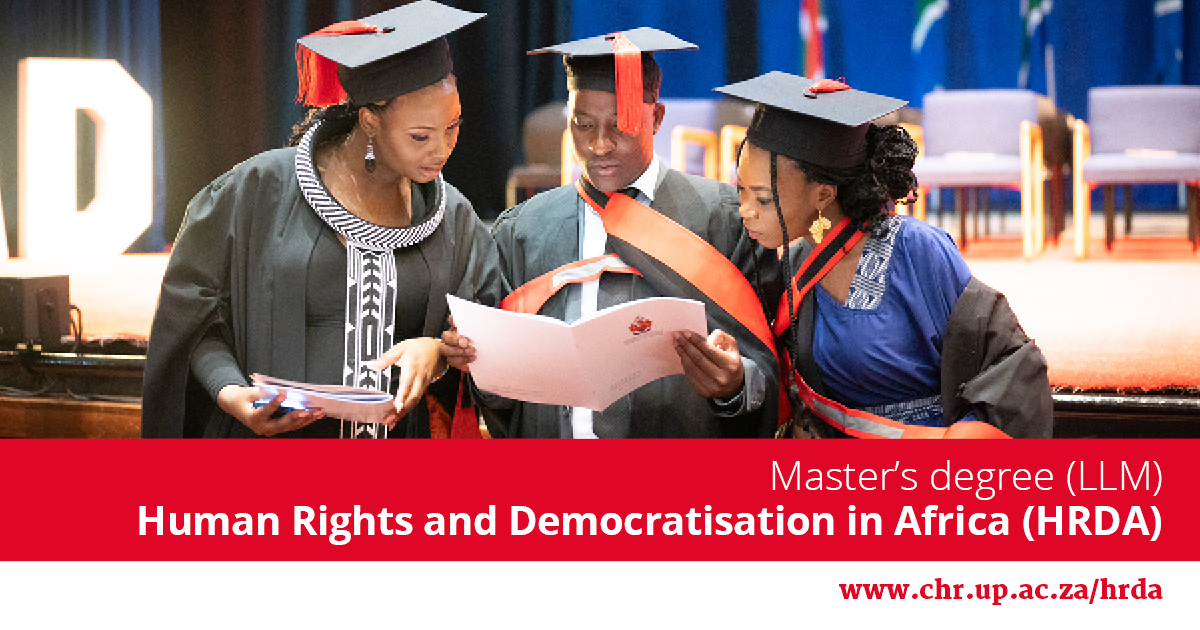
The programme, which mixes theoretical study with practical application, is very intensive. Particular attention is paid to human rights and democratisation as seen from an African perspective. Details regarding the first semester, the second semester, pedagogy, study visits, graduation and internships can be found on this page.
The programme is divided into two semesters.
The aim of the course is to equip African human rights defenders with:
- sound knowledge of international human rights law and democratisation, with a focus on Africa;
- research, writing, word-processing and oral presentation skills of relevance to international human rights defenders;
- the ability to engage analytically and critically with the relevant material; and
- a commitment to the advancement of human rights and democratisation in Africa.
First semester (January to end of June):
Six months at the Centre for Human Rights, University of Pretoria:
Core module:
- Module 1: Methodology of human rights research and education (NRM 801)
Fundamental modules:
- Module 2: Democratisation in Africa (DIA 801)
- Module 3: International and comparative human rights (ICH 801)
- Module 4: Human rights in Africa (HRA 801)
- Module 5: Introduction to the South African legal system and Bill of Rights (RVM 801)
- Module 6: Human rights in the field (AHR 801)
- Language Module: Students are assigned to do language classes in French or another language.
Second semester (July to end of November):
Six months at one of the partner universities:
Module 7: Accredited courses (ACH 802)
- an advanced human rights-related module (minimum of 28 lecture hours for the academic module, assessed by way of one or more assignments to a total minimum of 8 000 words);
- an internship (minimum 150 hours).
- The Module 7 academic course is for some of the second-semester destinations presented at the University of Pretoria at the start of the second semester.
Module 8: Dissertation (MND 802)
Dissertations
- View all the LLM (HRDA) dissertations from previous years on UPSpace
- View all the LLM (HRDA) dissertation topics per year
Language (First and Second semester)
Besides the 8 modules, students must study French, English or another language.
Mixing theory and practice
Instruction is through formal lectures and practical exercises. Emphasis is placed on classroom participation. The study visits provide an excellent opportunity for students to interact with international experts who make a personal contribution to the general experience. Throughout the first semester, each student is assigned to a ‘clinical group’ which works on a practical human rights or democratisation issue with clear objectives and outcomes which forms part of the assessment.
Read more about the Human Rights Clinics
Global Campus of Human Rights
With eight regional programmes delivered by over 100 prestigious universities, the Global Campus is the world's largest network for postgraduate education in human rights and democratisation.The network’s focal point and umbrella organisation - and eight Regional Programmes which are based in Venice for Europe, in Sarajevo/Bologna for South East Europe, in Yerevan for the Caucasus, in Pretoria for Africa, in Bangkok for Asia-Pacific, in Buenos Aires for Latin America and the Caribbean, and in Beirut for the Arab world.
The collaboration between the regional human rights masters programmes involves:
- Lecturer exchanges
- Student exchanges (3-4 students join the one-week global classroom with students from the other programmes, in 2025, the Global Classroom will be hosted in Mahidol, Asia Pacific.
Other areas of collaboration include:
- A joint publication of the best dissertations from each programme
Study visits
In 2024, on-site visits (‘field trips’) are expected to take place in Southern Africa. Students cannot go to their home countries for field visits.
In the past, students have undergone visits to the following destinations:
1. Botswana
Students learn about the various social issues which Botswana is facing including the high incidence of HIV/AIDS. They visited:
- Government offices
- Non-governmental organisation
- Religious institutions
2. Lesotho
The students learn about issues related to leadership including tensions between traditional leadership and modern forms of government. They visited:
- Government and non-governmental entities
- They met academics and interacted with other key players in Lesotho
3. Rwanda
Students studied the history of genocide and the combined efforts at national and international levels to deal with its repercussions. As well as attending Gacaca court hearings and interacting with students at the National University of Rwanda, the LLM students visit the following:
- Unity and Reconciliation Commission
- Genocide sites
- National Council of Women
- Human Rights Commission
- Office of the Prosecutor, International
- Criminal Tribunal for Rwanda
4. Swaziland
The students learn about the challenges facing Swaziland including issues of democracy and the HIV/AIDS challenges. They visited:
- Non-governmental organisations
- Interacted with key players in Swaziland including academics, politicians and members of the judiciary
5. Sierra Leone
Students examined the causes and effects of the civil war and the efforts of that country and the United Nations to prosecute the main culprits and the simultaneous attempts to re-build the country and promote reconciliation. While in Sierra Leone, some of the institutions that the students interact with include:
- Special Court for Sierra Leone
- International Committee of the Red Cross
- Inter-Religious Council
- Campaign for Good Governance
- National Accountability Group
- Visit an amputee camp
- National Commission for Social Action
6. Somaliland
The students who visited Somaliland learn about issues of state creation, lobbying for recognition, democratisation and the challenges faced by countries in the Horn of Africa. The students visited the following institutions:
- Ministry of Foreign Affairs
- Office of the President
- University of Hargeisa
- Academy for Peace and Development
- United Nations Development Programme
- Horn of Africa Voluntary Youth Organisation
- Somaliland National Youth Organisation
7. Zimbabwe
The students study the challenges facing Zimbabwe including issues of democracy and human rights. During the visit the students:
- Visited numerous NGOs
- Visited places of interest to human rights
- Interviewed victims of human rights violations
In addition, students:
- Visit the Constitutional Court of South Africa, where they attend a case and write a judgment (alternative socio-legal assignment related to the South African constitution can be done)
- Defend their dissertation proposals before a panel of academics
- Attend sessions of the African Commission on Human and Peoples’ Rights
- Some students have observed elections in Zimbabwe, Lesotho, Botswana Madagascar, Malawi and Mauritius
Graduation and Awards
Graduation takes place in a specially organised ceremony at the University of Pretoria. The graduation coincides with International Human Rights Day on 10 December of every year. At the ceremony some students receive prizes and a guest speaker delivers an annual lecture in the area of human rights and democratisation in Africa. Guest speakers have included:
- Dr Vera Chirwa, Director, Malawi Centre for Advice, Research and Education for Rights (CARER)
- Ms Navanethem Pillay, Office of the United Nations High Commissioner for Human Rights
- Advocate George Bizos, renowned human rights advocate
- Chief Justice Pius Langa, Constitutional Court of South Africa
- Justices Zak Yacoob and Johann van der Westhuizen, Constitutional Court of South Africa
- Prof EVO Dankwa, former Commissioner, African Commission on Human and Peoples' Rights
- Ms Mojanku Gumbi, the former legal adviser to President Thabo Mbeki of South Africa
Prizes that are awarded at the ceremony are:
- The Nelson Mandela Prize for the best overall student
- The Kéba M’Baye Prize for the best dissertation
- The Ubuntu Prize for the student who best embodies the values and spirit of Ubuntu (humanity).
- The Vera Chirwa Prize for alumna/us who after graduation makes a difference in the protection of human rights
- The Victor Dankwa Prize for the best performance in Module 5
Internships
Upon completion of the course, some graduates get the opportunity to serve an internship (ranging from three months to one year). Some of the organisations that hosted former students include:
- African Union (AU) Commission, Addis Ababa, Ethiopia
- African Commission on Human and Peoples’ Rights (ACHPR), Banjul, The Gambia
- Constitutional Court of South Africa, Johannesburg, South Africa
- European Court of Human Rights, Strasbourg, France
- International Criminal Tribunal for Rwanda (ICTR), Arusha, Tanzania
- International Criminal Tribunal for the former Yugoslavia (ICTY), The Hague, Netherlands
- Office of the UN High Commissioner for Human Rights (OHCHR), Geneva, Switzerland
- South African Human Rights Commission (SAHRC), Johannesburg, South Africa
- Special Court for Sierra Leone (SCSL), Freetown, Sierra Leone
- Institute for Human Rights and Development in Africa, Banjul, The Gambia
- National Human Rights Commission, Lagos, Nigeria
- National Commission of Human Rights, Yaounde, Cameroon
- Ethiopian Human Rights Commission, Addis Ababa, Ethiopia
- Kenya Human Rights Commission, Nairobi, Kenya
- Institute for Security Studies, Pretoria, South Africa
- Benin Human Rights Commission, Cotonou, Benin
- CIVICUS, Johannesburg, South Africa
- International Criminal Court, The Hague, The Netherlands
- Foundation for Community Development, Maputo, Mozambique
- Gender Studies and Human Rights Documentation Centre, Accra, Ghana
- Lawyers for Human Rights, Pretoria, South Africa
- International Committee of the Red Cross, Pretoria, South Africa
- South African Parliament, Cape Town, South Africa.
Doctoral programme
One or two students are selected at the end of each year to register for doctoral studies at the University of Pretoria and serve as tutors on the HRDA programme. Others go on to register for doctoral degrees at other universities in the world. The following are some of the universities where alumni have registered for doctoral degrees:
- Åbo Akademi University, Finland
- University of Birmingham, United Kingdom
- University of Cambridge, United Kingdom
- Université Catholique de Louvain, Belgium
- University of Hong Kong, China
- University of Khartoum, Sudan
- University of the North, South Africa
- University of Notre Dame, United States of America
- University of Oxford, United Kingdom
- University of Pretoria, South Africa
- University of the Western Cape, South Africa
- University of the Witwatersrand, South Africa.
Countries represented on the programme from 2000 - 2018
 Download the list of countries represented on the programme from 2000 - 2018
The LLM/MPhil in Human Rights and Democratisation in Africa is a unique programme to which 25 to 30 individuals from African countries with the following degrees and preferably experience in the field of human rights are admitted:
- Law students
A degree allowing access to the legal profession (eg LLB or licence en droit) - Other students (non-law students)
At least an Honours degree in a discipline relevant to human rights and democratisation
During an intensive one-year course, they are taught by eminent lecturers in the field of human rights and gain invaluable practical exposure. It is the only course of its kind in Africa.
Brochure
Who can apply?
Individuals from all African countries are invited to apply for admission to study for the Master’s Degree (LLM/MPhil) in Human Rights and Democratisation in Africa at the Centre for Human Rights, University of Pretoria, South Africa.
How to apply - Online
Applicants are required to apply online for this course.
Applicants must be in possession of the first degree in Law (LLB, licence en droit or licenciatura em direito) or an Honours degree relevant to human rights and democratisation.
Application Deadlines
Deadline: 31 July 2018
Partners
The LLM/MPhil in Human Rights and Democratisation in Africa is a regional co-operation initiative presented in partnership by the Centre for Human Rights, Faculty of Law, University of Pretoria, and the faculties of law at:
- Université d'Abomey-Calavi (Benin)
- Addis Ababa University (Ethiopia)
- University of Alexandria (Egypt)
- Catholic University of Central Africa (Cameroon)
- Universidade Eduardo Mondlane (Mozambique)
- Université Gaston Berger de Saint Louis (Senegal)
- University of Ghana
- University of Lagos (Nigeria)
- Makerere University (Uganda)
- University of Mauritius
- University of Nairobi (Kenya)
- University of Venda
- University of the Western Cape (South Africa)
First semester
This premier course, the only one if its kind, focuses specifically on human rights as seen from the African perspective. The course is presented full time over one academic year (two semesters) that runs from the end of January to early December and comprises eight modules. The first semester is spent at the Centre for Human Rights, University of Pretoria, studying the following modules:
Core module:
Fundamental modules:
- Module 2: Democratisation in Africa (DIA 801)
- Module 3: International and comparative human rights (ICH 801)
- Module 4: Human rights in Africa (HRA 801)
- Module 5: Introduction to South African legal system and Bill of Rights (RVM 801)
- Module 6: Human rights in the field (AHR 801)
- Language Module: Students are assigned to do language classes in French (FRN 181), Portuguese (PTG181) or English.
Second semester
At the end of the first semester, the class is divided into seven groups, each of which spends the next five months at one of the partner universities where they complete the following two modules and/or internships:
Module 7: Accredited courses (ACH 802)
- an advanced human rights-related module (minimum of 28 lecture hours for the academic module, assessed by way of one or more assignments to a total minimum of 8 000 words);
- an internship (minimum 150 hours).
- The Module 7 academic course may for some students be presented at the University of Pretoria at the start of the second semester. In 2016, the second semester academic component for Addis Ababa, Catholic University, Gaston Berger, Lagos, Mauritius, Nairobi and Venda will most likely be presented in Pretoria.
At the University of the Western Cape, accredited courses consist of two advanced human rights-related modules.
At most partner universities students continue with a language course.
Module 8: Dissertation (MND 802)
Language (First and Second semester)
Besides the 8 modules, students must study French, English, Portuguese or, exceptionally, another elective course.
Test of English as a Foreign Language (TOEFL)
An important new requirement of admission to the programme is that applicants who did not undertake their undergraduate degrees in English are now required to submit test results for the Test of English as a Foreign Language (TOEFL) examination. In order to be admitted to the LLM/MPhil programme you must at least score as follows in the test:
- Reading: 21
- Listening: 17
- Speaking: 23
- Writing: 22
- Total Score: 83
If you would like to register for the TOEFL test, please visit the following website for more information: www.ets.org
The Centre for Human Rights is not able to assist you with any additional information about this test as it is presented by independent authorities. For purposes of your application please send your score results when you apply. Should this not be possible please ensure that you send your TOEFL results as soon as possible. Should you be admitted to the LLM/MPhil programme in the meantime, such admission would be provisional until we receive your TOEFL results.
It is your responsibility to cover the costs of taking the TOEFL examination.
Please note that it can take several months to finalise the process of obtaining a test date for TOEFL and also to obtain the results. In view of this, we strongly advise that you start the process of registering and writing this test as soon as possible.
Course format
Instruction is by way of formal lectures and practical exercises. The lecturers are some of the most prominent human rights experts in the world. Emphasis is placed on classroom participation and there is ample opportunity for informal interaction between the students and lecturers. Students can make use of extensive library facilities.
A substantial part of the course is dedicated to the use of the Internet in research on human rights law. The medium of instruction is English, of which students must have a good working knowledge in order to follow lectures and participate fully in class discussions and practical exercises. Students who did not undertake their studies in English are required to write the Test of English as a Foreign Language. Upon admission to the programme advanced English is provided for students from non-English speaking countries and French is taught to students from English speaking countries. Students who are fluent in both English and French study Portuguese. Admission is on a competitive basis and bursaries are available.
 Click here to read more about the Test of English as a Foreign Language (TOEFL)
The LLM in Human Rights and Democratisation in Africa is a unique programme to which 25 to 30 individuals from African countries with the following degrees and preferably experience in the field of human rights are admitted:
- Law students
A degree allowing access to the legal profession (e.g. LLB or licence en droit) - Other students (non-law students)
An Honours degree in a discipline relevant to human rights and democratisation - A weighted average of at least 65% at final-year level
In addition to the general admission requirements, the following specific selection criteria are used in combination to select the eligible students:
- a demonstrated professional, academic and personal interest in and commitment to human rights and democratisation in Africa.
- an indication that the applicant would be likely to put the qualification to good use in his or her future career, preferably in his or her country of origin (the ‘multiplier effect’);
- geographic representation(in the sense that an overrepresentation of students from a particular African country will be avoided, given the pan-African scope and ambitions of the programme);
- gender representation (in the sense that an equitable balance between women and men is sought);
- equitable representation of persons from vulnerable communities (such as persons with disabilities, persons belonging to indigenous communities and LGBTI persons).
All complete applications, received in a particular year, are processed and considered by the LLM Programme Coordinator/Manager and the Academic Coordinator of the programme, who identify a number of eligible candidates three times the available positions.
Each applicant is then contacted and required to write an essay within a restricted period (for example, 24 hours) of being given the topic. Applicants may also be required to make a video or audio presentations or be interviewed.
On the basis of all the assessments, the Chair of the Council of Directors of the HRDA Programme, who is a representative of one of the partner faculties, scrutinises the applications and makes a recommendation on the pre-selected students.
A final selection is made by the full Admissions Committee, consisting of the Chair of the Council of Directors of the LLM Programme (if available), the Director of the Centre for Human Rights, the Assistant Director of the Centre for Human Rights, the LLM Programme Coordinator/Manager and the Academic Coordinator of the HRDA Programme.
How to apply?
Applications for the programme to study at the University of Pretoria are fully online.
Application Procedure
All applications are handled via the online UP system.
Application deadline
The deadline for applications is 31 July 2026
Application Guidelines
- Individuals from all African countries are invited to apply for admission to study for the Master’s Degree (LLM) in Human Rights and Democratisation in Africa at the Centre for Human Rights, University of Pretoria, South Africa.
- Applicants must be in possession of the first degree in Law (LLB, licence en droit or licenciatura em direito) or an Honours degree relevant to human rights and democratisation.
- All documents uploaded must be typewritten.
- The following documents will be requested during your application:
- Previous academic records/transcripts
- Previous degree certificate(s)
- Copy of bio-data page of passport
- A good quality photograph of yourself
- For applicants who did not obtain their qualifications in English: TOEFL, SAT1 or IELTS Test certificate.
Deadline for receipt of applications for the 2027 class is 31 July 2026.
All applicants will be notified whether they were successful or not by 30 September 2026.
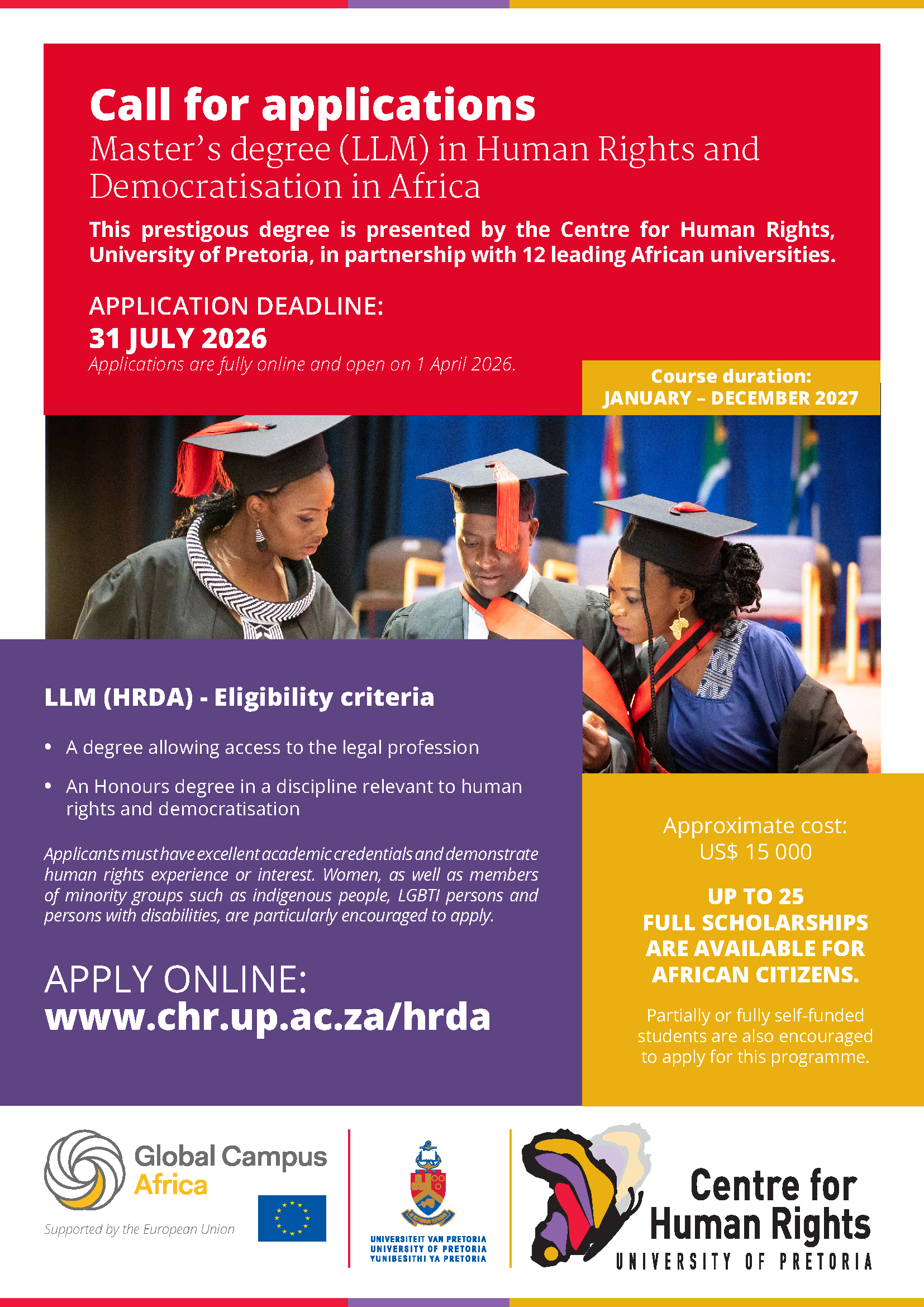 About the programme
The LLM in Human Rights and Democratisation in Africa (HRDA) is a prestigious one-year intensive course where 25-30 exceptional individuals spend six months in Pretoria and six months at one of the 12 partner universities all over Africa. They are taught by eminent lecturers in the field of human rights and undergo many practical training exercises. It is the only course of its kind in Africa. Graduates become members of the HRDA Alumni Association whose 663 members are currently active in the full spectrum of human rights work: from grassroots, through civil service, to international organisations including the African Union and the United Nations. Individuals from all African countries are invited to apply for admission to study for the Master’s degree (LLM) in Human Rights and Democratisation in Africa at the Centre for Human Rights, University of Pretoria, South Africa.
Application deadline
The deadline for applications is 31 July 2026
Objectives
The objectives of the LLM programme are:
-
To train human rights experts who can be employed in government ministries, and other national, international and regional bodies concerned with human rights and democracy. The aim is to ensure the effectiveness of these bodies, through imparting professionalism and operational competence. The end result is to ensure the transfer of technical skills and strengthen the capacity of these organisations with the goal of improving the protection and promotion of human rights and democratisation in Africa.
-
Expand collaboration among African universities. Collaboration should result in a network of lawyers and academics specialised in human rights and democracy. The programme envisages promoting research and teaching that addresses the particular needs of Africa. Some identified needs include conflict prevention; democratic transition; strengthening of civil society, institutional building and the rule of law. The programme also aims at developing and strengthening links between civil society, governmental bodies, and international organisations.
-
Develop a relationship between the African Masters and the other regional masters, such as the European Masters Degree in Human Rights and Democratisation (EMA), the Master’s Degree in Human Rights and Democratisation in South Eastern Europe and the Mediterranean Master’s Programme in Human Rights and Democratisation.
Course details
This premier course, the only one of its kind, focuses specifically on human rights as seen from the African perspective. The course is presented full-time over one academic year (two semesters) that runs from the end of January to early December and comprises eight modules.
Instruction is by way of formal lectures and practical activities. The lecturers are some of the most prominent human rights experts in the world. Emphasis is placed on classroom participation and there is ample opportunity for informal interaction between the students and lecturers. Students can make use of extensive library facilities.
A substantial part of the course is dedicated to the use of the Internet in research on human rights law. The medium of instruction is English, of which students must have good working knowledge in order to follow lectures and participate fully in class discussions and practical exercises. Students who did not undertake their undergraduate studies in English are required to write the Test of English as a Foreign Language (TOEFL). Upon admission to the programme advanced English is provided for students from non-English speaking countries and French is taught to students from English speaking countries. Students who are fluent in both English and French study another language such as Arabic, Portuguese, admission is on a competitive basis and bursaries are available.
Scholarships
A limited number of up to 30 students are selected per year. Depending on the availability of funding, full-scholarships covering at least tuition, accommodation and official programme activities are covered for up to 25 citizens of Africa. Students who do not receive scholarships may be admitted as self-funding or partially-self funding students, provided they meet all the minimum admission criteria and provided they guarantee payment of all or at least a significant part of tuition, accommodation and official programme activities, to an amount set by the Centre annually.
Watch this video to find out more about this programme
Global Campus of Human Rights
 View the Global Campus Annual Report 2024
±100 Universities, 8 regional programmes: The largest university network of human rights programmes in the world
The HRDA programme at the Centre for Human Rights is the hub of the African regional programme under the Global Campus of Human Rights.
The Global Campus of Human Rights is an EU-funded global network of universities based on cooperation between eight Regional Programmes based in Venice for Europe, in Sarajevo/Bologna for South East Europe, in Yerevan for the Caucasus, in Pretoria for Africa, in Bangkok for Asia-Pacific, in Buenos Aires for Latin America and the Caribbean, and in Beirut for the Arab world and Bishkek, Kyrgyzstan for Central Asia.
Already composed of some 100 prestigious universities, the Global Campus of Human Rights is the largest university network in the world specialising in human rights and democracy issues. Its partners are renowned worldwide for their leading role in education, research and advocacy in human rights and democratisation.
“We decided to dedicate our Annual Report 2024 to the Persistence of Frontline Human Rights Educators. The recent experiences of the Global Campus of Human Rights as the world’s largest network on postgraduate human rights education give testimony to the many difficulties we are confronted with and our persistence to nevertheless continue our eight Master’s programmes and other activities”.
– Manfred Nowak
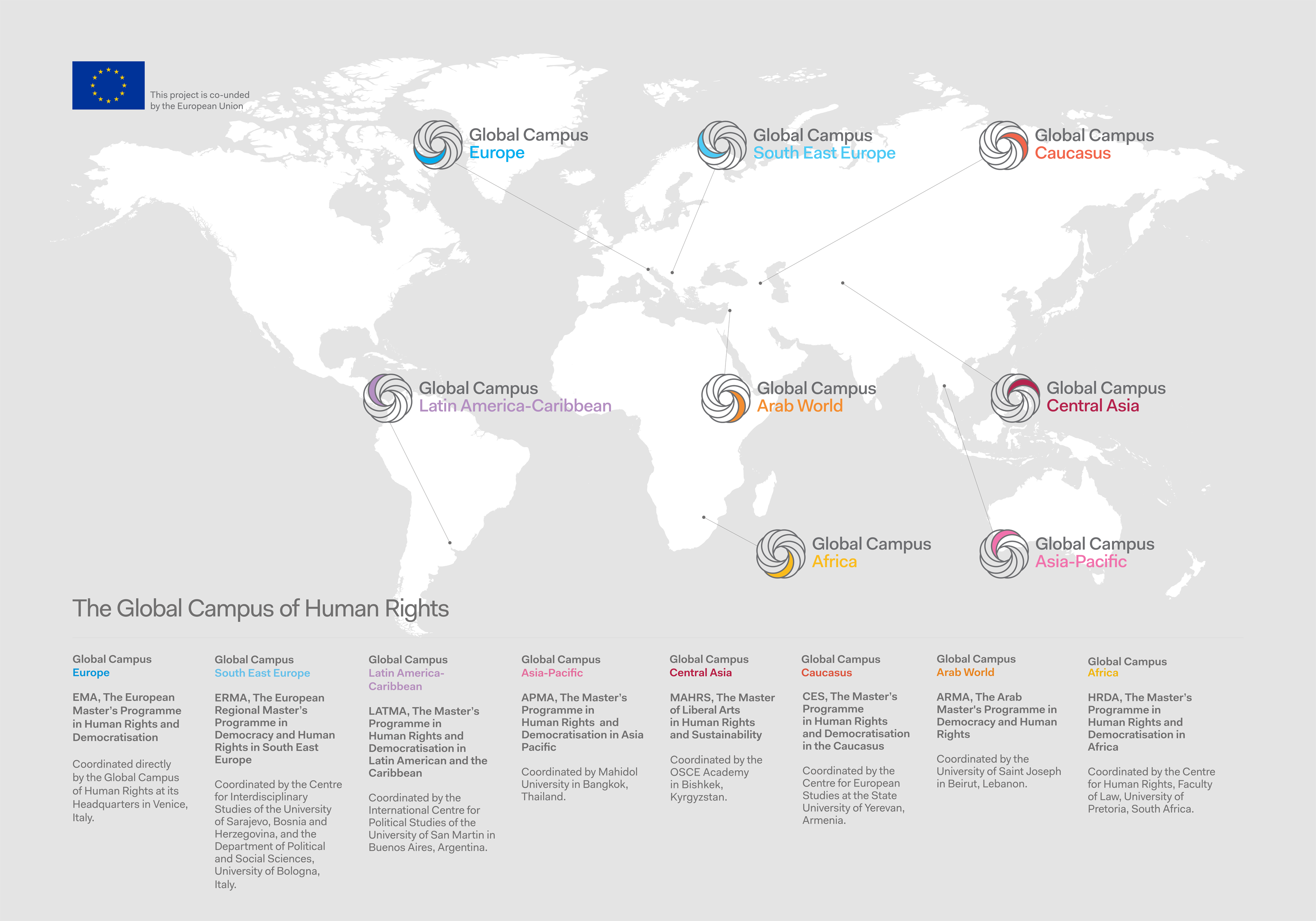
Please visit the Global Campus of Human Rights website for more information.